
पीएम-आशा 2026: मंडी भाव गिरने पर MSP खरीदी, PDPS और MIS से किसानों को भूगतान कैसे मिलता है, यह योजना जमीनी स्तर पर कैसे चलती है और छोटे, सीमांत व किराए पर खेती करने वाले किसानों के लिए इसके क्या व्यावहारिक मायने हैं, इसे इस लेख में विस्तार से समझाया गया है।
Every harvest season brings the same worry to a pulse or oilseed grower: the mandi rate on the day the crop arrives can sit well below the announced support price, and local traders may refuse to match MSP, a risk that climate variability and weather shocks can make worse. PM-AASHA — the Pradhan Mantri Annadata Aay Sanrakshan Abhiyan (प्रधानमंत्री अन्नदाता आय संरक्षण अभियान) — is the Union government’s answer to that gap between MSP on paper and the cash that finally reaches a farmer’s bank account. Launched in September 2018, it now bundles four separate price mechanisms under one framework, and which one applies to you depends entirely on the crop you grow, whether it has MSP or not, and how you decide to sell it. This article explains each component, the exact ceilings and payment rules notified in the scheme guidelines, how these interact with the MSP procurement system, and the registration, documentation and payment flow on the e-Samridhi and e-Samyukti portals that decide whether you actually get paid.
What PM-AASHA Is, and How Its Four Parts Fit Together / पीएम-आशा क्या है, MSP से इसका संबंध क्या है, और इसके चार घटक कैसे जुड़ते हैं
PM-AASHA was designed to make the Minimum Support Price (MSP) system work in the mandis and collection centres rather than only on paper or in speeches. On 18 September 2024 the Union Cabinet approved the continuation of an integrated PM-AASHA with a total financial outgo of ₹35,000 crore for the 15th Finance Commission cycle up to 2025-26, and merged the Price Support Scheme (PSS) with the Price Stabilisation Fund (PSF) into it for operational purposes. The scheme now has four components: PSS, PSF, the Price Deficiency Payment Scheme (PDPS) and the Market Intervention Scheme (MIS). In practice, PM-AASHA sits on top of the MSP system: MSP is notified first, and then PM-AASHA mechanisms are triggered only when market prices fall below that MSP (for eligible MSP crops) or when there is a sharp crash in selected non-MSP perishables.
The Department of Agriculture and Farmers Welfare (DA&FW) runs PSS, PDPS and MIS; PSF sits with the Department of Consumer Affairs. Alongside the ₹35,000 crore outlay, the government renewed and enhanced its guarantee for MSP procurement of notified pulses, oilseeds and copra to ₹45,000 crore, which is what allows nodal agencies to pay farmers promptly while the stock is later disposed of. In simple terms, this guarantee is a “backstop” for NAFED and NCCF: they can buy from you at MSP even when private buyers are not coming forward, because the Union government stands behind those payments and the eventual losses from selling the stock later at a lower rate.
The practical split is simple for a farmer once the basic terms are clear. If your crop has an MSP and is physically bought at that price, it is PSS. If it has an MSP but you sell it in the open mandi and the government tops up the difference, it is PDPS. If your crop is a perishable with no MSP at all — tomato, onion, potato, apple, ginger, chilli — it is MIS. PSF is the consumer-facing buffer that keeps pulses and onion stocks moving in and out of the market. Seen together, these four mechanisms try to do three things: prevent distress sale at harvest, spread government support beyond just wheat and paddy, and moderate extreme price swings that hurt both farmers and consumers.
Price Support Scheme: Direct Procurement at MSP / मूल्य समर्थन योजना: MSP पर सीधी सरकारी खरीद और व्यावहारिक नियम
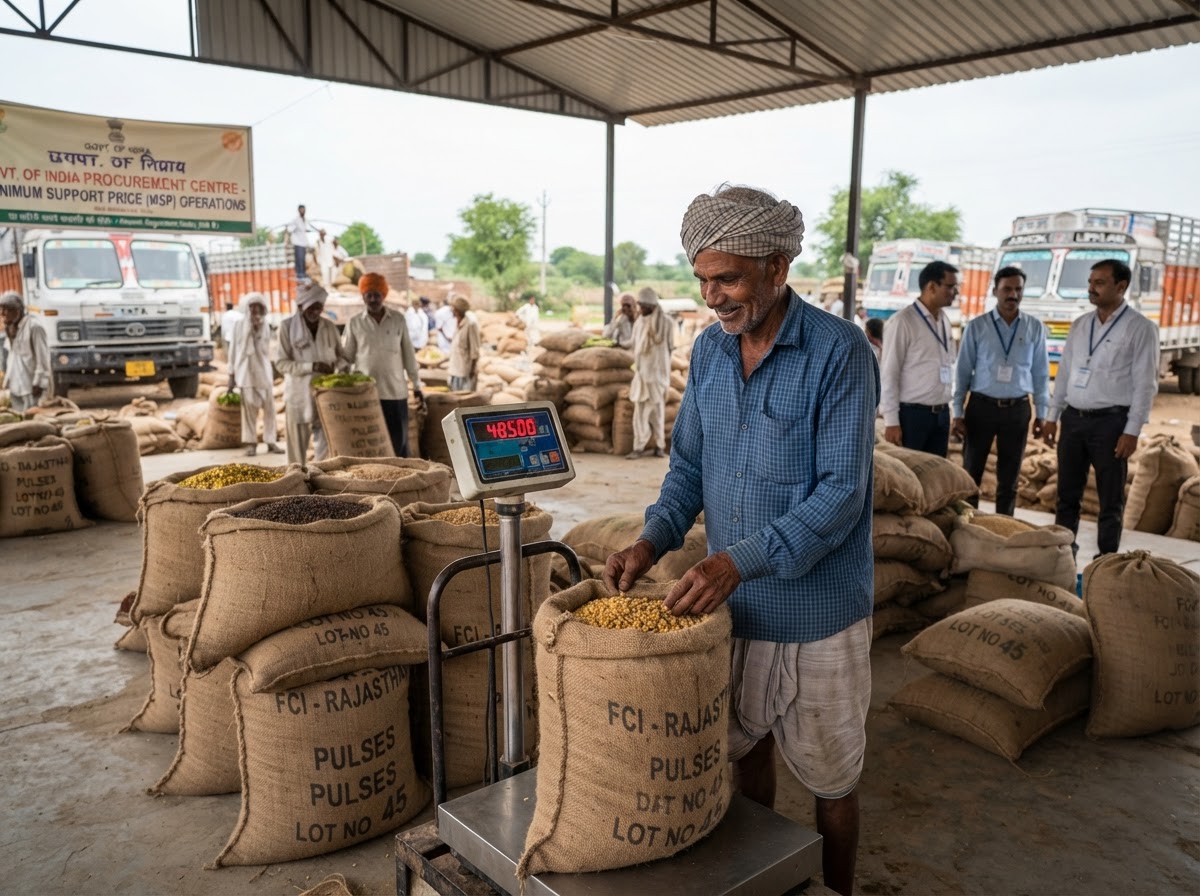
PSS is the component most farmers recognise because it looks like traditional MSP procurement. It is operationalised on the request of a state or UT government, and only when market prices of notified pulses, oilseeds and copra fall below the notified MSP during the peak harvesting period. The state must agree to exempt the procurement from mandi tax and provide basic logistics (space, weighing, staff support). Buying is done by Central Nodal Agencies — NAFED and NCCF — working through state-level agencies, directly from pre-registered farmers who hold valid land records, so that no intermediary stands between the farmer and the payment. In most states, PSS centres are opened for a limited number of days in notified mandis or separate procurement centres, and each centre is mapped to villages in its catchment area.
Two conditions decide whether your lot is accepted under PSS. First, the produce must meet the prescribed Fair Average Quality (FAQ) norms — free from excessive moisture, stones, broken or shrivelled grain beyond limits, and other foreign matter — as notified separately for each crop. Second, the quantity offered must fall within the season’s procurement ceiling. From the 2024-25 procurement year, sanction is given initially up to 25% of the state’s production of that crop; if a state exhausts that, additional procurement up to 25% of national production can be sanctioned with approval of the Committee of Secretaries. For tur, urad and masur, the ceiling was lifted entirely to support domestic pulse output — PIB’s August 2026 note on the scheme states that procurement of these three pulses is permitted up to 100% of state production. That is the provision the Mission for Aatmanirbharta in Pulses leans on, especially in states that have expanded area under these pulses and want assurance that the entire marketable surplus can, in principle, be absorbed.
Procurement windows are tight by design so that the scheme focuses on the main arrival period and does not become a year-round buying operation. In a Lok Sabha reply of 4 August 2026, the Ministry of Agriculture stated that the procurement period is generally up to 90 days and may be extended by a further 30 days on the request of the state government. Missing the registration window is the single most common reason a farmer loses the benefit, because the portal closes registration before the centre opens for physical delivery. In many districts, farmers wait for rumours that “rate achha milega” and then discover that registration is already closed. The practical rule is: as soon as MSP for your crop is announced and the state issues a notification for procurement, complete portal registration and confirm your centre even if you are unsure whether you will finally sell there.
Price Deficiency Payment Scheme: Cash in the Bank Instead of a Purchase / मूल्य अंतर भुगतान योजना: सरकारी खरीद की जगह सीधे बैंक खाते में राशि
PDPS takes the opposite route compared to PSS. Nothing is physically procured by the government. Instead, the central government pays the difference between the MSP and the actual selling or modal price in the notified market, straight into the farmer’s bank account, capped at 15% of the MSP value. PDPS is aimed at oilseeds such as mustard and soybean, whose MSP is notified by the Government of India, and is particularly suited where storage is weak and the government wants farmers to continue using normal mandis while still getting some MSP protection. Because no stock is taken over, PDPS relies heavily on accurate mandi price reporting and proper recording of the farmer’s sale slips and identity.
The 2024 revamp widened the scheme in three ways. Coverage rose from 25% to 40% of the state’s production of that particular oilseed. The implementation window lengthened from three months to four, which better matches the staggered arrivals in many states. And states were given the option to run PDPS for vegetables as well, on the same 15% cap — a point the Union Agriculture Minister made while briefing on the revamp in September 2024. To claim under PDPS you must be a pre-registered farmer, sell up to 40% of your production, meet FAQ standards and sell in the notified market yard through the stipulated transparent auction process so that the price is captured in the mandi’s official system. The 15% cap exists deliberately: it stops traders from artificially depressing mandi rates on the assumption that the government will make up any shortfall. For an individual farmer, this means PDPS will not fully cover an extreme price crash but can still make the difference between a loss and a modest profit.
States choose between PSS and PDPS for a given oilseed in a given year or season — a farmer cannot opt for both on the same lot and cannot sell the same quantity twice. Some states prefer PSS when they have storage and are willing to handle physical stock; others prefer PDPS to avoid logistical burdens and encourage open-market sales. Oilseed growers should also track the PMEO Oilseeds Mission, which works on the production side (seed, extension, area expansion, processing) while PM-AASHA works mainly on the price realisation side. If you are planning which oilseed to sow, check both the PMEO package for that crop in your state, match the crop to your soil using the Complete Guide to Soil, and whether it has been covered under PSS or PDPS in recent seasons.
Market Intervention Scheme: Cover for Perishables With No MSP / बाजार हस्तक्षेप योजना: बिना MSP वाली जल्दी खराब होने वाली फसलों के लिए सहारा और नुकसान कम करने के उपाय
Tomato, onion, potato, apple, ginger and chilli have no MSP, and they are exactly the crops that crash hardest in a glut when arrivals suddenly rise. MIS is triggered at the request of a state or UT when market prices fall by at least 10% compared with the previous normal season, as measured in representative mandis. The state must be willing to share the loss 50:50 with the Centre — 75:25 in the case of North-Eastern states — and must put in place arrangements for grading, temporary storage, transport and disposal (processing, sale in deficit areas or other channels). For a vegetable or fruit grower, this means that the scheme activates only after the state government formally sends a proposal and the Centre approves it; routine price ups and downs do not qualify.
The February 2025 revision of the MIS guidelines raised the procurement or coverage limit from 20% to 25% of the state’s production of that crop, and gave states the option of paying the difference between the Market Intervention Price (MIP) and the selling price directly into farmers’ bank accounts instead of physically procuring the crop — useful where cold storage is scarce or the cost of transporting and handling stock is high. The price difference is capped at 25% of the MIP. For the TOP crops, the Centre reimburses NAFED and NCCF for storage and transport from producing states to consuming states when a price gap exists between the two, and FPOs, FPCs and state-nominated agencies can also be brought in to procure. This is where an FPO becomes useful: a registered producer organisation can aggregate members’ produce and deal with the procuring agency as a single seller, negotiate transport, arrange grading, and ensure members follow the same quality and documentation standards.
Price Stabilisation Fund: The Consumer-Side Buffer / मूल्य स्थिरीकरण कोष: उपभोक्ता पक्ष का बफर और उत्पादन निर्णयों पर इसका अप्रत्यक्ष असर
PSF does not pay farmers directly. Managed by the Department of Consumer Affairs, it maintains strategic buffer stocks of pulses and onion, buys at market price when rates run above MSP or when there is a risk of shortage, and releases stock in lean months to cool retail prices. The same fund has financed interventions in tomato and the subsidised sale of Bharat Dal, Bharat Atta and Bharat Rice. For a farmer the relevance is indirect but real: buffer buying absorbs surplus at the top of the price cycle, which softens the crash that would otherwise hit the next sowing season, and regular releases give a signal about how much of the earlier surplus is still lying in government godowns. When you plan sowing, tracking PSF operations and government buffer announcements for pulses and onion can help you avoid blindly increasing area when large public stocks already exist.
How to Register and Sell: e-Samridhi and e-Samyukti, Step by Step / पंजीकरण और बिक्री: ई-समृद्धि और ई-सम्युक्ति पर पूरी प्रक्रिया, आवश्यक कागज़ात और आम गलतियाँ
Registration is the gate to every rupee under PSS and to most MSP-based operations for pulses and oilseeds. NAFED runs the e-Samridhi portal and mobile app; NCCF runs e-Samyukti. The Ministry of Agriculture’s own description of the flow is: farmer registration, purchase-centre selection, scheduling of a physical visit, quality assessment, weighment, and direct transfer of the MSP payment. In between these steps are small details — choosing the right bank account, entering land details correctly, and checking the activation status of your crop and centre — that often decide whether you actually receive payment or end up only with a registration ID.
- Open the portal or app. Go to esamridhi.in (or the official e-Samridhi Android app) and choose Farmer Registration. Enter your mobile number, complete the captcha and verify the OTP. Use a mobile number that you regularly use; SMS alerts about schedule, rejection due to quality or bank errors will come on this number.
- Complete Aadhaar-based identification. Fill your name and details exactly as per Aadhaar and finish the Aadhaar face or OTP authentication so the profile is verified. If there is a spelling mismatch between Aadhaar and your bank account, correct it first with the bank or Aadhaar centre; otherwise payments may fail at the Public Financial Management System (PFMS) stage.
- Add land records. Upload or enter the khasra/plot details for the land on which the crop was grown, attaching the latest khasra-khatauni, Record of Rights or other state-prescribed proof. Procurement is restricted to farmers with legitimate land records; in many states sharecroppers or bataidars must upload a written consent or agreement from the recorded landowner if the state allows such cases under its own rules.
- Add bank details. Enter the account number and IFSC of an account in your own name; payment is made by Direct Benefit Transfer through PFMS. Joint accounts are usually allowed if your name appears as one of the holders, but payments cannot be made to a commission agent’s or trader’s account. Double-check the IFSC from your passbook; a single digit error can push your payment into a failed or suspense status and delay it by weeks.
- Enter crop details. Select the crop, season and expected quantity, then choose an active scheme and the nearest available purchase centre. Registration can also be done through a PACS, FPO or cooperative society if you cannot do it yourself; a CSC can help. Enter a realistic expected quantity based on sown area and average yield; highly inflated declarations may invite scrutiny or rejection when actual arrivals are much lower. Before saving, check that your chosen centre shows an “active” status for that crop and season on the portal.
- Attend on the scheduled date. Carry the produce, Aadhaar, land papers and bank passbook to the centre. Staff grade the lot against FAQ norms, weigh it, and generate a digital receipt with a unique sale identifier; payment status can then be tracked on the portal. Keep the printed or SMS copy of this receipt safely — it is your proof in case of any dispute. Normally, nodal agencies aim to transfer payment within a defined period after weighment (as per state-level orders and agency SOPs), but delays can occur if bank account details are wrong, documents are incomplete or quality objections are raised.
One caution worth repeating: registering does not guarantee that your crop, district or centre is active in that cycle, nor that every kilogram you offer will be accepted. Crop coverage, centre activation and dates are notified season by season, so check the live scheme shown in your portal account rather than relying on a registration message forwarded on WhatsApp. Before harvest, confirm: (1) your crop is listed as “approved” for procurement in that season in your district, (2) your centre is showing active dates, and (3) the state has not already reached its sanctioned procurement ceiling.
What the Scheme Is Worth in 2026-27, and What Is Still Pending / 2026-27 में योजना की वित्तीय तस्वीर और आगे की अनिश्चितताएँ
The money has grown steadily, signalling that both Centre and states are using PM-AASHA more actively. PIB’s August 2026 release records actual expenditure of ₹5,437.99 crore under PM-AASHA in 2024-25, a budget estimate of ₹6,941.36 crore for 2025-26, and ₹7,200 crore for 2026-27. On the evidence side, the Development Monitoring and Evaluation Office of NITI Aayog commissioned an evaluation of PSS in 2024, carried out by NCAER, and evaluations of PDPS and MIS during 2025-26; the Ministry told the Lok Sabha in August 2026 that the PSS study found procurement at MSP protects farmers from distress sales and is positively associated with farm income and productivity. For farmers, these evaluations matter because they influence whether ceilings, coverage percentages and operational rules are tightened or relaxed in future Cabinet decisions.
There is one open question a farmer should know about before making long-term plans. The Cabinet approval of September 2024 covered the 15th Finance Commission cycle, that is, up to 2025-26, and no fresh Cabinet approval for a new cycle had been announced in the official releases reviewed for this article as of November 2026. The scheme is nonetheless operating with a ₹7,200 crore provision for 2026-27, and procurement is sanctioned season by season. The practical takeaway is to confirm the sanction for your crop and state on e-Samridhi or e-Samyukti before you commit a lot to the scheme, and to keep the other supports in place — a Kisan Credit Card for working capital, PMFBY for yield loss, and an Agriculture Infrastructure Fund loan if you want your own storage so that you are not forced to sell at the bottom of the cycle. Selling on the e-NAM platform, meanwhile, widens the buyer pool beyond the local mandi, and listing produce on K-Bazaar opens up another direct channel to buyers, often deciding whether the PDPS benchmark price works in your favour. In short, treat PM-AASHA as one safety net among several, not as your only plan for managing price risk.
Key Takeaways / मुख्य बातें और व्यावहारिक सुझाव
- PM-AASHA has four parts: PSS (physical procurement at MSP), PDPS (cash top-up of the MSP–market gap), MIS (support for perishables without MSP) and PSF (consumer buffer stocks), and which one benefits you depends on what you grow and how you choose to sell it.
- PSS procurement is sanctioned up to 25% of state production, extendable to 25% of national production with approval; tur, urad and masur are permitted up to 100% of state production, subject to FAQ norms, registration and active procurement windows.
- PDPS pays the difference between MSP and the mandi price, capped at 15% of MSP, for pre-registered oilseed farmers selling up to 40% of production within a four-month window in the notified market, based on transparent auction prices.
- MIS activates only when prices fall at least 10% below the previous normal season, covers up to 25% of state production, and requires the state to share the loss 50:50 (75:25 in the North-East), with the option to pay farmers the MIP–market gap directly in cash within a 25% cap.
- Register on e-Samridhi (NAFED) or e-Samyukti (NCCF) with Aadhaar, land records, bank details and crop details, choose an active centre and scheme for your crop, and always confirm current-season approval and ceilings before harvest based on the live portal rather than forwarded messages.
Sources / स्रोत
- PIB, “Pradhan Mantri Annadata Aay Sanrakshan Abhiyan (PM-AASHA): Strengthening MSP-Based Price Support”, 21 August 2026 — pib.gov.in
- PMO India, “Cabinet approves continuation of schemes of PM-AASHA”, 18 September 2024 — pmindia.gov.in
- PIB, “Empowering Farmers Through PM-AASHA”, December 2024 (PDF) — pib.gov.in
- PIB, “Measures to reduce dependence on middlemen under PM-AASHA”, 21 March 2025 — pib.gov.in
- PIB, “Government revises Market Intervention Scheme (MIS) guidelines”, 10 February 2025 — pib.gov.in
- PIB, “PRADHAN MANTRI ANNADATA AAY SANRAKSHAN ABHIYAN (PM-AASHA)”, 12 August 2025 (e-Samridhi and e-Samyukti registration flow) — pib.gov.in
- Lok Sabha Unstarred Question No. 2569, Ministry of Agriculture and Farmers Welfare, answered 4 August 2026 (procurement period, DMEO evaluations, PACS/FPO participation) — sansad.in
- The Hindu BusinessLine, “No more private sector involvement in MSP-based procurement in revamped PM-AASHA”, 19 September 2024 (PDPS for vegetables, 40% coverage, four-month window) — thehindubusinessline.com
- e-Samridhi portal, NAFED — esamridhi.in


Leave a Reply