

Banana Farm – Complete Planting and Care Guide from Sucker to Market / भारत में केला की खेती: सुक्कर से बाज़ार तक संपूर्ण रोपाई और देखभाल गाइड
For most Indian farmers, banana is a dependable fruit crop: it usually gives a harvest in 11 to 16 months, it ratoons for two more cycles from the same field, and it finds a buyer in almost every district. But the difference between a 35-tonne crop and a 65-tonne crop is rarely about luck – it is decided in the first three months, through the quality of the planting material, the depth and preparation of the pit, good drainage in the plot, and whether the first fertilizer dose is applied at the correct time, distance, and depth from the plant.
This practical guide brings the full lifecycle of a banana crop into one place for Indian conditions: climate and soil needs, suitable planting season, common varieties, planting method and spacing, irrigation planning, the exact manure and fertilizer schedule with method of application, crop care at each growth phase, the five major problems that cause most yield losses and how to manage them, how to compare a healthy plant with a sick one in the field, how to harvest at the right stage of maturity, and how to handle, store, and move the bunch after it is cut so that it reaches the market in good condition.
Banana at a Glance / एक नज़र में केला खेती
• India is the largest producer of banana in the world. Production increased from 28.5 million tonnes in 2011–12 to 37.81 million tonnes in 2023–24 from about 1.0 million hectares, and the second advance estimate for 2024–25 puts output at a fresh high of 38.04 million tonnes (Department of Agriculture and Farmers Welfare estimates, reported by The Hindu BusinessLine). National productivity is roughly 37.8 tonnes per hectare, which shows that a well-managed banana field still has good scope to produce much more than the average. • These numbers matter for farmers because they show steady demand, strong market presence, and the potential to improve income by raising yield per hectare through better planting and care.
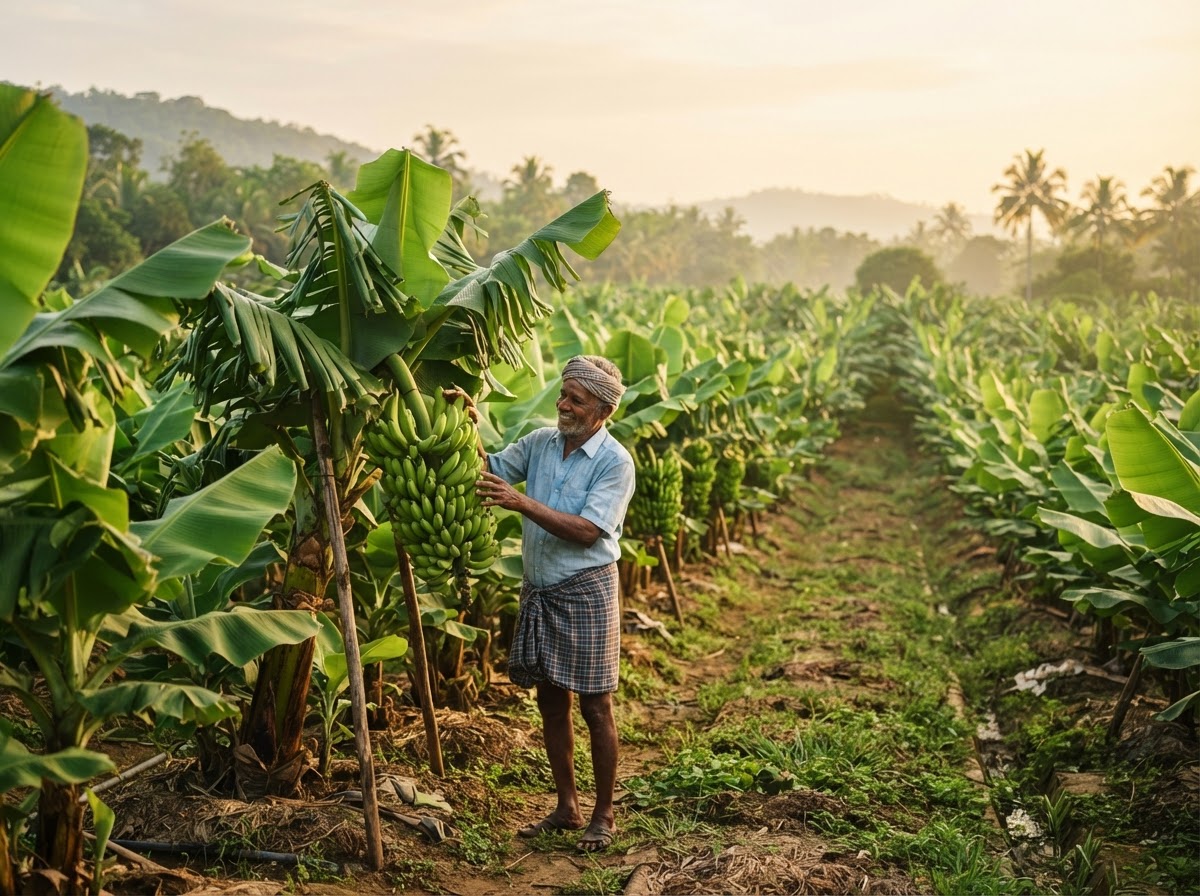
• Maharashtra leads production with 6.53 million tonnes in 2023–24, about 17.4% of the national crop, followed by Andhra Pradesh, Tamil Nadu, Gujarat, Karnataka, and Madhya Pradesh (National Horticulture Board estimates). • The crop is successfully grown from the sea coast up to about 2,000 m above mean sea level, and from humid tropical Kerala to the semi-arid belts of Gujarat and Maharashtra, showing that banana can fit into many different agro-climatic zones when basic crop requirements are met.
Botanically, banana is not a tree but a giant herb. What appears like a trunk is actually a pseudostem made of tightly packed leaf sheaths, and the true “stem” that carries the bunch grows up through the middle of this structure. Once the bunch is harvested that pseudostem is finished – the next crop comes from a side shoot, called a sucker, which is why banana is managed as a ratoon crop with one main plant followed by successive sucker crops.
Climate and Soil Requirements / जलवायु और मिट्टी की आवश्यकता
Climate / जलवायु
Banana grows well between 15°C and 35°C with a relative humidity of 75–85%, and chilling injury sets in below 12°C (National Horticulture Board). Growth begins around 18°C, is fastest near 27°C, and stops near 38°C, when sun scorching of the bunch and leaves becomes a real risk. Wind above about 80 km/h damages the crop badly — plants topple or the pseudostem snaps under the weight of the bunch.
Rain matters more than most guides admit. The four monsoon months from June to September, with 650–750 mm of rain, drive the vigorous vegetative growth that decides bunch size (NHB). Where the monsoon is short, the crop must be carried by irrigation, and the cost of that water changes the economics of the whole plot.
Soil / मिट्टी
Deep, well-drained, fertile loam is the ideal, with a pH of 6.5–7.5 (NHB). Banana can be grown on soils up to pH 8.5 with suitable amendments, and it performs well on sandy loam where plants establish faster than on heavy vertisols, provided organic matter is added generously (ICAR-CIARI package of practices). Saline, sodic and calcareous soils are not suitable. Keep soil electrical conductivity below about 1.0 dS/m — the crop is sensitive to salt.
The single non-negotiable is drainage. Banana roots need air, and water standing in the basin for even a few hours after a heavy rain opens the door to bacterial rot. If your plot holds water, plant on raised beds or ridges rather than flat land, and cut a drainage channel before the monsoon, not after the first casualty. A soil test before planting, and a Soil Health Card reading of pH, organic carbon and available NPK, is what turns a generic fertilizer schedule into your own.
Season and Planting Calendar / मौसम और रोपाई कैलेंडर
Banana is planted so that the bunch does not emerge in the windiest or coldest weeks of the local year. Within that rule, the planting window depends on the type of land.
| Land type / भूमि का प्रकार | Planting season / रोपाई का समय | Varieties usually planted |
|---|---|---|
| Garden land / बागान भूमि | January–February and November–December | Grand Naine, Robusta, Poovan, Rasthali |
| Wet land / गीली भूमि | February–April; April–May for Nendran and Robusta | Poovan, Rasthali, Monthan, Karpuravalli, Ney Poovan, Nendran |
| Padugai (river-bed) land / पडुगई भूमि | January–February and August–September | Local table varieties |
| Hill banana / पहाड़ी केला | April–May (lower Palani hills); June–August (Sirumalai) | Virupakshi, Sirumalai, Namarai |
The logic of these windows is simple: the crop must have eight to nine warm, moist months of vegetative growth before flowering. If you plant so that shooting falls in the peak of winter, the bunch will be small and the fingers will not fill. If it falls in the peak of the pre-monsoon wind, you will be staking every plant. This is the same season logic that governs the kharif, rabi and zaid calendar for field crops — only here the unit is a 12-month crop cycle rather than a season.
Varieties and Planting Material / किस्में और रोपण सामग्री
Choose a variety by the market you can actually reach, not by the yield figure in a brochure.
- Grand Naine (AAA) — the commercial standard for the domestic and export trade: tall, heavy bunches, good finger length, tolerant of handling. Yields reported up to about 65 t/ha under good management (NHB).
- Dwarf Cavendish (AAA) — short, wind-firm, no propping needed; 30–40 t/ha (NHB). Good for high-density planting.
- Robusta (AAA) — similar to Cavendish with a longer finger; 38–45 t/ha (NHB).
- Nendran (AAB) — the Kerala dual-purpose plantain, prized for chips; 30–35 t/ha.
- Poovan, Ney Poovan, Rasthali, Karpuravalli — the South Indian table and dessert bananas. Poovan and Nendran are the ones usually recommended where Fusarium wilt is endemic.
- Monthan, Karpuravalli, Red Banana — culinary and premium-table types with longer duration; they need bigger suckers and wider spacing.
- Hill types — Virupakshi, Sirumalai, Namarai — for the Palani and Sirumalai hills.
Suckers or tissue-culture plants / सुकर या टिशू कल्चर पौध
Sword suckers should come from mother plants free of virus, fungus and nematode, be 3–5 months old and uniform, and weigh 1–1.5 kg for Nendran, Rasthali, Ney Poovan and Poovan. For long-duration types such as Karpuravalli and Red Banana, use 1.5–2.0 kg suckers (ICAR-NRCB). A good sword sucker has a broad corm and narrow, sword-shaped leaves — water suckers with broad leaves are a poor investment.
Tissue-culture plants are the safer route where wilt or bunchy top has been a problem. Buy secondary-hardened plants about 30 cm tall with a 5 cm girth and at least five fully opened healthy leaves, true to type (NRCB). Be aware that tissue-culture plants grow more vigorously and carry more roots, so they need about 50% more fertilizer than conventional suckers, applied in 5–7 splits at 30–45 day intervals instead of the usual three. The general principles of clean seed selection and seed treatment apply here too — planting material is where most banana disease enters a farm.
Sucker treatment before planting / रोपाई से पहले सुकर उपचार
Pare the sucker: trim all roots and shave the surface layer of the corm to remove rotten or discoloured portions. Then dip the pared sucker in 0.2% carbendazim (2 g per litre of water) for 15–20 minutes as a prophylactic against Fusarium wilt, and keep it in shade overnight before planting (NRCB). For tissue-culture plants, drench the bag one week before planting with 1.0% bleaching powder or 0.2% Emisan in 100 ml water to guard against bacterial rot.
Older package-of-practices documents also recommend 40 g of carbofuran granules per pit for nematodes. Carbofuran is banned in India, so do not copy that line from an old bulletin — check the current CIB&RC registration status of any soil insecticide with your KVK, and use neem cake, Trichoderma and a sunnhemp intercrop as the nematode strategy instead.
Land Preparation and Planting Method / भूमि तैयारी और रोपाई विधि
Plough the land thoroughly three to four times. Apply about 10 tonnes of well-rotted FYM or compost per hectare at the last ploughing and mix it in, or put 10–15 kg of FYM into each pit of 60 × 60 × 60 cm (NRCB). Where drainage is doubtful, form raised beds 15–20 cm high and plant on them.
Spacing depends on variety and on whether you are planting conventionally or going for high density:
| System / प्रणाली | Varieties | Spacing (m) | Plants per hectare |
|---|---|---|---|
| Conventional | Dwarf Cavendish | 1.5 × 1.5 | 4,440 |
| Conventional | Robusta, Nendran | 1.8 × 1.8 | 3,080 |
| Conventional | Rasthali, Poovan, Karpuravalli, Monthan | 2.1 × 2.1 | 2,260 |
| Paired row (HDP) | Dwarf varieties | 1.2 × 1.2 × 2.0 | 5,200 |
| Paired row (HDP) | Grand Naine, Poovan, Rasthali, Ney Poovan | 1.5 × 1.5 × 2.0 | 3,800 |
| Three suckers per hill | Robusta, Nendran, Grand Naine | 1.8 × 3.6 | 4,500 |
High-density planting is not a gimmick. In Grand Naine, the paired-row system recorded 52.7 t/ha against the conventional system in NRCB trials, and combining it with drip and weekly fertigation saved 30–40% of irrigation water and about 25% of fertilizer. The sowing and planting methods that matter for field crops translate here into pit depth, row orientation and plant population — get the population right and half the yield question is settled.
Plant the sucker in the centre of the pit with the corm just below ground level, press the soil firmly around it so that no air pocket remains, and irrigate the pit thoroughly the same day. Firming the soil is not a formality: loose soil around a fresh sucker dries out the roots and delays establishment by two to three weeks.
Watering and Irrigation / सिंचाई और जल प्रबंधन
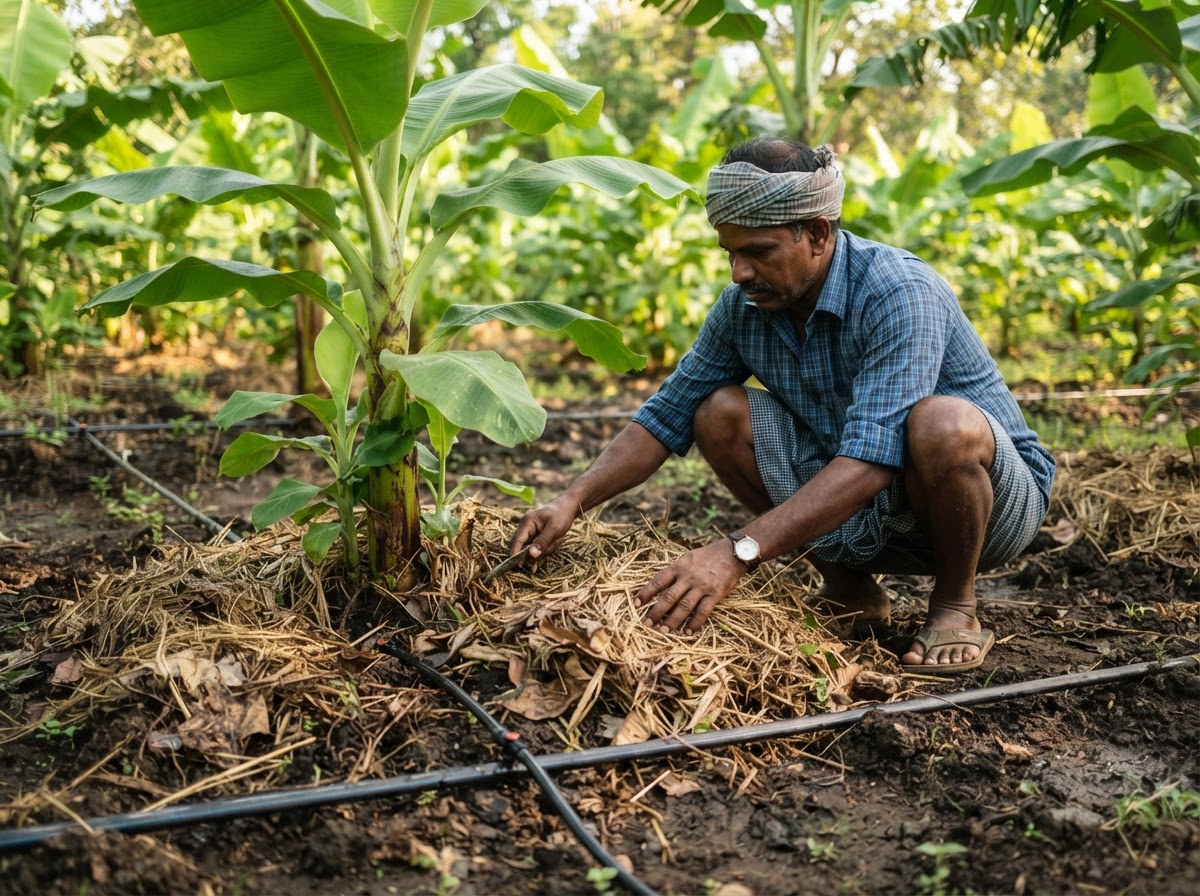
Banana is a succulent, evergreen, shallow-rooted crop and needs a lot of water — 1,800–2,000 mm a year (NHB). In practice that means irrigation every 7–8 days in winter and every 4–5 days in summer, or roughly 70–75 irrigations in a furrow-irrigated crop. Stop irrigation about 15 days before harvest so the soil dries enough for labour and transport to move through the plot.
Drip is where the money is. The NRCB daily drip schedule by growth stage:
| Stage / अवस्था | Weeks after planting | Water per plant per day |
|---|---|---|
| After planting / ratoon | 1–4 | 4–6 litres |
| Juvenile phase | 5–9 | 8–10 litres |
| Critical growth stage | 10–19 | 12 litres |
| Flower bud differentiation | 20–32 | 16–20 litres |
| Shooting stage | 33–37 | 20 litres and above |
| Bunch development | 38–50 | 20–24 litres |
Drip with mulch has been reported to save around 58% of irrigation water while raising yield by 23–32%, and it also brings the bunch to maturity 30–45 days earlier (NHB). Mulching with straw or black polythene keeps the basin moist and suppresses weeds. If you are setting up drip, the Per Drop More Crop component of PMKSY and the Micro Irrigation Fund are the two support lines farmers most often use for the capital cost.
Manure, Fertilizer and How to Apply / खाद, उर्वरक और देने का तरीका
Banana removes large quantities of potassium. A tonne of fruit takes roughly 7–8 kg of nitrogen, under 1.5 kg of phosphorus, and 17–20 kg of potash. Most farmers over‑apply urea and under‑apply potash. For banana, this is exactly backwards.
The ICAR‑NRCB schedule for a plant crop, per plant, is a sound, practical base for Indian conditions:
| Time / समय | Fertilizer per plant | Notes |
|---|---|---|
| At planting | 10–15 kg FYM in the pit | Mix well with soil before planting |
| 3rd month | Urea 100 g + SSP 300 g + MOP 100 g | Basin 30 cm away from the plant |
| 4th month | Azospirillum 30 g + phosphobacteria 30 g + Trichoderma viride 30 g with 5–10 kg FYM | Keep 2–3 weeks away from chemical fertilizer |
| 5th month | Urea 150 g + MOP 150 g + neem cake 300 g | Basin 45 cm away; add lime 50 g and MgSO₄ 25 g |
| 7th month | Urea 150 g + MOP 200 g | Last dose before shooting |
How to apply. Never broadcast fertilizer at the base of the pseudostem. At the third month, make a shallow basin 30 cm away from the plant. At the fifth month, make a shallow basin 45 cm away from the plant. Spread the fertilizer evenly in the basin, cover it with soil, and irrigate copiously immediately afterwards. The feeding roots are at that distance. Applying closer burns the corm while feeding nothing.
For micronutrients, apply a micronutrient mixture at 10 g per plant in the third and fifth months, along with the lime and magnesium sulphate already listed. Where drip is installed, fertigation is more efficient. The NRCB weekly schedule totals about 340 g of urea and 375 g of MOP per plant, spread from week 9 to week 46. In this schedule, urea is front‑loaded in weeks 9–30 and potash is loaded in the later weeks when the bunch is filling. The principles behind these splits — why nitrogen early and potash late — are set out in this guide to plant nutrients for healthy growth, and the broader logic of combining organic and chemical sources is covered in integrated nutrient management.
Care During the Growth Phase / वृद्धि अवस्था में देखभाल
First month. Press the soil around each plant again after the first irrigation, and gap-fill any sucker that has not sprouted or has rotted. Sow cowpea or sunnhemp in the interspaces as green manure. Short-duration intercrops — onion, greengram, blackgram, beans, radish, greens, marigold — are safe and give early income. Do not intercrop tomato, chilli or cucurbits: they host nematodes and aphids, and the aphids carry the viruses that destroy a banana crop.
Second month. Plough the green manure back into the soil at flowering, about 40 days after sowing. Light digging and earthing up keeps weeds down. For wilt-susceptible varieties, drench with 0.2% carbendazim around the plant, or apply Trichoderma viride or Pseudomonas fluorescens with FYM as a preventive.
Fourth month onward. Remove side suckers every month up to the eighth month — cut them above ground level and pour a little kerosene into the central core so they do not regrow. Each retained sucker steals nutrients from the mother plant and gives the pseudostem weevil a place to breed. Remove dried leaves as they appear; a clean pseudostem is easier to inspect and dries faster after rain. Where the bunch is heavy, prop the plant with bamboo or a fork stick before it leans. General weed management discipline — clean basins in the first five months — does more for banana yield than an extra bag of urea.
Pests and Diseases: Prevention and Treatment / कीट-रोग: रोकथाम और उपचार
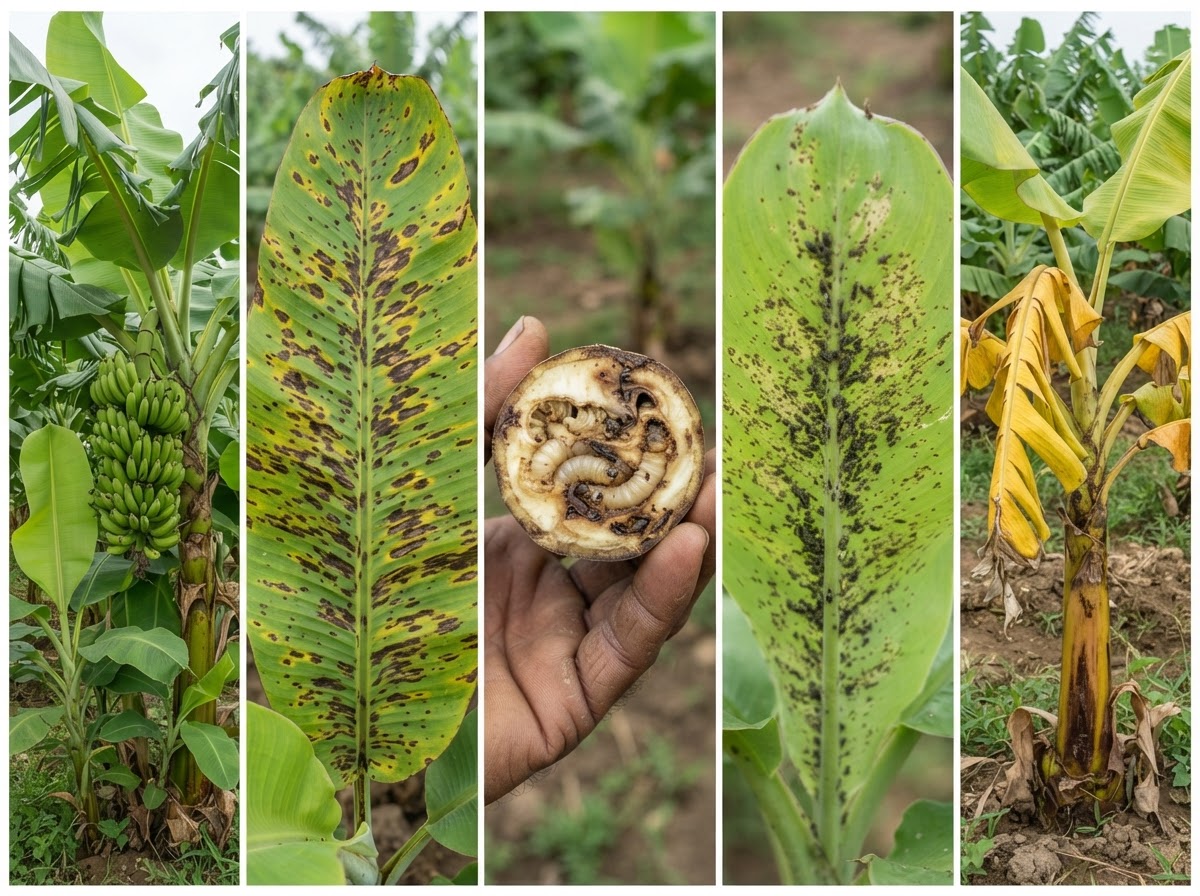
Panama wilt (Fusarium wilt) / पनामा विल्ट
Yellowing starts on the lower leaves; the leaf margins dry, the petiole buckles and hangs around the pseudostem, and the pseudostem splits lengthwise. Cut a diseased stem and the water-conducting vessels are reddish brown. In the final stage only a few upright, spiky leaves remain and the plant dies. The fungus is soil-borne and spreads through infected suckers, implements and irrigation water.
Prevention is nearly the whole treatment: plant pathogen-free suckers dipped in 0.2% carbendazim, grow resistant varieties such as Poovan and Nendran in endemic areas, and avoid Rasthali, Monthan, Karpuravalli and Kadali there. Rotate with paddy or sugarcane for two to three cycles, keep drainage open, apply neem cake at 250 kg/ha, and use Trichoderma viride with Pseudomonas fluorescens and FYM. Where the disease is already present, drench carbendazim 0.2% at 2–3 litres per plant around the base every month from the first month. Severely infested soil should not be replanted with banana for three to four years (NHB).
Erwinia rot (bacterial soft rot) / एर्विनिया सड़न
Young suckers rot and give off a foul smell; a yellowish to reddish ooze appears when the collar is cut open, and an affected plant can be pulled out whole, leaving the corm and roots in the soil. Hot, wet weather and standing water trigger it, and the bacteria enter through wounds.
Use disease-free suckers, avoid planting in the rainy season, grow sunnhemp or cowpea in the interspaces to shade the soil, and irrigate in the morning or evening rather than in the heat of the day. Apply bleaching powder at 8 g per mat at 10–15 day intervals for two or three times. NRCB’s effective package is Pseudomonas fluorescens at 50 g per litre, 1–2 litres per plant, at the 0th, 2nd, 4th and 6th months after planting, combined with sunnhemp in the interspaces.
Sigatoka leaf spot / सिगाटोका पत्ती धब्बा
Small pale spots appear on the leaves and enlarge into dark purplish-black lesions with grey centres; in severe cases the leaf looks burnt, bunch filling is poor and fruits ripen unevenly. It spreads by wind and rain, and is worse on shallow, poorly drained soils.
Keep the field weed-free, maintain drainage, follow the recommended spacing, remove and destroy infected leaves, and never leave dried leaves hanging on the plant. Spray as soon as symptoms appear, at 20–25 day intervals, with mineral oil 10 ml plus propiconazole 0.1% (1 ml per litre), or mineral oil with carbendazim 0.1%, or mineral oil with tridemorph 0.1%. Cover both surfaces of the leaves, including the topmost unfurled leaf, and do not exceed the recommended dose — the point of alternating products is to avoid resistance.
Bunchy top virus (BBTV) / बंची टॉप वायरस
Leaf margins turn yellow with dark green streaks, new leaves come out narrow, wavy and bunched at the top, and any fruit that forms is twisted and unmarketable. The virus is spread by the banana aphid.
There is no cure. Use only certified virus-free tissue-culture plants, remove and destroy infected plants the day you see them, and spray a systemic insecticide to knock down the aphid vector. Because aphids move between farms, control only works as a community effort — if one plot in the village is left infected, it re-infects everyone.
Pseudostem weevil / तना घुन
Infestation usually starts around the fifth month. A pinhead hole on the stem with jelly-like exudation is the first sign; later, chewed fibre is pushed out of the hole, the stem rots with a foul smell and the plant may snap. The adult weevil breeds in the pseudostem, which is why a harvested stem left standing is a nursery for the next generation.
Follow clean cultivation, uproot and burn infested plants, remove old and dried leaves, prune side suckers monthly up to the eighth month, and destroy the pseudostem at ground level after harvest instead of leaving it to recycle in the field. Apply a mud slurry with 5% neem oil to the pseudostem at the fifth month in heavily infested areas, or plaster with cowdung-ash slurry. For monitoring, use longitudinal split pseudostem traps — about 10–15 per acre — with the split face towards the ground, renewing the material weekly, and pheromone traps based on 2-methyl-4-heptanol.
These five problems, handled as a schedule rather than as firefighting, are the core of integrated pest management. The general symptom-reading method — what a lesion shape, a colour change or a wilting pattern tells you — is set out in this guide to crop diseases, symptoms and management, and spraying technique and dose discipline in agrochemical application methods.
Healthy Plants vs Warning Symptoms / स्वस्थ पौधे और चेतावनी संकेत
Read the crop weekly. What you are looking for is not perfection but consistency.
| What you see / क्या दिखता है | Healthy plant / स्वस्थ पौधा | Warning sign / चेतावनी संकेत |
|---|---|---|
| Leaves | Broad, uniformly bright green, unfurling steadily; a new leaf every 7–10 days in the growing season | Pale or yellowing lower leaves, streaks, marginal drying, narrow wavy leaves bunched at the top |
| Pseudostem | Thick, firm, uniformly coloured, no splits, no jelly at the base | Longitudinal splits, ooze, pinhead holes with jelly, a soft base |
| Growth habit | Upright, not leaning, suckers appearing at the base | Leaning, plant pulling out of the soil, spiky upright leaves with the rest collapsed |
| At shooting | Bunch emerges straight and hangs down; fingers fill and the angles round out | Choked or twisted bunch, uneven finger size, fingers that stop filling |
| Basin | Moist, weed-free, no standing water after rain | Water standing for hours, cracks, salt crust, weeds crowding the plant |
Two stage markers are worth memorising. Shooting normally happens in the sixth to ninth month after planting, and the bunch then takes about 90–120 days to mature. Dwarf varieties are ready to harvest 11–14 months after planting; tall varieties take 14–16 months. If shooting is late or the bunch is small, look first at water and potash, then at nematodes — not at the seed.
Harvesting / कटाई
Harvest at the maturity the market wants. For long-distance transport, cut at 75–80% maturity; for local sale, allow the fruit to colour further on the plant. The reliable field indicators are: the top leaves begin to dry, the fruit colour changes from dark green to light green, the angles of the fingers fill out and become rounded, the floral end drops at the slightest touch, and the fruit gives a metallic sound when tapped (NHB). Another practical index is that the fingers of the second hand from the top are three-quarters rounded.
Cut the bunch in one clean stroke about 30 cm above the first hand, with a helper holding the bunch so it does not fall and bruise. Never let the bunch touch the ground. Take it to shade immediately — light hastens ripening and softening. Typical yields are 30–40 t/ha for Dwarf Cavendish, 38–45 t/ha for Robusta and 20–30 t/ha for most other varieties, with Grand Naine reaching far higher under good management (NHB).
After Harvest: Handling, Grading, Ripening and Storage / कटाई के बाद: प्रबंधन, ग्रेडिंग, पकाना और भंडारण
Post-harvest handling decides whether a good crop becomes a good price.
- De-hand. Separate the hands with a sharp, clean knife, cutting close to the stem with a smooth single cut. Lay the hands crown-down on clean leaves for about 10 minutes so the latex drains.
- Treat the crown. Dip the hands in 0.1% benomyl or thiabendazole solution to restrict crown rot, then air-dry.
- Grade. Grade by number and size of fingers per hand, and by colour and maturity. Discard overripe, injured and diseased fruit at this stage — one rotting hand spoils a box.
- Pack. For the local market, bunches or hands padded with banana leaves are still normal. For distant and export markets, pack de-handed clusters in corrugated fibreboard cartons of about 13–14.5 kg with perforated polyethylene liners, curved side up, so the crown of the upper layer does not press into the fruit below.
- Pre-cool. Bring pulp temperature down to about 13°C within 10–12 hours of harvest, by forced-air cooling at 13°C and 85–90% relative humidity.
- Store. Hold mature-green fruit at 13–15°C and 90–95% relative humidity. Below 13°C the fruit suffers chilling injury — dull colour, failure to ripen, browning flesh. Mature-green bananas keep about three weeks in ethylene-free air and up to six weeks in controlled atmosphere at 14°C.
- Ripen. Banana is climacteric, so it can be ripened deliberately with ethylene or a low dose of ethrel at 15–18°C for uniform colour without losing flavour.
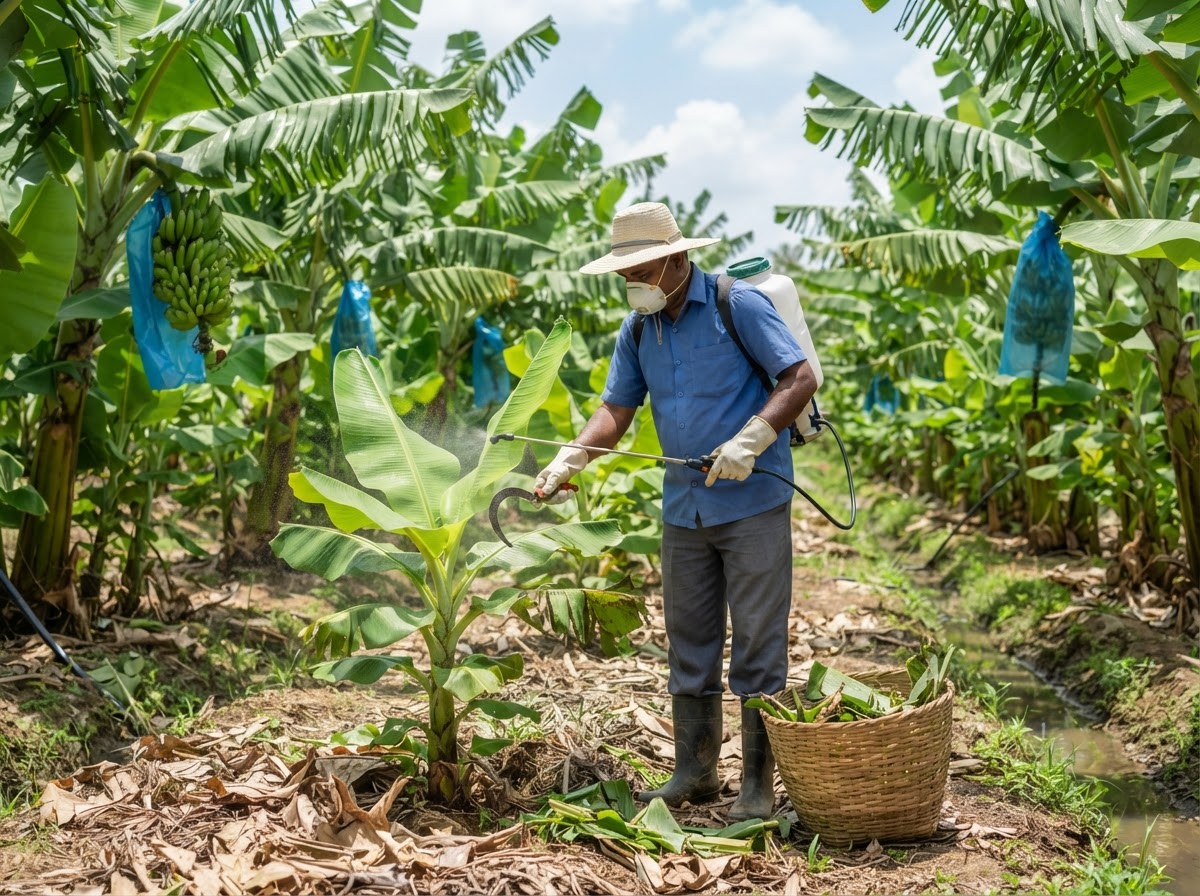
Then comes the ratoon. After cutting the bunch, take the leaves and leave the plant system in place so the suckers draw on it — this saves about 15% of irrigation and gives the next crop a head start. The first ratoon is ready 8–10 months after the main harvest and the second 8–9 months after that, so three crops can come off one planting in 28–30 months (NHB).
For selling, register on e-NAM so you are not limited to the nearest mandi, and look at cold chain and pack-house support if you are grading and holding fruit rather than selling it green at the farm gate. Horticulture planting and infrastructure costs are partly covered under MIDH, and crop insurance under PMFBY is worth checking before planting, not after a storm.
Key Takeaways / मुख्य बातें
- Banana is a 12-month crop decided in the first 90 days: disease-free planting material, a deep pit with FYM, firm soil around the corm and a plot that drains are worth more than any spray.
- Plant so that shooting and bunch filling do not fall in peak winter cold or peak pre-monsoon wind.
- Feed potash, not just urea. Follow the NRCB schedule — 100:300:100 g urea:SSP:MOP at the third month, then potash-heavy doses at the fifth and seventh months — applied in a basin 30–45 cm from the plant and watered in immediately.
- Drip with mulch saves around 58% of water and adds 23–32% yield; high-density paired-row planting with fertigation saves a further 30–40% water and about 25% fertilizer.
- Panama wilt, Erwinia rot, sigatoka, bunchy top and the pseudostem weevil cause most losses, and every one of them is managed mainly by prevention, clean suckers and field hygiene.
- Harvest at 75–80% maturity for distant markets, de-hand and drain latex within minutes, pre-cool to 13°C, and store at 13–15°C — then keep the plant for two ratoons.
Sources / स्रोत
- ICAR–National Research Centre for Banana (NRCB), Tiruchirappalli — Agricultural operations, high-density planting, fertigation and post-harvest technology pages. https://nrcb.org.in
- National Horticulture Board (NHB), Ministry of Agriculture & Farmers Welfare — Banana: production technology, harvesting and post-harvest management. https://nhb.gov.in
- Tamil Nadu Agricultural University (TNAU) Agritech Portal — Horticulture: Fruits – Banana; Banana expert system (crop protection, harvest and post-harvest). https://agritech.tnau.ac.in
- ICAR–Central Agricultural Research Institute (CIARI), Port Blair — Package of Practices for Major Horticultural Crops. https://ciari.res.in
- National Institute of Plant Health Management (NIPHM) / National IPM network — Package of practices for banana pest and disease management. https://nriipm.res.in
- ICAR–Indian Institute of Horticultural Research (IIHR) and ICAR ePublications — Indian Horticulture articles on banana and tomato disease management.
- The Hindu BusinessLine, 25 June 2025 — Report on the second advance estimates of horticulture production for 2024-25 (banana at 38.04 million tonnes).
- Department of Agriculture & Farmers Welfare / NHB horticulture statistics, as cited in published banana value-chain studies — area, production and productivity 2011-12 to 2023-24.
Note: Fertilizer doses, spacing and spray schedules are the standard recommendations of the institutions cited above. They are not a substitute for a soil test and local KVK advice, and pesticide use must follow the current CIB&RC label and the waiting period before harvest.


Leave a Reply