
Mission for Aatmanirbharta in Pulses: 100% MSP Purchase of Tur, Urad and Masur, Free Seed Kits and a ₹25 Lakh Processing Subsidy / दलहन में आत्मनिर्भरता मिशन: तुअर, उड़द और मसूर की 100% एमएसपी खरीद, मुफ्त बीज किट और ₹25 लाख तक प्रसंस्करण सब्सिडी
India’s pulses programme changed shape in October 2025. The Union Cabinet approved a six-year, ₹11,440-crore Mission for Aatmanirbharta in Pulses that promises something farmers have asked for since the 2018 MSP announcements: an open-ended government purchase of tur, urad and masur at the minimum support price, backed by free seed kits and a subsidy for small processing units. This article sets out what the mission actually delivers, what it does not, the MSP rates in force for the current rabi season, and the exact steps to register so that a harvest can be sold to NAFED or the NCCF instead of being dumped in a mandi below cost.
At a Glance
- 100% MSP procurement of tur, urad and masur in participating states, through NAFED and NCCF, with no 25% ceiling.
- Free and certified seed support — 88 lakh seed kits and 126 lakh quintals of certified seed planned over the mission period, delivered through state agriculture departments and KVKs.
- Up to 33% assistance, capped at ₹25 lakh, for setting up new pulse processing and packaging units, against a target of 1,000 units.
What the Mission Is, and Why It Exists / मिशन क्या है और क्यों ज़रूरी है
The Mission for Aatmanirbharta in Pulses was announced in the Union Budget 2025-26, approved by the Union Cabinet on 1 October 2025 and launched by the Prime Minister on 11 October 2025. It is a centrally sponsored scheme running from 2025-26 to 2030-31 with a financial outlay of ₹11,440 crore, and the Ministry of Agriculture & Farmers Welfare expects it to reach roughly two crore farmers.
The problem it addresses is simple arithmetic. India is the world’s largest producer and consumer of pulses, but domestic output has not kept pace with demand, and imports were running 15–20% above the previous level. The mission’s target is self-sufficiency by 2030-31: production of 350 lakh tonnes from 310 lakh hectares at a yield of 1,130 kg per hectare, which means adding 35 lakh hectares to the pulses area — 24.5 lakh hectares in traditional growing districts and 10.5 lakh hectares in non-traditional ones, largely by using rice fallows and by pushing intercropping.
The starting point is stronger than it was a few years ago. According to the Third Advance Estimates for 2025-26, pulses production rose to 274.09 lakh tonnes from 256.83 lakh tonnes in 2024-25, area expanded from 277.20 lakh hectares to 286.46 lakh hectares, and yield improved from 926 kg to 957 kg per hectare. In value terms, pulses imports fell 31.52% — from ₹46,427.60 crore in 2024-25 to ₹31,793.59 crore in 2025-26 — while import volume dropped from 72.56 lakh tonnes to 59.64 lakh tonnes. The mission is designed to hold that trajectory and, on the government’s own numbers, to move from “mostly enough” to “self-sufficient”.
The Core Offer: 100% Procurement of Tur, Urad and Masur at MSP / मुख्य लाभ: तुअर, उड़द और मसूर की 100% एमएसपी खरीद
This is the provision that matters most to a farmer deciding what to sow. Under the Price Support Scheme (PSS) of the PM-AASHA price assurance framework and the MSP system, NAFED and the National Cooperative Consumers’ Federation (NCCF) will procure tur (arhar), urad and masur equivalent to 100% of a participating state’s production, from farmers who register with these agencies and enter into an agreement. The usual 25% ceiling on PSS procurement does not apply to these three crops. It still applies to every other pulse, including chana (gram) and moong.
State participation is the hinge the whole guarantee turns on. Procurement under PSS is activated state by state, usually once market prices soften below MSP, and only after the state government formally requests the central agencies to open centres. A farmer in a state that has not requested procurement for a given season has no live purchase centre to sell to, regardless of what the mission promises nationally. Checking that your own state has opened tur, urad or masur procurement for the current season — on the e-Samridhi or eSamyukti portal, or through the district agriculture office — is therefore a precondition, not a formality.
Three qualifications are worth stating plainly, because they decide whether the guarantee bites in a given season:
- Your state has to opt in. Procurement under PSS is taken up on the request of the state government, and normally when market prices fall below MSP. The 100% commitment applies to states that participate in the procurement cycle; it is not an automatic nationwide buy-back.
- You have to be registered and in agreement. The purchase is from pre-registered farmers who have signed up with NAFED or NCCF for that crop and season. Selling to a trader and then claiming MSP is not how it works.
- The four-year window is the operative one. The Budget 2025 announcement committed 100% procurement for four years, up to 2028-29. A PIB release of 29 October 2026 describes procurement from pre-registered farmers through the central nodal agencies under the mission running till 2030-31. Farmers should treat the notified procurement year for their own state as the window that counts, and check the live scheme on the agency portal before sowing on the strength of it.
To fund this, the government raised the PM-AASHA procurement guarantee for pulses at MSP from ₹45,000 crore to ₹60,000 crore. Chana remains India’s largest pulse — 125.14 lakh tonnes estimated in 2025-26 — so a rabi farmer weighing chana against masur should note that chana is bought at MSP only within the 25% cap, while masur carries the open-ended commitment.
MSP rates that apply now (₹ per quintal)
| Crop | Season / marketing year | MSP | Change from previous year |
|---|---|---|---|
| Lentil (Masur) | Rabi, RMS 2027-28 | 7,390 | +390 |
| Gram (Chana) | Rabi, RMS 2027-28 | 5,958 | +83 |
| Tur / Arhar | Kharif, 2025-26 | 8,000 | +450 over 2024-25 |
| Urad | Kharif, 2025-26 | 7,800 | +400 over 2024-25 |
| Moong | Kharif, 2025-26 | 8,768 | +86 over 2024-25 |
The rabi MSPs were approved by the Cabinet Committee on Economic Affairs on 30 September 2026 for the Rabi Marketing Season 2027-28, with an estimated ₹90,962 crore to be paid to farmers for 324 lakh tonnes of produce. Masur’s 92% return over the all-India weighted average cost of production is the second-highest among rabi crops after wheat; gram’s margin is 59%.
Free Seed Kits and Certified Seed / मुफ्त बीज किट और प्रमाणित बीज
The production side of the mission is delivered through seed, demonstrations and training, in a cluster-based approach that the government says follows NITI Aayog’s recommendation. Over the mission period the plan is to distribute 88 lakh seed kits free of cost and 126 lakh quintals of certified seed, covering 370 lakh hectares by 2030-31. Multi-location trials of new varieties — higher-yielding, pest-resistant and climate-resilient — are part of the design, so that a variety recommended in Madhya Pradesh is tested for suitability there rather than assumed from another state’s results.
In the first year, 2025-26, the ministry reported 4.79 lakh hectares of demonstrations on improved production and protection technology, production of 4.33 lakh quintals of quality seed, distribution of 3.10 lakh quintals of certified seed and 9.25 lakh seed kits given free to farmers. Seed kits and demonstrations are routed through state agriculture departments and Krishi Vigyan Kendras (KVKs) in the mission clusters, so the practical route to claim one is the district agriculture officer or the local KVK — there is no separate national application window that a farmer signs up to individually. For background on handling that seed well, see our guide to seed selection and seed treatment and to pulses cultivation practices.
In practical terms, a seed kit is meant to be sown in full on the plot declared at the KVK or agriculture office, since demonstration plots are used to measure the variety’s performance in that cluster and inform the next season’s recommendations. Farmers receiving certified seed should keep the issue slip or receipt, as it is often the same record used later to verify the crop and area at the time of MSP registration. Where a kit includes a new variety, sowing a small check strip of the farmer’s usual seed alongside it makes it easier to judge the result before committing a larger area in future seasons.
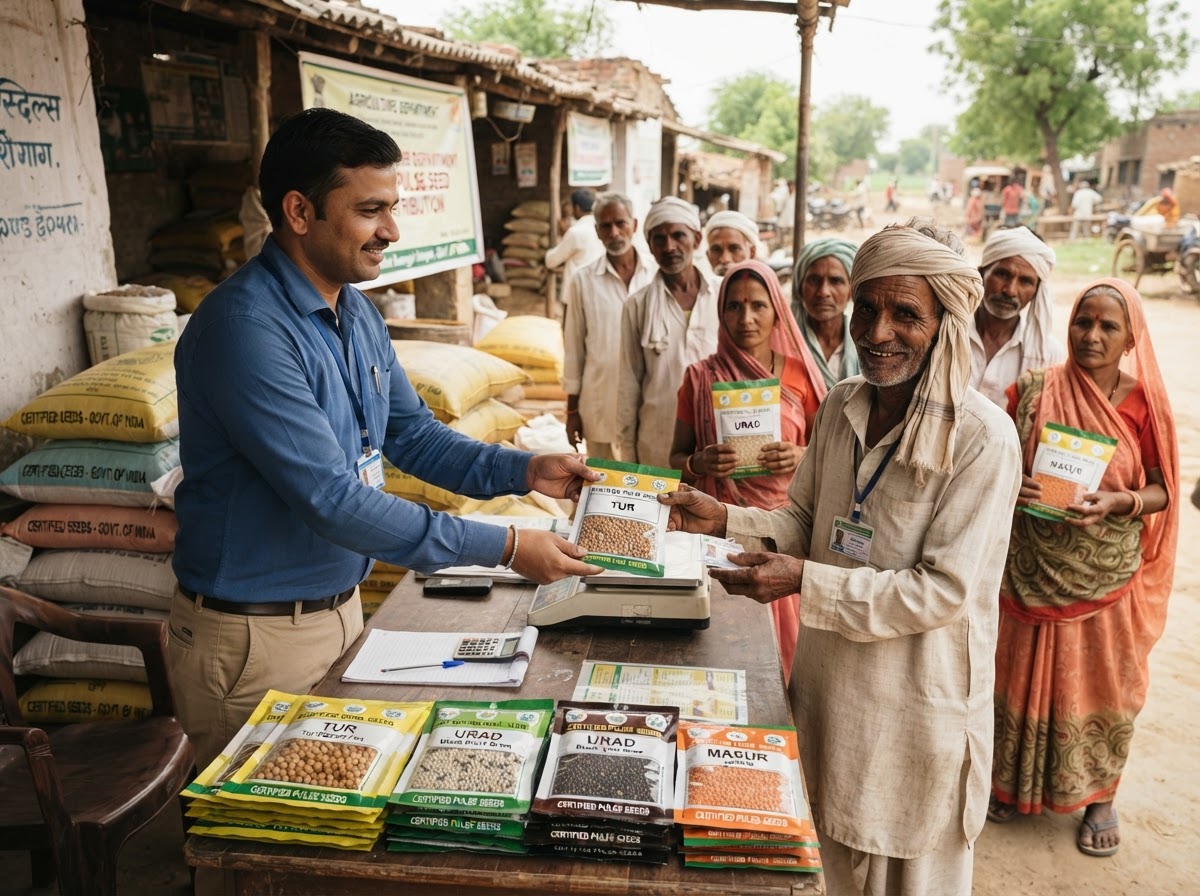
Certified pulse seed distribution and farmer guidance
How to Register for MSP Procurement, Step by Step / एमएसपी खरीद के लिए पंजीकरण: चरण दर चरण
Registration is done on one of two central nodal agency portals — NAFED’s e-Samridhi (esamridhi.in) or NCCF’s eSamyukti (esamyukti.in). Both are free; there is no registration fee. Registration does not by itself guarantee a purchase centre or a sale, because the crop, state and centre must be live in the notified procurement cycle for that season.
- Prepare the documents. Aadhaar number, an Aadhaar-linked mobile number, land or cultivation details (khatauni, khasra or the state’s accepted land record showing the area sown), and a bank account seeded with Aadhaar so that payment can come by direct benefit transfer.
- Open the portal and choose farmer registration. Enter the mobile number and captcha, then complete Aadhaar-based eKYC. Identity verification is through Aadhaar authentication, which is also how duplicate and benami entries are filtered out.
- Fill in land, crop and bank details. Add the area under the notified pulse, the expected quantity and the bank account. Where the portal offers a choice of purchase centre, select the nearest one that is active for your crop.
- Register through a PACS or FPO if that is easier. Both portals allow registration through a Primary Agricultural Credit Society, a Farmer Producer Organisation or a Common Service Centre operator. This is the practical option if the farmer does not use a smartphone comfortably.
- Sign the agreement and keep the acknowledgement. The purchase is from farmers who register and enter into an agreement with the agency. Save the registration number; it is what the procurement centre will ask for.
- Deliver to the centre and collect the payment. Produce is weighed and quality-checked at the centre, a warehouse receipt is generated, and payment is credited to the Aadhaar-seeded account. NCCF’s published guidance is that payment is typically processed within 48 hours of the warehouse receipt being approved.
By May 2025 the two agencies had together pre-registered over 64 lakh farmers — 38 lakh with NAFED and 26 lakh with NCCF — and both now offer spot registration at procurement centres to widen reach. Registering early still matters: the agreement, the land record verification and the centre allotment all take time, and a registration completed after the harvest has been sold is of no use. For selling outside MSP, our guide to e-NAM registration and mandi sales covers the alternative route.
On quality and payment, it helps to know what happens at the centre before arriving there. Produce is weighed and checked against the notified moisture, foreign-matter and damaged-grain limits for that crop; lots that fail the specification are liable to be rejected or priced down, so on-farm grading and proper drying before transport reduce the chance of a wasted trip. Once a lot clears quality checks, a warehouse receipt is issued, and NCCF’s published guidance of payment typically within 48 hours of that receipt being approved gives a reasonable expectation for both agencies, since payment in both cases is routed as a direct benefit transfer to the Aadhaar-seeded account given at registration. Keeping the registration number and the warehouse receipt until payment clears is the simplest way to resolve any delay.
Processing and Packaging Units: 33% Subsidy up to ₹25 Lakh / प्रसंस्करण और पैकेजिंग इकाइयाँ: 33% सब्सिडी, ₹25 लाख तक
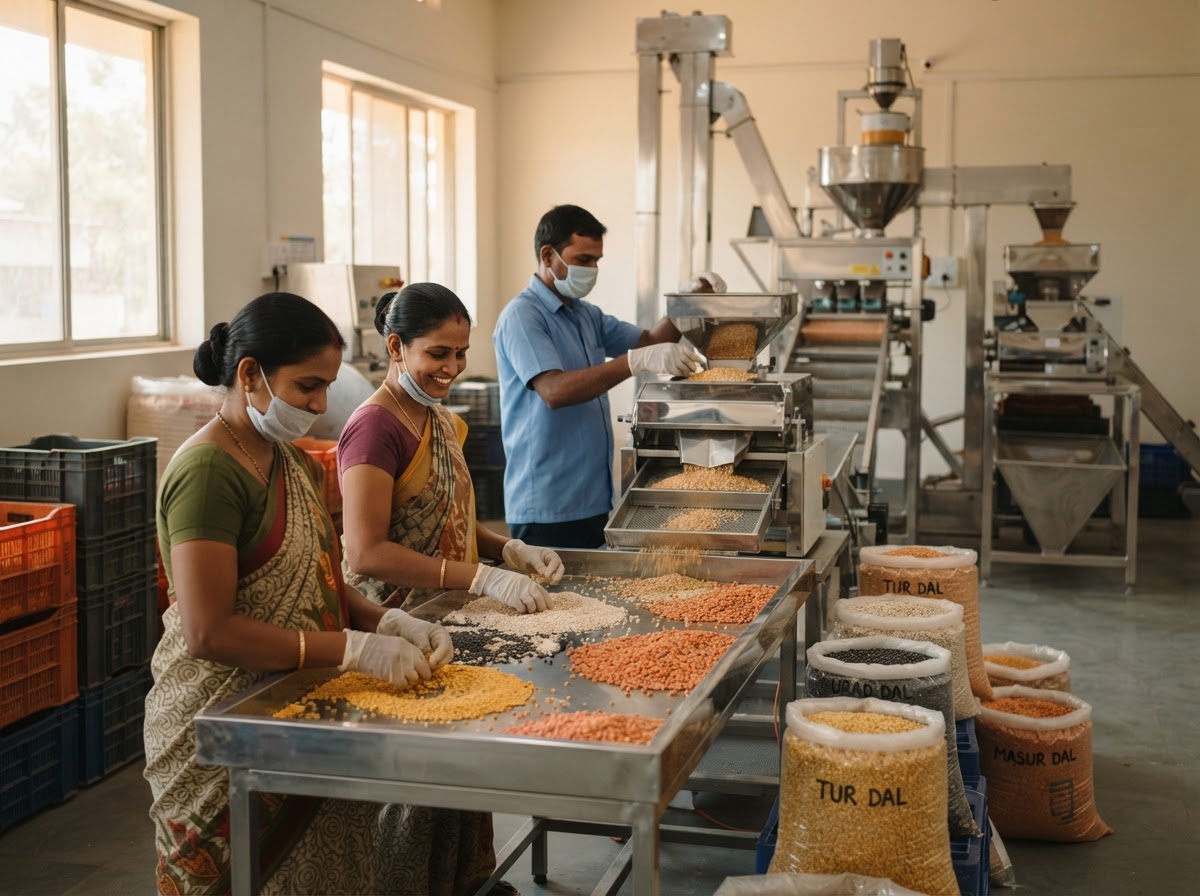
The mission’s post-harvest component is where an agri-entrepreneur, an FPO or a larger farmer can build something durable. Financial assistance is available for setting up new pulse processing and packaging units at 33% of the project cost, subject to a maximum of ₹25 lakh, whichever is less. A total of 1,000 units is targeted over 2025-26 to 2030-31, and in the first phase 528 units have been allotted to states and union territories, with state-wise targets published in the Cabinet approval.
The processing-unit subsidy is structured as reimbursement of part of a new unit’s project cost, not as upfront working capital, so an applicant should budget to finance the unit first and recover the assistance afterward. In practice this means: apply to the state agriculture or horticulture department against that state’s allotted target under the mission; present a project cost estimate covering machinery, packaging and basic infrastructure; and expect the assistance to be released at 33% of the approved project cost or ₹25 lakh, whichever is lower. Because the mission’s 1,000-unit target is distributed state-wise, an FPO or entrepreneur should check the state’s remaining allotment before investing time in a detailed project report, and should treat this assistance as complementary to, not a substitute for, other processing support such as PM Kisan SAMPADA Yojana, which an applicant cannot necessarily claim twice for the same unit.
This sits alongside, not instead of, existing processing support. Twenty-three pulse processing projects have been approved under the Creation and Expansion of Food Processing and Preservation Capacities component of the PM Kisan SAMPADA Yojana, of which 18 are complete, with a total project cost of ₹315.88 crore and approved grants-in-aid of ₹74.39 crore creating 4.44 lakh metric tonnes of annual capacity. Our article on PMFME’s 35% micro food processing subsidy explains the neighbouring option. Applications for the mission’s units are processed through the state agriculture or horticulture department against the state’s allotted target, so the first call is to the state nodal officer named in the mission guidelines.
What Farmers Should Check Before This Rabi Season / इस रबी सीज़न से पहले किसान क्या जाँचें
Rabi sowing of masur and chana is under way, and the decisions that matter are made now rather than at harvest.
- Register before sowing, not after. Land record verification against the crop sown is easier when the sowing entry exists in the state’s record. Keep the sowing details consistent between the land record, the portal entry and the actual plot.
- Confirm that your state is procuring your crop this season. Log in to e-Samridhi or eSamyukti and check the live scheme, crop and purchase centre listed for your district. A mission document is not a procurement notification.
- Plan for the 25% cap if you are sowing chana. Chana is bought at MSP only within the ceiling, so treat MSP as a floor with a volume limit, and use Kisan Credit Card credit and crop insurance rather than the MSP promise to carry the risk.
- Meet the quality specification. Moisture, foreign matter and damaged-grain limits are enforced at the purchase centre; grading at the farm gate before transport avoids rejection.
- Use the mission’s agronomy, not just its price. Intercropping and the rice-fallow route are the two area-expansion levers the mission funds. Our notes on intercropping for yield and soil health and on rice-fallow and rainfed cropping systems cover both.
Key Takeaways / मुख्य बातें
- The Mission for Aatmanirbharta in Pulses is a ₹11,440-crore centrally sponsored scheme for 2025-26 to 2030-31, approved by the Cabinet on 1 October 2025 and launched on 11 October 2025, targeting 350 lakh tonnes of pulses by 2030-31.
- Tur, urad and masur are bought at MSP for 100% of a participating state’s production by NAFED and NCCF under PM-AASHA’s Price Support Scheme, with no 25% ceiling — chana and moong remain capped at 25%.
- Registration is free on NAFED’s e-Samridhi or NCCF’s eSamyukti, needs Aadhaar, an Aadhaar-seeded bank account and land records, and can be done through a PACS, FPO or CSC.
- Current MSP: masur ₹7,390 and gram ₹5,958 per quintal for Rabi Marketing Season 2027-28; tur ₹8,000 and urad ₹7,800 per quintal for kharif 2025-26.
- Processing and packaging units get 33% of project cost as assistance, up to ₹25 lakh, against a target of 1,000 units; 88 lakh free seed kits are planned over the mission period.
Sources / स्रोत
- PIB, “Union Cabinet Approves ‘Mission for Aatmanirbharta in Pulses’ with ₹11,440 Crore Outlay” (17 March 2026) — pib.gov.in/PressReleasePage.aspx?PRID=2241411
- PIB, “India’s Mission for Aatmanirbharta in Pulses: Enhancing Production and Farmers’ Income” (factsheet, 11 October 2026) — pib.gov.in/FactsheetDetails.aspx?NoteId=151113
- PIB, “Minimum Support Price for Rabi: Marketing Season 2027-28” (29 October 2026) — pib.gov.in/PressReleseDetailm.aspx?PRID=2329868
- PIB, “Cabinet approves Minimum Support Prices (MSP) for Rabi Crops for Marketing Season 2027-28” (30 September 2026) — pib.gov.in/PressReleseDetailm.aspx?PRID=2316956
- PIB, Rajya Sabha reply on the status of the mission, 7 August 2026 — pib.gov.in/PressReleasePage.aspx?PRID=2296205
- PIB, Rajya Sabha reply “Status of Aatmanirbharta Mission in Pulses”, 13 March 2026 — pib.gov.in/PressReleasePage.aspx?PRID=2239790
- PMO, “Union Cabinet Approves Mission for Aatmanirbharta in Pulses for 2025-26 to 2030-31” (1 October 2025) — pmindia.gov.in
- PIB, “Govt. committed to purchase 100 percent of production of Tur at MSP” (23 April 2025) — pib.gov.in/PressReleasePage.aspx?PRID=2123761
- NAFED e-Samridhi portal — esamridhi.in; NCCF eSamyukti portal — esamyukti.in
- Financial Express, “Assured MSP purchase of pulses to aid crop diversification” (26 May 2025)


Leave a Reply