
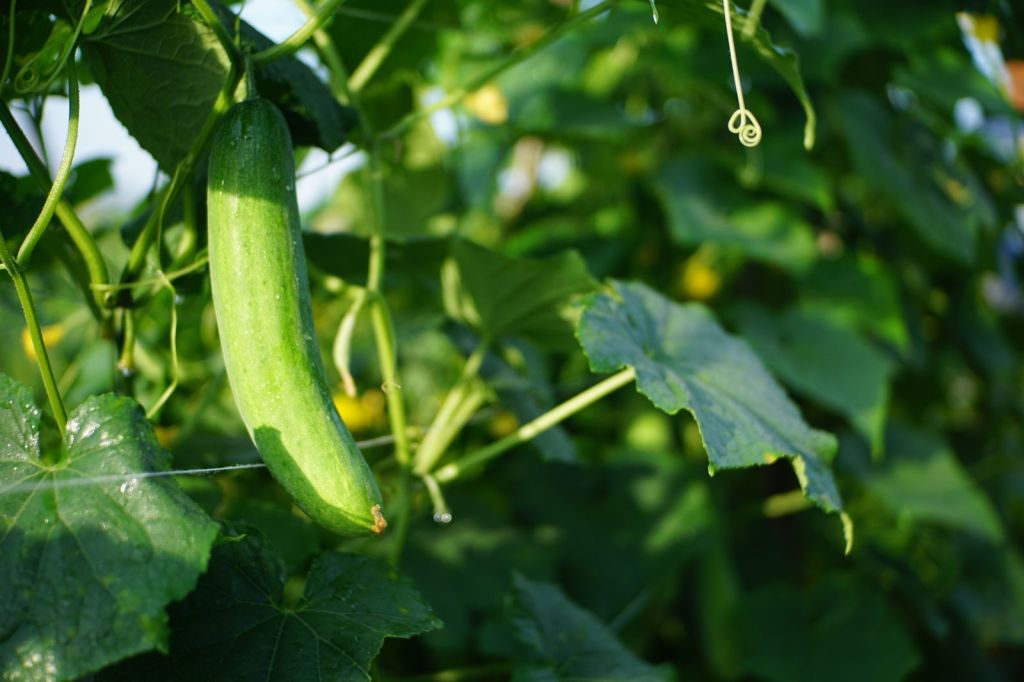
भारत में खीरे की खेती: बीज से मंडी तक संपूर्ण पौधारोपण और देखभाल गाइड | Cucumber — kheera in Hindi, vellari in Tamil and Malayalam — is the quickest cash crop in the Indian vegetable basket. Tamil Nadu Agricultural University’s package of practices puts the first picking at about 45 days after sowing, with 8–10 pickings over an 80–90 day crop. That short cycle means the crop pays back within a single season, but it also means there is no time to correct a mistake: weak land preparation, a late first irrigation or a missed mildew spray costs fruit that you cannot recover later.
This guide walks the whole lifecycle in order — climate and soil, season and variety, sowing, irrigation, manure and fertiliser, how to apply fertiliser, growth-phase care, disease prevention, treatment of a sick crop, how to read a healthy versus a struggling plant, harvesting, and what to do after harvest. Every figure below is taken from an ICAR institute, a state agricultural university package of practices, NIPHM’s national IPM package, or the USDA post-harvest handbook, and each is named where it appears.
Crop at a Glance / एक नज़र में: खीरा फसल
| Parameter | Figure | Source |
|---|---|---|
| Crop duration | 80–90 days; 8–10 pickings | TNAU |
| First harvest | About 45 days after sowing; 68 days for Punjab Naveen in open field | TNAU; PAU |
| Seed rate | 2.5 kg/ha (about 1 kg/acre); PAU open field 1.0 kg/acre | TNAU; PAU |
| Spacing | Channels 1.5 m apart, hills 0.6 m apart | TNAU |
| Farmyard manure | 40 t/ha basal; 8–10 t/acre | TNAU; NIPHM |
| Fertiliser, per acre | 40 kg N, 20 kg P₂O₅, 20 kg K₂O | PAU |
| Irrigation | Every 4–6 days, 10–12 irrigations in all | PAU |
| Open-field yield | 8–10 t/ha; about 70 q/acre for Punjab Naveen | TNAU; PAU |
| Poly-net house yield | 304–370 q/acre (Punjab Kheera-1) | PAU |
Climate and Soil Requirements / जलवायु और मिट्टी की ज़रूरत
Cucumber is a warm-season crop and is very sensitive to frost, according to Punjab Agricultural University’s package of practices for vegetables. PAU gives about 26°C as the optimum temperature for cucumber production and notes that seed germinates well at 25°C. Below that, germination drags and the seedlings sit in wet soil long enough to pick up damping-off.
Humidity is the other half of the climate story. PAU states plainly that excessive humidity promotes downy mildew and powdery mildew — the two diseases that decide whether a cucumber crop finishes its 8–10 pickings or collapses at the fifth. If you farm in a coastal belt, a river valley or a monsoon window, plan for airflow from day one: wider beds, trellising, and a spray programme ready before the first symptom.
For soil, TNAU recommends a well-drained sandy loam rich in organic matter with a pH of 6.5–7.5, and PAU prefers a well-drained loamy soil. Drainage matters more than fertility here: cucumber roots are shallow and intolerant of standing water, and PAU lists Pythium rot and collar rot among the cucurbit diseases that follow waterlogged patches. If your field holds water for even a few hours after rain, grow on raised beds — 15 cm of height is enough to change the outcome. Before planting, a soil test through your state soil testing laboratory or Krishi Vigyan Kendra will tell you whether to adjust pH, and it will let you cut the fertiliser dose below instead of guessing high.
Season, Varieties and Seed Choice / मौसम, किस्में और बीज का चुनाव
Cucumber is grown in three windows across India, and the window you pick changes almost every other decision.
- North Indian plains: PAU lists February–March for open-field sowing, mid-November under low tunnels, and September and January inside a poly-net house. Low-tunnel beds are prepared in December and the plastic is removed once it warms up in February.
- Tamil Nadu: TNAU sows in June, or from January to April.
- Kerala: the State Horticulture Mission and Kerala Agricultural University list January–March and September–December.
Variety choice should follow your market, not the seed shop’s display. PAU’s Punjab Naveen is an open-field type that takes about 68 days and yields around 70 q/acre; Punjab Kheera-1 is a parthenocarpic, bitter-free, seedless type bred for poly-net houses, with first picking at 45 days (September sowing) and average yields of 304–370 q/acre — several times the open-field figure. Kerala’s package lists Pusa Sheethal, Poinsette and Poona Khira as salad types, while ICAR’s Swarna Sheetal is a kharif-season variety. Buy seed only from a licensed dealer, keep the bill, and check the packing date: cucumber seed loses vigour quickly in Indian summer storage.
Land Preparation, Beds and Sowing / खेत की तैयारी, क्यारी और बुवाई
TNAU’s field preparation is simple and worth following exactly: plough four times and form long channels 1.5 m apart. On drip, form raised beds about 120 cm wide with 30 cm furrows and run the lateral down the centre of each bed. PAU’s layout for Punjab is beds 2.5 m wide with seed sown on both sides at 60 cm spacing; ICAR lists 1.2 × 0.3 m for its named varieties and 1.5 × 0.5 m for hybrids, with 2–3 seeds per hill.
Before the last ploughing, work in the organic matter. TNAU applies 40 t/ha of farmyard manure as a basal dose, and adds Azospirillum and Phosphobacteria at 2 kg/ha each plus Pseudomonas at 2.5 kg/ha, mixed with 50 kg FYM and 100 kg neem cake. NIPHM’s national cucurbit package uses 8–10 t/acre of FYM applied two to three weeks before sowing. Where wilt appeared in the previous crop, change the crop family for at least two seasons — rotating into a cereal or a legume breaks the soil-borne disease cycle.
Seed treatment is not optional. TNAU recommends Trichoderma viride at 4 g/kg of seed, or Pseudomonas fluorescens at 10 g/kg, or carbendazim at 2 g/kg before sowing. NIPHM’s guidance is blunt: never sow without seed treatment against seed-borne disease. Sow two seeds per hill and thin to the stronger seedling, and do not sow deeper than 5–7 cm — NIPHM’s limit for cucurbits. If you are new to the mechanics of bed sowing versus broadcasting, our guide to sowing methods in agriculture covers the equipment and depth rules in detail.
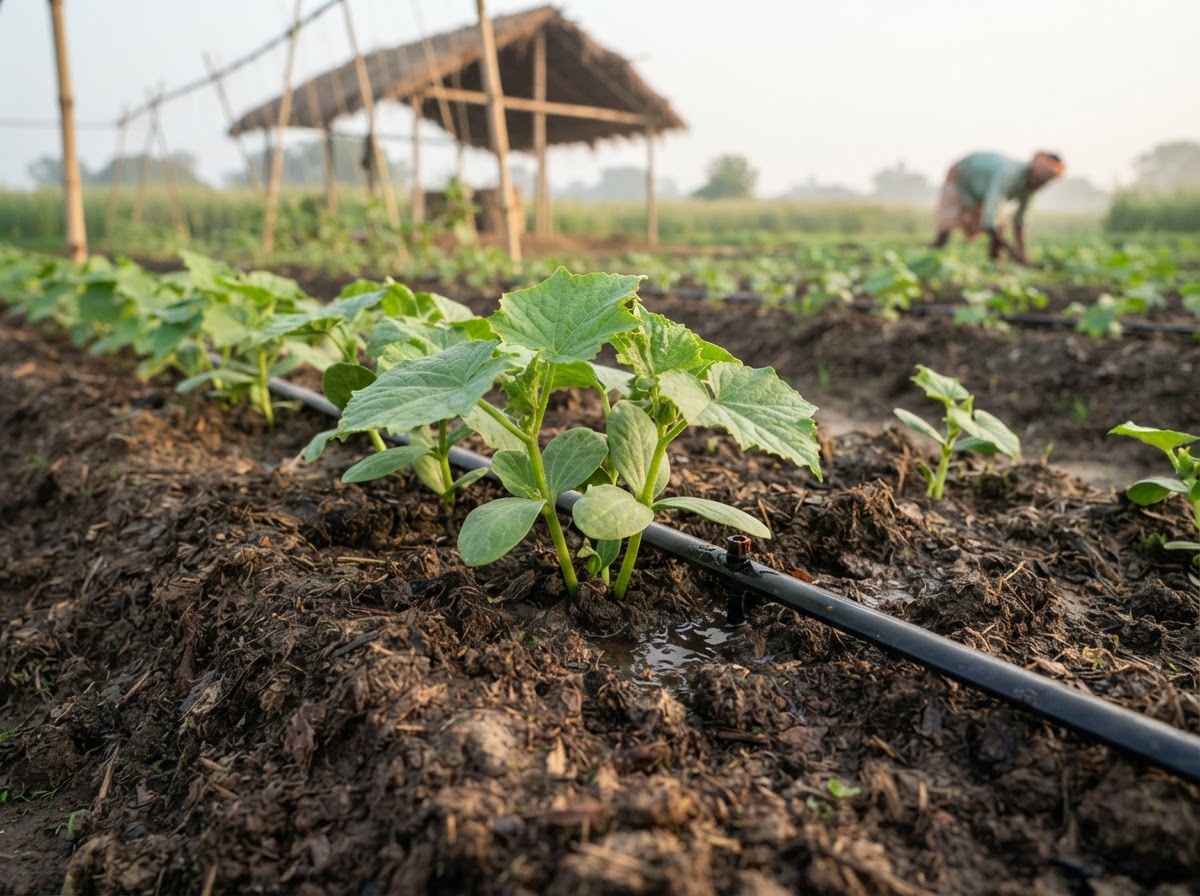
Gap-fill at 7–10 days after sowing, while the seedlings are still small enough to move without tearing roots, and keep a nursery of 5 per cent extra seedlings in coco-peat trays for the same purpose.
Watering: The Irrigation Calendar / सिंचाई: कब और कितना पानी
Cucumber is shallow-rooted and quick-growing, so the irrigation calendar has to change with the stage of the crop. PAU irrigates at 4–6 day intervals with 10–12 irrigations in total, and specifically lists avoiding flood irrigation as a disease-control measure. TNAU irrigates roughly once a week. Kerala’s package is finer-grained: irrigate every 3–4 days in the early stage and on alternate days during flowering and fruiting.
Three stage rules cover most of the risk:
- Establishment (0–20 days): light, frequent irrigation to keep the top 15 cm moist. This is when damping-off and collar rot start, so never let water stand around the collar.
- Vining and flowering (20–45 days): the crop’s water demand peaks. Stress here causes flower drop, misshapen fruit and a bitter taste.
- Fruiting and picking (45 days onward): keep moisture even; wide wet-dry swings split fruit and invite fruit fly. Stop heavy irrigation a week before you expect to finish picking.
Drip with mulch is the better system wherever it can be installed: it keeps the foliage dry, which directly suppresses downy mildew, and it lets you fertigate. TNAU’s drip layout for cucumber uses laterals at 1.5 m with drippers of 3.5–4 litres per hour, wetting the beds for 8–12 hours before planting. Central support for drip and sprinkler installation is available to farmers under the Per Drop More Crop component of PMKSY — check the subsidy rate with your state horticulture department, because it differs by state and category.
Manure and Fertiliser: What to Apply / खाद और उर्वरक: क्या दें
Cucumber responds to a modest, well-split fertiliser programme — not to a heavy one. Excess nitrogen produces lush leaf and few fruit, and it makes the crop more attractive to sucking pests.
PAU’s per-acre dose for cucumber is 40 kg N, 20 kg P₂O₅ and 20 kg K₂O — practically 90 kg urea, 125 kg single super phosphate and 35 kg muriate of potash. NIPHM’s national cucurbit figure is close: 40:32:24 kg N:P:K per acre, with all phosphorus and potash at sowing and nitrogen split into two halves at 25 and 45 days after sowing, on top of 8–10 t/acre of FYM. TNAU’s Tamil Nadu schedule applies 40 t/ha of FYM as basal plus 35 kg N/ha at 30 days after sowing for open-pollinated types, and 150:75:75 kg NPK/ha through fertigation for F1 hybrids, with 75 per cent of the phosphorus given as a basal dose.
The differences between these schedules are regional, not contradictory. Use your soil test to pick the closest one, then adjust. In practice a workable Indian programme looks like this:
- Basal, at sowing: full FYM, full phosphorus, full potash, and one-third of the nitrogen — placed in bands about 15 cm away from the seed row, as PAU specifies.
- Top dressing 1, at 25–30 days (vining begins): one-third of the nitrogen, as urea, followed by light irrigation.
- Top dressing 2, at 45–50 days (flowering to first fruit): the remaining nitrogen.
- Micronutrients: correct any deficiency — zinc, boron, magnesium — by foliar spray of that specific nutrient, as NIPHM advises, rather than by a general mixture.
- Organic route: where you are converting to organic, replace part of the chemical nitrogen with vermicompost and neem cake and keep the biofertiliser inoculants; the nutrient budget is discussed in our explainer on Integrated Nutrient Management.
How to Apply Fertiliser Correctly / उर्वरक देने का सही तरीका
The method decides whether the money reaches the root or evaporates. Five rules matter.
Place, don’t scatter. Band the basal dose 10–15 cm to the side of the seed row at sowing depth, then cover it. Broadcasting urea on the surface of a bed loses a large share of the nitrogen to volatilisation, especially in hot weather.
Fertilise into moisture, then irrigate. Apply the top dressing when the soil is already moist, and irrigate lightly immediately after. Applying urea to dry soil and waiting two days for the next irrigation wastes the dose.
Keep fertiliser off the stem. Cucumber stems are soft and the collar is the entry point for rot. Place fertiliser 10–15 cm away and never let granules touch the stem.
Split the nitrogen. Two or three splits — not one large dose — carry the crop through 8–10 pickings. If you are on drip, fertigation in weekly splits is better still; TNAU’s hybrid schedule runs the whole 150:75:75 kg/ha through the drip system in splits.
Use a foliar spray as first aid, not as a plan. A 1–2 per cent urea or a nutrient-specific spray corrects a visible deficiency quickly, but it does not replace a soil-level correction. Keep a notebook of what you applied and when; the pattern across two or three crops is more useful than any single soil test.
Care During the Growth Phase / बढ़वार अवस्था की देखभाल
Between the 20th day and the first picking, cucumber needs five things done on time.
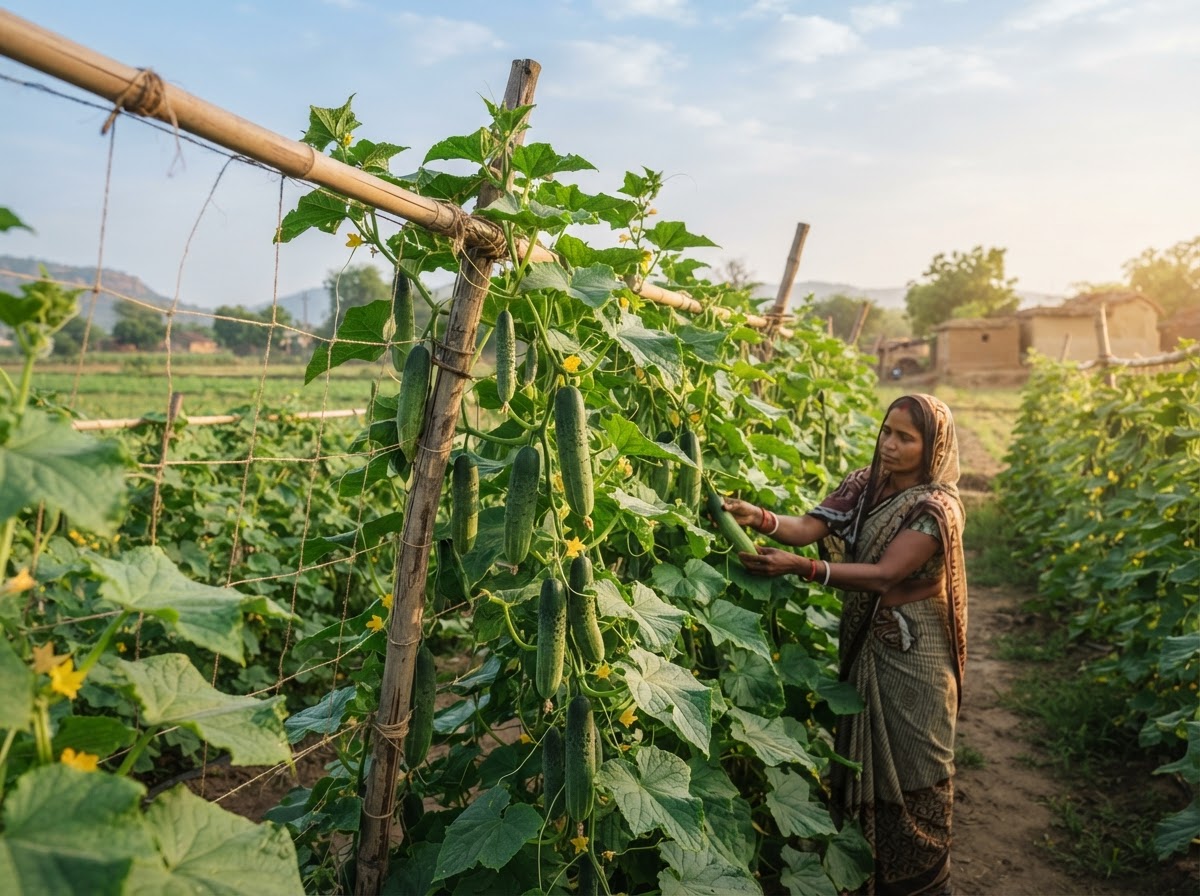
- Trellis or train the vines. NIPHM states that growing cucumber on bamboo support, trellising or in a greenhouse reduces downy mildew through lower leaf wetness and free air flow. It also keeps fruit clean and straight, which is what the buyer pays for. Erect the support by day 20, before the vines run.
- Weed early and shallow. The root system is shallow, so hand-weed rather than hoe deep. Two weedings — at 20–25 and 40–45 days — plus mulching usually carries the crop; our note on weed management practices covers mulching and pre-emergence options.
- Mulch. Straw or silver-black plastic mulch conserves moisture, suppresses weeds and keeps fruit off wet soil, which reduces rot at the fruit end.
- Protect the pollinators — or plant parthenocarpic types. Open-pollinated and hybrid cucumbers need bees for good fruit set; avoid spraying insecticide on open flowers and on flowering weeds around the field. Parthenocarpic poly-net house types such as Punjab Kheera-1 set fruit without pollination, which is one reason their yields are so much higher.
- Scout once a week, on a fixed day. Walk a diagonal, turn 20 leaves over, and look at the underside. Every spray decision in the next section depends on what you find there.
Diseases and Pests: Prevention First / रोग और कीट: पहले बचाव
Four problems account for most cucumber losses in India: downy mildew, powdery mildew, fruit fly and cucumber mosaic. Prevention is cheap; cure is not.
| Problem | What you see | Prevention |
|---|---|---|
| Downy mildew (Pseudoperonospora cubensis) | Angular yellow patches on the upper leaf, grey downy growth underneath, veins blighted; spreads fast in humid, wet weather | Raised beds, trellising for airflow, drip instead of overhead irrigation, crop rotation, resistant varieties |
| Powdery mildew (Sphaerotheca fuliginea) | White floury coating on leaves and soft stems; leaves yellow, curl and dry; fruit poorer in quality and flavour | Wider spacing, no excess nitrogen, remove infected debris, avoid dense shade |
| Fruit fly (Bactrocera cucurbitae) | Pin-prick punctures on tender fruit, maggots inside, rotting and drop; peaks in the rainy season | Cue-lure and yellow sticky traps, collect and destroy infested fruit twice a week, rake soil to expose pupae, harvest on time |
| Cucumber mosaic and other viruses | Mottled, distorted, puckered leaves; stunted vines; few fruit | Aphid control, virus-free seed, rogue out infected plants early, keep the field and bunds weed-free |
Two cultural habits do more than any spray. First, sanitation: burn or bury crop debris after the last picking, because infected debris carries downy mildew and anthracnose into the next crop. Second, rotation: do not follow cucumber with another cucurbit — bitter gourd, bottle gourd, watermelon, muskmelon — and do not plant it next to an old cucurbit field.
For the vector-borne problems, NIPHM’s package is specific: cue-lure traps for fruit fly at 10 per acre (plywood blocks soaked for 48 hours in an ethanol : cue-lure : DDVP solution of 8:2:1), yellow sticky traps at 10 per acre, and delta and blue traps at 5 per acre for whitefly and thrips respectively, followed by a neem spray. For the red pumpkin beetle, NIPHM allows a need-based spray of DDVP 76 EC at 627 ml/ha or trichlorfon 50 EC at 1.0 kg/ha. Kharif growers will recognise the wider pest pressure — our round-up of monsoon crop pests in India covers the season’s other visitors.
Treating a Diseased Crop / बीमार फसल का इलाज
Once symptoms are visible, the goal shifts from prevention to slowing the spread and protecting the fruit that is still on the vine. Work in this order.
1. Confirm the disease before you buy a chemical. Downy mildew and powdery mildew look nothing alike on the underside of a leaf, but both get treated with whatever is in the shop if the farmer does not check. Compare the leaf with the table above, and if you are unsure, take a sample to your KVK or the district horticulture office — most run a plant clinic free of charge.
2. Remove what cannot be saved. Pull and destroy severely infected plants and heavily infested fruit. Do not drop them on the bund.
3. Spray on the right target. For downy mildew, TNAU advises mancozeb or chlorothalonil at 2 g per litre sprayed twice at 10-day intervals, and warns that copper and sulphur dust are phytotoxic on cucumber — do not use them. NIPHM’s national package offers azoxystrobin 23% SC at 500 ml/ha or cymoxanil 8% + mancozeb 64% at 1.5 kg/ha in 500 litres of water for downy mildew, and carbendazim 50 WP at 300 g/ha in 600 litres of water, or thiophanate methyl 70 WP at 1430 g/ha, for powdery mildew and anthracnose.
4. Harvest the mature fruit before any spray. NIPHM’s instruction is explicit: before any chemical pesticide spray, all mature fruits should be harvested. Respect the pre-harvest interval printed on the label — cucumber is picked every second day, so a wrong interval puts residue in a salad vegetable.
5. Rotate the mode of action. Repeated use of the same fungicide selects resistant mildew. Alternate between groups across the season, and never tank-mix products the label does not allow.
6. Correct the cause, not only the symptom. Mildew on a well-drained, trellised, drip-irrigated crop is a much smaller problem than mildew in a flood-irrigated, dense canopy. If you spray three times and the disease returns in a week, the field layout is the real issue.
Reading the Plant: Healthy vs Problem Symptoms / पौधा क्या कह रहा है: स्वस्थ और बीमार पौधे की पहचान
A cucumber vine tells you its condition long before the fruit does. Learn these markers and you will catch most problems a week earlier.
A healthy plant has vines that grow 5–8 cm a day in warm weather, dark green leaves held flat to the sun with clean undersides, a flower at nearly every node once vining is over, and fruit that fills out evenly and stays dark green. New growth at the tip is slightly paler than mature leaves — that is normal, not a deficiency.
A plant in trouble shows specific signatures. Yellowing between the veins on older leaves first points to magnesium; yellowing on new leaves points to iron or a waterlogged root. Pale, oversized, floppy leaf with few female flowers means too much nitrogen. Wilting at midday that recovers by evening is a water shortfall; wilting that does not recover is a root or collar problem. Bitter fruit usually follows a water-stress or heat spell during fruit development. Hard, deformed fruit with a bent tip is a pollination failure — check bee activity, or switch to a parthenocarpic type. Small holes with a brown weep on the fruit is fruit fly, and it will not improve on the vine.
Harvesting / कटाई
PAU’s harvest rule is the one to remember: pick the fruit young and tender, while the seeds inside are still soft, and before the colour turns from green to yellow. A yellowing cucumber is past edible maturity and will not be bought at a good price.
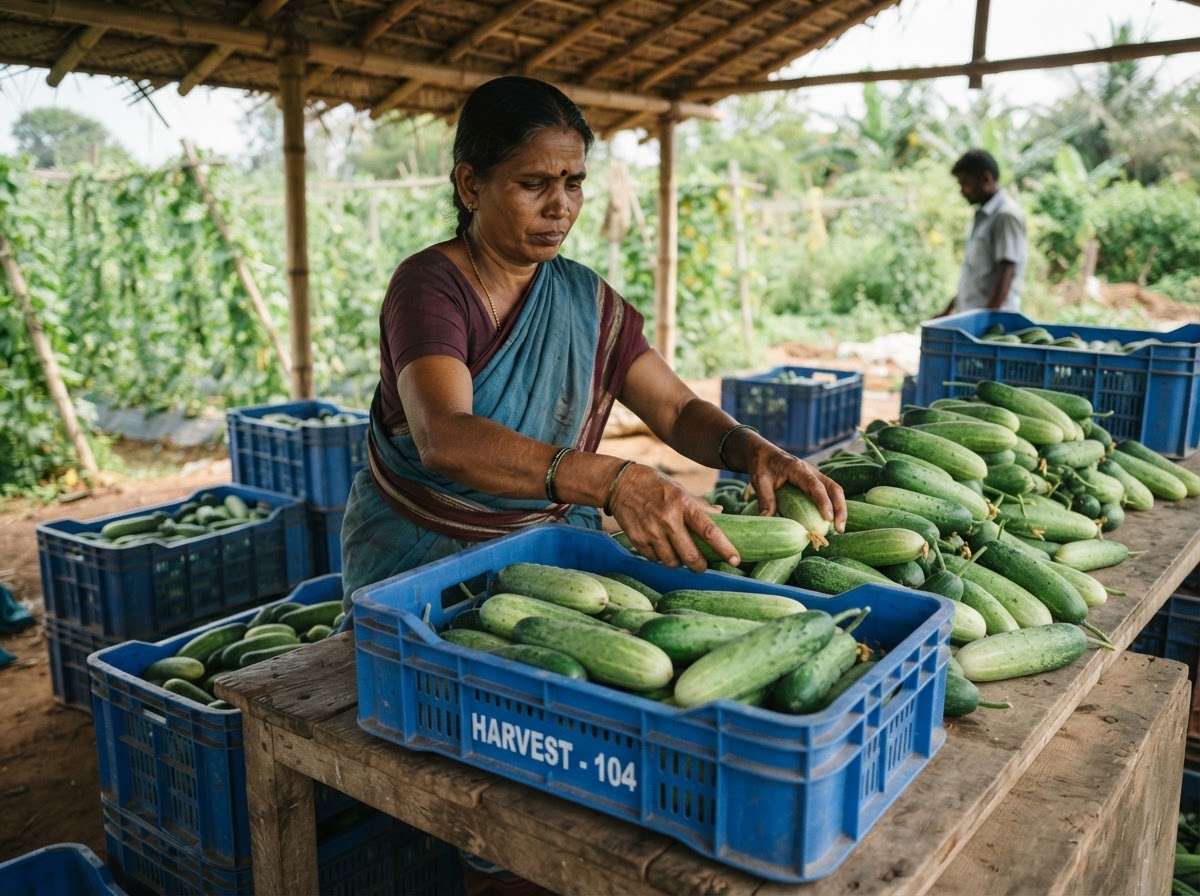
Timing follows the season and the type. TNAU puts the first picking at about 45 days after sowing and expects 8–10 pickings over 80–90 days; PAU gives 68 days from sowing to first harvest for Punjab Naveen in the open field, and 45–60 days for poly-net house crops depending on the sowing month. In practice, once picking starts, go through the field every second day — fruit sizes up fast in warm weather and an over-mature fruit left on the vine also pulls the plant’s energy away from the next set.
Harvest in the cool of the morning, with a sharp knife or secateurs, leaving a short stalk on the fruit. Do not pull or twist — you will tear the vine. Use shallow crates rather than gunny sacks; cucumber bruises and a bruised fruit rots within two days. Grade as you pick: uniform, straight, dark green fruit for the fresh market, and everything else separately for local sale or processing.
After Harvest: Grading, Storage and Selling / कटाई के बाद: ग्रेडिंग, भंडारण और बिक्री
Cucumber is one of the most perishable vegetables in the mandi, and post-harvest handling is where a good crop turns into a poor price.
Cool it down. Remove field heat immediately — move crates into shade, and if you have a cold room, precool with forced air. The USDA Agriculture Handbook 66 recommends storage at 10–12.5°C with about 95 per cent relative humidity, where quality holds for under 14 days. Cucumber is chilling-sensitive: below 10°C, pitting, water-soaked flesh and decay appear within two to three days, and at 15°C the fruit yellows quickly. Keep cucumber away from ripening fruit such as banana or mango — it is very sensitive to ethylene, which speeds yellowing and decay.
Grade and pack for the buyer you have. There is no cucumber-specific AGMARK grade in general mandi use, so lots are judged by eye: length, straightness, colour and freedom from blemish. Straight, evenly cylindrical, dark green fruit fetches the best rate. Pack in ventilated crates, do not stack more than four high, and shade the load during transport.
Choose the channel deliberately. Local mandi, commission agent, direct supply to a hotel or restaurant, or an e-NAM-linked mandi — each has a different price and a different payment risk. Registering on e-NAM lets you see bids from other mandis before you commit your load.
Value-add the surplus. Oversized or slightly blemished fruit is not waste — it is pickle, salad-cut or dehydration material, and a micro-processing unit can be part-financed under PMFME. The same logic applies to crop planning: cucumber fits neatly into a rotation before or after tomato or okra, provided the two crops are not both cucurbits or both carrying the same virus pressure. If you plan to move into poly-net house production, capital subsidy for protected cultivation structures is available under MIDH — confirm the current rate and eligibility with your state horticulture department before you build.
Key Takeaways / मुख्य बातें
- Cucumber is an 80–90 day crop with the first picking around 45 days after sowing — quick money, but no room for a late correction.
- Warm weather and well-drained sandy loam at pH 6.5–7.5; raised beds and trellising are disease control, not decoration.
- Treat seed before sowing (TNAU: Trichoderma viride 4 g/kg or Pseudomonas 10 g/kg) and never sow deeper than 5–7 cm.
- Keep the fertiliser modest and split — PAU’s 40:20:20 kg N:P₂O₅:K₂O per acre, banded at sowing and top-dressed twice, with full FYM.
- Downy mildew and fruit fly are the two losses to plan against; spray only after scouting, harvest mature fruit before every spray, and respect the pre-harvest interval.
- Pick every second day before the fruit yellows, cool it to 10–12.5°C, and keep it away from ripening fruit.
Sources / स्रोत
- Tamil Nadu Agricultural University, Agritech Portal — Horticulture: Vegetables: Cucumber. agritech.tnau.ac.in
- Punjab Agricultural University — Package of Practices for Cultivation of Vegetables (Cucumber chapter). pau.edu
- Kerala Agricultural University — Package of Practices Recommendations: Crops (Vegetables), and State Horticulture Mission Kerala, Cucumber. pop.kau.in
- NIPHM / NRI-IPM — Validated Integrated Pest Management Strategies for Major Vegetable Crops. nriipm.res.in
- ICAR — Swarna Sheetal: cucumber variety for kharif season, Indian Horticulture. epubs.icar.org.in
- USDA Agriculture Handbook 66, Commercial Storage of Fruits, Vegetables and Florist and Nursery Stocks — cucumber storage conditions, as summarised in AroWest’s cucumber crop note. arowest.com


Leave a Reply