
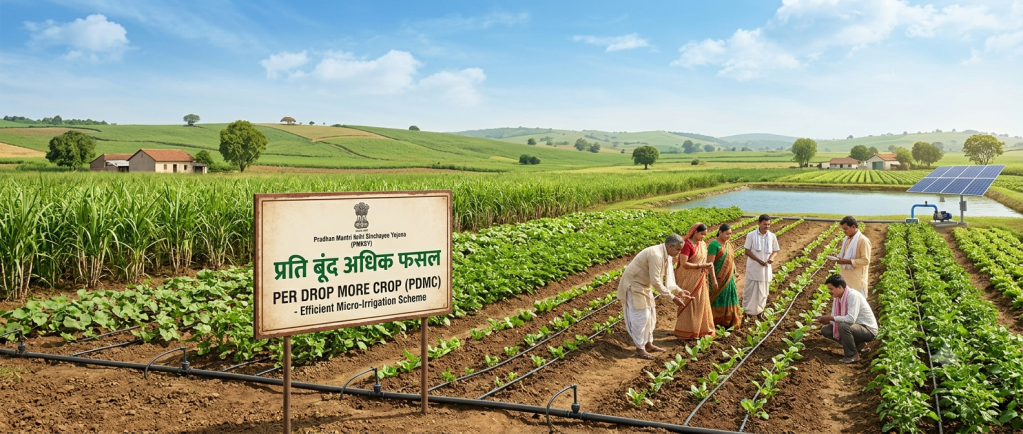
Water scarcity and changing rainfall patterns present significant challenges for modern agriculture. For decades, traditional surface flood irrigation has dominated farming landscapes, often leading to substantial water loss through evaporation, runoff, and deep percolation.
To address water management challenges and boost agricultural productivity, the Government of India launched “Per Drop More Crop” (PDMC). Designed to promote micro-irrigation technologies, this Centrally Sponsored Scheme aims to transform water usage across Indian farms and among top promoted schemes to reserve water.
What is Per Drop More Crop (PDMC)?
Per Drop More Crop (PDMC) was launched in 2015–16 as a key component of the broader Pradhan Mantri Krishi Sinchayee Yojana (PMKSY). Originally managed under PMKSY, the scheme was subsequently aligned under the Rashtriya Krishi Vikas Yojana (RKVY) framework to streamline agricultural development funds.
The core objective of PDMC is straightforward: maximize water-use efficiency at the farm level by encouraging the adoption of precision irrigation systems like drip and sprinkler technologies.
Key Objectives
- Enhance Water Productivity: Increase crop yield per unit of water consumed.
- Expand Coverage: Extend micro-irrigation systems to rainfed, water-stressed, and under-irrigated regions.
- Promote Fertigation: Deliver fertilizers directly through irrigation networks to reduce nutrient leaching and input costs.
- Energy Efficiency: Reduce overall electricity and diesel consumption required to pump heavy volumes of water.
- Soil Health: Prevent soil erosion, waterlogging, and salinity degradation caused by flood irrigation.
Core Technologies Funded Under PDMC
PDMC heavily subsidizes two primary precision farming setups tailored to different soil types, topographies, and crop choices:
1. Drip Irrigation Systems
Drip irrigation applies water drop-by-drop directly into the root zone via emitters connected to a network of plastic pipes.
- Best Suited For: Wide-spaced row crops, sugarcane, cotton, fruit orchards, vegetables, and commercial crops.
- Water Savings: Up to 40% to 70% higher efficiency compared to traditional flooding.
- Fertigation Potential: Highly effective for applying liquid fertilizers directly to active roots.
2. Sprinkler Irrigation Systems
Sprinkler systems spray water under pressure through nozzles, simulating natural rainfall across the field area.
- Best Suited For: Close-spaced field crops like pulses, oilseeds, wheat, groundnut, and uneven terrains.
- Water Savings: Saves roughly 30% to 50% water compared to channel/flood methods.
- Versatility: Ideal for rolling terrains where field leveling is expensive or impractical.
Financial Assistance & Subsidy Structure
To lower the barrier to adoption, PDMC offers financial support to farmers purchasing certified micro-irrigation equipment. Subsidy percentages are calculated based on landholding size and regional demographics:
| Farmer Category | Financial Assistance / Subsidy Share |
| Small & Marginal Farmers (< 2 Hectares) | Up to 55% of the standard benchmark cost |
| Other / Large Farmers (> 2 Hectares) | Up to 45% of the standard benchmark cost |
Note: Individual states may offer additional top-up subsidies through state-specific agricultural funds, bringing the net cost even lower for smallholders in certain areas.
Institutional Structure: Funding Allocation
PDMC operates as a Centrally Sponsored Scheme with a cost-sharing ratio between the Central and State governments:
┌─────────────────────────────────────────────────────────────┐│ FUNDING DISTRIBUTION PATTERN │├─────────────────────────────────────────────────────────────┤│ General / Plain States ││ [ Central Govt: 60% ] ─────────────── [ State Govt: 40% ] ││ ││ Himalayan & North-Eastern States ││ [ Central Govt: 90% ] ────────────── [ State Govt: 10% ] ││ ││ Union Territories (UTs) ││ [ Central Govt: 100% ] │└─────────────────────────────────────────────────────────────┘
Impact and On-Ground Benefits
Implementing micro-irrigation through PDMC offers several tangible advantages for agricultural producers:
- Lower Input Costs: Targeted water delivery discourages weed growth between crop rows, cutting labor and herbicide costs.
- Fertilizer Efficiency: Combining fertilizer with drip irrigation (fertigation) improves nutrient uptake efficiency by up to 25%–30%.
- Increased Crop Yields: Consistent moisture balance prevents crop stress, leading to higher quality produce and increased harvest volumes.
- Expanded Farm Area: Water saved on primary plots can be redirected to cultivate additional acreage during drier seasons.
How Farmers Can Apply for PDMC
Eligibility criteria and application steps generally follow a standardized workflow across states:
1. Eligibility
- Open to individual farmers, self-help groups (SHGs), cooperative societies, and producer companies.
- Land ownership documents (or long-term lease agreements) are required.
2. Key Required Documents
- Aadhaar Card (for identity verification).
- Land record proof (7/12 extract, Khasra/Khatauni, or lease deed).
- Bank account details linked to Aadhaar (for Direct Benefit Transfer).
- Passport-sized photographs.
3. Application Process
- Online Registration: Visit the respective State Agriculture Department portal or the national PMKSY/PDMC portal.
- Vendor Selection: Choose an empanelled, certified micro-irrigation manufacturer or registered dealer.
- Field Survey: An agricultural officer or technical team conducts an initial site survey to measure plot dimensions and source water capacity.
- Installation & Inspection: Once approved, the equipment is installed on-site, followed by physical verification and geotagging.
- Subsidy Release: The subsidy amount is credited directly via Direct Benefit Transfer (DBT) to the farmer or the designated empanelled supplier, depending on state guidelines.
To apply for the Per Drop More Crop (PDMC) scheme under the Pradhan Mantri Krishi Sinchayee Yojana (PMKSY), implementation and subsidy distribution are handled through Direct Benefit Transfer (DBT) on state-specific agriculture/horticulture portals.
1. Specific Eligibility Criteria
To qualify for financial assistance under the PDMC scheme, applicants must meet the following criteria:
- Applicant Eligibility: Individual farmers, tenant farmers/lessees (with registered lease agreements), Self-Help Groups (SHGs), Cooperative Societies, and Farmer Producer Organizations (FPOs).
- Land Ownership & Ceiling: Subsidy benefit is capped at an overall land ceiling of 5 hectares (12.5 acres) per beneficiary.
- Water Source: The farm plot must have an operational and assured water source (e.g., tube well, open well, farm pond, or canal connection).
- Equipment Certification: Systems (drip or sprinkler) must be purchased exclusively from BIS-marked (Bureau of Indian Standards) equipment manufacturers empanelled by the state.
- Cooling-off Period: Farmers who have previously availed of a government micro-irrigation subsidy for a specific plot are generally ineligible for re-application on the same land for 7–10 years.
2. Step-by-Step Application Process
1.Online Registration & Profile Creation:
Visit your state’s Agriculture/Horticulture DBT portal. Register using your Aadhaar number, mobile number, and basic personal details. Ensure your Aadhaar is linked to your active bank account for DBT.
2.Document Upload & Application Submission:
Fill out the online PMKSY/PDMC application form. Upload scanned copies of required documents:
- Aadhaar Card
- Land Ownership Records (7/12 extract, Khasra/Khatauni, or registered lease deed)
- Bank Account Passbook (showing IFSC code)
- Caste/Category Certificate (if claiming SC/ST preferential subsidy rates)
- Passport-sized photograph
3.Empanelled Vendor Selection & Cost Estimation:
Select an officially approved micro-irrigation supplier/vendor from the portal’s empanelled list. The vendor will visit your field to survey plot dimensions, map the water source, and generate a technical design and official cost quotation.
4.Pre-Sanction Approval:
The Block or District Agriculture Officer reviews your application, land records, and vendor quotation. Upon verification, an official Pre-Sanction / Work Order is issued through the portal.
5.System Installation & Geo-Tagged Verification:
The vendor installs the drip or sprinkler system. An agricultural inspector performs a joint physical site inspection to verify the installation and record geotagged photographs of the operational system.
6.Subsidy Release via Direct Benefit Transfer (DBT):
After final inspection approval, the government subsidy (up to 55% for small/marginal farmers and 45% for others) is credited directly to your bank account or directly paid to the vendor upon your written authorization.
3. Key Online Portals for PDMC Application
Applications are processed via official state portals (with central coordination via Ministry of Agriculture):
| Region / Portal Type | Official Portal Name | Website Link |
| National / Central Portal | PDMC Central Monitoring System | pdmc.da.gov.in |
| Maharashtra | MahaDBT Farmer Portal | agridbtworkflow.mahaonline.gov.in |
| Gujarat | Gujarat Green Revolution Company (GGRC) | portal.ggrc.co.in |
| Rajasthan | RajKisan Saathi Portal | rajkisan.rajasthan.gov.in |
| Uttar Pradesh | UP Micro Irrigation Portal (UPMIP) | upmip.in |
| Haryana | MICADA Portal | micada.haryana.gov.in |
| Punjab | Tupka Sinchayee Portal | tupkasinchayee.punjab.gov.in |
| Madhya Pradesh | MP FSTS / DBT Portal | mpfsts.mp.gov.in |
| Bihar | Horticulture Bihar Portal | horticulture.bihar.gov.in |
| Tamil Nadu | TN Horticulture Portal | tnhorticulture.tn.gov.in |
Offline Alternative: Farmers who prefer offline registration or live in areas with low connectivity can submit physical applications at their nearest Gram Panchayat, Block Agriculture Office, or Common Service Center (CSC). Alternatively, you can call the toll-free Kisan Call Centre at 1800-180-1551 for assistance.
 KrishiCenter
Leave a comment