
भारत में मटर की खेती: बीज से फली तुड़ाई तक संपूर्ण गाइड – Garden pea (Pisum sativum / मटर) is the vegetable that defines the Indian winter kitchen, and it is also one of the most rewarding cool-season crops a farmer can sow. It matures in 55 to 110 days depending on the variety, it fixes its own nitrogen when inoculated with the right Rhizobium culture, it fits neatly into a rice fallow or a gap before wheat and potato, and green pods fetch a steady premium from November to February.
This guide walks through the entire lifecycle — soil and climate, the sowing window, seed rate and seed treatment, manure and fertilizer with exact application method, irrigation at each stage, growth-phase care, the diseases and pests that actually cost money in a pea field, how to read a healthy plant against a mature one, harvesting, and what to do with the crop after harvest. Every figure below is attributed to an ICAR institute, a state agricultural university, the National Horticulture Board, or a state package of practices.
Why Pea Belongs in the Rabi Plan / रबी योजना में मटर क्यों रखें
Pea is a legume, so it leaves nitrogen behind for the next crop instead of mining the soil. With Rhizobium leguminosarum inoculation, nodulation starts early and the crop’s nitrogen requirement falls sharply — Punjab Agricultural University recommends cutting the basal nitrogen dose where inoculation is done, and Assam Agricultural University’s package halves urea from 45 kg to 22 kg per hectare when culture is used.
Green pod yields vary widely with duration and management. Early varieties give roughly 2.5–4.0 tonnes per hectare of green pods, mid-season types 6.0–7.5 t/ha and late main-season types 8.0–10.0 t/ha, according to Tamil Nadu Agricultural University’s horticulture course material. At the top end, ICAR–Indian Institute of Vegetable Research (IIVR), Varanasi, records 110–120 quintals per hectare of green pods for its variety Kashi Nandini, with a seed yield of 15–16 q/ha.
The crop also leaves a haulm (dried vines) that is genuine fodder, which is why pea fits well into a mixed farm. As a rabi season crop, it slots into the same window as wheat and potato, so the choice between them is really a choice about water, market and labour at harvest.
Climate and Soil / जलवायु और मिट्टी
Pea is a cool-season crop. ICAR-IIVR puts the optimal temperature at 10–18 °C, with germination best around 20–25 °C. ICAR’s extension bulletin on cultivating garden pea in Punjab notes that seeds will germinate even at 4–5 °C, but severe frost at flowering and pod formation damages flowers and young pods, while temperatures above 27 °C shorten the crop’s life and disrupt pollination. High heat at pod fill also converts the sugars in the seed to starch and hemicellulose, which is exactly why late-sown peas taste floury.
For soil, choose a well-drained loam or sandy loam with a pH of 6.0–7.5 (ICAR-IIVR). Heavy clay and any field that holds water after rain are the wrong choice: waterlogging in a pea field invites Fusarium wilt and root rots, and the crop will not recover. Prepare a fine tilth with two to three ploughings followed by harrowing and planking, and open drainage channels before sowing rather than after the first heavy rain.
Sowing Window / बुवाई का समय
For the plains rabi crop, ICAR’s Punjab bulletin is specific: sow between mid-October and mid-November, and deliberately avoid September sowing, which raises the risk of pea wilt. Early varieties can go in from early October, mid-season varieties in November. In the hills, the National Horticulture Board records a first crop sown from mid-March to end-May and a second crop in autumn.
The penalty for sowing late is cumulative. A Punjab Agricultural University trial on single-harvest pea found that the 20 December sowing gave the fewest pods per plant and the lowest pod yield, because pod development coincided with high temperature and low humidity; the best treatment was 5 November sowing. Late crops also run straight into powdery mildew season.
Varieties Worth Sowing / बुवाई योग्य किस्में
Pick by market, not by habit. An early variety reaches the market first and earns the early premium; a main-season variety gives more weight per hectare.
| Variety | Source | Duration | Green pod yield | Notes |
|---|---|---|---|---|
| Arkel | IARI introduction, widely notified | 50–55 days to harvest | About 7.5 t/ha | Dwarf, deep green pods about 8 cm, good for fresh market and dehydration; susceptible to collar rot at high temperature |
| Kashi Nandini (VRP-5) | ICAR-IIVR, Varanasi; notified 25 April 2006 | 55–57 days to first harvest | 110–120 q/ha | Erect, determinate, 8–10 pods per plant, 43–45% shelling, tolerant to leaf miner and pod borer; recommended for UP, Punjab, Bihar, Jharkhand, Uttarakhand, HP, J&K, Karnataka, TN, Kerala |
| Kashi Udai, Kashi Mukti | ICAR-IIVR | Main season | High | IIVR’s main-season pea line-up alongside Kashi Nandini; Kashi Udai gave the highest seed yield in an IIVR sowing-date trial |
| Azad P-1 (Azad Matar), Azad P-3 | CSAUAT, Kanpur | Early to mid | 8–12 t/ha | Long, sweet, dark-green pods; the Azad P-2 type is noted as resistant to powdery mildew |
| Rachna | CSAUAT, Kanpur | 85–90 days | 100–120 q/ha | Powdery-mildew-resistant mid-season pea for green pods or dry seed |
| VL Ageti (VL-7) | ICAR-VPKAS, Almora | Hill season | High | Early dwarf type for Himachal Pradesh and Uttarakhand hills |
Note that published yields differ between sources: IIVR’s release figures and the national check-list do not always agree, so plan your economics on the lower number and treat the higher one as upside.
Seed Rate, Seed Treatment and Sowing Method / बीज दर, बीजोपचार और बुवाई विधि
Seed rate depends on seed size, spacing and season. PAU recommends 45 kg per acre for early-maturing varieties and 30 kg per acre for main-season varieties; ICAR-IIVR gives a broader band of 70–100 kg per hectare. Bold-seeded varieties need more seed to hit the same plant population.
Seed treatment is the cheapest yield gain in this crop and there are two components:
- Rhizobium culture. Treat seed with Rhizobium leguminosarum before sowing — one packet is sufficient for one acre. Mix the culture thoroughly in about half a litre of water and rub the suspension gently over the seed until every seed is coated, then shade-dry before sowing (PAU). Farmers can source the culture from the Department of Microbiology at PAU, Ludhiana, or from the local KVK.
- Fungicide or biocontrol. The National Horticulture Board recommends carbendazim at 2 g per kg of seed to protect seedlings from wilt; Assam’s package recommends carboxin at 2 g/kg. Where chemical-free management is preferred, seed treatment with Trichoderma or Pseudomonas fluorescens is the standard biological route. Many farmers also dust treated seed with a thin layer of fine ash before sowing to reduce sticking in the drill. More on the technique is in our guide to seed selection and seed treatment.
Sow in lines at 30 cm × 7.5 cm for early varieties and 30 cm × 10 cm for main-season varieties, at a depth of 3–5 cm (PAU, ICAR-IIVR). Sowing can be done on flat beds or on ridges and furrows; on ridges, dibble the seed on either side of the furrow. For larger areas a seed-cum-fertilizer drill covers an acre in about an hour. The principles behind these choices are covered in our piece on sowing methods.
Manure and Fertilizer: What to Apply and How / खाद एवं उर्वरक: क्या दें और कैसे दें
Because pea fixes nitrogen, the fertilizer plan is phosphorus-led, not nitrogen-led. Get a soil test first — the Soil Health Card report tells you whether your field is already high in phosphorus and whether potash or sulphur is short.
Organic matter. Apply 8 tonnes of well-rotted farmyard manure per acre (roughly 20 t/ha) and incorporate it during land preparation, as PAU recommends; ICAR-IIVR suggests 15–20 t/ha. This is not decoration — it improves water-holding in light soils and reduces the wilt pressure that builds in continuously cropped pea fields.
Inorganic dose. Two widely used recommendations:
- PAU (per acre): 20 kg N (about 45 kg urea) and 25 kg P₂O₅ (about 155 kg single super phosphate), applied before sowing.
- ICAR-IIVR (per hectare): 20 kg N, 60 kg P₂O₅ and 40 kg K₂O, with FYM at 15–20 t/ha. IIVR’s variety card for Kashi Nandini lists 40 kg N, 60 kg P and 50 kg K per hectare.
Where a farmer prefers DAP, 100 kg per hectare of DAP can replace the urea and SSP combination in non-inoculated crops, per Assam Agricultural University’s package; where Rhizobium is used, nitrogen drops to about 10 kg/ha and phosphorus rises to 46 kg/ha in that package.
How to apply. Place the fertilizer in bands about 7–8 cm away from the seed row and 2.5 cm deeper than the seed (KVK recommendation). Never drill urea in direct contact with germinating seed — the salt load burns the emerging radicle. The entire phosphorus dose goes as a basal application at sowing because pea has no time for a later correction; potash, where soils are deficient, also goes basal. Apply the integrated nutrient management principle here: FYM plus culture plus a soil-test-based mineral dose beats any single input.
Irrigation: Timing Matters More Than Volume / सिंचाई: मात्रा से अधिक समय मायने रखता है
A pre-sowing irrigation is essential for even germination — this is the single most common omission in rainfed pea. The first irrigation after sowing comes about 15 days later. After that, two stages decide the yield: flowering and pod formation. Water stress at flowering causes flower drop; water stress at pod fill gives shrivelled, light pods.
PAU’s guidance is 3–4 irrigations in total, depending on soil type and weather; KVK packages suggest light irrigations at 10–15 day intervals. In a normal north Indian winter that means roughly one irrigation at the pre-flowering stage and one or two during pod development. Pea can also be grown on residual moisture in rice fallows where the soil profile is charged, but only if sowing is done into moist soil. A simple field check farmers use is to press a handful of soil at 10 cm depth — if it crumbles instead of holding a ball, irrigation is overdue. Where water is scarce, drip or sprinkler layouts supported under Per Drop More Crop are worth evaluating.
Two cautions. First, do not flood the field; standing water for even a day in heavy soil sets off root rot and wilt. Second, irrigate in the morning on a sunny day during winter, not in the evening, so the canopy dries before the cold night — wet foliage through the night is how Ascochyta blight and downy mildew get started. Where water is scarce, drip or sprinkler layouts supported under Per Drop More Crop are worth evaluating.
Growth-Phase Care / वृद्धि अवस्था की देखभाल
0–25 days: establishment. Check germination a week after sowing and fill gaps where a crust has formed. Birds pull sprouting peas in small plots; a light scarecrow or bird perches solve it. Do the first hoeing at about the fourth week.
25–45 days: vegetative growth and flowering. PAU recommends two hoeings, at the fourth and eighth week after germination — they remove weeds and break the soil crust for aeration. Where the crop is sown in close rows, hand weeding is impractical, so a pre-emergence herbicide plus one hand weeding is the workable combination (ICAR-IIVR). Our weed management guide covers the herbicide-to-hand-weeding balance. Avoid a nitrogen top-dress at this stage: extra nitrogen gives lush leaves and poor pod set. Tall main-season varieties benefit from light support — brushwood or sticks along the row — so pods do not touch wet soil.
45 days onwards: pod fill. Keep moisture steady, and start scouting weekly. This is when powdery mildew, rust, aphids and pod borer appear together. Spray in the evening, never in the morning during peak flowering, so that bee activity is not disrupted; pea is largely self-pollinated but insect visits still help pod set.
Diseases, Prevention and Treatment / रोग, रोकथाम और उपचार
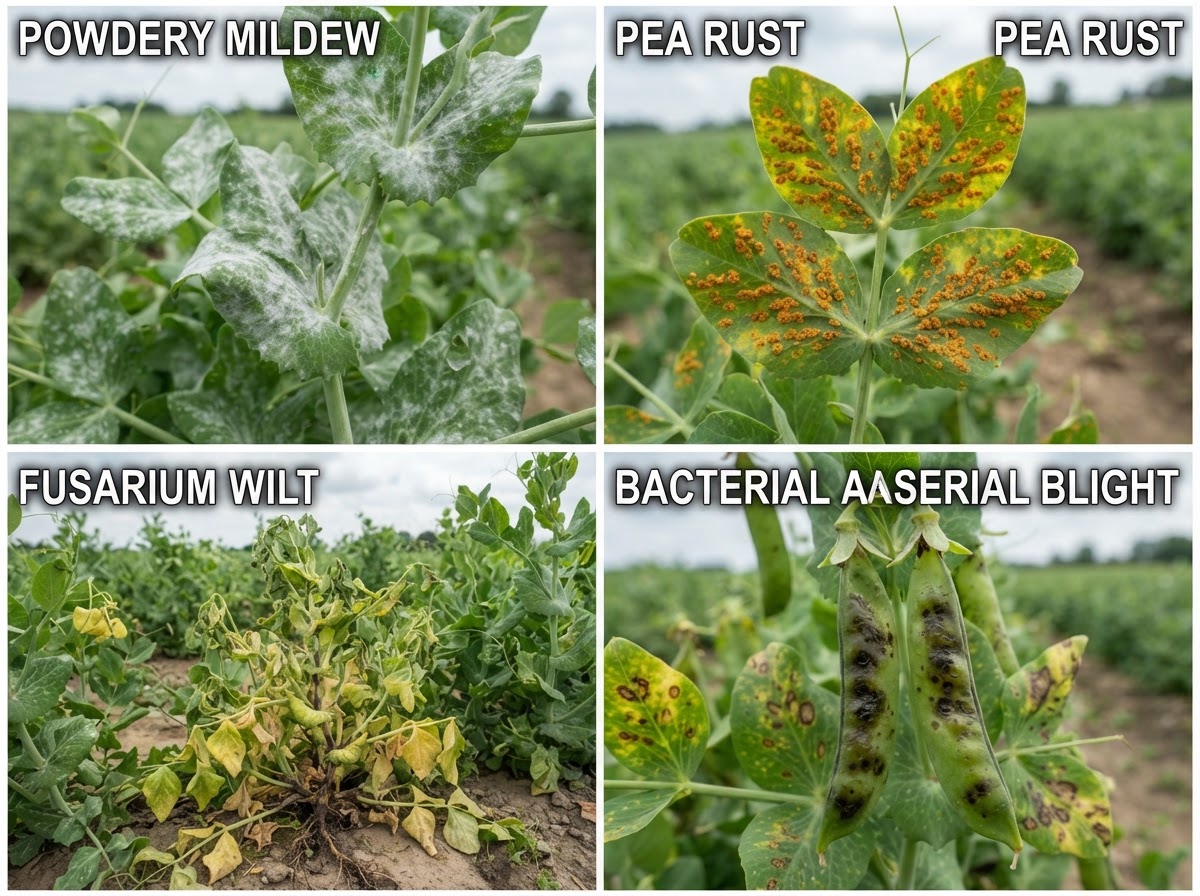
The general principles of diagnosis are in our piece on crop diseases, symptoms and management. In pea, four diseases account for most of the loss. Walking the field weekly and checking both the upper and lower leaf surfaces catches most outbreaks early, before they spread across the plot.
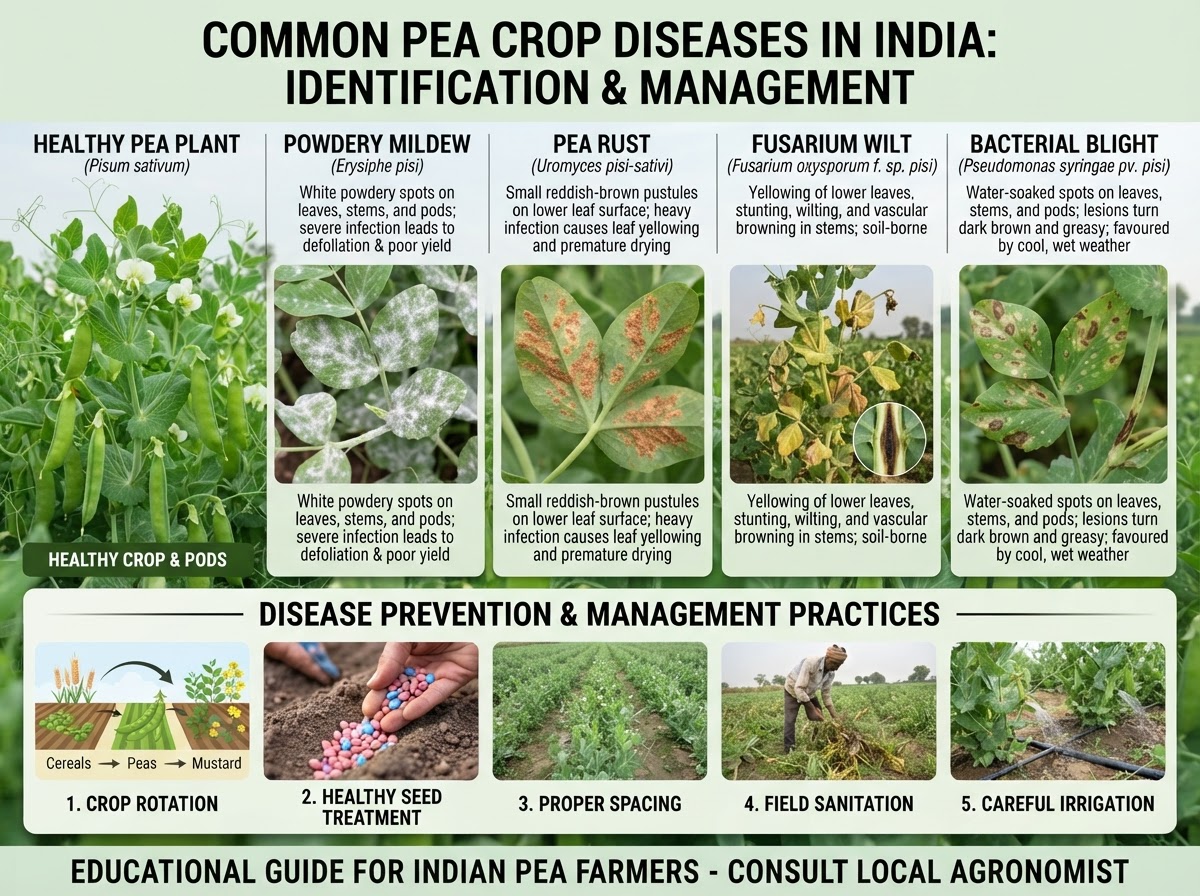
Powdery mildew (Erysiphe polygoni). White powdery patches appear first on leaves, then on tendrils, stems and pods, and in severe cases the whole plant is coated. ICAR’s plant pathology review records up to 80% yield loss in field pea from this disease, and it is induced by dry weather — which is why the late-sown crop suffers most. Prevention: sow on time, avoid late planting, destroy crop residue after harvest, and choose tolerant varieties such as Rachna or the Azad types. Treatment: spray wettable sulphur at 0.2% (Sulfex at 3 kg/ha in about 1,000 litres of water) at first appearance, repeat after 14 days, and a third time only if needed (Sikkim agriculture department); ICAR lists dinocap 0.1%, tridemorph 0.1% or wettable sulphur 0.2% at 10–15 day intervals. Sulphur dusting at 25 kg/ha is an option in dry weather.
Rust (Uromyces fabae). Creamy-white to orange-brown pustules on both leaf surfaces, most on lower leaves, spreading to stems and pods, followed by premature defoliation. High humidity with 20–22 °C favours it, and recorded losses range from 50% to almost total crop failure in severe years (ICAR). Prevention: field sanitation, tolerant varieties such as Pant Pea 347 or HFP 1428. Treatment: preventive sprays of mancozeb 0.25%, propiconazole 0.1% or hexaconazole 0.1% at early disease development (ICAR).
Fusarium wilt (Fusarium oxysporum f. sp. pisi). Plants droop and die suddenly, leaves yellow and drop, pod formation stops, and a cut stem shows a dark brown band around the vascular tissue. Diseased plants pull out more easily than healthy ones because the roots are rotted — a useful field test. The fungus survives in soil for years. Prevention: long rotation with non-legume crops for at least two to three years, avoid early September sowing, use wilt-resistant varieties, and treat seed with carbendazim at 2 g/kg. Treatment: soil drenching with copper oxychloride 0.25% around affected patches, and remove and destroy wilted plants rather than ploughing them in.
Bacterial blight (Pseudomonas syringae pv. pisi) and Ascochyta blight. Blight shows water-soaked lesions on stems, leaves and pods, with reddish-brown spots with a translucent centre, and a white to cream slimy ooze on the lesions in humid, cold weather. There is no effective chemical cure; the answer is certified disease-free seed, rotation, and removal of infected debris. Ascochyta blight responds to seed treatment followed by a carbendazim spray at 0.1% at flowering in the IPM module tested at Kullu.
A word on doses. All the fungicide rates above are extension or research recommendations, not a prescription for your field. Confirm the product and dose with your KVK or state package of practices, follow the label, and respect the pre-harvest interval — you are picking green pods for fresh sale, often within days of a spray.
Insect Pests and Integrated Control / कीट और एकीकृत नियंत्रण
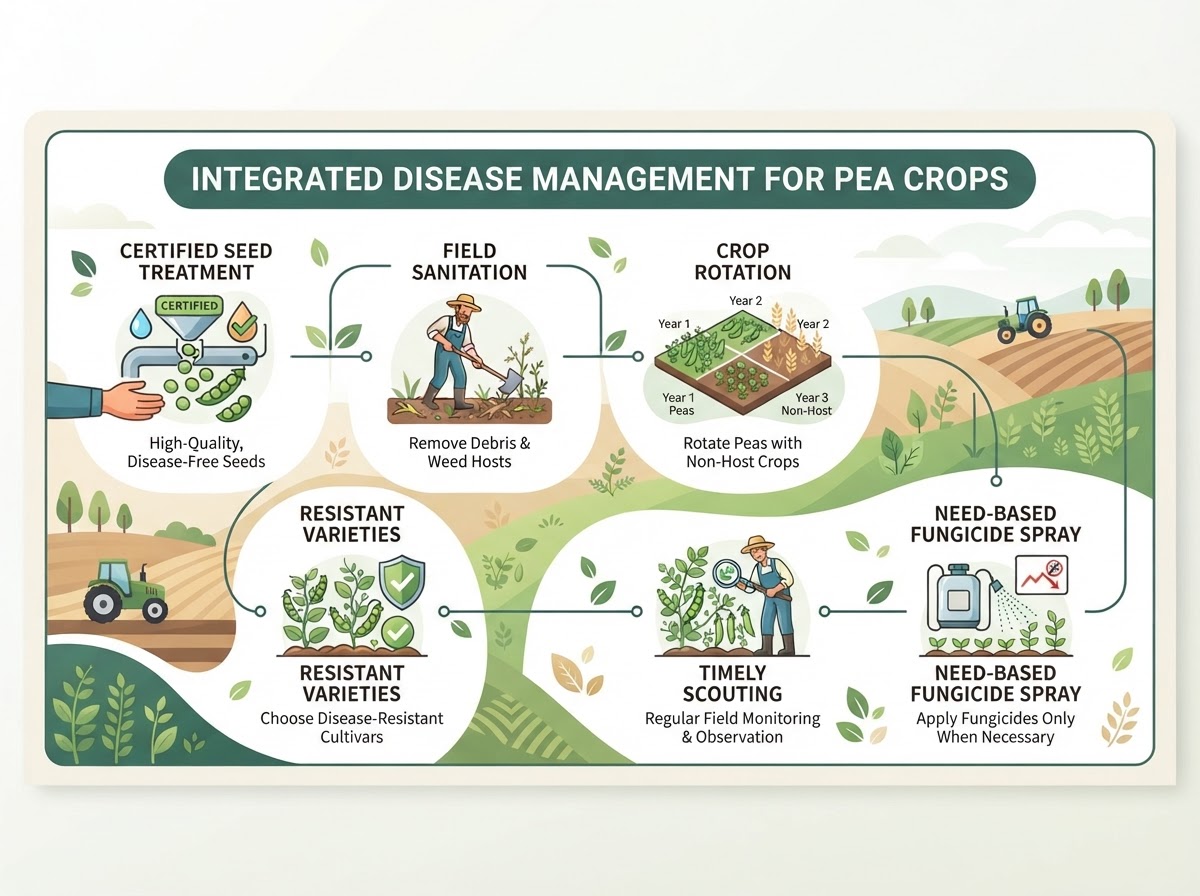
Scouting, not spraying, should drive pest decisions. The standard integrated pest management package for pea, as documented in BHU field trials, combines pheromone traps, yellow sticky traps and neem-based sprays with chemicals only when counts rise.
- Pea aphid (Acyrthosiphon pisum) — green nymphs and adults suck sap on young growth from January onwards; plants stunt, pods curl and fail to fill. Imidacloprid 0.005% was the most effective treatment in the BHU comparison, followed by thiamethoxam 0.01%, Verticillium lecanii and azadirachtin. Conserve ladybirds and syrphid flies; they often hold aphids down without a spray.
- Pod borer (Helicoverpa spp., Etiella zinckenella) — caterpillars bore into green pods and eat the seed, worst near maturity. Install 4–5 pheromone traps per acre at flowering, and hand-pick larvae in early infestation. Spray at flowering to early pod formation when young larvae are first seen.
- Leaf miner (Chromatomyia horticola) — serpentine silvery mines in tender leaves; mined leaves turn pale, distort and dry. Yellow sticky traps at 10–12 per acre catch adults; Kashi Nandini carries tolerance.
- Thrips and stem fly — thrips rasp and silver the foliage; stem fly maggots bore the stem and wilt the plant. Seed treatment and removal of infested plants are the practical first steps.
Bird perches at 15–20 per acre give free caterpillar control. When a chemical is unavoidable, spray in the evening, cover the underside of leaves, and rotate modes of action. Application technique is covered in agrochemical application methods, and the national programme framework in the National IPM Programme.
Healthy Plant vs Mature Plant: What to Look For / स्वस्थ और परिपक्व पौधे के लक्षण
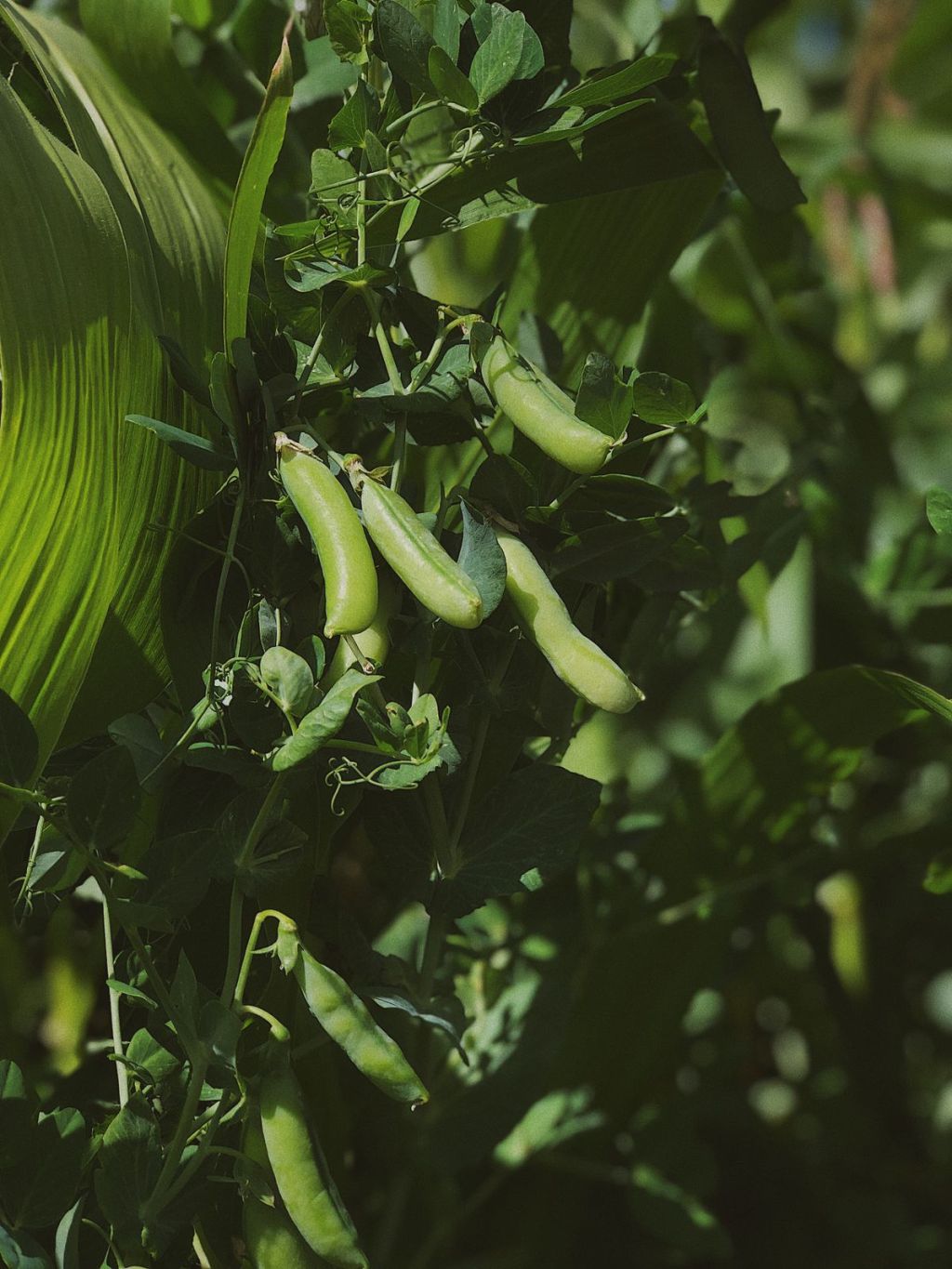
A healthy pea plant grows upright and evenly across the row, with dark green leaves carrying a faint waxy bloom, no yellowing of the lower leaves before pod fill, and clean white flowers opening about a month after sowing (Kashi Nandini flowers first at roughly 32 days). New pods appear steadily at successive nodes, the growing tip stays green, and the stem is free of brown streaks. Bees working the flowers in mid-morning are a good sign that the canopy is open and the spray programme has not scared off pollinators.
A crop ready to pick looks different: pods are fully filled and the seeds bulge visibly through the pod wall but still feel tender when pressed, the pod colour shifts from dark green to light green, and the pod snaps cleanly when bent. Sugar content falls and the seed coat toughens as the pod matures, which is why a pod left two days too long loses both flavour and price. In a picking crop the lower leaves begin to yellow as the plant diverts everything into the pods — that is normal senescence, not a disease.
Harvesting / कटाई और तुड़ाई
ICAR-IIVR puts harvest at 90–110 days after sowing for the crop as a whole, but variety matters: Kashi Nandini reaches its first harvest in 55–57 days, and early types are ready in about 65 days. Green pods for market are picked when well filled and the colour has turned from dark green to light green, and typically three to four pickings are possible at about 10-day intervals.
Pick in the early morning while the pods are cool and turgid, into shallow baskets or crates rather than gunny sacks, and never drop them — bruised pods turn black within a day and are rejected at the mandi. Do not strip the vines; repeated light picking keeps the plant producing. For a seed crop, leave the pods on the plant until they turn yellow-brown and the seed rattles, then pull the vines, dry them on a clean floor and thresh.
Realistic yield expectations: 6.0–7.5 t/ha of green pods from mid-season varieties and 8.0–10.0 t/ha from late types, with 110–120 q/ha recorded for Kashi Nandini under IIVR conditions.
After Harvest: Grading, Storage and Sale / कटाई के बाद: ग्रेडिंग, भंडारण और बिक्री
Pea loses quality faster than almost any other winter vegetable. Sort immediately: remove damaged, diseased and over-mature pods, grade by pod size, and keep the produce in the shade. Shelled peas deteriorate much faster than podded peas, so shell close to the time of sale, not at harvest. ICAR-IIVR’s post-harvest guidance is sorting, grading, packaging and cool storage for fresh peas; even a few hours in a cool, ventilated space before transport makes a visible difference.
Sell through the channel that pays best on the day. Local mandis and commission agents are the default, but e-NAM lets you compare prices beyond the local mandi, and an FPO can aggregate volume for a buyer who wants a truckload rather than a quintal. Where a cold store or a pack-house is within reach, the cold chain schemes and MIDH support post-harvest infrastructure with capital subsidy.
Finally, do not sell the haulm short. Pea vines are palatable fodder for cattle and goats, and if the field is carrying disease, the residue should be collected and destroyed or composted properly rather than ploughed back — that single step reduces the inoculum load for next season’s crop.
Key Takeaways / मुख्य बातें
- Sow the plains rabi crop between mid-October and mid-November; avoid September sowing to escape Fusarium wilt, and avoid late sowing to escape powdery mildew and heat at pod fill.
- Treat seed with Rhizobium leguminosarum (one packet per acre) plus carbendazim at 2 g/kg — the cheapest yield gain in the crop.
- Fertilize for phosphorus, not nitrogen: about 20 kg N and 25 kg P₂O₅ per acre with 8 t of FYM, banded 7–8 cm from the seed row and 2.5 cm deeper.
- Irrigate at pre-sowing, about 15 days after sowing, and critically at flowering and pod fill — three to four irrigations in all.
- Pick pods when they are filled but still tender and the colour has turned light green; three to four pickings at 10-day intervals, graded and cooled quickly.
Sources / स्रोत
- ICAR-IIVR, Varanasi — Pea varieties and cultivation details: icariivr.org.in/pea-2 and the IIVR variety reckoner (PDF)
- ICAR — “Cultivating Garden pea in Punjab”, Indian Horticulture: epubs.icar.org.in
- ICAR — “Diseases panorama in major cool-season pulses”, Indian Farming: epubs.icar.org.in
- National Horticulture Board — pea planting, varieties and diseases: nhb.gov.in
- Punjab Agricultural University — Package of Practices for Cultivation of Vegetables: pau.edu
- KVK Anjaw (ICAR network) — pea package of practices: kvkanjaw.nic.in
- Assam Agricultural University, KVK Chirang — Pea package of practices (PDF)
- Tamil Nadu Agricultural University — Horticulture lecture on pea production: eagri.org
- Department of Agriculture, Sikkim — pea disease management: agri.sikkim.gov.in
- BHU, Varanasi — “Assessment of various IPM modules against major insect pests of pea”, Journal of Pharmacognosy and Phytochemistry, 2021
- Punjab Agricultural University — agronomic practices for mechanical harvesting of single-harvest garden pea, PMC, 2023


Leave a Reply