
Krishi Bhagya: 80–90% subsidy on pond, lining, fencing and pump in Karnataka – Krishi Bhagya gives a general-category farmer 80% of the approved cost of a farm pond and related works, and a Scheduled Caste or Scheduled Tribe farmer 90%. The pond comes as part of a six-component package, not as a stand-alone item. For 2026-27, the scheme has been given ₹100 crore under guidelines dated 8 May 2026. This guide explains who is eligible, what each component pays, pond sizes and land conditions, how to apply through the Raitha Samparka Kendra, how and when the subsidy is released in two instalments, and the common mistakes that lead to rejection so that you can avoid them.
What Krishi Bhagya Is / कृषि भाग्य क्या है
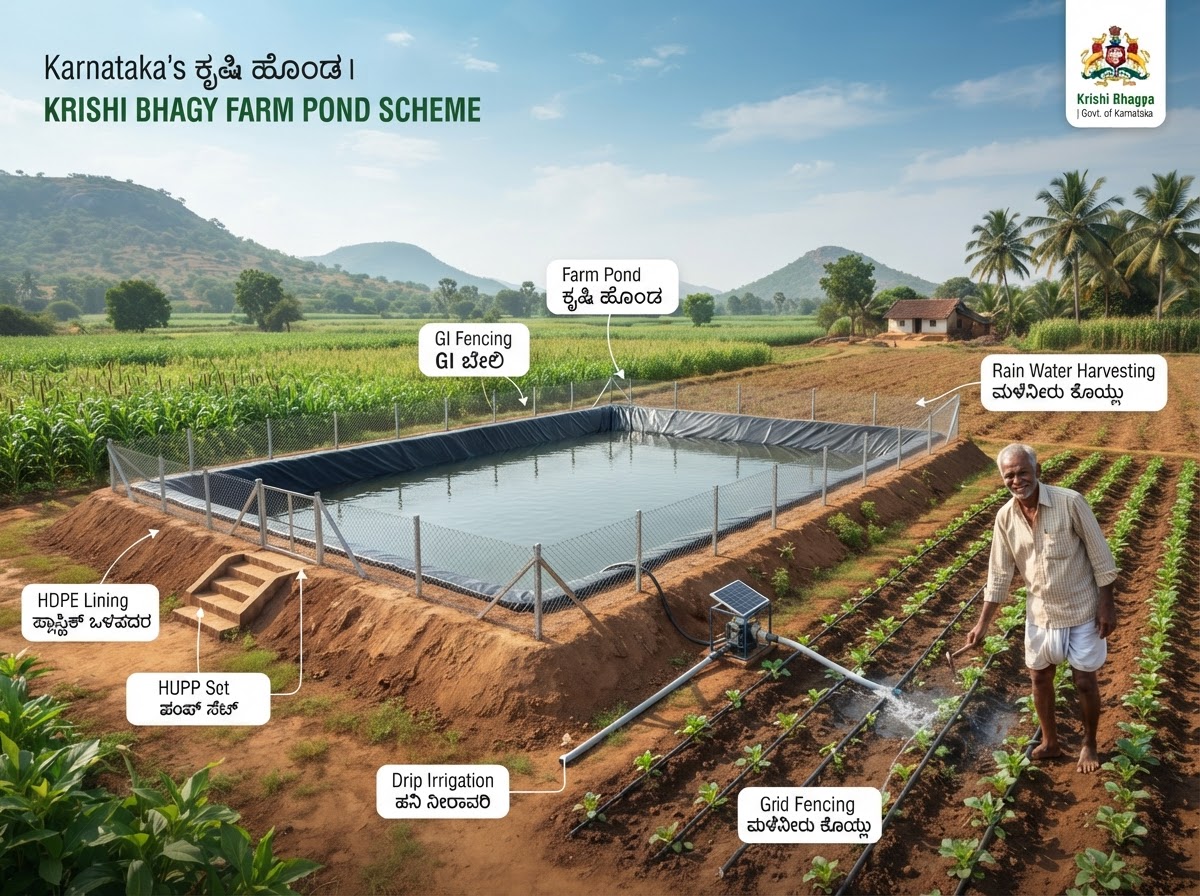
Krishi Bhagya is a Karnataka state scheme run by the Department of Agriculture. It is meant for rain-fed farmers so they can store monsoon runoff in a farm pond dug on their own land and use that water for protective irrigation when there is a dry spell during the crop season. The 2026-27 guidelines note that about 64% of the state’s cultivated area depends only on rain – this is why the scheme exists. The guideline also points out a practical fact most farmers know: in low-rainfall areas a borewell can cost up to ₹2 lakh and still fail, while spending the same money on a lined pond and a pump usually gives a more reliable water source that the farmer can see and control.
The scheme started in 2014-15 under the state’s rainfed agriculture policy (Government Order dated 22 July 2014). It was revived in 2023-24 with fresh guidelines dated 13 December 2023 and extended to all taluks of all districts from 2024-25. It continues as an ongoing scheme in 2026-27, with ₹100 crore provided in that year’s budget estimates.
The farm pond is called a krishi honda in Kannada, and the official guideline calls this component “Neeru Sangrahana Rachane (Krishi Honda)”. Krishi Honda is not a separate scheme – it is the pond component inside Krishi Bhagya.
The Six-Part Package / छह हिस्सों का पैकेज
The scheme is designed so that the pond actually works in the field. For this reason, a farmer is normally expected to take the components together rather than select only one part:
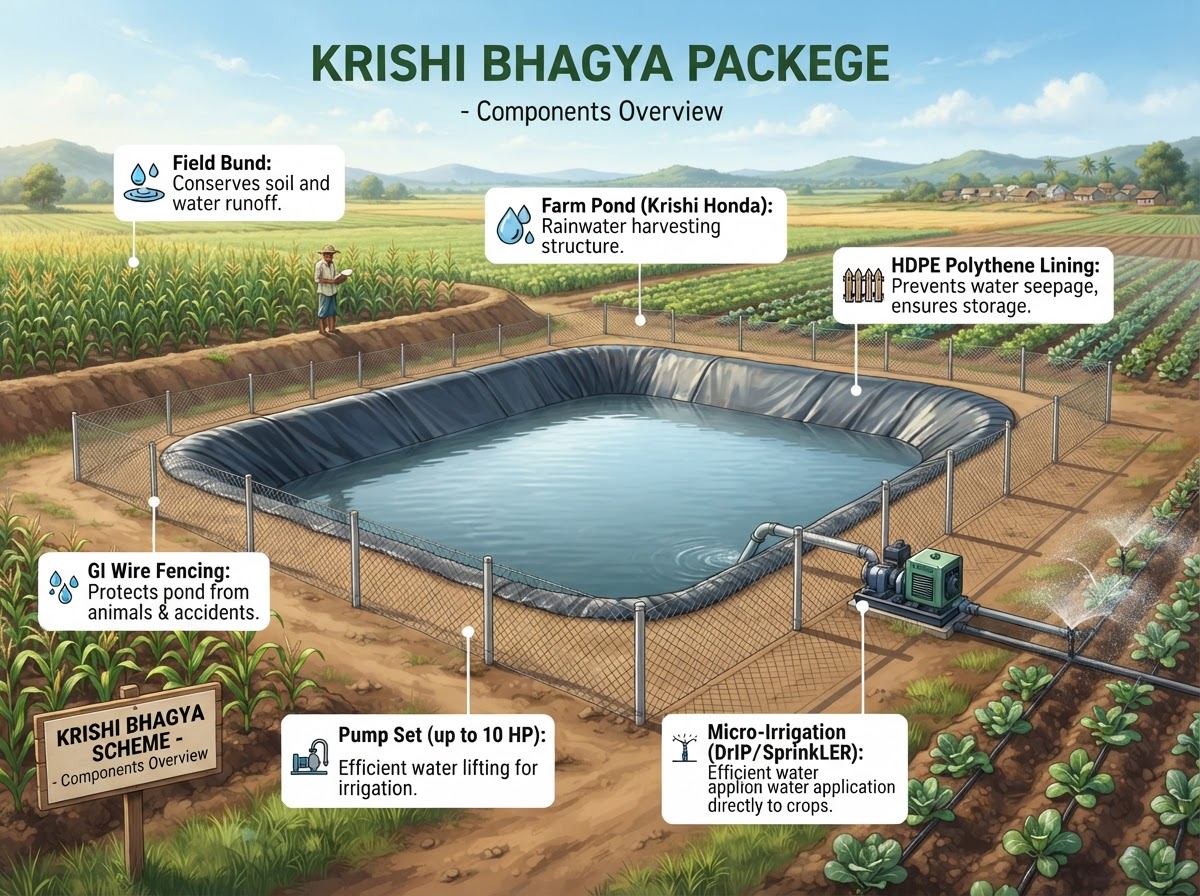
- Field bund — a bund or trench that slows rainwater runoff so that water either soaks into the soil or moves in a controlled way to the pond.
- Farm pond (krishi honda) — the storage structure itself, in one of the approved sizes.
- Polythene lining — HDPE geo-membrane sheeting that reduces or stops seepage, compulsory in red soil areas.
- GI wire fencing — a safety fence around the pond, compulsory for all ponds for both protection and to avoid accidents.
- Pump set up to 10 HP — diesel, petrol or solar pump to lift water from the pond to the crop.
- Micro irrigation — a drip or sprinkler system that uses pond water efficiently; this is paid through other schemes (such as PM-RKVY micro-irrigation or Atal Bhujal) rather than from the Krishi Bhagya budget.
What It Pays in 2026-27 / 2026-27 में कितनी सब्सिडी
Under the 2026-27 guidelines, general-category farmers get 80% and SC/ST farmers get 90% of the approved cost for four components: the field bund, the farm pond, the polythene lining and the pump set. Fencing is supported at a lower rate: 40% subsidy for general-category farmers and 50% for SC/ST farmers. Micro irrigation carries 90% subsidy for all categories, but this support comes under the PM-RKVY micro-irrigation component or Atal Bhujal scheme and not from Krishi Bhagya funds.
Two financial ceilings are important. First, polythene lining subsidy is capped at ₹70,000 for a general-category farmer and ₹80,000 for an SC/ST farmer, per farmer. The 2026-27 rate contract, extended by a circular dated 28 April 2026, fixes the price of HDPE geo-membrane at ₹83.29 per square metre for 250 GSM (Type-1) and ₹129.03 per square metre for 420 GSM (Type-2), both including 5% GST. An empanelled agency supplies and lays the sheet in the pond, and the farmer pays his or her share directly to that agency. Second, the guideline offers a ₹30,000 incentive to a beneficiary who installs a solar pump set.
The subsidy is always calculated on the approved cost fixed by the department for the chosen pond size and soil type, not on what the farmer finally spends. Digging a bigger pond than what is sanctioned will not increase the subsidy amount.
Pond Sizes and the Land You Need / होंडा का आकार और ज़मीन की शर्त
Five pond sizes are approved: 10×10×3 m, 12×12×3 m, 15×15×3 m, 18×18×3 m and 21×21×3 m. The land requirement increases with pond size. For a 15×15×3 m pond or larger, the farmer must have at least one acre of cultivated land in a single survey number. A farmer with about half an acre can still build a 10×10×3 m pond, or a 12×12×3 m pond in black soil, if the catchment area feeding the pond is at least one acre.
Two exclusions are strict. First, a farmer who has already received a farm pond under Krishi Bhagya or under any other government scheme is not eligible for another pond. Second, a pond or bund already built under MGNREGA, or a pump already taken under SMAM or PM-KUSUM, is recorded as an “existing component” in the K-KISAN system. In such cases, Krishi Bhagya will pay only for the components the farmer has not received elsewhere. A No Objection Certificate from the other department is taken to show that there is no double benefit.
How to Apply / आवेदन कैसे करें
There is no direct farmer-facing online form for this scheme. The only route is through the Raitha Samparka Kendra (RSK) at taluk level. There, the taluk Assistant Director of Agriculture provides the prescribed application form (Namune-1) free of cost and the staff enter the details into the K-KISAN system.
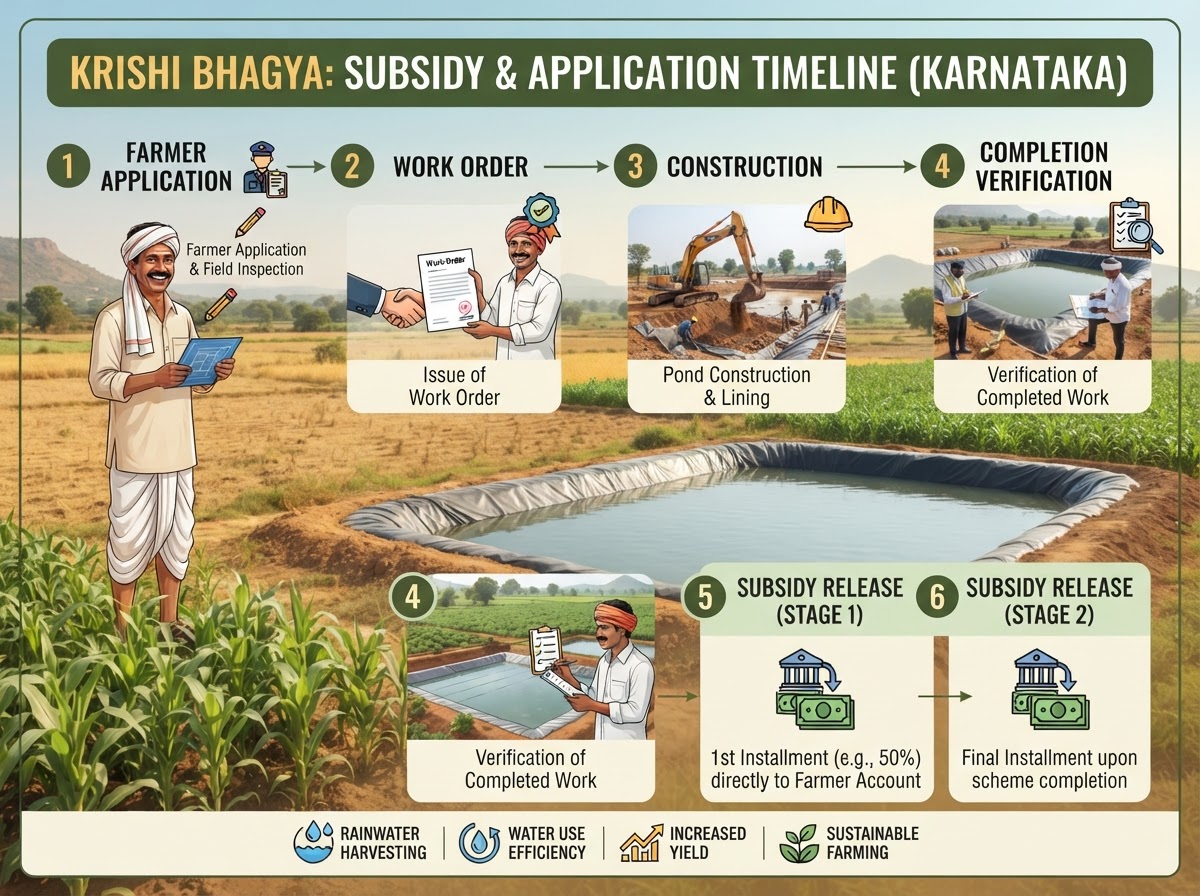
- Collect and fill the Namune-1 form at your RSK, attach all the documents it asks for (such as land records and identity proof), and submit it back at the same Kendra. Applying is free – do not pay any agent or middleman.
- Applications are taken up in the order of registration date. Where applications are more than the year’s target, a district-level committee selects beneficiaries by lottery, and the department keeps a waiting list of roughly 20% more names than the target.
- An agriculture officer visits and inspects your field, generally within about seven days of registration, and decides the suitable pond size with you on site. A work order is then issued based on this decision.
- You must build the pond within the time window mentioned in the work order – the guideline normally allows about 15 to 30 days. If you miss this deadline, your application is cancelled and the opportunity is passed to the next eligible farmer.
- After the work is completed, the department again inspects the site, records GPS-tagged photographs and then releases the subsidy directly to your bank account through DBT (Direct Benefit Transfer).
The guidelines do not set a fixed closing date. Applications are accepted through the year, but the total number of beneficiaries is limited by the annual budget allocation. This is why the date of registration is important – those who apply earlier are considered first until the target is met.
Payment in Two Parts, and What to Watch / दो हिस्सों में भुगतान और सावधानियां
The subsidy is paid in two stages, not in a single transfer. The first instalment – about 75% of the subsidy for the bund and pond – is released after the pond is completed and the farmer gives a written undertaking to put up fencing. The remaining 25% is released only after all six components, including fencing and the display board, are fully completed and photographed. A farmer who builds only the pond and stops there will not receive the final instalment.
Several mistakes commonly lead to rejection. The most serious is starting work before sanction – digging the pond first and applying later makes the application ineligible, and many cases fail here. The second is digging a pond on land that does not meet the scheme’s size-to-land rule. The third is trying to claim subsidy twice for the same component – for example, taking a bund once from MGNREGA and again from Krishi Bhagya.
For the irrigation equipment side of the package, the Per Drop More Crop component of PMKSY subsidises the drip and sprinkler sets that turn pond water into efficient irrigation. On dryland crops such as ragi and jowar, one protective irrigation at the right crop stage can be the difference between saving the crop and losing it. Since the pond is a drought-management measure and not a full guarantee, keep risk cover in place as well – PMFBY crop insurance remains the main support when an entire season fails, and a Kisan Credit Card limit is usually the cheapest way to arrange the farmer’s share of the total cost.
Key Takeaways / मुख्य बातें
- Krishi Bhagya is a Karnataka scheme for rain-fed farmers that offers 80% subsidy for general-category and 90% for SC/ST farmers on field bund, farm pond, polythene lining and pump set, with fencing supported at 40% for general and 50% for SC/ST farmers.
- The 2026-27 guidelines are dated 8 May 2026 and provide ₹100 crore for the scheme; polythene lining subsidy is capped at ₹70,000 for general and ₹80,000 for SC/ST farmers, and a beneficiary who installs a solar pump receives a ₹30,000 incentive.
- Approved pond sizes range from 10×10×3 m to 21×21×3 m; a 15×15×3 m pond or bigger requires at least one acre of cultivated land in a single survey number, while smaller ponds are possible on smaller holdings if the catchment area is large enough.
- To apply, visit the Raitha Samparka Kendra and fill Namune-1; details are entered into K-KISAN, selection is mainly by date of registration (and lottery if required), and the subsidy is released in two instalments, with the last 25% paid only after fencing and the signboard are completed.
- Do not start digging before the work order, do not ignore the land-size requirement, and do not claim the same component twice – all three are routine reasons for rejection and loss of subsidy.
Sources / स्रोत
- Department of Agriculture, Government of Karnataka – Raitamitra scheme and guideline pages, including Agricultural Production Programmes and Guidelines 2026-27 (budget provision for Krishi Bhagya, ₹100 crore under head 2401-00-102-0-27) – see raitamitra.karnataka.gov.in and the official 2026-27 guidelines (PDF).
- Krishi Bhagya implementation guidelines 2026-27 (dated 8 May 2026), as summarised with clause references by Kisan Subsidy – covering subsidy percentages, pond-size and land conditions, payment stages and application process – see kisansubsidy.com.
- Katyayani Organics, “Krishi Bhagya Scheme Karnataka: Farm Pond (Krishi Honda) Subsidy, Sizes, Eligibility and How to Apply in 2026”, 26 October 2026 – summary of scheme history, component list, two-part payment and lining rate contract – see katyayaniorganics.com.
- BigHaat Kisan Vedika, “Krishi Bhagya Karnataka: Farm Pond Subsidy and Eligibility”, 24 October 2026 – explains that cost norms can vary by year and advises farmers to confirm current rates at their Raitha Samparka Kendra – see bighaat.com.


Leave a Reply