
लहसुन की खेती – कम ज़मीन, कम समय, अच्छा मुनाफ़ा: Garlic / लहसुन is the rare cash crop that slots into a gap most farmers already have — the quiet window between the paddy harvest and the next kharif sowing. Plant in November, lift bulbs by March, and an otherwise idle field turns into income without disturbing your main cropping calendar. India already grows about 35.65 lakh tonnes of garlic on 4.19 lakh hectares in 2024-25, according to the final estimates of the Horticulture Statistics Division, Department of Agriculture and Farmers Welfare. Yet the average Indian farm manages only about 8.5 tonnes a hectare, while NHRDF regularly gets 13 to 17.5 tonnes a hectare from its own varieties. That gap is not about better land or expensive inputs — it comes down to four things any farmer can control: planting on time, choosing the right clove size, treating cloves before sowing, and curing bulbs properly after harvest. Get those four right, and this guide shows you exactly how.
This guide walks the whole lifecycle of a garlic crop — climate and soil, the planting window for your state, varieties, clove selection and treatment, land preparation, irrigation, the exact manure and fertilizer schedule, how and when to apply it, the five problems that actually cost you money (purple blotch, Stemphylium blight, thrips, white rot and basal rot), what a healthy plant looks like at each stage, harvesting at neck-fall, and the curing and storage routine that decides whether your bulbs hold six months or rot in six weeks.
Garlic at a Glance: Why It Fits Indian Farms / एक नज़र में लहसुन: भारतीय खेतों के लिए क्यों उपयुक्त है
Garlic is a rabi season bulb crop. Sown in October–November across most of the plains, it is ready in about 130–175 days depending on variety and region, which places harvest in March–April, before the heat builds. It is a shallow-rooted crop — ICAR-DOGR notes the roots work mostly in the top 5–8 cm — which makes it unusually responsive to irrigation and unusually vulnerable to drought stress at the same time.
The crop is concentrated. Madhya Pradesh alone accounted for about 2.10 lakh hectares and 21.97 lakh tonnes in 2024-25, followed by Rajasthan (about 82,900 hectares and 4.98 lakh tonnes), Uttar Pradesh (about 43,300 hectares and 2.77 lakh tonnes), Gujarat and Assam. That concentration is worth understanding, because it also drives price behaviour: a good year in Malwa or Kota can crash the mandi price nationally, and garlic has no minimum support price to fall back on. Plan for a market, not just for a yield.
Field tip: Garlic has no Minimum Support Price. Before you expand your area, check mandi price trends in your district for the last two seasons — a bumper national crop can crash prices even when your own yield is excellent.
Agronomically, garlic earns its place because it is short, it can be intercropped (with coriander, spinach, or in young orchards), it responds strongly to organic manure, and its nitrogen and sulphur needs make it a good rotation partner for cereals. What it does not tolerate is a field that has grown onion, garlic or other Allium crops recently.
Climate and Soil Requirements / जलवायु और मिट्टी की आवश्यकता
Garlic wants a cool, moist growing period and a dry, warm finish. Tamil Nadu Agricultural University’s package of practices puts the vegetative growth window at 12–18°C with short days, and notes the crop is grown between 1,200 and 2,000 m elevation in the hills. In the plains, the natural rabi season delivers exactly that: cool December–January growth, warming February bulb filling, dry March finish.
On soil, the recommendations converge. A well-drained, friable loam or sandy loam rich in organic matter, with pH 6.0–7.0, is ideal. Both the KVK package and TNAU are explicit that heavy soils, highly alkaline soils and saline soils are not suited — garlic bulbs in a waterlogged or compacted soil simply rot or deform. If your field holds water for even a day after rain, put garlic on raised beds, not on flat land.
What this means in practice / व्यवहार में इसका अर्थ
Once your soil and climate line up, the next decision is the one that matters most for yield: exactly when to put cloves in the ground. Get the date right for your state, and everything downstream — bulb size, disease pressure, even storage life — gets easier.
- Drainage first. Raised beds 15–20 cm high, or ridges and furrows at 30 cm spacing (TNAU’s recommendation), are safer than flat sowing on any soil that crusts.
- Organic carbon matters. The organic package of practices from ICCOA recommends a minimum of 1% organic carbon for garlic; below that, budget 40–50 tonnes of FYM per hectare and plough it in well ahead of planting.
- Test before you fertilise. A Soil Health Card reading for N, P, K and sulphur turns the blanket dose below into a real prescription.
Season and Planting Window by Region / मौसम और रोपण का समय
Planting date is the single largest yield lever in garlic, and it is region-specific. The ICAR-Directorate of Onion and Garlic Research publishes the following windows:
| Region / क्षेत्र | Season | Planting | Harvest |
|---|---|---|---|
| Madhya Pradesh, Chhattisgarh, Gujarat, Maharashtra | Rabi | September–November | March |
| Karnataka | Rabi | September–October | March |
| Andhra Pradesh, Tamil Nadu | Rabi | September–November | March–April |
| Bihar, Haryana, Punjab, Rajasthan, Uttar Pradesh, Uttarakhand | Rabi | October–November | March–April |
| Odisha, West Bengal | Rabi | October–November | March |
| Hilly areas (long-day types) | — | September (also March–April in higher hills) | May |
Two cautions. First, late planting in the north pushes bulb filling into rising March temperatures, and you end up with small, poorly filled bulbs — ICAR-DOGR’s work on the variety Yamuna Purple-10 recommends finishing planting between 15 and 30 October for exactly this reason. Second, very early planting is linked to sprouting in the field before harvest, which ICAR-DOGR attributes to early planting combined with excess nitrogen and irrigation close to harvest.
If you are still deciding which crops fit which window, our guide to kharif, rabi and zaid crops lays out the full Indian cropping calendar.
Choosing Varieties / किस्मों का चयन
Garlic varieties are grouped by day-length requirement — short-day types for the plains, long-day types for the hills — and planting a long-day variety in the plains is a common and expensive mistake. The main notified varieties and what they deliver:
| Variety | Developed by | Type | Recommended area | Maturity (days) | Yield (t/ha) |
|---|---|---|---|---|---|
| Agrifound White (G-41) | NHRDF | Short day | Madhya Pradesh, Maharashtra | 130–135 | 12–14 |
| Yamuna Safed (G-1) | NHRDF | Short day | All India | 120–130 | 15–17 |
| Yamuna Safed-2 (G-50) | NHRDF | Short day | Northern India | 120–130 | 15–20 |
| Ooty 1 | TNAU | Intermediate | Tamil Nadu | 120–130 | 15–17 |
| VL Garlic 1 | ICAR-VPKAS | Long day | Hills: HP, J&K, Uttarakhand, UP, Bihar, Punjab | 180–190 | 14–15 (hills), 9–10 (plains) |
| Yamuna Purple-10 (G-404) | NHRDF, Karnal | Short day | Zone II and Zone IV, notified 2019 | 165–175 | 18–20 |
Two of these deserve a note. Yamuna Purple-10 (G-404) was notified by the Government of India in November 2019 and is reported as highly tolerant to purple blotch and Stemphylium blight, which is a real advantage in a humid rabi — it also needs a longer season (165–175 days). Yamuna Safed-3 (G-282) and Agrifound Parvati (G-313) have larger cloves and are the ones to look at if you are growing for export rather than the local mandi.
NHRDF reports average yields of 130 q/ha for Agrifound White and 150–175 q/ha for Yamuna Safed (G-1). Treat those as a ceiling under good management, not a promise.
Planting Material: Clove Selection, Seed Rate and Treatment / रोपण सामग्री: कल्ली चयन, बीज दर और उपचार
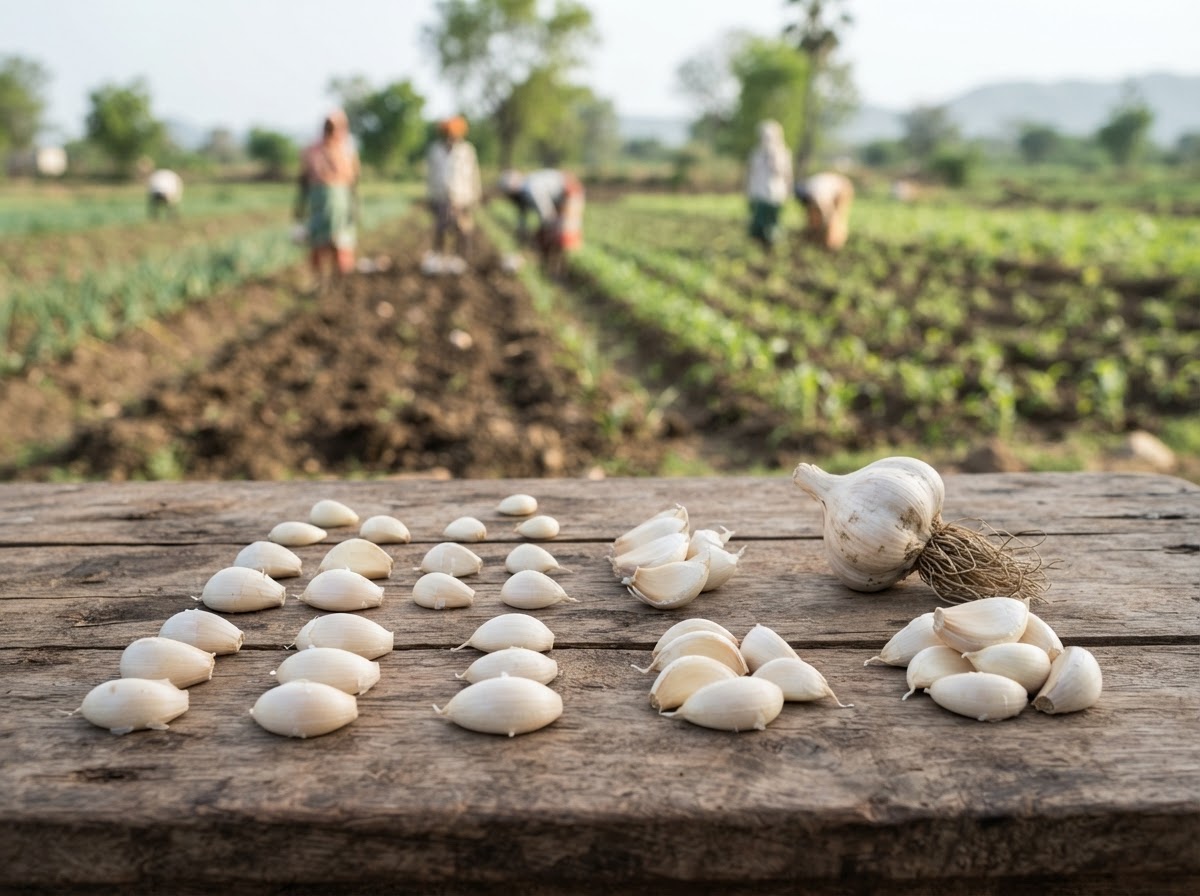
Garlic is propagated vegetatively from cloves — there is no seed in the ordinary sense, so the “seed” you plant is also your first harvest decision. Every clove you put in the ground is a bulb you did not sell, which is why seed rate and clove size are the two numbers that set your economics.
Field tip: Keep different clove sizes separate at planting. Big cloves in one patch and small ones in another lets you time top-dressing and harvest more accurately, since bulb-size differences carry through all the way to neck-fall date.
Clove size and seed rate / कल्ली का आकार और बीज दर
- Select cloves 8–10 mm in diameter, taken from the outer side of the bulb. The ICAR e-course material and ICCOA both specify this size class, and note that bigger cloves give higher yields of better quality.
- Seed rate: about 500 kg of cloves per hectare at that size class. TNAU quotes 500–600 kg/ha. The KVK package expresses the same quantity as 5–7 quintals per hectare. Kerala Agricultural University’s figure of 200–240 kg per acre works out to the same range.
- Never plant cloves from a bulb that is soft, sprouting, or showing mould. Grade your seed lot before planting; it takes an hour and saves a season.
Clove treatment before planting / रोपण से पहले कल्ली उपचार
Garlic has no seed coat protection worth the name, and the base plate is an open door to soil-borne fungi. Treat the cloves:
- Bio-agent treatment: Trichoderma viride at 10 g per kg of cloves (Kerala Agricultural University recommendation). TNAU also recommends Pseudomonas fluorescens at 5% and biofertilizers Azospirillum and Phosphobacteria at 500 g/ha using rice gruel as the sticker. Note the caution from the Kerala package: do not use water for Trichoderma clove treatment — the fungus needs to sit on the clove, not wash off it.
- Where thrips and foliar disease pressure is historically high, a five-minute dip of Carbendazim at 1 g/L plus Carbosulfan at 2 ml/L before planting gave the best results in a two-year NHRDF Nashik trial on Agrifound White, followed by four sprays through the season.
- Our general guide to seed selection and seed treatment covers the principles if you are adapting this to other crops.
Land Preparation and Planting Method / भूमि तैयारी और रोपण विधि
Garlic needs fine tilth and a firm, level seedbed. Plough two to three times, break clods, and remove the previous crop’s residue — buried trash in a shallow-rooted crop means gaps, poor bulb shape and disease.
- Incorporate organic matter early. Apply farmyard manure at least three weeks before planting so it is fully decomposed by the time cloves go in. Our detailed note on how to prepare soil for garlic and onions covers compost choice and bed dimensions.
- Form beds or ridges. Raised beds of a convenient size, or ridges and furrows at 30 cm spacing (TNAU). Flat beds are workable only on light, well-drained soil.
- Dibble the cloves upright. Plant at 5–7 cm depth with the growing end pointing up, at 15 × 10 cm spacing for large-clove varieties, and 12.5 × 7.5 cm for small-clove varieties (KVK package). KAU recommends 15 × 8 cm. Deeper than 7 cm and the bulb struggles to emerge and the neck stays thick; shallower and the bulb pushes out of the soil and sunburns green.
- Irrigate immediately. A light irrigation right after planting settles the soil around the clove and is not optional.
Dibbling is the norm; broadcasting cloves and raking them in gives uneven stands and is not worth the labour saved. For the general principles behind dibbling versus drilling, see our piece on sowing methods in agriculture.
Irrigation and Watering Schedule / सिंचाई और जल प्रबंधन
Garlic’s root zone is shallow, so the crop wants frequent, light irrigation during growth and a hard stop at the end. The ICAR e-course recommendation is the clearest baseline:
- Vegetative growth: irrigate at about 8-day intervals.
- Maturation: stretch to 10–15 days.
- Stop irrigation once the tops begin to break over and dry — and, in practice, 15–20 days before harvest.
TNAU adds the start-up detail: irrigate before planting and again after, give a “life irrigation” on the third day, then move to weekly intervals.
Decision point: If the tops have started bending over and the soil is still moist, skip the next irrigation. Stopping water 15–20 days before harvest matters more than hitting a fixed calendar date.
The failure modes are well documented and all three cost you money:
- Continuing irrigation as the crop matures rots the roots and bulb scales, discolours the bulbs, exposes outer cloves and destroys market value.
- Irrigating after a long dry spell splits the bulbs.
- Over-irrigation at any stage causes sprouting, and sprouted bulbs do not store.
On beds, drip and sprinkler irrigation are the practical route — ICAR-DOGR reports that drip and sprinkler on raised beds are very successful for garlic precisely because the root zone is shallow. If you are considering it, Per Drop More Crop and the Micro Irrigation Fund both subsidise on-farm micro-irrigation.
Manure and Fertilizer: What to Apply and How / खाद एवं उर्वरक: क्या दें और कैसे दें
Garlic responds very strongly to organic manure — this is the one crop where skimping on FYM shows up directly in bulb size. The published recommendations vary by region, so here are the main ones side by side, and then a workable schedule.
Recommended doses / अनुशंसित मात्रा
| Source | Organic | N : P₂O₅ : K₂O (kg/ha) | Other |
|---|---|---|---|
| KVK package (general) | 10–15 t FYM/ha, three weeks before planting | 100 : 50 : 50 | 30 kg sulphur, 20 kg zinc |
| ICAR e-course / ICCOA | 50 t FYM/ha | 100 : 50 : 50 | Micronutrients increase yield potential |
| TNAU | 50 t FYM/ha + 1 t neem cake | 40 : 75 : 75, plus 35 kg N at 45 DAP | Azospirillum 2 kg + Phosphobacteria 2 kg/ha, 50 kg MgSO₄ |
| ICAR-DOGR, Yamuna Purple-10 | 20 t FYM or 5 t vermicompost/ha | 120 : 50–80 : 50–60 | 30 kg sulphur; foliar 19:19:19 at 1% on 30, 45, 60 DAP and 13:46:0 on 75, 90, 105 DAP |
A schedule that works / एक व्यवहार्य कार्यक्रम
- Three weeks before planting: 20–50 t/ha of well-rotted FYM (or 5 t/ha vermicompost), ploughed in. Add 1 t/ha neem cake if nematodes or soil-borne rot have been a problem.
- At final ploughing (basal dose): the full phosphorus, the full potash, the full sulphur and zinc, and half the nitrogen. Also incorporate Trichoderma viride and Pseudomonas fluorescens at 5 kg/ha each into the bed.
- 30–35 days after planting: top-dress the first quarter of the nitrogen.
- 45–50 days after planting: top-dress the remaining nitrogen — this is the TNAU timing (35 kg N/ha at 45 DAP) and it coincides with the start of bulb initiation.
- Optional, for quality: 1% 19:19:19 foliar sprays at 30, 45 and 60 DAP, followed by 13:46:0 at 75, 90 and 105 DAP, improved yield and bulb quality in ICAR-DOGR’s trials on Yamuna Purple-10.
How to apply it / उर्वरक कैसे दें
- Band, don’t broadcast. Place fertilizer in a band 5–7 cm to the side of the plant row and at root depth, then cover. Broadcasting on a shallow-rooted crop wastes phosphorus, which barely moves in soil.
- Apply nitrogen in splits, never all at once. A single large nitrogen dose gives you tall, soft, disease-prone leaves and poor bulb filling.
- Keep nitrogen off the bulb. TNAU specifically warns against applying nitrogen as urea for garlic in its package, recommending ammonium sulphate instead, to reduce “rubberisation” — the condition where bulbs stay soft and fail to cure. Follow your local KVK on this, but do not dump urea late.
- Irrigate lightly after top-dressing so the nutrient reaches the root zone.
- Sulphur is not optional. Garlic’s flavour compounds are sulphur-based, and 30 kg/ha of sulphur appears in every serious recommendation. Zinc at 20 kg/ha likewise.
For the underlying principles — which nutrient does what, and how to read a deficiency — see Integrated Nutrient Management and our guide to plant nutrients for healthy growth.
Weed Control and Intercultural Operations / खरपतवार नियंत्रण एवं अंतर-सस्य क्रियाएँ
Quick Scan: Which Disease or Pest Is It? / त्वरित पहचान तालिका
| What you see in the field | Likely problem | What to do |
|---|---|---|
| Silvery streaks, curled leaves, tiny black specks | Thrips | See Thrips treatment below |
| Purple-brown blotches with rings on leaves | Purple blotch | See Purple blotch treatment below |
| Grey, elongated lesions; leaves collapse in cool, humid weather | Stemphylium blight | See Stemphylium blight treatment below |
| Plant yellows and lifts easily; white fluffy mould with tiny black sclerotia at the base | White rot | No cure in-season — prevention only, see below |
| Leaves yellow from the tip down; base plate browns and softens | Basal rot | No cure in-season — clean seed and thorough curing, see below |
Garlic is a poor competitor. It is short, it is slow to canopy, and its leaves do not shade the ground, so the first six weeks belong to the weeds if you let them.
- Two hand weedings — the standard recommendation is at 30 and 60 days after planting (TNAU).
- Chemical option where labour is scarce: ICAR-DOGR recommends oxyfluorfen at 0.25 kg a.i. per hectare plus one hand weeding at 45 DAP for broad-leaved weeds. Use only labelled herbicides at label rates, and read our guide to agrochemical types and usage before spraying.
- Chemical option where labour is scarce: ICAR-DOGR recommends oxyfluorfen at 0.25 kg a.i. per hectare plus one hand weeding at 45 DAP for broad-leaved weeds. Use only labelled herbicides at label rates, and read our guide to agrochemical types and usage before spraying.
- Rotation is the real weed and disease strategy. ICCOA recommends rotating garlic away from other Allium crops for four to five years, using leafy vegetables, tomato, sugar beet, cotton or melon as rotation partners. Our tomato farming guide and weed management practices cover both halves of that plan.
Diseases and Pests: Symptoms, Prevention and Treatment / रोग एवं कीट: लक्षण, रोकथाम और उपचार
Five problems account for most of the loss in Indian garlic. Two are foliar fungal diseases that arrive together in humid weather, one is an insect that both damages leaves and opens the door to the fungi, and two are soil-borne rots that you cannot cure — only prevent.
1. Purple blotch (Alternaria porri) / बैंगनी धब्बा रोग
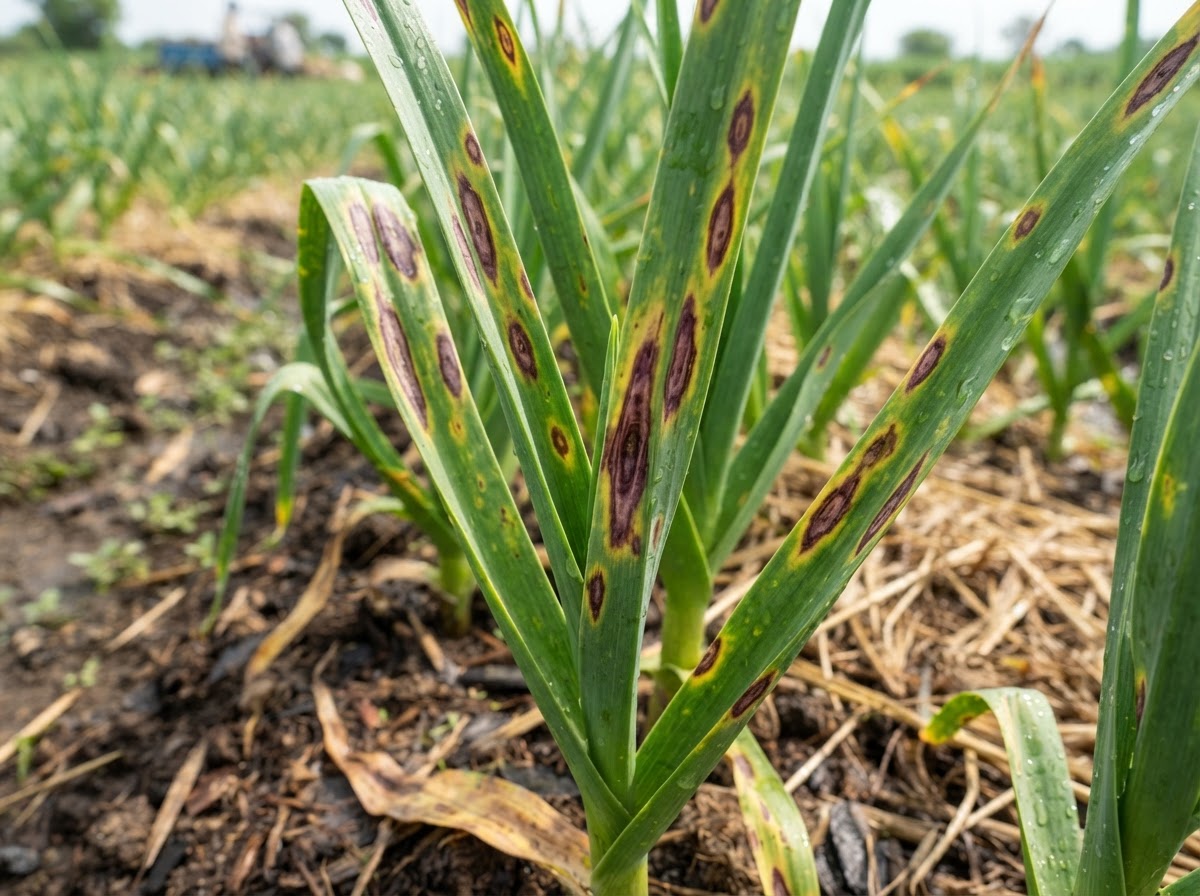
Symptoms: small, sunken, whitish lesions on the leaves that enlarge into purple-brown blotches with concentric rings; leaves die back from the tip. NHRDF field data identifies the economic threshold: an incidence of about 21% with 1.73% leaf-area intensity at 45 days after planting already causes measurable yield loss.
Prevention: clean, treated cloves; wider spacing and good drainage (reduced plant density and drainage significantly cut incidence); avoid heavy nitrogen and frequent irrigation; grow a tolerant variety such as Yamuna Purple-10 where it suits your zone.
Treatment: NHRDF’s three-year trial found mancozeb at 0.25% the best performer, followed by tebuconazole 0.1% and azoxystrobin 0.1%, with sprays starting around 30 DAP and repeating at 15-day intervals for four sprays. Always add a sticker.
2. Stemphylium blight (Stemphylium vesicarium) / स्टेम्फीलियम झुलसा
Symptoms: elongated, pale to grey-brown lesions along the leaf, often starting at the tip or margin, spreading fast in cool, humid weather and merging until the leaf collapses.
Prevention: as above — sanitation, rotation, no overhead irrigation in the evening, and early clove treatment.
Treatment: tebuconazole 0.1% gave the lowest disease index (PDI 1.90%) among seven fungicides tested over two seasons, with azoxystrobin 0.1% close behind; four sprays at ten-day intervals from disease onset gave the best control. The commonly published field recommendation is mancozeb 0.25% or ziram 0.3% with a sticker at 0.06%, at fortnightly intervals from first appearance.
3. Thrips (Thrips tabaci) / थ्रिप्स
Symptoms: silvery, streaked, curled leaves; tiny black specks of frass; stunted plants and small bulbs. Thrips also aggravate fungal disease and can vector viruses.
Prevention: monitor with yellow and bright blue sticky traps (TNAU’s IPM schedule); clear alternate weed hosts on bunds; destroy culled onion and garlic; do not plant garlic immediately after onion or in the lee of an older planting.
Treatment: Junagadh Agricultural University trials over three rabi seasons found fipronil 5% SC at 1 ml/L with sticker gave the fastest knockdown (2.09 thrips/plant 48 hours after spray), while a tank mix of metiram 55% + pyraclostrobin 5% WG at 2 g/L with cyantraniliprole 10.26% OD at 0.9 ml/L controlled both thrips and the two blights and gave the highest marketable yield (69.30 q/ha). Older recommendations include dimethoate 0.06% and cypermethrin 60 g a.i./ha. Rotate modes of action — thrips resistance to repeated pyrethroid use is well documented.
4. White rot (Sclerotium cepivorum) / सफेद सड़न
Symptoms: plants yellow, wilt and lift easily because the roots have rotted; a white, fluffy mould on the base plate studded with tiny black sclerotia the size of poppy seeds. The sclerotia survive in soil for many years, so an infested field stays infested.
Prevention — this is the whole game: long rotation away from all Allium crops (four to five years), only clean disease-free cloves, raised beds and assured drainage, rogue out and destroy affected plants together with the soil around them.
Treatment: there is no cure once the base plate has rotted. Trichoderma species — T. viride, T. harzianum, T. hamatum — applied to soil and cloves have given the most consistent suppression in Indian and international trials, and combining a bio-agent with a fungicide clove treatment performs better than either alone.
5. Basal rot (Fusarium oxysporum f. sp. cepae) / तना आधार सड़न
Symptoms: leaves yellow and die back from the tips, roots rot, the base plate browns and softens, often with a light pink-white mould; the bulb rots from the base upward and will not keep in storage.
Prevention: clean seed, rotation, avoid warm-soil planting into fresh manure, and cure bulbs thoroughly before storage — much of the loss shows up in the store, not the field.
Treatment: in vitro screening at Indian institutions found Trichoderma viride the strongest antagonist (74% inhibition of mycelial growth) and Pseudomonas fluorescens the best bacterial agent. Treat cloves and drench the bed; do not rely on fungicide alone.
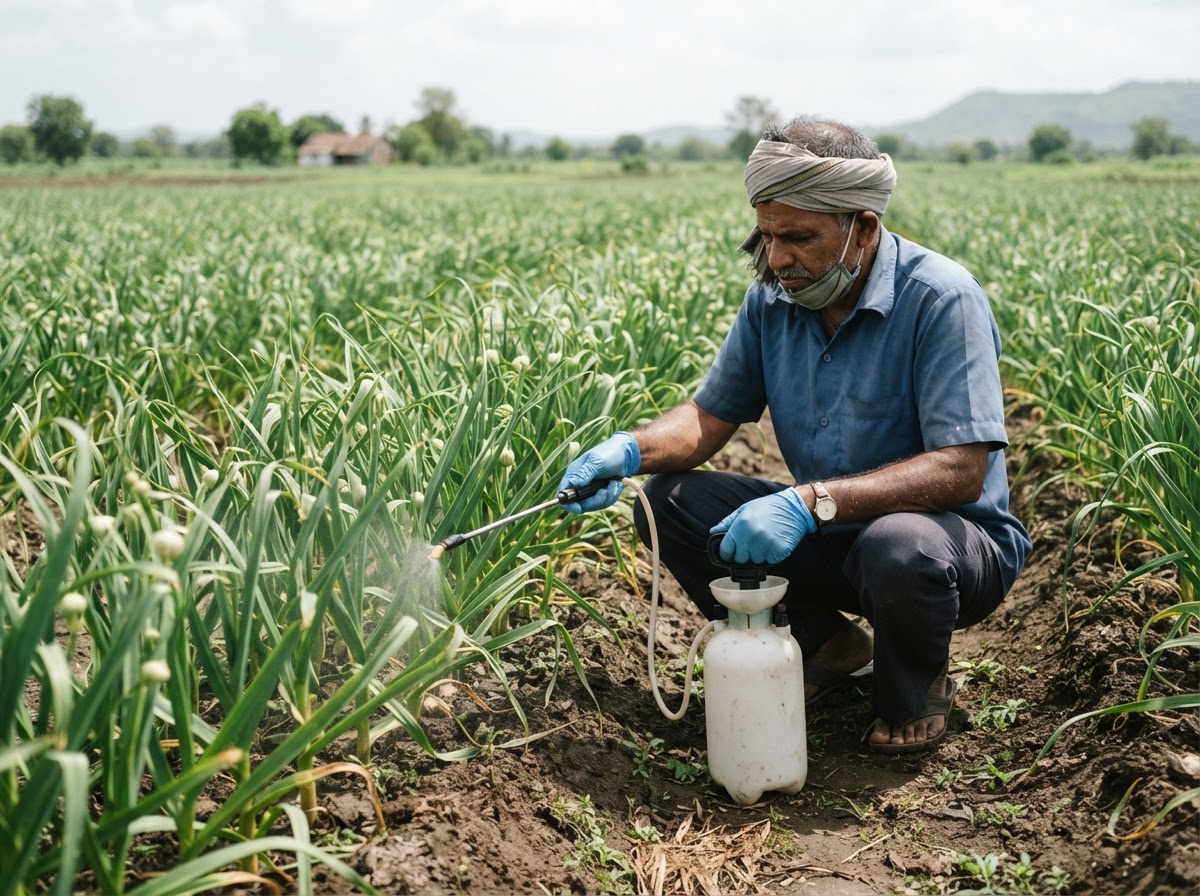
Two rules apply to every spray in this section. First, follow the label dose and pre-harvest interval — garlic is harvested with the leaves still on the plant, and residues end up on the bulb. Second, integrate: rotate chemistry, use bio-agents, and keep the cultural practices in place. Our integrated pest management guide and the crop diseases overview explain the framework. When in doubt, take a sample to your nearest Krishi Vigyan Kendra before you spray.
Growth-Phase Care Calendar / वृद्धि अवस्था देखभाल कैलेंडर
| Stage | Days after planting | What the crop needs |
|---|---|---|
| Establishment | 0–15 | Immediate irrigation after planting, life irrigation on day 3, then weekly. Watch for gaps — replant missing cloves early. |
| Vegetative growth | 15–45 | Irrigate every 8 days. First weeding at 30 days. First nitrogen top-dress at 30–35 days. Start watching for thrips and early leaf spots. |
| Bulb initiation | 45–75 | Second nitrogen split at 45–50 days. Second weeding at 60 days. Protective fungicide sprays if disease has appeared. Foliar 19:19:19 at 1% helps. |
| Bulb development | 75–105 | Hoe lightly before bulbs swell. Hold moisture steady — no dry spells, no flooding. Continue disease scouting. Foliar 13:46:0 where recommended. |
| Maturation | 105–140+ | Stretch irrigation to 10–15 days, then stop entirely 15–20 days before harvest. Do not apply nitrogen. Watch for neck fall. |
| Harvest and cure | 130–175 | Lift at 75–100% neck fall, windrow, cure in shade, cut necks, grade, store. |
Healthy Plant vs Problem Symptoms / स्वस्थ पौधे के लक्षण और समस्या के संकेत
Garlic tells you what it needs, if you look at the leaves rather than the calendar.
A healthy garlic plant has four to eight erect, stiff, uniform blue-green leaves with no yellowing at the tips; it stands without support; new leaves emerge steadily through the vegetative phase; the pseudostem (the false stem above the bulb) is firm and thick; and by 90–110 days the bulbs have visibly swollen and the soil cracks around the base. No lesions, no silvery streaks, no wilting at midday.
Warning signs and what they usually mean:
- Yellowing from the leaf tips downward, plants lift easily — root rot, basal rot or white rot. Dig one up and look at the base plate; do not wait.
- Silvery streaks, curled leaves, black specks — thrips.
- Purple-brown blotches with rings, or grey elongated lesions — purple blotch or Stemphylium blight. Spray now, not next week.
- Tall, soft, dark green leaves with no bulb swelling — too much nitrogen, too late.
- Bulbs splitting before harvest — irrigation after a long dry spell.
- Bulbs sprouting in the field — early planting plus excess nitrogen and late irrigation.
- Thick, green necks that will not dry — deep planting, late nitrogen, or harvest taken too early; these bulbs will not store.
Field tip: A harvested bulb is not a finished bulb. A rushed cure is the single most common reason farmers lose stored garlic to rot within weeks — treat curing as its own essential stage, not clean-up after harvest.
Harvesting at the Right Stage / सही समय पर कटाई
NHRDF’s post-harvest recommendation is precise: harvest at 75–100% neck fall — the point at which three-quarters to all of the tops have bent over. Before that, bulbs are immature, light in weight and shrivel in curing. After that, you risk sunscald, splitting and re-growth.
Practically:
- Stop irrigation 15–20 days before the expected harvest date. This is the single most common mistake; a wet field at harvest gives you muddy, discoloured bulbs and a short storage life.
- Lift with a khurpi or a blade harrow rather than pulling — pulling breaks the neck and opens the bulb to rot.
- Keep the tops on. Do not cut leaves at harvest; the foliage is how the bulb continues to dry down.
- Handle gently. A bruised bulb is a rotting bulb in month two of storage.
Curing, Grading and Storage / क्योरिंग, ग्रेडिंग और भंडारण
Curing is where garlic growers either make or lose their margin, because garlic is harvested in March and sold across the whole year.
Curing / क्योरिंग
- Windrow in the field for two to three days with the tops on, to dry the outer skin and reduce infection and water loss (NIFTEM’s processing note). Avoid prolonged direct sun, which causes excessive shrinkage and sloughing.
- Then bundle and cure in shade. ICAR-DOGR describes the standard method: tie 20–25 plants into bundles with the tops, divide the tops into three segments and interweave them tightly, and stand the bundles upright in shade for 15 days, or use forced air.
- Cut the neck leaving 2.5 cm above the bulb (NHRDF). Not flush — a short neck stub protects the base of the bulb.
- For seed garlic, a pre-harvest spray of 0.1% carbendazim and disinfecting the store before filling reduce decay losses.
Storage / भंडारण
- Well-cured bulbs with dry necks and skins, firm to the touch, keep five to six months at ambient temperature in ventilated structures — provided relative humidity stays below 70%.
- Grade before storing. High humidity in the store encourages mould and rooting, and poorly cured bulbs mould regardless of the store.
- For bulk, ICAR-DOGR describes arranging bulbs in circular heaps about 4 feet across at the base tapering to 3 feet at the top, 3 feet high, with gaps between heaps for ventilation.
- For long-term holding, cold storage at −1°C to 0°C with 60–70% relative humidity is the recommended regime. Irradiation at 2–6 krad of cobalt-60 gamma rays within eight weeks of harvest is an approved anti-sprouting treatment, though doses above 10 krad reduce the diallyl disulfide that gives garlic its flavour.
- Practical storage in nylon-netted bags is what NHRDF recommends for reducing post-harvest loss at farm level.
If you are building storage rather than renting it, the cold chain schemes and the MIDH horticulture mission both support pack-houses and cold rooms. And because garlic has no MSP, how you sell matters as much as how you store — see our guide to e-NAM and selling beyond the local mandi.
Yield, Cost and What Moves Your Margin / उपज, लागत और मुनाफ़े को प्रभावित करने वाले कारक
Realistic yield expectations, from NHRDF’s own variety data, are 12–14 t/ha for Agrifound White, 15–17 t/ha for Yamuna Safed, and 18–20 t/ha for Yamuna Purple-10 under good management. India’s national average is far below that — about 8.5 t/ha in 2024-25 — which is the size of the opportunity and the size of the gap.
On price: garlic is not covered by MSP, and it is one of the most volatile horticultural commodities in the country. Rather than quote a figure that will be wrong by the time you read it, use the arithmetic. At a marketable yield of 150 q/ha, every ₹10 per kg movement in the price you realise changes gross income by about ₹1.5 lakh per hectare. That is why the decisions that cost you nothing — planting date, clove grading, clove treatment, curing properly, storing instead of dumping at harvest — matter more than any input you can buy.
Three structural levers worth knowing: forming or joining an FPO to grade and sell collectively; using Kisan Credit Card limits to avoid distress selling at harvest; and, for anyone adding value, the PMFME micro food processing scheme for peeling, paste and dehydrated garlic.
Key Takeaways / मुख्य बातें
- Plant on time, not when convenient. October–November in the plains, September–November in the south and central states, March–April in the hills. Late planting means small bulbs.
- Clove size is yield. Select 8–10 mm cloves from the outer side of the bulb, at about 500 kg/ha, and treat them with Trichoderma before planting.
- Feed for sulphur and zinc, not just NPK. 100:50:50 kg NPK plus 30 kg sulphur and 20 kg zinc per hectare, with nitrogen split into two or three doses and never dumped late.
- Stop watering before harvest. Irrigation 15–20 days before lifting is the difference between bulbs that store six months and bulbs that rot in six weeks.
- Harvest at 75–100% neck fall, cure in shade for 15 days, cut the neck at 2.5 cm. Nothing in the field costs more to get wrong than this.
Sources / स्रोत
- Horticulture Statistics Division, Department of Agriculture & Farmers Welfare — Area and Production of Horticulture Crops, 2024-25 final estimates. agriwelfare.gov.in/en/StatHortEst
- ICAR-Directorate of Onion and Garlic Research (DOGR) — Garlic Agropedia: seasons, varieties, storage. dogr.res.in
- ICAR-DOGR / NHRDF — Yamuna Purple-10 (G-404): a new promising garlic variety, Indian Horticulture. epubs.icar.org.in
- National Horticultural Research and Development Foundation — Garlic varieties and post-harvest technology. nhrdf.com
- Tamil Nadu Agricultural University, Agritech Portal — Horticulture: Vegetables: Garlic. agritech.tnau.ac.in
- TNAU — Organic farming: garlic, and IPM schedule for vegetables (onion and garlic thrips).
- Krishi Vigyan Kendra, Anjaw — Package of Practices: Garlic. kvkanjaw.nic.in
- ICAR e-course, HORT 281 — Origin, area, production, varieties and package of practices for garlic. eagri.org
- Kerala Agricultural University — Garlic package of practices. keralaagriculture.gov.in
- ICCOA / Access Agriculture — Organic Package of Practices for Garlic.
- Gupta, Pandey & Gupta (2014), Journal of Spices and Aromatic Crops 23(1) — Management of purple blotch (Alternaria porri) of garlic, NHRDF Nashik.
- Journal of Plant Disease Sciences 12(2) — Exploration of fungicides against Stemphylium blight of garlic.
- Junagadh Agricultural University (2025) — Efficacy of insecticides and fungicides against thrips and major foliar diseases of garlic.
- NHRDF Regional Research Station, Nashik (2025) — Management of foliar diseases and thrips of garlic through clove treatment and spray schedules.
- Plant Science Today (2025) — In vitro evaluation of biocontrol agents against basal rot of garlic.
- Agricultural Reviews (2021) — Prevalence and management of major diseases of garlic: a review (white rot, Sclerotium cepivorum).
- NIFTEM / PMFME — Garlic processing.


Leave a Reply