
For a farmer, an FPO or a self-help group that wants to turn raw produce into a saleable product — puffed makhana, cold-pressed oil, packaged spices, millet flour, pickle, honey — the Pradhan Mantri Formalisation of Micro Food Processing Enterprises (PMFME) scheme has been the largest single source of cheap capital in India’s food processing sector since 2020. This article sets out exactly what the scheme pays for, who qualifies, how an application travels from the district office to the bank, and — just as importantly — where its deadline now stands, because the scheme’s extended term ended on 30 September 2026 and no further extension had been notified when this was written. पीएमएफएमई: सूक्ष्म खाद्य प्रसंस्करण इकाइयों के लिए 35% सब्सिडी — और अब योजना कहाँ खड़ी है
What PMFME Is / पीएमएफएमई क्या है
PMFME is a centrally sponsored scheme of the Ministry of Food Processing Industries (MoFPI), launched in June 2020 as part of the Aatmanirbhar Bharat package. It was approved with an outlay of ₹10,000 crore for the period 2020-21 to 2024-25, and it is implemented in partnership with the states — the Centre and the state share the grant 60:40, and 90:10 for the North-Eastern and Himalayan states.
It is not a cash transfer. PMFME is a credit-linked capital subsidy: the entrepreneur takes a bank loan for a new or upgraded processing unit, and the government pays a part of the project cost into the loan arrangement. That structure is what makes it useful to people who have produce and a market but no collateral.
The scheme’s stated objectives are to widen access to credit for new and existing micro food processing entrepreneurs, FPOs, SHGs and cooperatives; to pull unorganised micro units into the formal framework through Udyam, FSSAI and GST registration; to strengthen branding and marketing so small units can plug into organised supply chains; and to give them access to common processing facilities, laboratories, storage, packaging and incubation services. MoFPI’s target, stated on its scheme page, was the transition of two lakh existing enterprises plus new units into the formal framework.
What the Scheme Actually Pays For / योजना वास्तव में किस चीज़ के लिए पैसा देती है
There are four distinct components, and it helps to know which one you are applying under.
1. Credit-linked subsidy for an individual micro unit. A capital subsidy of 35 per cent of the eligible project cost, capped at ₹10 lakh per unit. The beneficiary contributes a minimum of 10 per cent of the project cost and the balance comes as a bank loan. The eligible project cost is the cost of plant and machinery plus technical civil work — and technical civil work cannot exceed 30 per cent of that eligible cost. The cost of land, and the rent or lease of a workshed, are excluded.
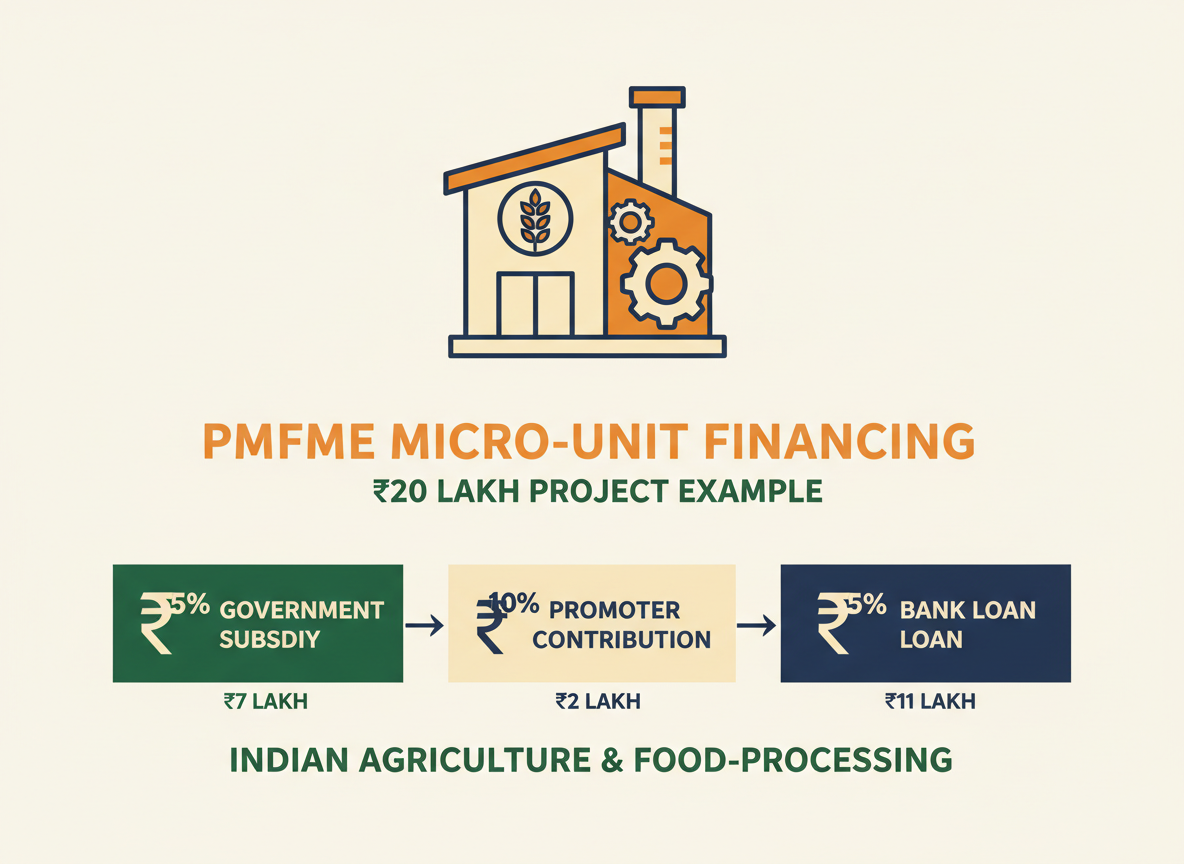
A worked example makes the arithmetic concrete. On a ₹20 lakh project, the subsidy works out to ₹7 lakh, the promoter’s own contribution to ₹2 lakh, and the bank loan to ₹11 lakh. The ₹7 lakh does not arrive as a cheque; it is placed in a mirror account against the loan and adjusted after three years, provided the account has stayed standard and the unit is running.
2. Credit-linked subsidy for common infrastructure. FPOs, farmer producer companies, cooperatives, SHGs and their federations, and government agencies can get 35 per cent of the eligible project cost, up to ₹3 crore per unit, for a common processing line, value chain facility or incubation centre. MoFPI’s page states there is no precondition of minimum turnover or experience for this component — which matters, because a young FPO rarely has either.
3. Seed capital for SHG members. ₹40,000 per member of a self-help group, up to ₹4 lakh per SHG, as seed capital for members to start or scale a food processing activity. This is the component that has reached the largest number of people: seed capital has been approved for 4,18,293 SHG members.
4. Training and handholding. Capacity building in food safety, packaging, bookkeeping, registration and machinery operation, plus a District Resource Person (DRP) who helps prepare the detailed project report and the loan file. There is no application fee and no charge for this handholding.
The scheme can be combined with other support. MoFPI’s guidelines specifically allow convergence with the credit guarantee cover of the Credit Guarantee Fund Trust for Micro and Small Enterprises (CGTMSE), with the 2 per cent interest subvention under the Interest Subvention Scheme for incremental credit to MSMEs, with PM MUDRA Yojana loans, and with NRLM support for SHGs — the last of which is described in our guide to the SHG-bank linkage programme.
Who Is Eligible / कौन पात्र है
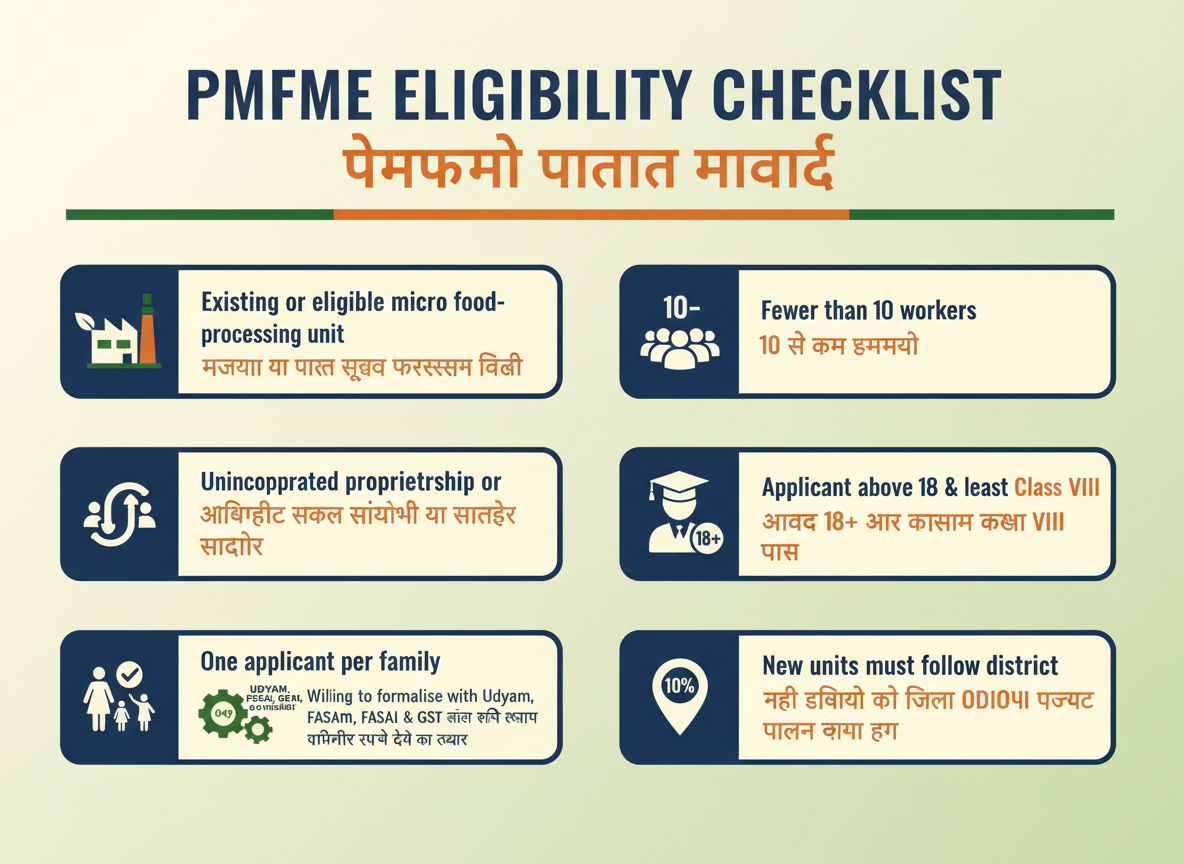
The eligibility rules for an individual micro enterprise are set out in MoFPI’s guidelines, and they are narrower than most summaries suggest. The applicant must:
- already run an existing micro food processing unit that is in operation — verified by the District Resource Person on physical inspection, with an electricity bill as evidence for units using power;
- run an unincorporated enterprise employing fewer than 10 workers, held as a proprietorship or partnership;
- own the enterprise, and be above 18 years of age with at least a Class VIII pass;
- be the only person from the family — self, spouse and children — applying for financial assistance;
- be willing to formalise the business (Udyam, FSSAI, GST as applicable) and to put in 10 per cent of the project cost.
New units are supported too, but only for the district’s One District One Product. Existing units producing the ODOP product get preference; existing units making other food products can still be considered. Proprietorship firms, partnership firms, FPOs, NGOs, cooperatives, SHGs and private limited companies are all listed as eligible organisation types on MoFPI’s scheme page.
The One District One Product Rule / एक जिला एक उत्पाद नियम
PMFME is built around the One District One Product (ODOP) approach. Each state identifies a food product for each district, chosen on the basis of existing clusters and the raw material available locally, so that support goes where procurement, common services and marketing can be shared rather than scattered.
In practice this decides what you can apply for. A new individual unit must be for the district’s ODOP product. An existing unit has more room, but preference still goes to ODOP. For a district where makhana is the identified product, for instance, the scheme’s common branding and marketing support is what turns dozens of small fox-nut processors into something a buyer can deal with — the production economics of that crop are covered in our makhana farming guide.
The ODOP logic has produced visible results. MoFPI reported in July 2026 that the scheme supports 40 common brands covering nearly 200 products, built around products such as makhana, millets, spices and GI-tagged items.
How to Apply, Step by Step / आवेदन कैसे करें — चरण दर चरण
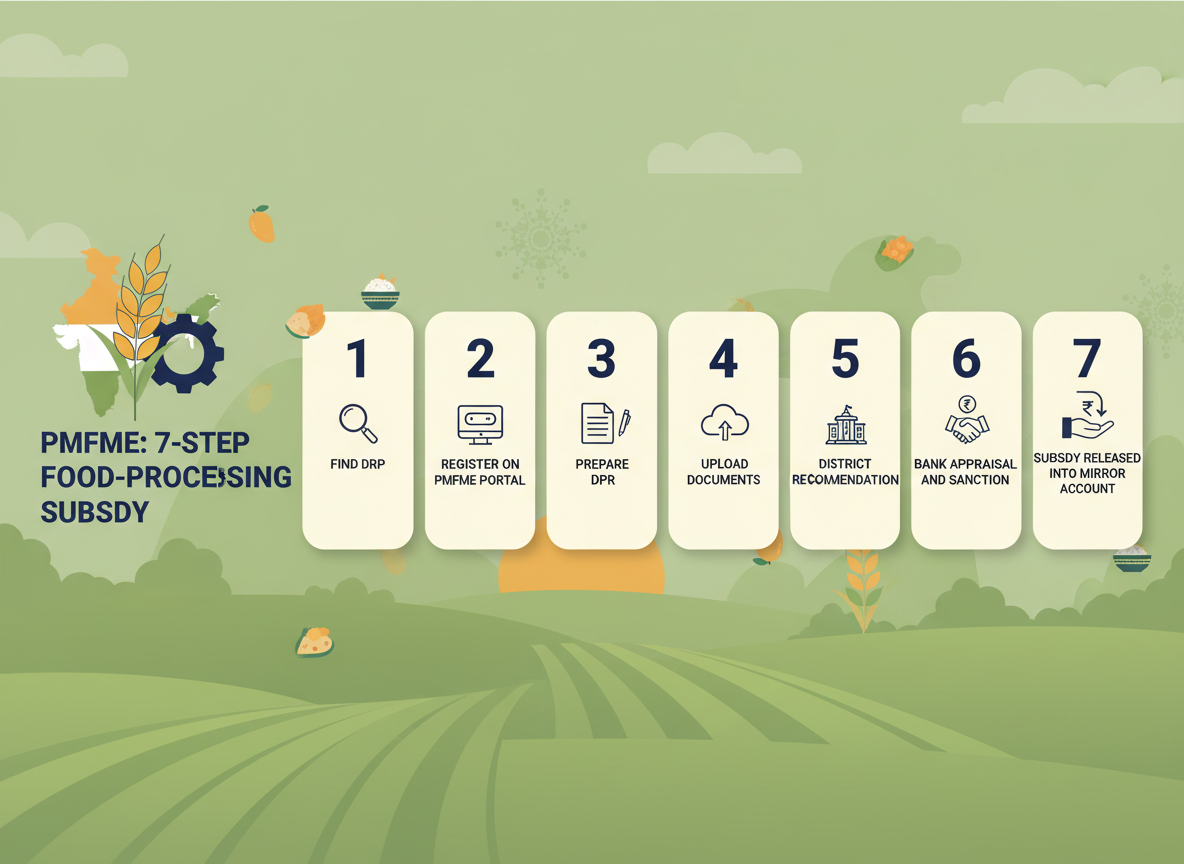
Applications are invited at the district level on a continuing basis and are filed through the online MIS portal at pmfme.mofpi.gov.in. The sequence is:
- Find your DRP. Every district has a nominated District Resource Person, listed under “Know Your DRP” on the PMFME portal. This person is the single most useful contact in the whole process, because they know the district’s ODOP product and the local bank branches.
- Register on the portal. Create the applicant account on the PMFME MIS. There is no application fee.
- Prepare the DPR. The DRP helps build the detailed project report: machinery quotations, technical civil work, working capital needs and a market plan. A weak DPR is the most common reason an application stalls, and the discipline of writing one is the same as for any other scheme — our note on the RKVY detailed project report walks through the structure.
- Upload the documents. Identity and bank details, proof that the unit exists and is operating, machinery quotations, and the DPR.
- District-level recommendation. The application is placed before the district committee, which recommends or returns it; the state nodal agency then forwards it.
- Bank appraisal and sanction. The lending bank appraises the project and sanctions the loan, with the promoter’s margin of at least 10 per cent.
- Subsidy release. The central and state shares of the grant are transferred through the national nodal bank to the lending branch, which credits the beneficiary’s mirror account. After three years, if the account is standard and the unit is operational, the grant is adjusted in the beneficiary’s account. If the account turns non-performing before that, the grant is adjusted towards repayment instead.
On security, the practical position has improved. MoFPI’s guidelines provide for CGTMSE credit guarantee cover on loans under the scheme, and banks generally take no collateral up to ₹10 lakh. Separately, the Reserve Bank of India raised the limit below which scheduled commercial banks may not insist on collateral for MSE loans from ₹10 lakh to ₹20 lakh, effective 1 April 2026 — a change noted in a PIB release of 16 March 2026. That is worth quoting at the branch if you are asked for a mortgage on a small loan.
What Six Years Have Delivered / छह वर्षों में क्या हासिल हुआ
PMFME reached its original target of two lakh beneficiaries. As on 30 June 2026, according to figures the Union Minister for Food Processing Industries gave in an interview and in a Lok Sabha reply, the scheme had sanctioned loans to 2,00,421 micro food processing enterprises, leveraging ₹20,434.81 crore of project investment and ₹17,032.53 crore of institutional bank credit, with ₹5,954.57 crore paid out as subsidy.
More than 75,000 supported enterprises have formalised through Udyam, FSSAI and GST registrations; seed capital has been approved for 4,18,293 SHG members; and the scheme reports over six lakh direct employment opportunities, with PIB putting direct and indirect employment together at nearly 11 lakh. Nearly 90 per cent of beneficiaries are first-generation entrepreneurs and about 44 per cent are women. Over 1.76 lakh people have been trained in food processing, packaging and business skills, roughly 77 per cent of them women. Bihar has the largest number of sanctioned units, more than 32,100, ahead of Maharashtra, Uttar Pradesh and Madhya Pradesh.
Where the Scheme Stands Now / अब योजना कहाँ खड़ी है
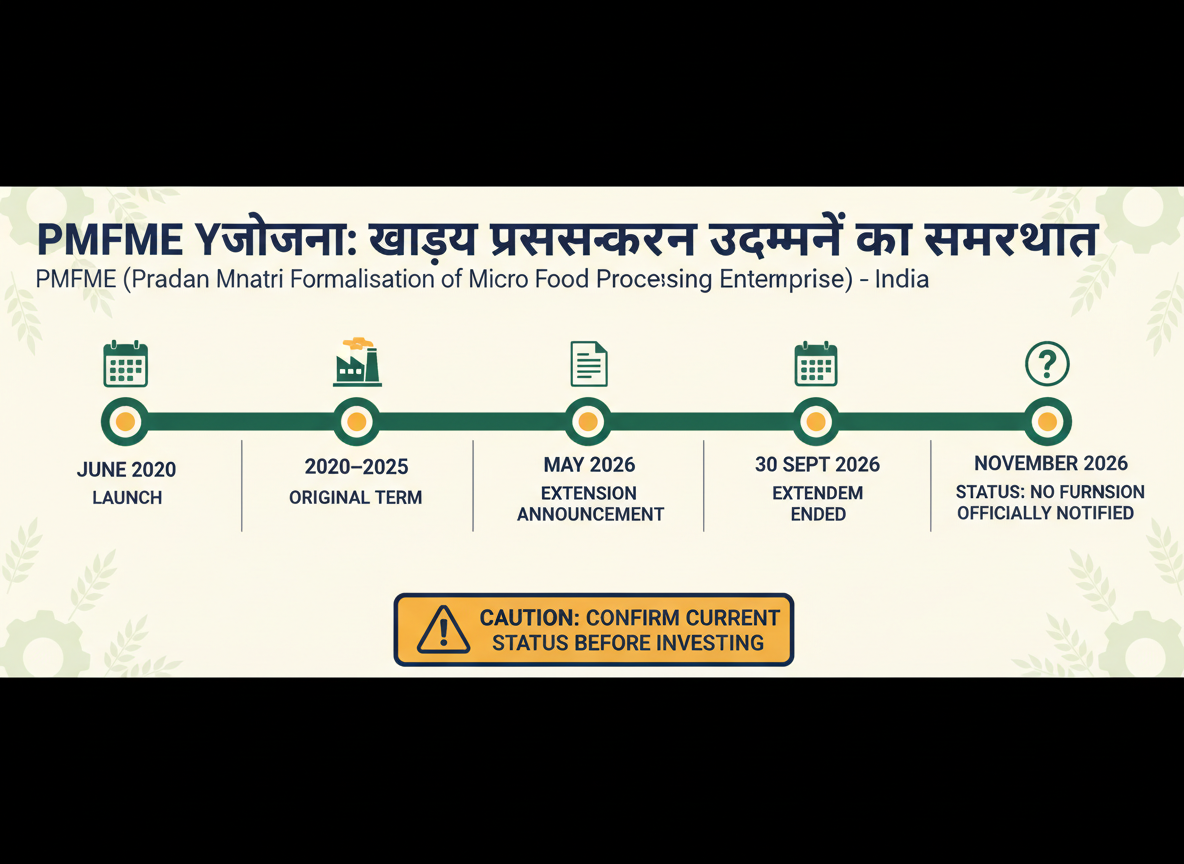
This is the part every applicant needs to read before spending money on a project report.
PMFME was approved for 2020-21 to 2024-25. In May 2026 MoFPI stated that the scheme had been extended until September 2026. That extended term ended on 30 September 2026. As of the first week of November 2026, no further extension, no Cabinet approval for a new period and no formally notified successor scheme had been published on PIB or on the PMFME portal.
What exists is a stated intention, not an approval. In July 2026 the Union Minister said the ministry was considering a PMFME 2.0 with suitable changes to attract more investment. In August 2026 he said the government was considering continuation during the 16th Finance Commission period, 2026-31. Mint reported in September 2026 that PMFME was among about a dozen flagship schemes being readied for Cabinet approval for five years to 2030-31, and the 2026-27 Union Budget provided ₹1,700 crore for the scheme. None of that is a notification.
The honest reading is therefore: treat new applications as uncertain until the position is clarified. Before you commission a DPR or buy machinery against an expected subsidy, confirm with your District Resource Person and the state nodal agency whether the portal is accepting applications and under which guidelines. Do not sign a supplier contract on the assumption that the subsidy will come through.
If you need capital now and cannot wait, several adjacent routes remain open. The Agriculture Infrastructure Fund supports post-harvest and processing infrastructure with interest subvention and credit guarantee. Cold chain schemes cover storage and preservation. A Kisan Credit Card handles the crop loan side. And for a group, the FPO formation and promotion programme and the Producer Organisation Development Fund are the usual first stops before a processing project.
Key Takeaways / मुख्य बातें
- PMFME gives a 35 per cent credit-linked capital subsidy, capped at ₹10 lakh per individual micro unit, with the promoter putting in at least 10 per cent and the rest as a bank loan.
- Only plant and machinery plus technical civil work count as eligible cost, and civil work is capped at 30 per cent of it; land and workshed rent are excluded.
- New individual units must be for the district’s One District One Product; existing units get preference for ODOP but other food products can be considered.
- The scheme’s extended term ended on 30 September 2026 and no further extension had been notified as of early November 2026 — confirm with your DRP or state nodal agency before committing money.
- By 30 June 2026 it had sanctioned 2,00,421 loans, leveraged ₹20,434.81 crore of investment and paid ₹5,954.57 crore in subsidy, with about 44 per cent women beneficiaries.
Sources / स्रोत
- Ministry of Food Processing Industries, PMFME scheme page — https://www.mofpi.gov.in/schemes/pmfme
- MoFPI, PMFME Scheme Guidelines (credit linkage, convergence) — https://pmfme.mofpi.gov.in/newsletters/docs/SchemeGuidelines.pdf
- MoFPI, Guidelines for Support of Individual Micro Food Processing Enterprises under PMFME — https://www.pmfmeap.org/sites/default/files/2021-07/06_Guidelines%20for%20Support%20of%20Individual%20Micro%20Food%20Processing%20Enterprises%20under%20the%20PMFME%20Scheme.pdf
- PMFME portal, application FAQs and District Resource Person listing — https://pmfme.mofpi.gov.in
- PIB, release on the two-lakh loan sanction milestone, 11 July 2026 — https://www.pib.gov.in/PressReleasePage.aspx?PRID=2283606
- The New Indian Express, interview with the Union Minister for Food Processing Industries, 7 August 2026 — https://www.newindianexpress.com/india/2026/Aug/07/interview-working-with-banks-for-faster-loan-okay-chirag-paswan
- The Economic Times, report on the two-lakh milestone and PMFME 2.0, 11 July 2026 — https://economictimes.indiatimes.com/news/economy/policy/2-lakh-micro-food-processing-enterprises-covered-under-credit-linked-subsidy-scheme-pmfme-govt/articleshow/132330815.cms
- Mint, report on Cabinet approval being sought for extending flagship schemes, 28 September 2026 — https://www.livemint.com/economy/government-schemes-extension-pm-kusum-pm-poshan-aif-pmfme-11790588034094.html
- PIB, release on credit guarantee and collateral-free MSME lending limits, 16 March 2026 — https://www.pib.gov.in/PressReleasePage.aspx?PRID=2240590
- ETV Bharat, report on PMFME outcomes and state-wise sanctions, 4 September 2026 — https://www.etvbharat.com/en/bharat/food-for-thought-2-lakh-fpus-taste-success-generate-11-lakh-jobs-enn26090406663


Leave a Reply