

भारत में भिंडी की खेती: बीज से मंडी तक संपूर्ण रोपण एवं देखभाल मार्गदर्शिका – Okra — bhindi, lady’s finger — is one of the few vegetables that pays a farmer within two months of sowing and keeps paying for months afterwards. This guide follows the crop through its whole life: soil and season, seed and seed treatment, sowing, watering, feeding, reading the plant for stress, managing yellow vein mosaic and the shoot and fruit borer, and handling pods so they still look fresh when they reach the mandi. Every figure below is attributed to an ICAR institute, the National Horticulture Board or a state package of practices listed in the Sources section.
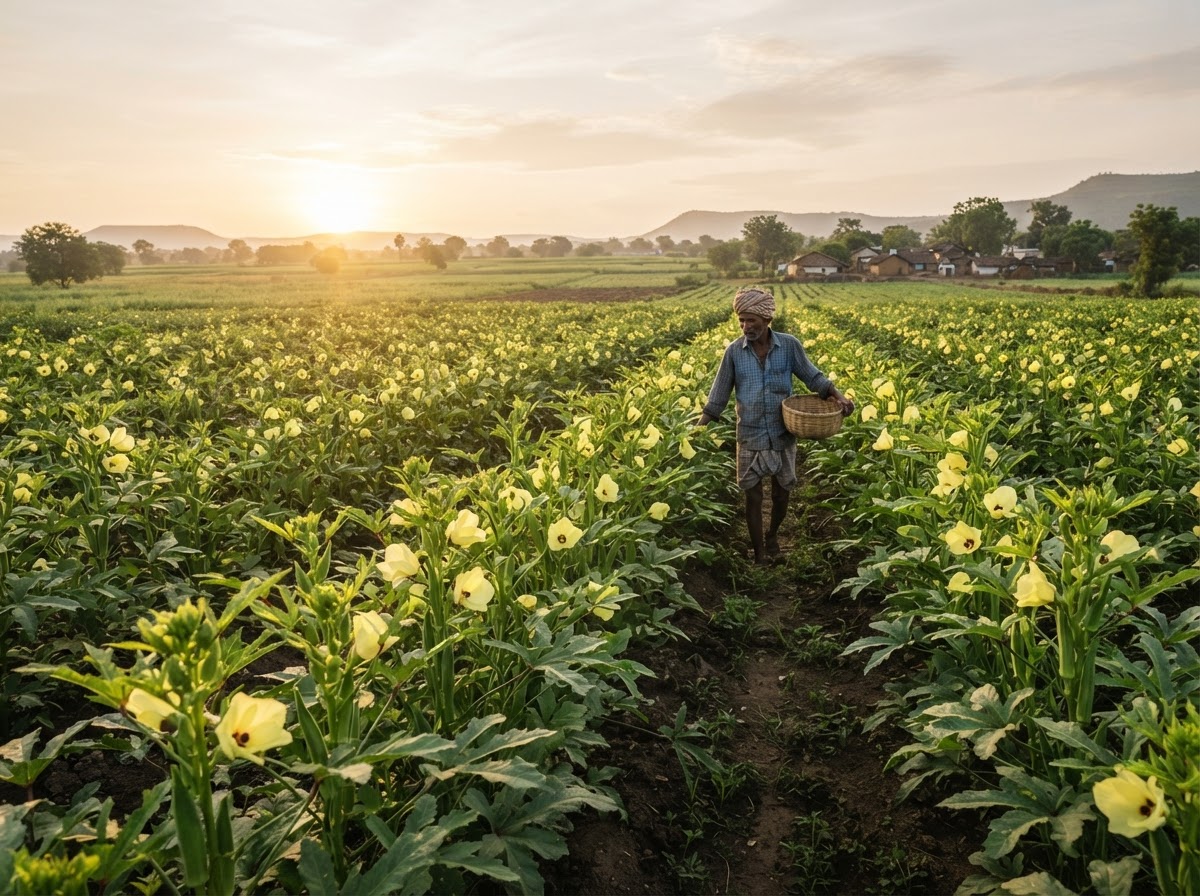
Why Okra Fits Indian Farms / भिंडी भारतीय खेतों के लिए क्यों उपयुक्त है
Okra occupies a small area but is harvested again and again. The first picking usually begins 45 to 60 days after sowing, and with disciplined picking the plants keep bearing for up to six months. Because the crop is short and can be slotted between two main crops, it suits both a smallholder who needs weekly cash and a commercial grower who wants a third crop in the year. Pusa Lal Bhindi-1, released by ICAR-Indian Agricultural Research Institute in 2022, is documented at an average yield of 120 q/ha in spring–summer and 150 q/ha in kharif, which is a fair benchmark for a well-managed crop.
Climate, Soil and Season / जलवायु, मिट्टी और मौसम
Okra needs a long, warm growing season. Seed will not germinate below 18 °C, the plants are susceptible to frost, and growth stalls in a continuous cold spell (ICAR-IARI package of practices for Pusa Lal Bhindi-1). A friable sandy loam rich in organic matter is the ideal soil, with a pH of 6.0–6.8; highly saline and calcareous soils are not suitable (ICAR, “Okra: Integrated crop management”, Indian Horticulture, July–August 2022). Drainage matters more than soil colour — okra will not tolerate a high water table or standing water. For help matching soil type and nutrient status to your field before you sow, see our complete guide to soil, and for how temperature and rainfall patterns across regions affect season choice, see our climate and agriculture overview.
There are two main seasons. The kharif crop is sown from mid-June to July; the spring–summer crop is sown in February–March. In the mild-winter south a third crop is taken in October–November (Kerala Agricultural University package of practices). Spring sowing should not be pushed too early: seed sown into cold soil rots, and a February crop that meets a late cold spell will flower and drop.
Varieties and Seed / किस्में और बीज
Pick a variety for the season and, above all, for tolerance to yellow vein mosaic, the virus that decides whether an okra season succeeds or fails. Green-fruited tolerant varieties widely recommended by ICAR institutes and state agricultural universities include Arka Anamika, Arka Abhay, Parbhani Kranti, Punjab Padmini, Phule Vimukta and Phule Utkarsha (ICAR, Indian Horticulture). Pusa Lal Bhindi-1 is a red-fruited, anthocyanin-rich variety from ICAR-IARI, released in 2022 and approved by the Delhi State Seed Committee on 17 January 2023.
Seed rate depends on spacing and season: 8–10 kg/ha for the kharif crop and 12–15 kg/ha for spring–summer (ICAR-IARI). Hybrids need noticeably less because they are sown thinner — around 75 × 60 cm. Buy certified seed, and check the packing date; okra seed loses vigour quickly in Indian summer storage.
Treat the seed before sowing. Dress it with imidacloprid 48% FS at 5 g/kg of seed to suppress whitefly, the vector of yellow vein mosaic, and so delay infection (ICAR, Indian Horticulture). If you also want biofertilizers, apply Azotobacter and phosphorus-solubilizing bacteria at 25 g each per kg of seed after the chemical treatment, never mixed with it. Already treated, packed seed needs nothing more. In summer, soaking seed in water for 6–12 hours before sowing improves and speeds germination. The full method is set out in our guide to seed selection and seed treatment techniques.
Land Preparation and Sowing / भूमि तैयारी और बुवाई
Plough two to three times to a fine tilth, level the field, and mix 20–25 t/ha of well-rotted farmyard manure into the soil at the final ploughing. Sow on ridges in February–March and on flat beds in June–July; in high-rainfall or waterlogging-prone fields use raised beds (ICAR-IARI). Spacing is 60 × 30 cm in kharif and 45 × 30 cm in spring–summer, with hybrids at about 75 × 60 cm. Dibble two to three seeds per hole, 2–3 cm deep, on the sides of the ridge, and thin to one healthy seedling about ten days after emergence.
Weed control starts on the day of sowing. Spray pendimethalin at 3 litres per hectare in 500 litres of water immediately after sowing while the soil surface is moist (ICAR-IARI). This pre-emergence spray buys the crop its first three weeks; the comparison of sowing systems is covered in sowing methods in agriculture, and the wider weed strategy in weed management practices.
Watering / सिंचाई
Okra wants light, frequent watering rather than heavy flooding. In summer, irrigate every two to three days (KAU package of practices); in the rainy season, irrigate only when a dry spell runs beyond a week, and drain standing water within hours, because waterlogging at the collar is how root rots and collar rot get in. Flowering and pod filling are the two stages where a short moisture gap costs real yield — flowers drop and pods turn fibrous and hard. Drip with plastic mulch holds the root zone steady, cuts weeding and saves water; the subsidy route is described under the Per Drop More Crop scheme.
Manure and Fertilizer: What to Use and How to Apply / खाद और उर्वरक: क्या दें और कैसे दें
Start with a soil test, not a bag of urea. At medium soil fertility, ICAR recommends 20 t of organic manure per hectare together with 100 kg N, 50 kg P₂O₅ and 50 kg K₂O; the National Horticulture Board gives 100:60:50 kg/ha with 20–25 t FYM; ICAR-IARI’s recommendation for Pusa Lal Bhindi-1 is 20 t FYM with 100:60:80 kg N:P:K per hectare. Adjust to the test: if soil nutrient status is low, add 25% to the recommended dose, and 50% if it is extremely low; if status is high, cut the dose by 25%, and by half if extremely high (ICAR, Indian Horticulture). The logic behind these combinations is explained in integrated nutrient management, and for a broader primer on fertilizer types and how crop requirements are worked out, see our guide to fertilizers.
The split matters as much as the dose. Apply the full dose of phosphorus and potash and half the nitrogen as a basal dose at final land preparation. Apply the remaining nitrogen in three equal splits at 30, 45 and 60 days after sowing, each followed by irrigation (ICAR-IARI). To top-dress, open a narrow furrow on one side of the ridge, drop the urea in, cover it with soil and earth up — urea broadcast on the surface is largely lost to volatilization and washing.
Alongside the chemical dose, apply neem cake at 250 kg/ha before sowing, and Azotobacter 2.5 kg, phosphorus-solubilizing bacteria 2.5 kg and Trichoderma 5–6 kg per hectare mixed into well-decomposed FYM or vermicompost (ICAR). If you want to prepare your own vermicompost rather than buy it, our vermicomposting guide covers the setup and timing. Tamil Nadu’s package adds a small nitrogen top dressing at every third picking, which holds pod size through the later harvests when the plant is carrying a heavy load.
Care in the Growth Phase / वृद्धि अवस्था की देखभाल
Okra is a poor competitor in its first month. Two weedings — around 20–25 days and again at 40–45 days — plus the pre-emergence spray keep the field clean, and earthing up during the rainy season keeps the collar out of water. Earth up again after the first top dressing to steady the stem, since a bearing plant is top-heavy. Keep nitrogen moderate: lush, dark, soft growth is exactly what whitefly and fruit borer prefer, and it produces pods that bruise and blacken in transit. Walk the field twice a week and remove borer-damaged shoots and bored fruits as soon as you see them; destroying one generation of larvae is worth more than a spray.
Diseases and Pests: Prevention and Treatment / रोग और कीट: रोकथाम और उपचार
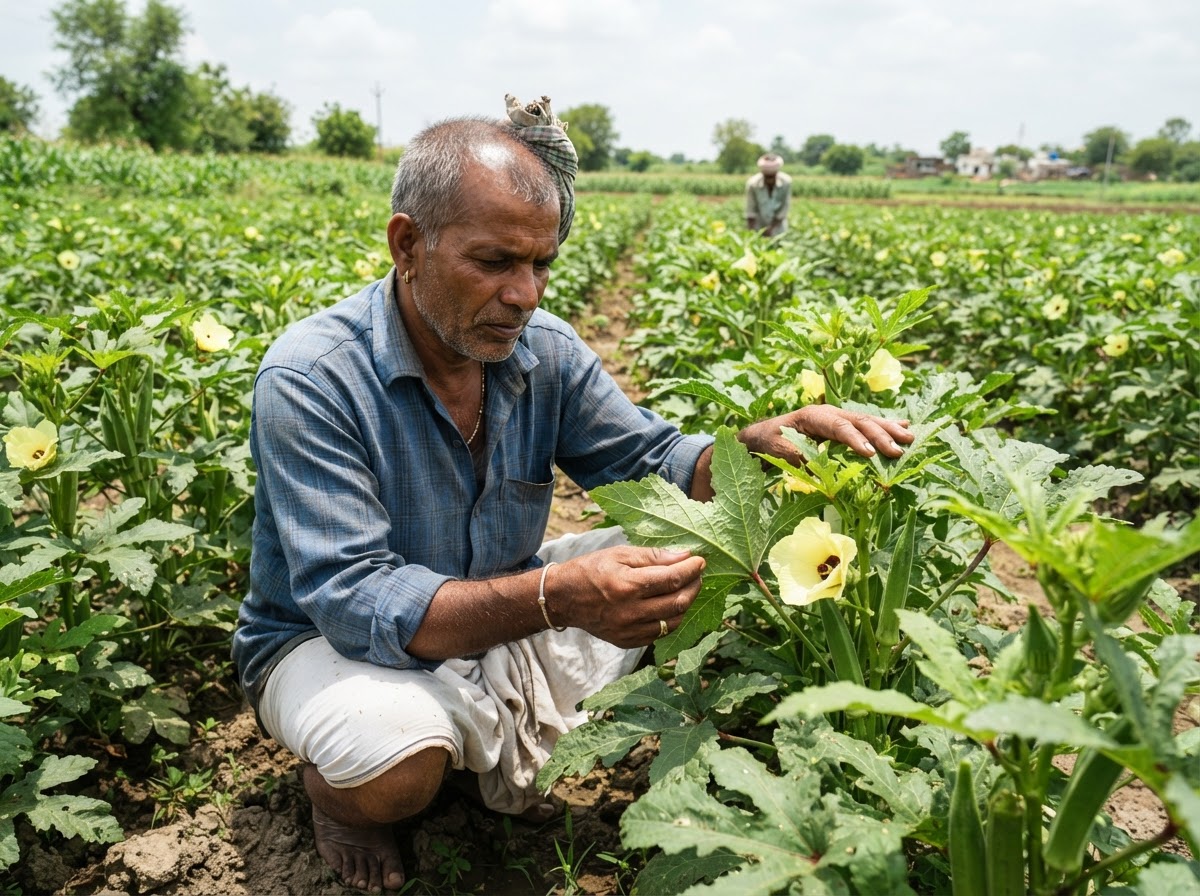
Yellow vein mosaic virus (YVMV). The classic okra disease. Leaves show a network of yellow veins that thickens until the leaf is chlorotic and leathery, plants stay stunted, and fruits are small and deformed. It is spread by whitefly, and there is no chemical cure — a literature review in Australia’s okra import risk assessment puts in-crop yield loss from okra yellow vein mosaic virus at 50–94%. Prevention is therefore the whole game: sow a tolerant variety, raise or buy seedlings under 40–50 mesh nylon net, plant two border rows of maize, bajra or sorghum as a barrier before the okra comes up, install yellow sticky traps at 20 per hectare, and rogue out infected plants the day symptoms appear. Where whitefly pressure is heavy, a need-based spray of imidacloprid 20 SL or thiamethoxam 25 WP, at label rates up to flowering only, reduces spread — not infection already inside the plant.
Shoot and fruit borer (Earias vittella). Larvae bore into terminal shoots, which wilt and dry, and then into tender pods, which become deformed and unfit for sale. ICAR’s review of okra pests records yield loss of 24.6–26% in shoots and 40–100% in fruits where it is uncontrolled. Manage it with pheromone traps at 20 per hectare for monitoring and mass trapping, hand-picking of larvae, and removal and destruction of damaged shoots and fruits. For spraying, neem seed kernel extract at 5%, or a CIBRC-approved product such as spinosad at 1 ml per 3 litres, at 10-day intervals when trap catches justify it.
Root-knot nematode, damping off and sucking pests. Nematode damage shows as patchy stunting and galls on the roots; rotate with cereals, keep Trichoderma and neem cake in the programme, and avoid okra-after-okra. Damping off in the nursery comes from overwatering and unsterilized media — use Trichoderma-treated compost and ventilated trays. Jassids and aphids are held down by yellow sticky traps and a 0.5% neem oil spray.
Two rules for every spray: use only products and doses registered with the Central Insecticides Board and Registration Committee for okra, and respect the pre-harvest interval on the label, because pods are picked every second day and residue sits on the fruit, not on a leaf you discard. The framework is set out in integrated pest management and in crop diseases: effects, symptoms and management.
Reading the Crop: Healthy Plants and Stressed Plants / फसल कैसे पढ़ें: स्वस्थ और रोगग्रस्त पौधे
A healthy okra plant tells you so. Look for deep green, broad, flat leaves with no cupping; a thick, upright stem; four to six tender pods of even size on the plant at any one time; flowers opening every day through the bearing period; and pods whose tips snap cleanly when bent. New growth should appear at the top every few days.
Stress has its own vocabulary. Yellow-veined, cupped or leathery leaves mean virus, and the plant should come out. Pale lower leaves and thin stems point to nitrogen shortage; scorched leaf margins point to potash shortage or salt build-up. Flower drop with no pod set usually means heat above the mid-30s, a moisture gap, or too much nitrogen. Pinholes with frass at the tip, or a wilted terminal shoot, mean borer. Pods that bend, look dull and feel hard are over-mature — they were left on the plant too long, and every one of them costs you the next flush.
Harvesting / कटाई
Harvest five to six days after the flower opens, when the pod is 8–12 cm long, green, tender and crisp, and the tip snaps readily when bent. Pick every one to two days, in the morning while the pods are cool, using clippers or a short thumb nail to leave about 0.5–1 cm of stalk on the pod; pulling tears the skin and darkens the edges. Harvesting begins 45–60 days after sowing and can continue for up to six months while the plants stay healthy (ICAR-IARI; reviewed production practice in Australia’s okra import risk assessment). Pick often and pick everything: an over-mature pod left on the plant signals it to stop setting new ones.
After Harvest / कटाई के बाद
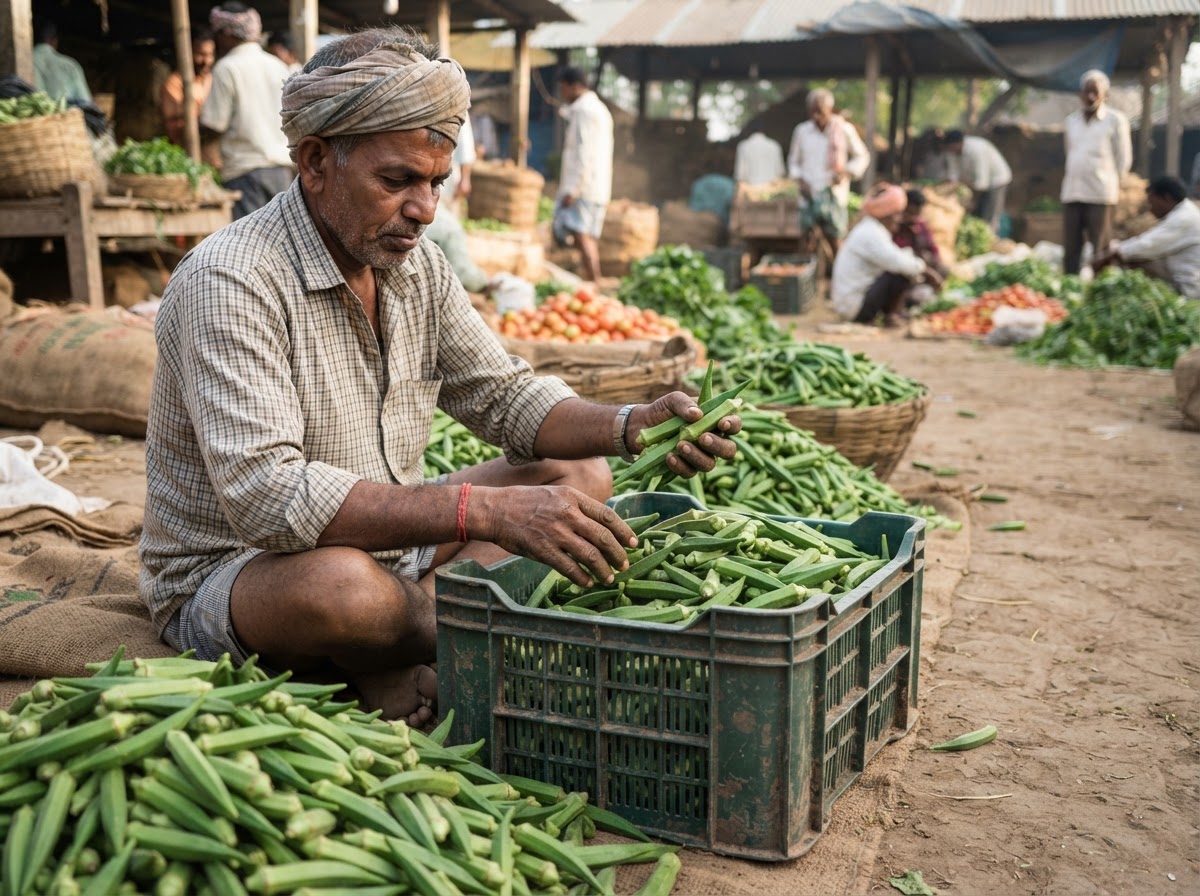
Okra is one of the most perishable vegetables in the mandi. Pods respire fast, heat up in bulk and blacken along the ridges within a day at room temperature. Never collect them in sacks or bamboo baskets — both bruise the pods and trap heat; use clean, ventilated shallow plastic crates and keep them in the shade from the moment they leave the plant. Do not wash pods that will be sold the same day. Grade out bent, spotted, borer-damaged and over-mature pods in the field, because one rotting pod spoils a crate.
For anything beyond a same-day sale, pre-cool the pods and hold them at 7–10 °C with 90–95% relative humidity, where okra keeps for seven to ten days; below 7 °C it suffers chilling injury and pits, and hydrocooling causes water spotting (post-harvest protocols compiled by CII-FACE and the National Horticulture Board’s storage guidance). Pack for transport in perforated corrugated fibreboard boxes rather than sealed bags. Cold-chain and pack-house support is available under the schemes described in cold chain schemes. Before you commit a crate to the local mandi, it’s worth checking current demand and prices on K-Bazaar.
Key Takeaways / मुख्य बातें
- Sow kharif okra in mid-June to July and spring–summer in February–March; seed will not germinate below 18 °C and the crop will not take frost.
- Choose a yellow vein mosaic tolerant variety — Arka Anamika, Arka Abhay, Parbhani Kranti, Punjab Padmini, Phule Vimukta or Phule Utkarsha — and dress seed with imidacloprid 48% FS at 5 g/kg.
- Apply 20–25 t/ha FYM with a basal dose of full P and K plus half the N; split the remaining N at 30, 45 and 60 days after sowing, in a furrow beside the ridge, followed by irrigation.
- Spray pendimethalin 3 L/ha immediately after sowing, keep the field weed-free for the first month, and earth up in the rains.
- Pick every one to two days at 8–12 cm, cool the pods in the shade in ventilated crates, and store at 7–10 °C and 90–95% RH for seven to ten days.
Sources / स्रोत
- ICAR, “Okra: Integrated crop management”, Indian Horticulture, July–August 2022 — epubs.icar.org.in
- ICAR-IARI, package of practices for Pusa Lal Bhindi-1 (DOV-68), Indian Horticulture — epubs.icar.org.in
- ICAR, “Conquering okra pests: a comprehensive guide to sustainable management”, Indian Horticulture — epubs.icar.org.in
- National Horticulture Board, okra: manuring and fertilization — nhb.gov.in
- ICAR-CCARI, Goa, okra cultivation and post-harvest notes — ccari.res.in
- Kerala Agricultural University, Package of Practices Recommendations: Crops (okra) — pop.kau.in
- CII-FACE / CCLRC, post-harvest management protocols for okra — face-cii.in
- Australian Government Department of Agriculture, Fisheries and Forestry, “Okra from India: biosecurity import requirements” (review of Indian production, harvest and post-harvest practice) — agriculture.gov.au


Leave a Reply