
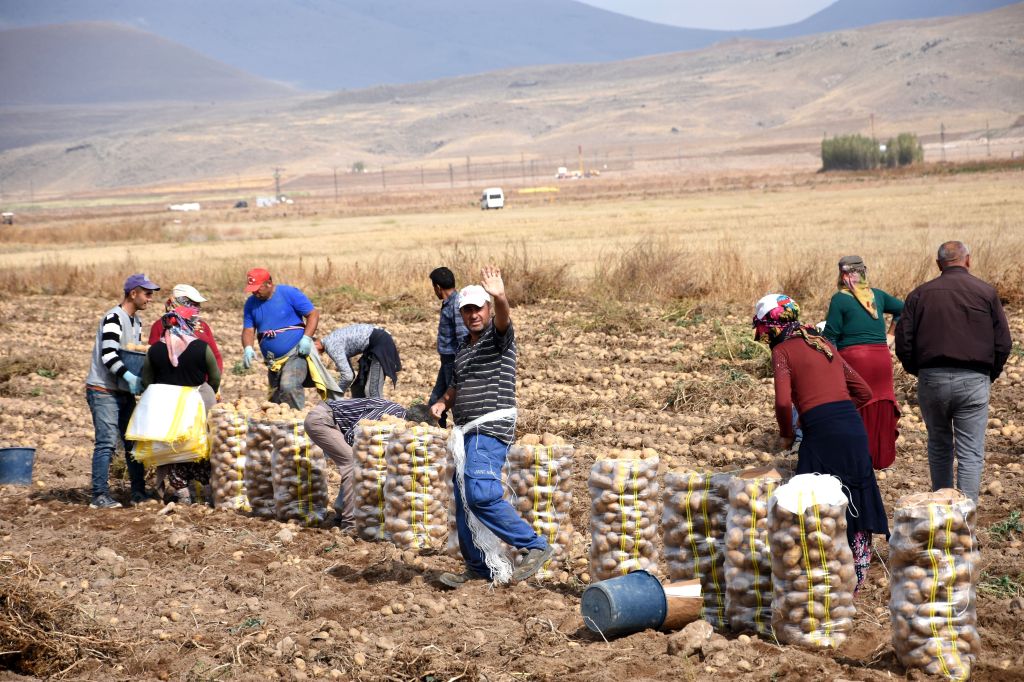
Potato is the single largest vegetable crop in India by volume, and almost all of it is grown in the short, cool winter window between October and February. That short window is unforgiving: a late planting, a missed earthing up, or one unsprayed week of cloudy weather in January can decide whether the crop goes to the cold store or to the mandi at a loss. This guide follows the whole lifecycle of the crop — climate and soil, season, seed tuber, planting method, manure and fertiliser, watering, growth-stage care, disease recognition and treatment, harvest, and what to do after harvest — using recommendations from ICAR-Central Potato Research Institute (CPRI), the National Horticulture Board (NHB), Punjab Agricultural University (PAU) and the Ministry of Agriculture’s latest production estimates. | आलू की खेती: रोपण से भंडारण तक संपूर्ण गाइड
Why the potato crop matters / भारत में आलू का महत्व
India produced an estimated 585.71 lakh tonnes (58.57 million tonnes) of potato in 2024-25, up 2.66 per cent from 570.53 lakh tonnes in 2023-24, according to the Final Estimates of horticultural crop production approved by the Union Agriculture Minister and released by the Press Information Bureau on 17 March 2026. That keeps India the world’s second-largest potato producer after China. For scale: total vegetable production in the same year was 2,177.97 lakh tonnes, so potato alone accounted for roughly 27 per cent of India’s vegetable output.
Agronomically, the potato is not a root but a tuber — a swollen, modified underground stem produced at the end of a stolon. That matters for management, because everything the plant does in the first 45 days is about building foliage and stolons, and everything after that is about moving sugar down into the tubers. CPRI notes that 85-90 per cent of India’s crop is grown in the sub-tropical plains during the short winter days from October to February, with the hills contributing under 5 per cent.
Climate and soil requirement / जलवायु और मिट्टी की आवश्यकता
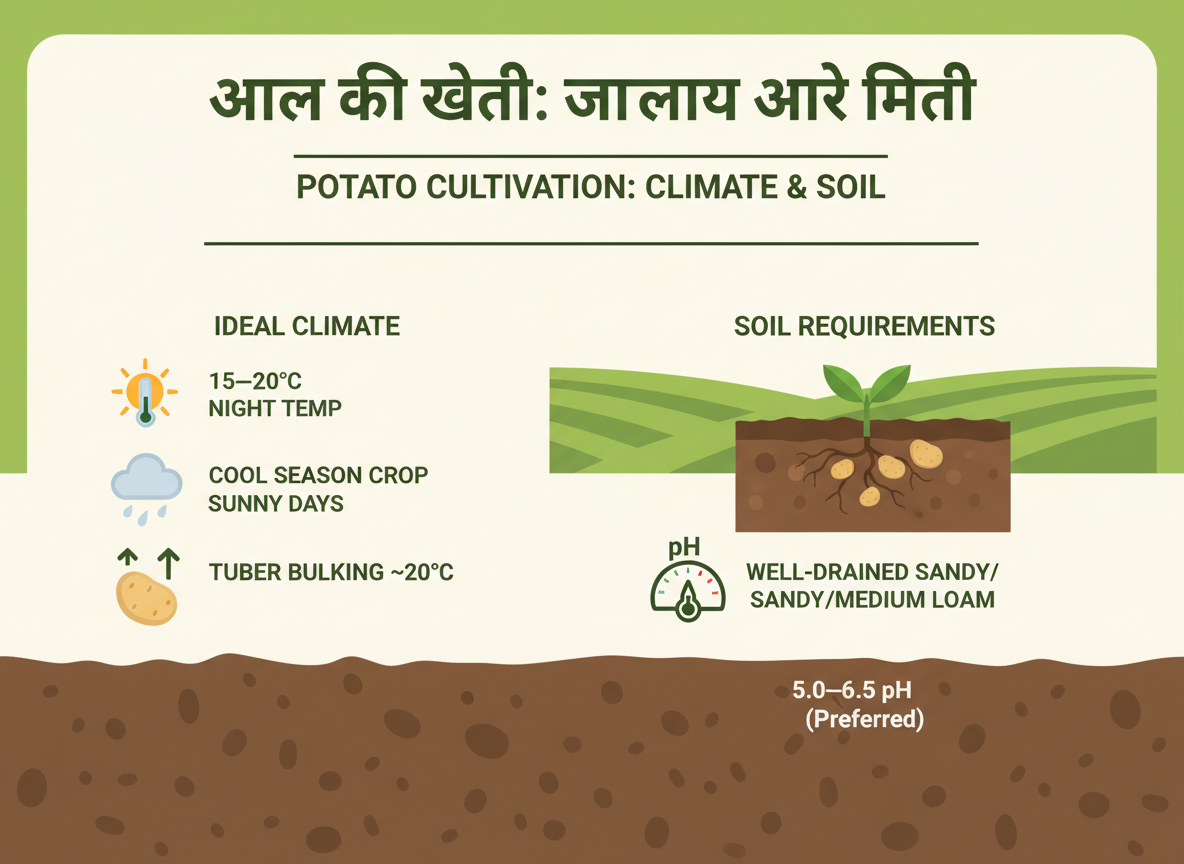
Potato is a cool-season crop. CPRI’s recommended target is night temperatures of 15-20°C with sunny days. Tuber initiation and bulking are best around 20°C and fall away sharply as temperature rises; tuberisation is badly affected at about 30°C, because at high temperature the plant respires away the carbohydrate it should be storing. Frost, on the other hand, can burn the crop outright in December-January in the north-western plains, so frost tolerance is a genuine varietal requirement there.
The crop wants a friable, well-aerated, fairly deep soil with good organic matter. Well-drained sandy loam and medium loam are the best choices, because light soils warm evenly and make harvesting easier; heavy clay soils produce cloddier, dirtier, more damaged tubers. A slightly acidic soil reaction of about pH 5.0 to 6.5 is preferred, since acidic conditions suppress common scab. Alkaline and saline soils are not suitable. Because fertility recommendations depend on the field, not the crop, get a soil test before deciding fertiliser doses.
Season and planting window / मौसम और रोपण का समय
In the northern plains the main (rabi) crop is planted from the first week of October to about the third week of October; NHB also places the main crop in the first week of October. In eastern India, KVK Assam puts the optimum window at mid-October to mid-November, and notes that Kufri Sindhuri can be planted up to mid-December. The practical rule CPRI gives is to plant when the maximum day temperature is below 32°C, so that tuberisation — which begins roughly 25-30 days after planting — falls in the 15-25°C range.
Around this main crop, growers also take an early crop planted in the third week of September (harvested immature for the early market, low yield but high price) and a late or spring crop planted in late January. In the hills the crop is planted from the third week of February to the second week of April. If you are planning rotations, the rabi season calendar is the right frame to work from.
Seed tuber selection and treatment / बीज कंद का चयन एवं उपचार
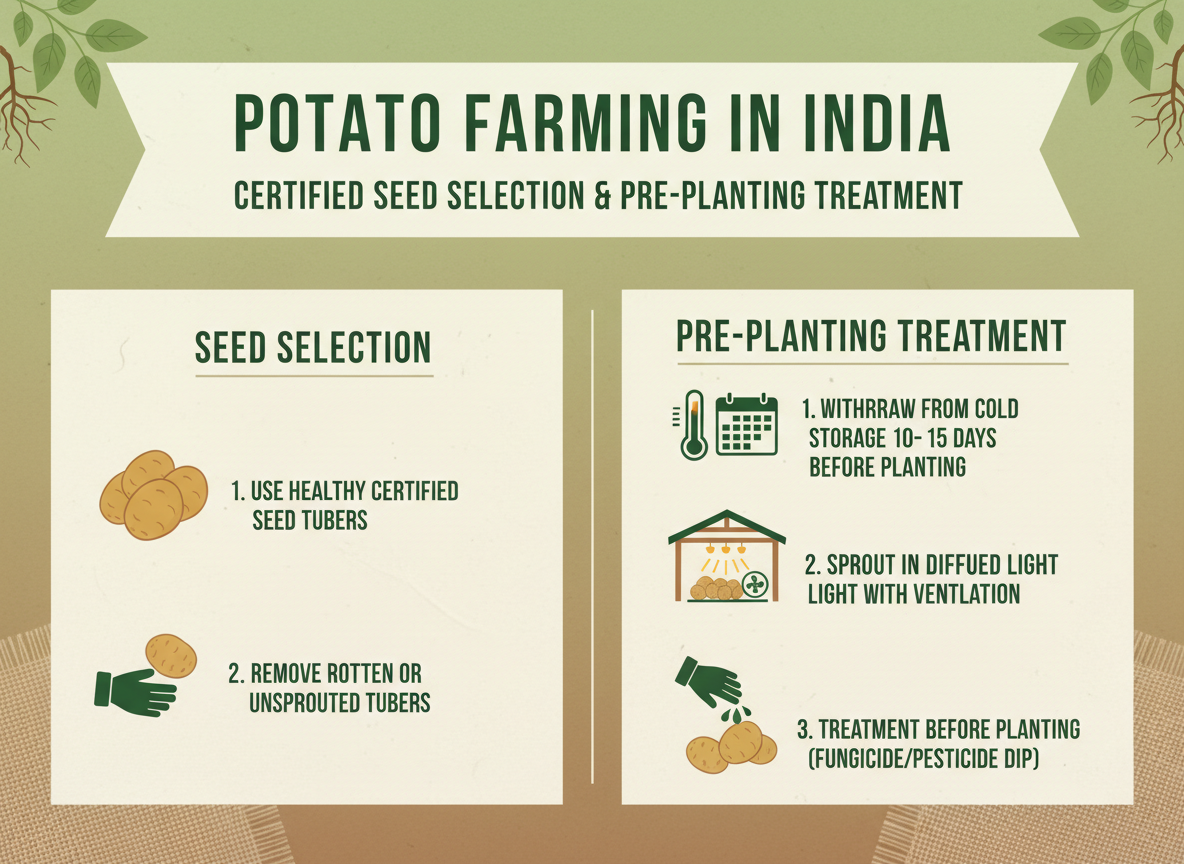
Seed is the largest single input cost and the largest single determinant of yield. Use certified seed from ICAR-CPRI, the National Seeds Corporation, a state seed corporation or another authorised agency, and replace the seed lot every three to four years. Virus degeneration accumulates in farm-saved seed and shows up as yield loss long before it shows up as visible symptoms.
Seed rate. NHB puts the requirement at 1.5-1.8 t/ha for round-tuber varieties and 2.0-2.5 t/ha for oval varieties. Where small tubers of about 25 g are planted at 15 cm within the row, the requirement works out to about 22.5-25 q/ha. Bigger tubers mean a higher seed rate at the same spacing, or a wider spacing at the same rate.
Pre-planting preparation. Seed potatoes should be withdrawn from the cold store 10-15 days before planting and kept in a single layer in baskets, trays or on the floor, in diffused light with good ventilation, so that sprouts develop and harden. Remove rotten, unsprouted and off-type tubers during this period. For black scurf and common scab, treat the tubers by dipping them for 10 minutes in Tafasan or Emisan at 2.5 g per litre of water after taking them out of cold storage, then dry them in shade. If tubers are cut, keep two to three eyes per piece and treat the cut surfaces the same way. The general principles of seed selection and seed treatment apply here as well.
Field preparation and planting method / खेत की तैयारी एवं रोपण विधि
Plough to a depth of 20-25 cm and expose the soil to the sun, then give two or three harrowings and level the field. If the field is dry, give a pre-planting irrigation 7-10 days before preparation so that planting moisture is adequate. Mix 25-30 t/ha of well-decomposed farmyard manure into the soil at the last ploughing.
Open furrows 50-60 cm apart, place the tubers 15-20 cm apart in the centre of the furrow at a depth of 5-7 cm with the sprout facing upward, and cover with soil. CPRI’s organic package for the north Indian plains uses a slightly wider geometry — 67.5 cm between rows, 20-35 cm between plants depending on seed size, and a planting depth of 8-10 cm. Ridge or furrow planting is better than flat planting followed by earthing up, because it places the seed in moist soil and gives the tuber room to swell. Handle the tubers carefully; a broken sprout is a lost stem.
Manure, fertiliser dose and how to apply it / खाद, उर्वरक मात्रा एवं देने का तरीका
For a table-purpose crop, CPRI’s recommended dose in the north Indian plains is 180 kg N, 80 kg P₂O₅ and 100 kg K₂O per hectare, applied by band placement and broadcasting. This is a guide, not a rule: a crop yielding 25-35 t/ha removes roughly 120-140 kg N, 25-30 kg P and 170-230 kg K, so a soil test can move these numbers meaningfully. Note that potash removal is high relative to the dose — potato is a heavy potash feeder. For the wider logic of nutrient management, see this guide to fertiliser use for crop yield.
Timing and method. Apply the full dose of phosphorus and potash and two-thirds of the nitrogen as a basal dose in the furrows at planting, mixed thoroughly into the soil, and top-dress the remaining one-third of the nitrogen at about 50-55 days after planting. Applying the entire nitrogen dose at planting is poor practice: much of it leaches before the crop’s peak demand at tuber bulking. Phosphorus and potash placed on the surface after planting are largely wasted, because both are fixed in the soil — they must go into the root zone at planting.
Source and placement. Urea for nitrogen, single super phosphate for phosphorus and muriate of potash for potash are the standard and cheapest sources. The one absolute rule is that the seed tuber must never come into direct contact with fertiliser — place a thin layer of soil between the fertiliser band and the tuber, or fertiliser burn will kill the sprout. Add biofertilisers such as Azotobacter and phosphate-solubilising bacteria with FYM or vermicompost where available, and correct zinc or boron deficiency on soil-test advice.
Watering / सिंचाई प्रबंधन
Potato is shallow-rooted and responds sharply to moisture stress at three stages. KVK recommendations for the eastern plains use three irrigations: the first at about 25 days after planting at stolon formation, the second at about 60 days at tuber formation, and the third at about 80 days during tuber development. Adjust this to your soil and weather — light soils need more frequent, lighter watering; heavy soils need less. Irrigate along the furrows and never submerge the ridges completely, because waterlogged soil suffocates the tubers and spreads rot.
Stop irrigation 10-15 days before the expected harvest date. Late watering delays skin setting, makes the tubers more susceptible to rot in store, and encourages late blight spread through the canopy. Where drip is available, it pairs well with fertigation and with micro-irrigation support, and it keeps the foliage drier than furrow irrigation.
Care during the growth phase / वृद्धि अवस्था में देखभाल
0-25 days. Watch for even emergence, fill gaps where tubers have failed, and give a light hoeing to break the soil crust. Keep the field free of weeds in this phase — the crop cannot compete while the canopy is open.
Earthing up is the single most important operation. Earth up at about 25-35 days after planting, before the first or second irrigation, so that a good ridge of soil sits over the developing tubers. Proper hilling does three things: it gives the stolons dark, loose soil to tuberise in; it prevents tubers from pushing above the surface and turning green; and it blocks late blight spores washed down from the foliage from reaching the tubers.
Weed control. Metribuzin at 0.75 kg/ha applied at about 10 per cent emergence gives good early control; otherwise follow two hand weedings. See these weed management practices for the general approach.
45-70 days — the yield-making window. This is tuber bulking. Keep moisture steady, avoid waterlogging, and make sure the nitrogen top dressing has gone on. Any stress now permanently reduces tuber size, and no later rescue can recover it.
70-90 days. The crop moves towards maturity: foliage begins to yellow and fall over, and the skin starts to set. Cut back watering. In the north-western plains, watch the December-January frost forecast and protect the crop with light irrigation or smoking on frost nights.
Diseases, prevention and treatment / रोग, बचाव एवं उपचार
Late blight (Phytophthora infestans) is the most damaging disease of the crop and CPRI describes it as occurring almost every year in both hills and plains. It begins as pale green, water-soaked patches on leaves that enlarge rapidly into dark brown to purplish-black lesions; in humid, cloudy weather a white cottony mould appears on the underside of the leaf at the edge of the lesion. Stems develop brown-black lesions, and infected tubers show a reddish-brown, granular dry rot. Prevention: use certified disease-free seed, destroy cull piles and infected tubers near cold stores, earth up properly, keep spacing wide enough for the canopy to dry, and choose a moderately resistant variety. PAU lists Kufri Ashoka, Kufri Chandramukhi, Kufri Bahar and Kufri Pukhraj as highly susceptible, and Kufri Jyoti, Kufri Sutlej, Kufri Badshah and Kufri Chipsona-1 and -2 as moderately resistant. Treatment: in low-to-moderate risk weather, start protectant sprays of mancozeb, chlorothalonil or propineb at 500-700 g/acre before the disease appears and repeat at weekly intervals. In high-risk weather (rain, fog, prolonged cloud), use a pre-packed systemic-plus-protectant mixture such as mancozeb with cymoxanil or fenamidone at 700 g/acre and repeat after 10 days. Never use an under-dose, and never tank-mix metalaxyl and mancozeb yourself — both practices breed resistance.
Early blight (Alternaria solani) appears as small dark spots on older leaves that enlarge into zonate, target-like lesions with a yellow halo. Rotation with non-solanaceous crops, removal of infected debris and a protectant fungicide programme keep it in check; Kufri Badshah carries resistance.
Bacterial wilt causes sudden wilting of a grown plant while the leaves are still green, with browning inside the stem and a milky bacterial ooze from a cut stem placed in water. There is no cure once it is in the field: rotate with cereals, use healthy seed, and remove affected plants.
Common scab and black scurf are soil- and seed-borne. Seed treatment, avoiding fresh undecomposed manure, keeping the soil slightly acidic and rotating away from potato for two to three years are the practical controls. For a broader framework, read this on crop diseases, symptoms and management and this on integrated pest management.
Among insects, potato tuber moth, aphids, whiteflies and cutworms are the common problems. Yellow sticky traps placed from 8-10 days after planting help monitor aphids and whiteflies, whose populations must be kept below the critical level in seed crops. Tuber moth damage shows as mined leaves and tunnels into tubers, and is worst in stored potatoes.
Healthy plants versus problem plants / स्वस्थ और रोगग्रस्त पौधे के लक्षण
A healthy crop looks like this: even, upright stems with dark-green compound leaves that close the rows by about 35-45 days; no wilting at midday; white or purple flowers on most varieties at 30-45 days; ridges intact with no tubers showing; and a canopy that dries out within a few hours of irrigation.
Read the symptoms before you spray: pale yellowing of the lower leaves usually means nitrogen shortage or waterlogging, not disease. Dark bluish-green leaves with downward curling and scorched margins point to potash deficiency, which directly reduces tuber size. Dull green leaves with margins turned upward and scorched suggest phosphorus shortage. Concentric brown target spots on older leaves are early blight; rapidly spreading water-soaked black patches with white mould underneath are late blight; sudden wilting with a hollow brown stem is bacterial wilt; curled, mosaic, stunted plants are virus-affected and should be pulled out and destroyed, not sprayed.
Harvesting / कटाई
CPRI groups varieties by maturity: early at 70-80 days, medium at 90-100 days and late at 110-120 days, and the plains main crop generally matures in about 90 days. Harvest when the foliage has yellowed and died back and the skin no longer rubs off easily with a thumb.
The professional step most small growers skip is dehaulming — cutting and destroying the foliage about two to three weeks before harvest. PAU recommends this specifically for late-blight-affected crops, because it stops spores moving from leaf to tuber, and it also lets the skin harden. Dig two to three weeks after dehaulming, in dry weather, lifting the whole ridge so tubers are not cut or bruised. Injured tubers do not store.
Yields vary widely with seed, season and management. CPRI reports an average yield of about 25 t/ha in Punjab, while its variety table gives potential yields of 30-35 t/ha for Kufri Bahar, Kufri Badshah and Kufri Sutlej and 35-40 t/ha for Kufri Pukhraj under good management.
After harvesting: curing, grading, storage and marketing / कटाई के बाद: सुखाना, ग्रेडिंग, भंडारण एवं विपणन
Heap the harvested tubers in shade for a few days so the skin hardens and adhering soil dries and separates. Then grade into seed, table and processing lots, and remove cut, bruised, greened and diseased tubers before storage — one rotting tuber can spoil a heap.
Storage temperature matters more than most growers realise. CPRI’s guidance is clear: 2-4°C cold storage is for seed potatoes only. Table and processing potatoes should be held at 10-12°C with a sprout suppressant, because storage at 2-4°C makes tubers accumulate reducing sugars — they turn sweet, darken on frying and lose keeping quality once removed. CIPC applied at 25 mg active ingredient per kg of tubers is the standard sprout inhibitor. India has roughly 7,000 cold stores with about 31 million tonnes of capacity, and about 80 per cent of that space is used for potato. For shorter holding, low-cost non-refrigerated on-farm structures can keep table potatoes for three to four months.
On the marketing side, decide the destination before harvest, because it sets the maturity at which you pick: greened, immature early-crop potatoes suit the local market but store badly, while mature, cured potatoes suit distant markets and cold storage. Processing varieties such as Kufri Chipsona-1, -2 and -3 and Kufri Frysona need a contract or a processor tie-up, not a mandi. And with price volatility being what it is, crop insurance under PMFBY is worth checking in your state before planting.
Key takeaways / मुख्य बातें
- Plant the main rabi crop in the first three weeks of October in the northern plains, so that tuberisation falls in the 15-25°C range; India produced 585.71 lakh tonnes in 2024-25 (PIB, March 2026).
- Use 1.5-1.8 t/ha of certified seed for round varieties and 2.0-2.5 t/ha for oval ones, sprouted in diffused light for 10-15 days after leaving cold storage.
- The CPRI table-crop dose is 180:80:100 kg N:P₂O₅:K₂O per hectare — full P and K plus two-thirds of the N as a basal band in the furrow, the remaining N top-dressed at 50-55 days, never touching the seed tuber.
- Earth up at 25-35 days, irrigate at stolon formation, tuber formation and tuber development, and stop watering 10-15 days before harvest.
- Late blight is the main risk: protect with weekly mancozeb-type sprays before symptoms, switch to a systemic mixture in cloudy, humid weather, and dehaulm two to three weeks before digging.
- Store seed at 2-4°C but table and processing potatoes at 10-12°C with CIPC — cold-stored table potatoes sweeten and darken on frying.
Sources / स्रोत
- Press Information Bureau, Ministry of Agriculture & Farmers Welfare — Final Estimates of horticultural crop production 2024-25 (17 March 2026): pib.gov.in
- ICAR-Central Potato Research Institute — Technical Bulletin No. 48, Transport and Storage of Potatoes for Processing: icarcpri.res.in
- ICAR-CPRI — Organic Potato Production Technology for North Indian Plains: icarcpri.res.in
- ICAR-CPRI — Seed and Ware Potato Production Technology for Southern Hills: icarcpri.res.in
- National Horticulture Board — Potato package of practices: nhb.gov.in
- Punjab Agricultural University — Late blight management in potato: pau.edu
- KVK Chirang, Assam Agricultural University — Rabi package of practices, Potato: kvkchirang.aau.ac.in
- Tamil Nadu Agricultural University, eagri — Potato (Solanum tuberosum) crop production lecture notes: eagri.org


Leave a Reply