
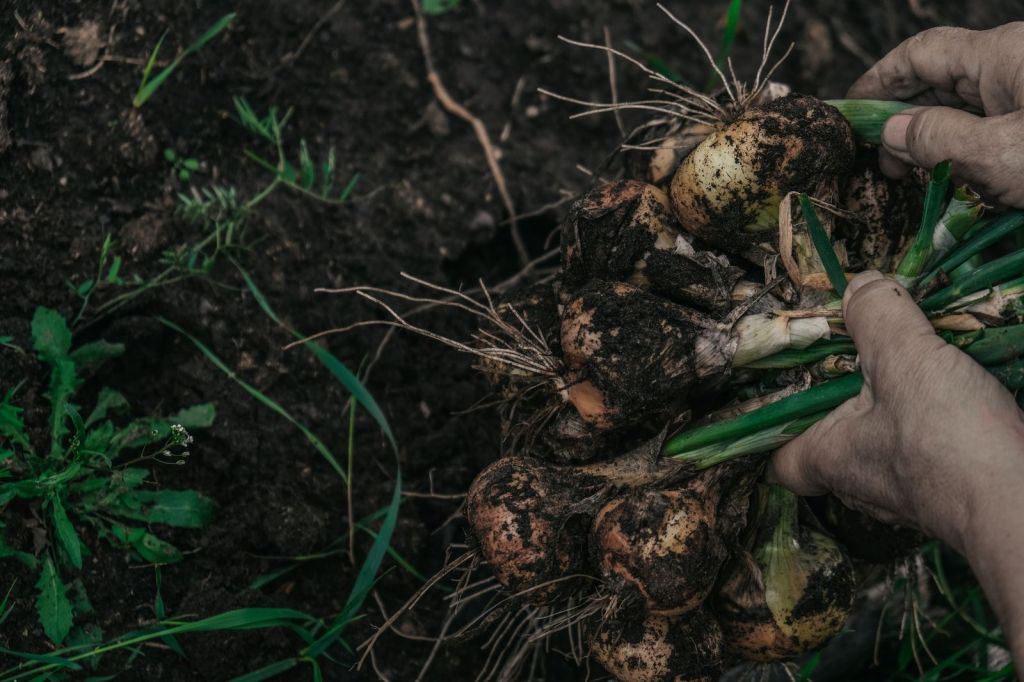
भारत में प्याज की खेती: बीज से भंडारण तक संपूर्ण गाइड
Onion is the one crop that can make a farmer money and make a government nervous in the same week. It is grown on 19.68 lakh hectares in India, it is harvested in three separate seasons, and the difference between a good and a bad year is usually decided in the nursery and in the first 45 days after transplanting. This guide walks the full lifecycle of a rabi onion crop — the season that is transplanted right now, in November and December — from soil and variety choice through nursery raising, transplanting, watering, fertiliser timing, thrips and purple blotch control, harvest at neck fall, curing, grading and storage. Every figure below is taken from ICAR-DOGR, the National Horticulture Board, NHRDF or the Ministry of Agriculture, and the source is named in the text.
Where the Indian onion crop stands / भारत में प्याज की स्थिति
India is the second-largest onion producer in the world after China, according to APEDA, and Indian onions are prized for their pungency. Production in 2024-25 was estimated at 307.67 lakh tonnes (30.77 million tonnes) from 19.68 lakh hectares — a jump of 26.79 per cent in production and 27.74 per cent in area over 2023-24, according to the Third Advance Estimates of horticultural crops released by the Ministry of Agriculture and Farmers Welfare in November 2025. Nearly all of that gain came from more area, not from higher yield, which is exactly the pattern that produces a price crash two seasons later.
Maharashtra alone grows 44.07 per cent of the national crop, followed by Madhya Pradesh at 14.44 per cent, according to APEDA. Onion is grown in three distinct seasons — kharif, late kharif and rabi — and ICAR-DOGR estimates that roughly 50-60 per cent of the crop comes from rabi, with 20-25 per cent each from kharif and late kharif. Rabi bulbs are the ones that store, which is why the rabi crop, not the kharif crop, carries the country from April to November.
Climate and soil / जलवायु और मिट्टी
Onion is a mild-weather crop. The Tamil Nadu Agricultural University package of practices puts the optimum range at 13-24°C for the vegetative stage, 16-21°C for bulbing and 30-35°C at maturity and harvest. Too much heat early gives you thick necks and poor storage; a cold snap on young seedlings pushes the plant into bolting, and bolted bulbs are worthless in the market.
For soil, ICAR-DOGR’s rabi recommendation is light, deep, friable and fertile soil — sandy loam to clay loam with a pH of 6.0 to 7.5. Onion is shallow rooted and extremely sensitive to a high water table, so a well-drained field with some slope is worth more than a rich field that holds water. Highly alkaline and saline soils are not suitable. If you are unsure where your field sits, a Soil Health Card test is the cheapest input you will buy this season; sandy soils in particular need more frequent irrigation plus extra farmyard manure.
If you are also planning garlic in the same block, our guide to preparing soil for garlic and onions covers the bed-making and organic matter part in more detail.
Season and variety / मौसम और किस्म का चुनाव
For rabi, ICAR-DOGR’s schedule is a nursery sown from October to mid-November and transplanting through November and December. Late kharif nursery goes in from August to September. Get the variety right before anything else, because storability — not yield — is what decides your price in a normal year.
DOGR’s own variety data for rabi: Bhima Shakti (red, 125-135 days, 28-30 t/ha, stores 5-6 months) and Bhima Kiran (light red, thin neck, 125-135 days, 28-32 t/ha, stores 5-6 months) are the two workhorses across most rabi states. Bhima Light Red gives 36-40 t/ha in Karnataka and Tamil Nadu in 110-120 days. Bhima Raj (dark red, Delhi, Gujarat, Haryana and Rajasthan, 115-120 days, 25-30 t/ha) and Bhima Red (Madhya Pradesh and Maharashtra, 110-120 days, 30-32 t/ha) store for only about three months. From NHRDF, Agrifound Light Red matures in 110-120 days at 30-32.5 t/ha and NHRDF Red-3 in 120-130 days at 35-40 t/ha. For kharif, DOGR recommends Bhima Super, Bhima Dark Red and Bhima Red.
Onion seed is short-lived. Buy fresh seed every season from DOGR, NHRDF, a state agricultural university or an accredited company, and check the lot number and germination percentage on the packet. Seed rate for a well-managed nursery is 5-7 kg per hectare; if germination is below 70 per cent or the nursery is raised on flat beds, plan on 8-10 kg. Our note on seed selection and seed treatment applies to onion as much as to any field crop.
Nursery: seed rate and seedling care / नर्सरी: बीज दर और पौध तैयार करना
About 0.05 hectare of nursery raises seedlings for one hectare of field, according to the Good Agricultural Practices manual for onion and garlic. Prepare raised beds 1.0-1.2 m wide and 15 cm high, of any convenient length, and work in 8-10 kg of well-decomposed farmyard manure per bed along with 100-150 g of 19:19:19 and 50 g of copper oxychloride, as DOGR’s rabi schedule advises. Trichoderma at 1.25 kg per hectare mixed into the manure cuts damping off.
Treat seed with captan, thiram or carbendazim at 2-3 g per kg before sowing — treated and packed seed from a good company does not need a second treatment. Sow in lines 5-7.5 cm apart and 1-1.5 cm deep, cover with fine sieved FYM or compost, water lightly, and mulch the bed with dry straw until germination is complete. Spray pendimethalin at 2 ml per litre right after sowing for weeds, and do one hand weeding at 20 days. Where damping off has been severe, solarise the nursery block under 200-gauge clear polythene for five to six weeks in the hot months before sowing.
Rabi seedlings are ready in 50-55 days. Anything older than that bolts and produces doubles and thick necks; anything younger establishes badly. Aim for seedlings with a pencil-thick stem of 0.8-0.9 cm and a height of 20-35 cm.
Field preparation and transplanting / खेत की तैयारी और रोपाई
Plough deep, harrow two or three times to a fine tilth, and incorporate 25-30 t of well-rotted FYM per hectare about 15 days before transplanting (DOGR). Neem cake at 250 kg per hectare at the same time is cheap insurance against nematodes. Make flat beds 1.5-2 m wide, or broad bed furrows 15 cm high with a 120 cm top and 45 cm furrows if you are on drip or in a heavy soil — the furrows keep the bulb shoulders out of standing water, which is where basal rot starts.
Before lifting seedlings, irrigate the nursery lightly so roots come out intact. Trim one-third off the top of each seedling, then dip the roots for about two hours in a solution of carbendazim at 1 g per litre plus carbosulfan at 2 ml per litre — DOGR’s standard transplant dip, which knocks back thrips and soil-borne fungi during establishment. Some state universities recommend a shorter dip of 15-30 minutes; follow your local recommendation.
Transplant at 15 cm between rows and 10 cm between plants, 2-3 cm deep, pressing the soil firmly around the roots without burying the neck. Plant population matters more in onion than in most crops: one seedling gives one bulb, and thin stands give you oversized, thick-necked, split and double bulbs instead of a uniform lot. Transplant in the evening where the sun is harsh, and give a light irrigation immediately. Our explainer on sowing and transplanting methods covers the mechanics of the operation.
Watering / सिंचाई प्रबंधन
Onion is shallow rooted and responds to frequent, light irrigation rather than deep flooding. Irrigate at transplanting, again two to three days later, and thereafter at 7-10 day intervals depending on soil and weather, as the TNAU package recommends. The two stages where a water deficit hurts most are bulb initiation around 30-45 days after transplanting and bulb development after that.
Waterlogging is the bigger risk. Standing water for even a few hours invites basal rot, Colletotrichum blight and damping-off in the nursery, so keep drains open and never let water sit in the furrow. Mulching with straw or black polythene conserves moisture and suppresses weeds. On drip, DOGR’s fertigation schedule applies 40 kg of nitrogen as a basal dose and the rest in six equal splits at ten-day intervals up to 60 days after transplanting. Subsidy support for drip is available under Per Drop More Crop.
As the crop approaches maturity, ease off. Most growers stop irrigation once neck fall begins, because a bulb harvested from wet soil cures slowly and rots in storage.
Manure and fertiliser: what to apply, and how / खाद और उर्वरक: क्या दें और कैसे दें
DOGR’s recommended dose for rabi and late kharif onion is 110:40:60:30 kg of N:P2O5:K2O:S per hectare; for kharif it is 75:40:40:30. Where soil test values are medium, the simpler 100:50:50 kg NPK plus 45 kg sulphur per hectare is also widely used. Adjust the dose to your soil test: DOGR’s guidance is to add 25 per cent more fertiliser where soil nutrient status is low, 50 per cent more where it is very low, and to cut it by 25-50 per cent where status is high.
How to apply it. One-third of the nitrogen and the full dose of phosphorus, potash and sulphur go at transplanting. Place them in bands 5-7 cm to the side of the seedling row and 4-5 cm below the surface, then cover with soil and irrigate — do not broadcast urea over the plants, and never let granular fertiliser sit against the neck. The remaining two-thirds of the nitrogen is split into two equal top dressings at 30 and 45 days after transplanting, applied in the furrow between rows and followed by irrigation. No nitrogen after 60 days. Late nitrogen gives you a thick neck, delayed maturity and a bulb that will not keep.
Sulphur is the nutrient most often skipped and it drives pungency and keeping quality: 45 kg per hectare before transplanting where soil sulphur is below 15 kg per hectare, 30 kg where it is above. Alongside the basal dose, apply biofertilisers — Azotobacter 5 kg, phosphate-solubilising bacteria 5 kg and Trichoderma 1.25 kg per hectare — mixed with well-decomposed FYM, one week after the chemical basal dose. As foliar support, 0.5-1 per cent 19:19:19 at 30 and 45 days and one spray of 0.5-1 per cent 13:00:45 or 00:00:50 at 60 days is DOGR’s recommendation; a micronutrient mix at 5 ml per litre at 45-60 days corrects zinc and boron deficiency, which is common in Indian soils. The general principles are set out in our pieces on integrated nutrient management and on plant nutrients for healthy growth.
Growth-phase care / वृद्धि अवस्था की देखभाल
Weeds are the silent yield thief in onion because the crop is shallow rooted and closely spaced and cannot out-compete them. Keep the field clean for the first 45 days: spray oxyfluorfen 23.5% EC at 1.5-2 ml per litre before transplanting or within a week after it, or pendimethalin 30% EC at 3.5-4 ml per litre, followed by one hand weeding at 30-45 days after transplanting. Our weed management guide has the wider picture.
Hoe shallow. Any injury to the stem or the bulb shoulder is an entry point for rot. From about 30 days after transplanting, walk the field twice a week and open the leaf whorl of a few plants — thrips hide at the base of the youngest leaves, and that is where you will see them first. Rogue out bolters, doubles and off-types as you find them; they never catch up and they take the plant’s share of water and nutrients.
Diseases: prevention and treatment / रोग: बचाव और उपचार
Purple blotch (Alternaria porri) is the disease that decides most rabi crops in a humid year. It starts as small water-soaked lesions with white centres that turn purple with dark concentric rings and a yellow halo; the lesions girdle the leaf and the foliage collapses. It needs 21-30°C with 80-90 per cent relative humidity, so it arrives with foggy nights and heavy dew. Spray mancozeb at 2.5 g per litre, or difenoconazole 25% EC at 40 ml in 200 litres of water, at 10-15 day intervals once symptoms appear, and alternate chemical groups.
Stemphylium blight gives light yellow-brown water-soaked lesions that coalesce and blight the leaf; mancozeb at 2.5 g per litre is the standard spray. Colletotrichum blight, called twister locally, twists and breaks the leaves — drench with metalaxyl 4% plus mancozeb 64% at 2 g per litre between the rows. Damping off in the nursery is managed with raised beds, Trichoderma, treated seed and solarisation, not with sprays after the seedlings fall. Basal rot and neck rot are storage and field-entry diseases: they come in through wounds, through a thick green neck and through bulbs harvested wet. Iris yellow spot virus is carried by thrips, so thrips control is the only real management.
Prevention is mostly free: three-year rotations away from onion and garlic, destroy infected debris and cull piles, irrigate early in the day so leaves dry before night, avoid excess nitrogen, and keep plant density at the recommended 15 × 10 cm. Our overview of crop diseases, symptoms and management explains how to read a field before a spray decision.
Pests: thrips, white grub and maggot / कीट: थ्रिप्स, सफेद ग्रब और मैगट
Thrips (Thrips tabaci) is the number one insect pest of onion. Adults and larvae rasp the leaf surface and suck the sap, leaving silvery-white streaks and patches; heavy infestation makes leaves curl, dry from the tip and the plant stops bulbing. Control depends on placement as much as chemistry: the spray has to run down between the erect leaves, which means higher pressure, higher volume and a sticker. DOGR recommends fipronil 5% SC at 1 ml per litre or carbosulfan 25% EC at 2 ml per litre, and warns against repeating the same molecule. Sprinkler irrigation washes thrips off and reduces populations; blue and yellow sticky traps at 15 per acre help you time the spray.
White grub comes into the field inside poorly decomposed FYM. Mix fipronil 0.3% granules into the manure heaps before they go to the field, or apply fipronil 80% WG at 1 kg per acre in the soil followed by irrigation. Onion maggot is managed by avoiding undecomposed manure and by rotation; a chlorpyrifos drench at 1.6-2 litres per acre before transplanting is the older recommendation. The full framework is in our piece on integrated pest management, and the safe handling and application side is covered in agrochemical application methods.
Reading the plant: healthy and problem symptoms / पौधे के लक्षण: स्वस्थ और रोगग्रस्त
A healthy onion plant at 60-90 days has 9-12 erect, dark green leaves, a firm pseudostem about the thickness of a pencil, no crinkling or twisting, and a bulb beginning to swell at soil level without splitting. Healthy crops mature evenly, with the tops falling over within a week or ten days of each other.
What the plant tells you when something is wrong: pale yellow leaf tips mean nitrogen or sulphur shortage, or waterlogged roots. Silvery streaks and curled leaves mean thrips. White sunken spots with purple centres and a yellow halo mean purple blotch. Leaves that twist and break at the bend mean Colletotrichum blight. A thick green neck at maturity, when the tops are falling, means late nitrogen or late irrigation, and that bulb will not store. A seed stalk shooting up before bulbing means bolting from cold exposure or over-aged seedlings. Splitting and doubles usually trace back to wide spacing or an over-mature nursery.
Harvesting / कटाई
Rabi onion matures in about 110-130 days after transplanting, depending on variety, soil and weather. The signal is neck fall: harvest about a week after 50 per cent of the tops have fallen over, when the leaves turn yellow and begin to die. Do not wait for the tops to go completely dry in the field, and do not harvest early to catch a price — immature bulbs shrink badly in storage.
Lift the bulbs with a khurpi or a small blade, keeping the outer dry scales intact; a damaged outer layer is an open door for rot and moisture loss. Shake off the soil, do not wash it off. Average rabi yields are 25-35 t per hectare under good management, with the National Horticulture Board putting irrigated rabi onion at 25-30 t per hectare.
After harvest: curing, grading and storage / कटाई के बाद: क्योरिंग, ग्रेडिंग और भंडारण
Curing is the single most valuable hour of labour in the onion cycle. It dries the neck and the two or three outer scales so the bulb stops losing moisture and stops inviting decay. Cure in the field for 7-10 days with the tops shading the bulbs, or in shade with better colour retention, or by tying the tops in bunches and hanging them on a pole in a ventilated shed. The bulb is cured when the neck is tight and the outer scales rustle, which corresponds to a weight loss of 3-5 per cent. NHRDF records that 15-50 per cent losses occur when curing, sorting and storage are done badly.
After curing, cut the leaves 2-2.5 cm above the bulb and remove the roots. Grade into extra large (above 6 cm), medium (4-6 cm) and small (2-4 cm), and discard thick-necked, bolted, doubled, injured and diseased bulbs — one rotten bulb spoils the lot in a stack.
Store in a ventilated structure at 25-30°C with 65-70 per cent relative humidity. Cool, humid air between 10 and 25°C encourages sprouting, and dry air below 60 per cent humidity cracks the skin. NABARD’s review of onion storage records total storage losses of 50-90 per cent depending on genotype and conditions, split roughly into 30-40 per cent weight loss, 20-30 per cent rotting and 20-40 per cent sprouting. The NHRDF improved storage structure cuts this sharply: in a six-month trial it recorded 14.52 per cent total loss against 33.4 per cent in a conventional ventilated structure. Handle bulbs gently — never drop them more than about six feet, and stack bags no higher than 2-2.5 m. A pre-harvest spray of carbendazim at 1 g per litre at 30 and 10 days before harvest reduces blue mould in store, and maleic hydrazide at 2500 ppm sprayed 75-90 days after transplanting checks sprouting.
Rabi onion is stored, not sold at harvest, in most years — that is the whole point of growing it. If you are holding stock for a later price, learn the e-NAM route beyond the local mandi, and if you are building storage or a grading line, the cold chain and storage schemes are worth a look before you spend your own money.
Key takeaways / मुख्य बातें
- India produced an estimated 307.67 lakh tonnes of onion in 2024-25 from 19.68 lakh hectares, up almost 27 per cent — a supply signal worth planning around.
- Rabi nursery goes in October to mid-November and transplanting in November-December; seedlings should be 50-55 days old, pencil-thick and dipped in carbendazim plus carbosulfan before planting.
- Fertiliser for rabi is 110:40:60:30 kg NPKS per hectare: one-third of the nitrogen with all the P, K and S at transplanting, the rest at 30 and 45 days, and no nitrogen after 60 days.
- Purple blotch, Stemphylium blight and thrips are the three problems that decide the crop; rotate chemical groups, spray to the base of the leaves, and keep nitrogen under control.
- Harvest a week after 50 per cent neck fall, cure until the neck is tight and the scales rustle, grade, and store at 25-30°C with 65-70 per cent humidity — curing and storage decide your price, not the harvest.
Sources / स्रोत
- ICAR-Directorate of Onion and Garlic Research (DOGR), Rajgurunagar — rabi onion production technology, variety descriptions and recommended practices: dogr.res.in
- ICAR-DOGR, “How to get high yield from rabi onion?” and “Scientific cultivation of kharif onion”, Indian Horticulture: epubs.icar.org.in
- National Horticulture Board — onion package of practices, post-harvest technology and storage: nhb.gov.in
- National Horticultural Research and Development Foundation (NHRDF) — plant protection and post-harvest technology: nhrdf.com
- MANAGE, Government of India — Good Agricultural Practices in Onion and Garlic: manage.gov.in
- Press Information Bureau — Third Advance Estimates of horticultural crops, 2024-25 (November 2025): pib.gov.in
- APEDA — Fresh Onions profile: apeda.gov.in
- NABARD — status of onion storage structures and storage losses in India: agritech.tnau.in
- Tamil Nadu Agricultural University — onion package of practices: agritech.tnau.ac.in


Leave a Reply