
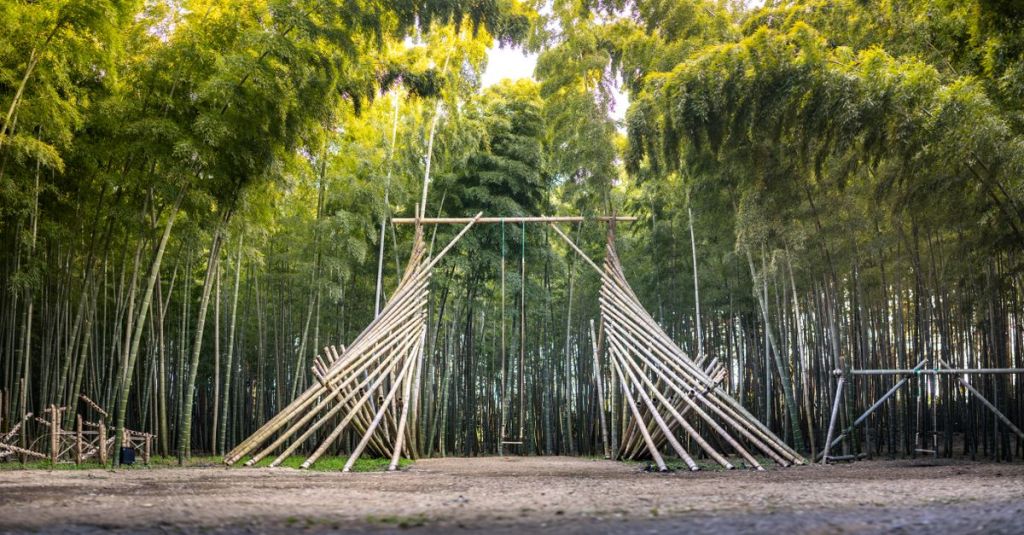
Once a forest tree that needed felling permission, bamboo is now a farm crop with a ₹28,005-crore industry behind it. Here is what the National Bamboo Mission offers, what it costs to plant, and what a grower can realistically earn.
Bamboo is the fastest-growing plant on earth, and for a farmer in India it has quietly become one of the most interesting long-term crops on the table. It can be cut every year once established, it survives drought and poor soil, it needs almost no pesticide, and it keeps producing for decades. What held Indian bamboo back for generations was not agronomy but law: bamboo was classified as a tree, so a farmer who grew it on private land needed felling and transit permission from the forest department to sell it. That changed in 2017, when the Indian Forest Act, 1927 was amended so that bamboo grown outside forests is no longer treated as a tree or as forest produce. From that point a farmer could cultivate, harvest and transport bamboo like any other crop. The restructured National Bamboo Mission followed in 2018-19 to build the value chain around that reform.
Why bamboo behaves differently from a normal crop / बांस आम फसल से अलग क्यों है
Bamboo is a grass, not a timber tree, and that changes the economics. A bamboo clump keeps sending up new culms every year, so a well-managed plantation gives an annual harvest instead of a single felling. It matures in a fraction of the time of timber: a stand is productive within about four to seven years, against 30–50 years for many trees, and the plantation itself can keep yielding for 25–40 years. Its root mat and leaf litter hold soil and recharge groundwater — research on degraded ravine land has found bamboo plantations retaining 80–100% of rainwater, with sediment loss cut to a fraction of an untreated watershed. Bamboo also sequesters carbon and, weight for weight, is stronger and more flexible than many timbers, which is why it moves into flooring, furniture, boards, fabric, paper and even bio-energy.
The size of the opportunity / अवसर का आकार
India is the second-largest reservoir of bamboo in the world, after China, with about 22 genera and 130-odd species. Yet the country exploits only a small share of that potential: of roughly 130 species, only about ten are commercially exploited today. The bamboo and rattan industry in India is already worth ₹28,005 crore, and the whole policy thrust of the National Bamboo Mission is to keep more of that value at the farm and village level rather than in imports. Bamboo shoots are eaten as a vegetable, culms are sold for construction and scaffolding, and processed bamboo goes into incense sticks, handicrafts, mats, boards and furniture.
The National Bamboo Mission / राष्ट्रीय बांस मिशन
The National Bamboo Mission began in 2006-07, was folded into the horticulture mission for a few years, and was restructured and relaunched in 2018-19 as a Centrally Sponsored Scheme. It is implemented through state nodal departments and their State Bamboo Missions, and now runs in 24 States and Union Territories. Funding is shared 60:40 between the Centre and the States, 90:10 for the North-Eastern and hilly States, and 100% for Union Territories and national-level agencies.
The Mission works across the whole chain, not just planting: quality planting material and hi-tech nurseries, area expansion, treatment and seasoning plants, processing and product development units, market infrastructure such as bamboo bazaars and depots, skill development, and research. For capital-intensive components it offers a credit-linked back-ended subsidy in a 50:10:40 pattern of subsidy, own contribution and loan, with an extra 10% for private-sector projects in the North-Eastern States. Bamboo-based Farmer Producer Organisations are being set up under the FPO scheme, and processing and marketing are also supported through the Agriculture Infrastructure Fund.
The physical progress reported for the restructured Mission up to 31 December 2024 gives a sense of scale: 408 bamboo nurseries (including 14 accredited ones), 60,000 hectares of non-forest area under bamboo plantation, 104 treatment and preservation units, 528 product development and processing units, and 130 market infrastructure facilities.
Species, spacing and planting / किस्में, दूरी और रोपण
The Mission identifies a set of commercially important species — among them Bambusa tulda, Bambusa bambos, Bambusa balcooa, Bambusa nutans, Dendrocalamus asper, Dendrocalamus hamiltonii and Melocanna baccifera. The right choice depends on your market: thick-walled species suit construction and furniture, thinner species suit baskets and handicraft, and some are grown mainly for shoots.
Planting is usually done at about 5 m × 5 m spacing, which works out to roughly 400 plants per hectare, using quality planting material from an accredited nursery rather than farm-lifted rhizomes. The Mission’s cost norm for plantation is ₹1.20 lakh per hectare (₹1.30 lakh in the North-Eastern States), and private growers can get 50% of the cost as subsidy, capped at 10 hectares over two years. An integrated plantation with drip irrigation is supported separately, and drip pays for itself by pushing early growth in the dry months. On marginal, sloped or fallow land bamboo often makes more sense than on the best field, and it can be intercropped with chilli, ginger or pulses in the early years while the clumps are filling in. Weed control and a little manure in the first two seasons matter far more than heavy fertiliser later.
What it costs and what it returns / लागत और आय
Establishment is the real cost. A full block plantation of about 400 saplings to the acre commonly runs to roughly ₹1.3–1.5 lakh in the planting year, covering saplings, pit digging, farmyard manure, drip and labour, with modest maintenance costs in the following years. Harvesting usually begins in the fourth or fifth year, and from then on a clump yields a few mature culms each year without replanting.
Field evidence from different states is consistent enough to plan around. In Tripura, the kanak-kaich variety under the state bamboo mission cost about ₹65,000 per acre to establish over three years, recovered in the first harvest in year four, and went on to return roughly ₹65,000 per acre a year for about 15 years — with one grower reporting ₹80,000 from an acre. In Maharashtra, a farmer who planted 4,000 saplings in 2019, supported by a State Bamboo Mission subsidy of ₹120 per plant over three years, earned ₹75,000 within two years by selling poles to other farmers. Commercial estimates for a well-managed acre put the long-run return at well over ₹1 lakh a year once the clumps are mature, with the caveat that pole prices move with supply and species.
Processing, marketing and the value chain / प्रसंस्करण, विपणन और मूल्य श्रृंखला
The difference between a marginal bamboo grower and a profitable one is almost always what happens after the pole leaves the field. Raw poles sold in a local mandi fetch the least. Treated and seasoned poles, bamboo shoots, incense sticks, mats, boards, furniture and handicraft all carry a multiple of the raw price, which is exactly why the Mission funds treatment plants, common facility centres and processing units, and why collective structures help. Selling through an FPO or a bamboo bazaar gives a grower bargaining power and access to buyers who will not visit a single small plot. Cold-chain and storage support for shoots and processed products is available through post-harvest schemes, and the broader set of government programmes for farm income — including NABARD refinance and horticulture-mission support — can be layered on top of the bamboo subsidy.
Challenges to plan for / जिन चुनौतियों की योजना बनानी चाहिए
Bamboo is not a quick crop. The first meaningful harvest is four to five years away, so it suits a farmer who can carry a plot through that gap — and it is a poor fit for someone who needs cash every season from the same land. The second risk is market mismatch: planting a species the local trade does not buy is the most common mistake, so line up your buyer before you plant. Skilled labour for harvesting and treatment, and the cost of a treatment or seasoning unit if you want to move up the value chain, are the other practical constraints. None of these is a reason to avoid bamboo; they are reasons to plan the plot around a specific end product.
Key takeaways
- Bamboo grown outside forests has been legally a crop, not a tree, since the 2017 amendment — no felling or transit permit is needed.
- The restructured National Bamboo Mission funds the whole value chain; plantation subsidy is ₹1.20 lakh/ha (₹1.30 lakh in the North-East), with 50% support to private growers up to 10 ha.
- Plant about 400 clumps per hectare at 5 m × 5 m using accredited planting material; expect the first harvest in year four to five.
- Establishment costs roughly ₹1.3–1.5 lakh an acre, and mature plantations have returned ₹65,000–₹1 lakh-plus an acre a year in reported cases.
- Choose the species for your buyer, and sell treated or processed bamboo, not raw poles, to capture the margin.
Sources
Press Information Bureau, Ministry of Agriculture & Farmers Welfare — restructured National Bamboo Mission releases and press notes (Feb 2025, Aug 2025); National Bamboo Mission operational guidelines (2025); NITI Aayog technical session on incentives for bamboo promotion; Department of Agriculture & Farmers Welfare; published economic analyses of bamboo plantation (NAIP/ICAR ravine studies); Uravu and Mobond bamboo cultivation cost-and-income estimates; The Hindu reports on kanak-kaich (Tripura) and progressive bamboo growers in Karnataka and Kerala; MANAGE bamboo farming case study (Maharashtra).


Leave a Reply