
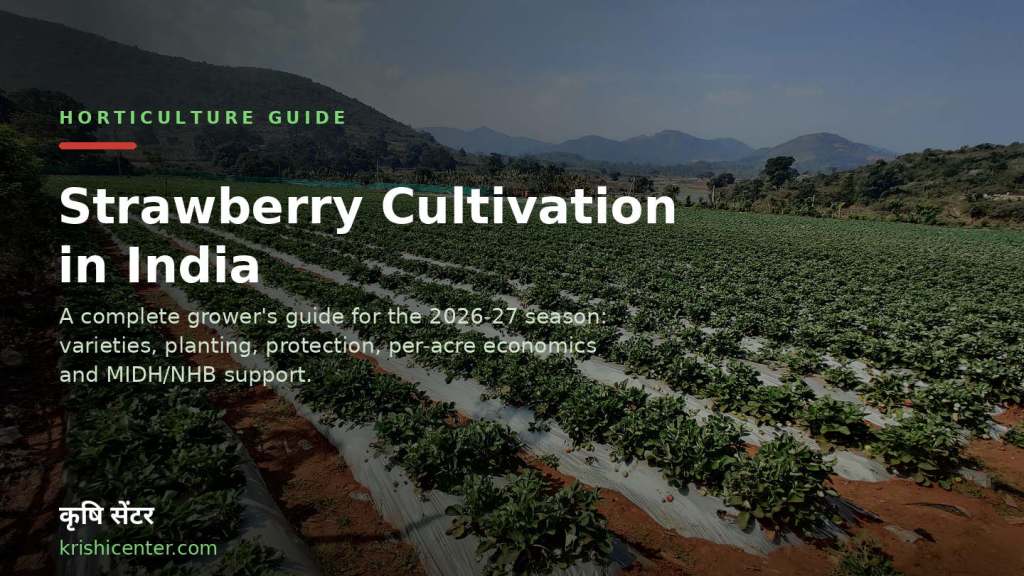
Varieties, planting, nutrition, protection, yield, costs and government support — a practical horticulture guide timed to the September–November planting window.
Strawberry is one of the most rewarding — and most demanding — crops a horticulture grower in India can take up. It is a high-value, short-duration winter crop: plant in September–October and you are picking fruit by December–January, with the whole cycle wrapped up in roughly five to six months. That speed, combined with strong urban demand and a market price that routinely runs several times that of cereals, is why strawberry area keeps expanding from the traditional hill belts into the plains.
The scale is still small relative to the opportunity. As of 2020–21, India grew strawberries on about 3,031 hectares, producing roughly 19,840 tonnes at an average productivity of about 7.8 tonnes per hectare. Maharashtra alone accounts for well over half of national production, with the Mahabaleshwar–Panchgani belt in Satara district — whose strawberry carries a Geographical Indication (GI) tag — as the country’s largest growing region. Himachal Pradesh, Uttarakhand, Jammu & Kashmir, Punjab, Haryana, Uttar Pradesh, Bihar, Meghalaya and the Nilgiris in Tamil Nadu all have established or fast-growing pockets.
This guide brings together the current package of practices with the market and policy picture as it stands for the 2026–27 season — so a grower can plan a crop that is both technically sound and commercially realistic.
Why strawberry is worth growing
Short, high-value cycle: a 5–6 month rabi crop that can return the season’s investment within a single harvest window.
Strong price realisation: farm-gate and mandi rates commonly sit in the range of ₹180–210 per kg, while city retail ranges from about ₹210 to ₹430 per kg depending on the city and grade.
Multiple income streams: fresh table fruit, processing (pulp, jam, crush, ice-cream), nursery runner production in the hills, and agri-tourism (pick-your-own farms).
Demand is growing faster than supply, and domestic production is still far below its potential — productivity in India averages under 8 t/ha against 25–35 t/ha achievable under good management and protected cultivation.
Climate and soil requirements
Strawberry is a cool-season crop. Most varieties grown in India are low-chill, short-day types that flower as day length falls below about 12–14 hours, which is exactly what an Indian winter provides. A temperature band of roughly 10–25°C is ideal; bright sunny days with cool nights give the best fruit colour, flavour and firmness.
The crop does best on a well-drained sandy loam to loamy soil rich in organic matter, with a pH of 5.7–6.5. The single most important soil rule is drainage: strawberry is shallow-rooted and cannot tolerate waterlogging, which invites root rots and red stele. Raised beds are not optional in most Indian situations — they are the foundation of a healthy crop.
Choosing the right variety
Varieties fall into two practical groups. Short-day varieties flower as the day shortens and form the backbone of the November-to-March Indian season. Day-neutral varieties flower on plant age rather than day length, fruiting roughly three months after planting whenever that happens — the only route to fruit outside the normal window, and best suited to protected cultivation.
Note that almost none of the varieties the National Horticulture Board officially lists — Chandler, Tioga, Torrey, Selva, Belrubi, Fern, Pajaro and others — are what the commercial belt actually plants today. The varieties in the field are largely introduced low-chill selections from California, Florida and Italy, sourced through certified nurseries rather than farm-saved runners.
| Variety | Type | Why growers choose it |
| Camarosa | Short-day | The workhorse of the belt — firm, dark, travels well; the default where fruit must survive transit |
| Chandler | Short-day | The classic hill variety; large fruit and excellent aroma, strong in Himachal and Uttarakhand |
| Sweet Charlie | Short-day | Earliest and sweetest; softer flesh, best sold quickly in local markets |
| Winter Dawn | Short-day | Low chill requirement and high sugar; gaining ground on the Panchgani plateau |
| Festival | Short-day | Big, firm berries with good disease tolerance; strong in Bihar and the plains |
| Nabila / Rania | Short-day | Large, uniform fruit favoured for gifting and hamper trade; Rania is the higher yielder |
| Selva / Seascape / Fern / Albion | Day-neutral | Multiple flushes and extended harvest; suited to polyhouse and high-altitude production |
Variety choice should follow your market, not just the yield tables. Grow for local fresh sale, wholesale transit, gifting or processing — each points to a different cultivar.
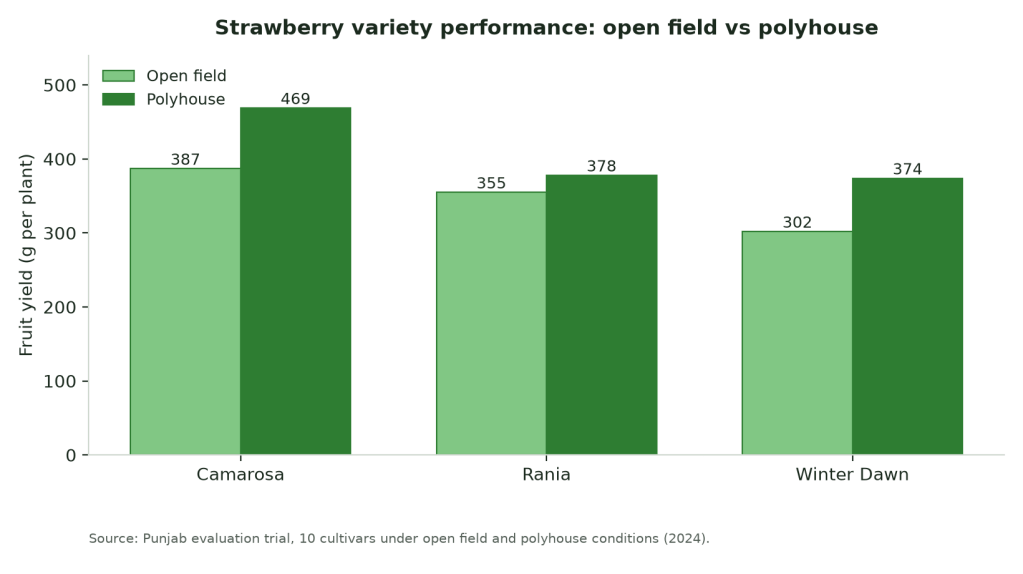
In a Punjab evaluation trial, polyhouse cultivation lifted yield per plant for every variety tested — Camarosa from 387 g to 469 g per plant.
When to plant: a region-wise calendar
Planting date is the second-most important decision after variety, because it fixes the harvest window and therefore the price you sell into. Planting too late compresses the season and cuts total yield; planting too early leaves plants without vigour.
| Region | Planting window | Harvest window |
| Hills — Himachal Pradesh, Uttarakhand, Mahabaleshwar | September–October | March–May |
| Northern plains — Punjab, Haryana, Delhi-NCR, western UP | October–November | January–March |
| Maharashtra plains and Bihar | October to mid-November | December–March |
| Tamil Nadu (Nilgiris, Kodaikanal) | September–November, and February–March | Winter and spring flushes |
Protected (polyhouse) growers in the plains have some flexibility either side of the window, since the structure moderates temperature.
Land preparation, mulching and planting
Prepare a fine, weed-free tilth with two to three ploughings, then form raised beds roughly 1–1.2 m wide and 15–20 cm high with clear drainage furrows between them. Work in 20–25 t/ha of well-rotted farmyard manure plus the basal phosphorus and potash dose, and add neem cake and a Trichoderma-based biocontrol where soil-borne disease is a history. Install an inline drip line down the centre of the bed, then stretch black (or silver-black) plastic mulch tightly over it and cut planting holes at your chosen spacing.
Planting material is either a runner (a rooted plantlet from a mother plant) or a lab-raised tissue-culture plantlet. Buy only from certified, disease-free nurseries — Mahabaleshwar and Himachal Pradesh both have established multiplication nurseries. Never plant runners lifted from an old, declining bed: red stele, verticillium wilt and viruses travel silently on the planting material and infect the whole new bed from day one.
Set plants 30 × 30 cm to 30 × 45 cm apart through the mulch holes, giving about 22,000–24,000 plants per acre. The one planting rule that matters most: the crown must sit exactly at soil level — buried and it rots, left exposed and the plant dries out. Irrigate by drip immediately after planting to settle the soil around the roots.
Nutrition and Fertigation
A general soil-applied dose is 25–50 t/ha of farmyard manure with roughly 75–100 kg N, 40–120 kg P₂O₅ and 40–80 kg K₂O per hectare, adjusted for soil type and variety. In practice, most commercial growers now split this through drip fertigation, which typically yields 20–30% more than broadcast fertiliser at similar input cost.
A workable schedule: a balanced NPK such as 19:19:19 during establishment and vegetative growth; a shift to high-phosphorus (0:52:34) at flower induction; and high-potassium (13:0:45) with calcium nitrate through fruiting for sweetness and firmness. Boron at flowering is easy to overlook and matters more than its cost suggests — a shortage causes poor pollination and misshapen fruit.
Irrigation
Being shallow-rooted, strawberry needs frequent but light irrigation; the root zone should stay moist, never waterlogged. Excessive water pushes leaf and runner growth at the expense of fruit and raises the risk of grey mould. Furrow irrigation is traditional, but drip is now standard: it saves around 30% of water and energy, keeps the canopy dry, and allows precise fertigation. In the north Indian plains, low plastic tunnels over the beds during December–January protect against frost and can advance flowering and lift yield substantially; in Maharashtra and the south, they are usually unnecessary.
Crop protection: the main risks
Grey mould (Botrytis): the number-one disease risk in humid, cloudy or rainy weather, rotting flowers and fruit. Manage with dry canopy, good spacing and ventilation, and active scouting during humid spells.
Red stele and verticillium wilt: soil- and planting-material-borne. Prevention is entirely about certified, disease-free runners and well-drained raised beds.
Two-spotted spider mite: scout leaf undersides as the canopy fills in; integrated pest management (IPM) — biological control, monitoring and need-based chemistry — is the recommended approach.
Nutritional and physiological disorders: poor pollination and misshapen fruit from boron shortage; blossom-end and firmness issues tied to calcium and potash balance.
Plasticulture itself is a protection tool: black mulch suppresses weeds and keeps ripening berries off wet soil, while low tunnels or anti-hail/anti-bird nets protect the crop and improve quality. Across trials, tunnel and mulch systems have consistently raised yields by around 20% and reduced plant mortality.
Harvesting and yield
Strawberries are picked when half to three-quarters of the skin has coloured, every second or third day, usually in the cooler morning hours, into shallow trays or punnets. Fruit is highly perishable, so shade it in the field and move it to cool storage or market quickly. Under good management, an open-field crop yields roughly 8–15 t/ha, while protected cultivation can reach 25–35 t/ha; per-plant yields of 500–700 g are a realistic commercial benchmark, with the best-managed plots and certain varieties doing considerably more.
What it costs and what it returns, per acre
Strawberry is capital-intensive at the start. Setup cost — planting material, mulch, drip, bed preparation and labour — typically runs ₹2.5–3.5 lakh per acre for a first planting. Gross income in a good season commonly lands in the ₹10–12 lakh per acre range, implying a net profit of roughly ₹5–7 lakh per acre for a well-managed crop with market access. The National Horticulture Board’s own bankable model is more conservative, working on 8 t/acre at ₹40,000 per tonne for a gross of about ₹3.2 lakh per acre, and its planting-material cost line has not kept pace with current nursery prices.
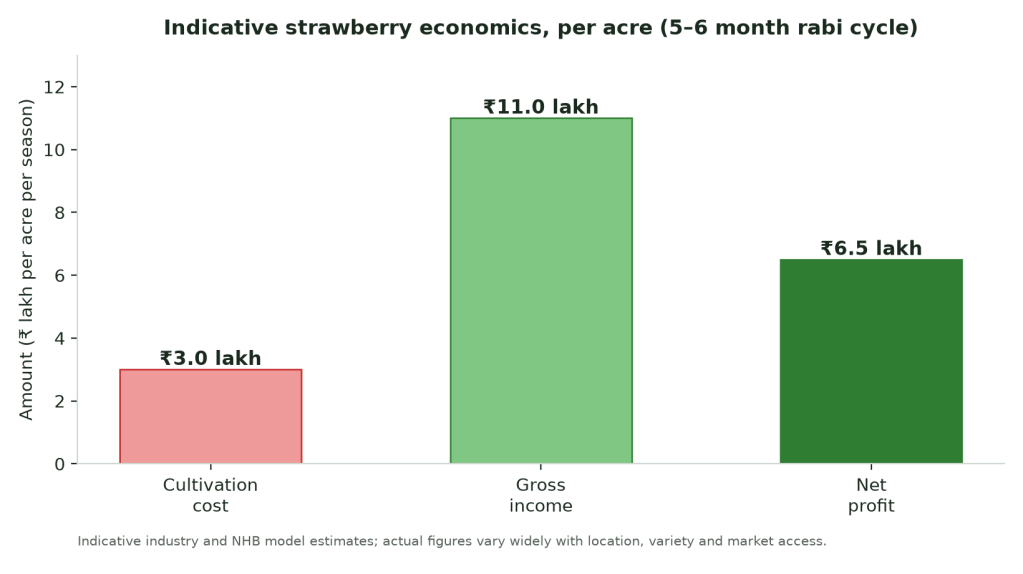
Indicative per-acre economics for a strawberry crop. Treat these as planning ranges, not guarantees — returns swing widely with variety, planting date, market access and season.
Four levers separate profitable crops from marginal ones: the quality of the planting material (certified runners out-yield uncertified stock by 25–35%); planting-date precision; fertigation discipline; and harvest frequency — picking every 2–3 days instead of letting fruit over-ripen can protect 10–20% of effective yield.
Government Support and Schemes
Strawberry is supported under the Mission for Integrated Development of Horticulture (MIDH), the centrally sponsored scheme that covers fruits, vegetables, flowers, spices, medicinal and aromatic plants, coconut, cashew, cocoa and bamboo. Strawberry is treated as a cost-intensive fruit crop, and support is delivered as a subsidy rather than a loan.
Area expansion (MIDH, revised 2025 guidelines): cost norm of ₹2.00 lakh per hectare for strawberry, with assistance of 40% in general areas and 50% in North-Eastern and Himalayan states, scheduled areas and island territories.
Integrated package with drip and mulching: support of up to ₹1.12 lakh per hectare (40% of cost) for planting material, irrigation and mulching.
Protected cultivation: MIDH supports polyhouses, shade-net houses, plastic and non-woven tunnels, plastic mulching and anti-bird/anti-hail nets, and now includes newer components such as hydroponics, aeroponics, sensor-based fertigation automation and solar-based technologies.
NHB project mode: for larger commercial projects, the National Horticulture Board provides a credit-linked, back-ended subsidy of 40% of project cost (up to ₹30 lakh per project) in general areas, and 50% (up to ₹37.50 lakh) in the North-East, hilly states and scheduled areas.
Applications are made through the MIDH-Suraksha portal or the NHB, with support routed through State Horticulture Missions, Krishi Vigyan Kendras and Centres of Excellence.
Recent developments for 2025–26
The policy environment has moved appreciably in the grower’s favour over the past two seasons. MIDH’s operational guidelines were restructured in 2025, raising cost norms across horticulture and adding provisions for high-value and exotic crops and for new technologies. In March 2026, MIDH wrote to state horticulture mission directors asking them to consider promoting low-cost protected cultivation for small and marginal farmers, citing an ICAR–Indian Institute of Horticultural Research (IIHR) evaluation of a low-cost shade-net design — a signal that affordable protected structures are being folded into the mainstream subsidy framework. The National Horticulture Board also issued amendments to its commercial horticulture and cold storage scheme guidelines in August 2026, rationalising subsidy rates and eligibility. Alongside these, the Clean Plant Programme (funded with Asian Development Bank support) is building clean-plant centres to make disease-free planting material more widely available — directly relevant to a crop whose biggest hidden cost is infected runners.
Marketing and value addition
Fresh fruit margins are highest when you control the last mile. Options that consistently outperform plain mandi sales include direct-to-consumer and farm-gate sales, agri-tourism and pick-your-own models, supply to hotels, bakeries and ice-cream makers, and aggregation through a Farmer Producer Organisation to negotiate better rates and share cold-chain costs. Fruit that does not make table grade has a ready second life in pulp, jam, crush and wine. Grade and pack consistently, and remember that firm, high-yield varieties such as Camarosa price differently from dessert-grade fruit — on an invoice, “strawberry” can mean several very different products.
Key takeaways
Strawberry is a high-value, 5–6 month winter crop with real headroom in Indian production and demand.
Variety and planting date decide your harvest window — and your price. Match both to your market.
Raised beds, certified disease-free runners and drip-plus-mulch are the non-negotiables.
Yield ranges from 8–15 t/ha in the open field to 25–35 t/ha under protection; certified runners, timely planting and disciplined fertigation drive the difference.
MIDH and NHB subsidies can cover a large share of the initial investment — apply through the MIDH-Suraksha portal or your State Horticulture Mission.
Sources:
National Horticulture Board (NHB) strawberry production technology and model bankable project; MIDH Operational Guidelines 2025 and cost norms; NHB scheme circular, August 2026; Press Information Bureau releases on MIDH revision and protected cultivation (2026); ICAR-IIHR evaluation cited by MIDH (2026); published cultivar evaluation trials from Punjab, Himachal Pradesh, Maharashtra and Andhra Pradesh; NHB and market price data, 2026.


Leave a Reply