

What is Kharif Season?
Kharif crops, also known as monsoon crops, are domesticated plants cultivated during the rainy season in South Asia. The monsoon season lasts between April and October, depending on the area.
What are Kharif Crops?
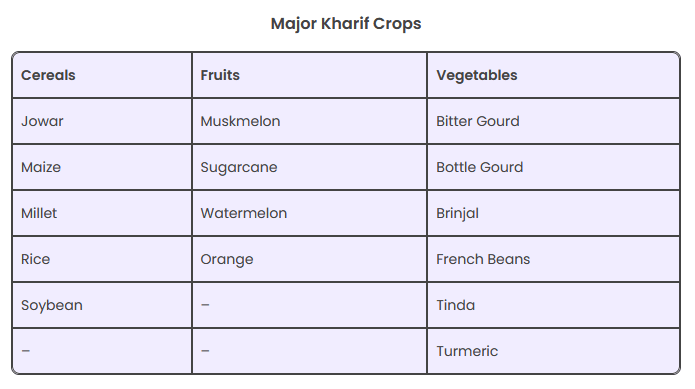
Kharif crops are monsoon crops that consist of plants as Rice. Ideally, the Kharif crops are harvested in the monsoon season. This season begins as early as May in some parts of the Indian subcontinent. Kharif crops are generally harvested from 3rd week of September to October. Below is the table for major Kharif crops.
Crops Grown:
Major Kharif crops include rice (paddy), maize, and sorghum (jowar). Other crops are pearl millet (bajra) and finger millet (ragi). Pulses like arhar (tur), moong, and urad are also grown. Additionally, there are soybean, groundnut, cotton, and sugarcane.
Timing:
- Typically begins with the arrival of the monsoon in June and concludes with harvesting around October. Sowing dates can vary slightly by region and crop. In some southern states, sowing starts as early as May. It extends into July in parts of North India.
Key Characteristics:
- Monsoon-dependent: Kharif crops rely heavily on the rainfall brought by the monsoon for successful growth. Too much or too little rain, or rainfall at the wrong time, can significantly impact yields.
- Hot and humid conditions: These crops thrive in the warm and humid climate prevalent during the monsoon months.
Significance:
- The Kharif season is crucial for India’s food security and economy. It contributes significantly to agricultural production. It also impacts employment and the country’s GDP. In essence, the Kharif season represents the period for cultivating and harvesting crops in the Indian subcontinent. This is done in sync with the monsoon rains.
Why Paddy Cultivation Matters in India?
India recently overtook China as the largest producer of rice in the world. Paddy cultivation is vital for the country’s food security. It also forms the backbone of rural livelihoods. It is primarily grown during the Kharif season (June to October), though Rabi paddy is also cultivated in specific regions.
Changing climate patterns, water scarcity, and pest outbreaks challenge farmers. They must adopt sustainable and climate-smart paddy cultivation practices. These practices ensure both yield and income stability.
Top Paddy Cultivation Zones in India
Eastern States: West Bengal, Odisha, Assam, Bihar

Southern States: Andhra Pradesh, Telangana, Tamil Nadu, Karnataka

Northern States: Punjab, Haryana, Uttar Pradesh

North-Eastern Hills: Arunachal Pradesh, Manipur, Nagaland, and Tripura
Climate Requirements for Paddy Cultivation
Temperature: 20°C to 35°C

Rainfall: 100–200 cm (well-distributed)

Soil: Fertile alluvial, clayey loam, and deep soils with good water retention

Water: Requires standing water for major growth stages
Tip: Monitor local weather conditions regularly to adjust sowing and irrigation practices.
Best Practices for Successful Paddy Cultivation
How to Grow Kharif Crops?
Seed Selection and Treatment

Choose high-yielding, pest-resistant, or climate-resilient varieties suited to your region.

Treat seeds with fungicides and biofertilisers to prevent early-stage infections.

Land Preparation

Plough land 3–4 times and maintain a smooth levelled field for uniform water distribution.

Ensure binding to avoid runoff and moisture loss.

Transplantation Techniques

Use the SRI (System of Rice Intensification) method for improved yields with less water.

Maintain appropriate spacing (20×20 cm) to allow better root and tiller development.

Water Management

Avoid water stagnation in early vegetative stages.

Maintain 2–5 cm standing water during active tillng and flowering.

Practice Alternate Wetting and Drying (AWD) to conserve water.

Integrated Nutrient Management

Apply Nitrogen, Phosphorus, and Potassium based on soil testing.

Incorporate green manure, compost, and farmyard manure for long-term soil health.

Pest and Disease Control

Monitor regularly for brown planthopper, stem borer, blast, and sheath blight.

Use integrated pest management (IPM) and minimise chemical pesticide use.
Climate-Smart Tips for Paddy Farmers
- Use Weather-Based Advisory Subscribe to agri-weather alerts for sowing, irrigation, and pesticide scheduling.
- Switch to Drought-Resistant Varieties Varieties like Sahbhagi Dhan and DRR Dhan 42 are suitable for water-scarce regions.
- Adopt Direct Seeding of Rice (DSR) Reduces water usage, labour, and greenhouse gas emissions.
- Practise Mulching and Crop Rotation Conserves soil moisture and reduces weed pressure in paddy fields.
Role of Crop Insurance in Paddy Cultivation
Paddy farmers are highly vulnerable to losses due to drought, floods, pest outbreaks, and cyclones. Crop insurance ensures financial stability in such cases.
Benefits of Crop Insurance for Paddy:
Protection against natural calamities

Coverage for pre-sowing to post-harvest stages

Compensation for yield loss or crop damage

Boosts confidence to invest in better practices
Using Technology to Enhance Paddy Cultivation
Modern farming tools like drones, soil sensors, satellite imagery, and AI-powered platforms are revolutionising paddy cultivation in India. These tools offer:
Real-time crop health monitoring

Pest and disease outbreak predictions

Precision input usage

Timely alerts on weather and insurance
Conclusion
By integrating digital solutions, farmers can adopt precision farming practices that not only improve yield but also reduce costs. We can connect farmers with government schemes. These include insurance products tailored to their region. This ensures both financial safety and agronomic efficiency. Embracing technology and Farming guide information through KrishiCenter can truly transform paddy cultivation into a profitable and future-ready enterprise.
Paddy cultivation in India stands at the intersection of age-old traditions and emerging innovation. To succeed in a climate-vulnerable world, Indian farmers must adopt sustainable practices, leverage technology, and protect their crops through insurance.
By adopting KrishiCenter suite of solutions, farmers can boost productivity, minimise risk, and ensure a stable livelihood. Together, let’s cultivate a safer, smarter, and more resilient future for Indian agriculture.

