
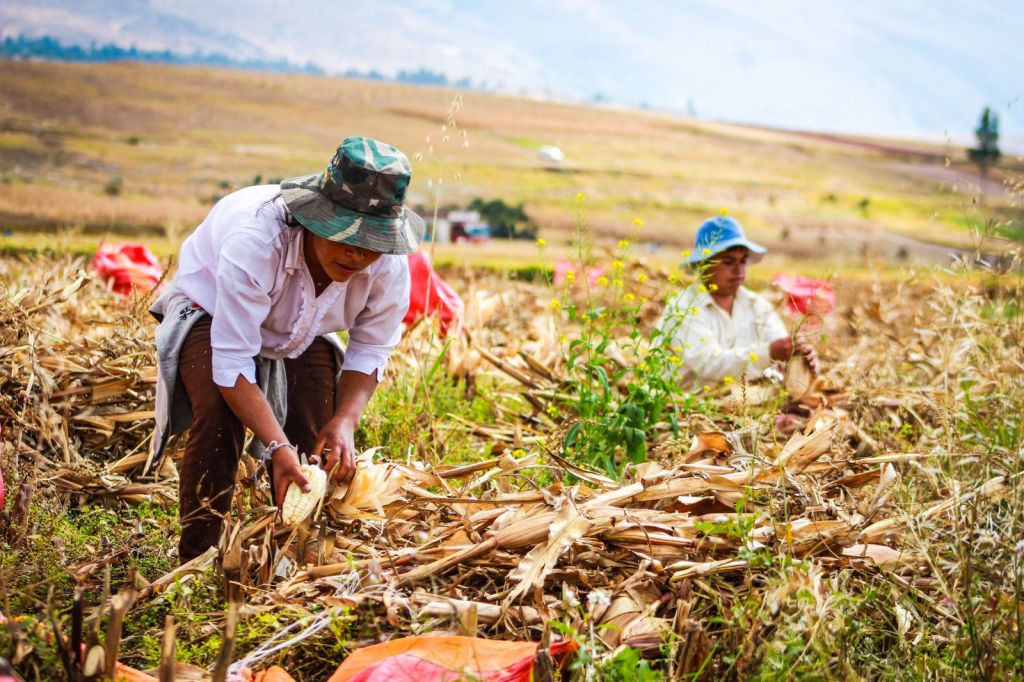
Maize (मक्का) is India’s highest-yielding cereal per hectare and the crop that carries the most risk in its first four weeks. It germinates fast, grows visibly every day, and then — in a bad kharif — loses a third of its potential to fall armyworm feeding inside the whorl while the farmer is still waiting for the first irrigation. This guide takes the crop from field selection and hybrid choice through land preparation, seed rate and geometry, the fertiliser schedule stage by stage, irrigation, growth-phase care, the symptoms that separate a healthy crop from a mature one, pest and disease prevention, treatment, harvesting and post-harvest drying and storage. Doses follow the ICAR-Indian Institute of Maize Research (IIMR) and ICAR-CCARI packages.
1. Climate, Season and Field Choice / जलवायु, मौसम और खेत का चुनाव
Maize is a warm-season crop grown in all three Indian seasons — kharif, rabi and spring/zaid — with kharif and rabi accounting for most of the area. It is a short-duration, high-yielding crop that responds strongly to management, which is why the season choice matters less than the field choice. ICAR-IIMR is blunt about one point: maize is very sensitive to waterlogging, and considerable yield loss occurs if the crop faces water stagnation for more than two days. Pick a well-drained field, and in kharif always go for raised-bed planting. Our kharif, rabi and zaid guide explains how the seasons map to crop choice.
2. Soil and Land Preparation / मिट्टी और खेत की तैयारी
Maize does best on a deep, well-drained loam or sandy loam with adequate organic matter; it tolerates a wide pH range but responds to a neutral to slightly acidic soil. Prepare the field with one deep ploughing followed by two or three harrowings to bring it to fine tilth, and level it — uneven fields are where water stands and maize dies. In kharif, prepare 70 cm wide raised beds (40 cm ridge and 30 cm furrow) with a bed planter; sowing on the southern side of an east–west ridge gives the seedbed more sun and warmth, an IIMR recommendation. Apply 12–13 tonnes of farmyard manure per hectare at the last ploughing. Deep ploughing before planting also exposes pupae of stem borers to sun and birds. Background on soil types is in our soil types guide.
3. Seed Rate, Hybrid Choice and Seed Treatment / बीज दर, संकर किस्म और बीजोपचार
For grain maize the seed rate is 20 kg per hectare; the IIMR figures for speciality corn are 8 kg/ha for sweet corn, 12 kg/ha for popcorn and 25 kg/ha for baby corn. Sow 3.5–5 cm deep. Optimum plant stand is what converts hybrid potential into yield: 60 × 20 cm gives about 83,000 plants per hectare, 75 × 20 cm about 66,000. Before sowing, treat the seed with a fungicide — Thiram or Captan at 2–3 g per kg of seed is the standard recommendation — and for kharif sowing treat with cyantraniliprole 19.8 per cent + thiamethoxam 19.8 per cent at 6 ml per kg, or chlorantraniliprole 50 FS at 5.6 ml per kg, which protects the seedling against early fall armyworm attack for about two weeks after germination. That seed treatment is the cheapest insect control in the whole season. See seed selection and seed treatment for the technique.
4. Sowing Method and Geometry / बुवाई की विधि और दूरी
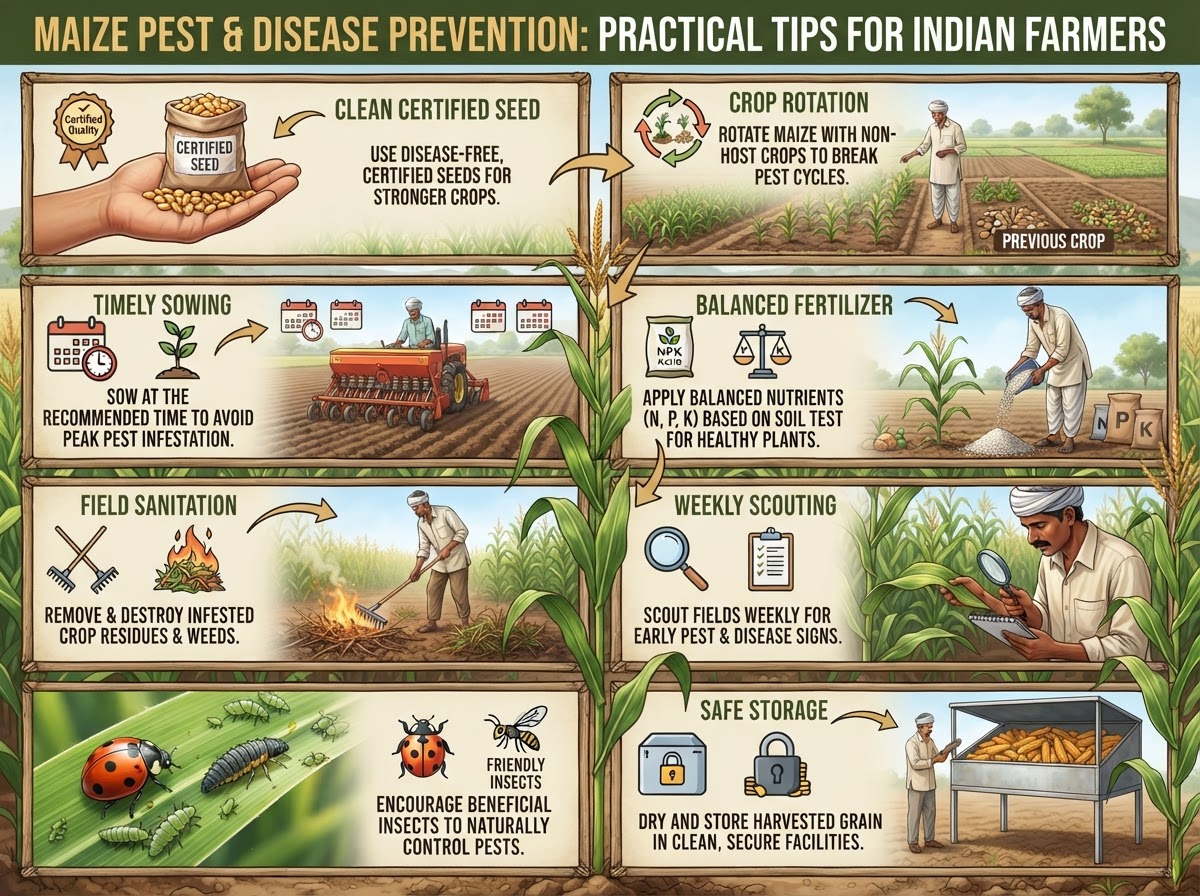
Sow in lines with a seed drill or bed planter at 60 × 20 cm or 75 × 20 cm; a spacing of 60 × 20 cm suits tractor intercultivation on wider rows. Keep rows straight and the depth uniform — a seed at 8 cm emerges a week late and never catches up. On raised beds plant a single line of maize per bed with 20 cm seed-to-seed spacing when maize is the sole crop. Where maize follows a legume or is intercropped, keep the legume strips to two or four rows of maize to one row of legume; intercropping with pigeonpea, cowpea or groundnut is an IIMR-recommended way to cut fall armyworm damage. The mechanics of drilling and line sowing are in sowing methods.
Sowing windows by season: Kharif maize is sown with the onset of the monsoon, roughly late June to early July across most of India. Rabi maize is sown October–November, mainly in peninsular and southern states with assured irrigation. Spring/zaid maize is sown January–February in north-western India, under irrigation, ahead of the summer heat. Match the hybrid’s duration to the window so that silking and grain filling do not fall in peak heat or in a heavy-rain spell — both cut yield sharply.
5. Watering and Irrigation / सिंचाई और जल प्रबंधन
Maize needs its first irrigation at the knee-high stage, then at pre-tasseling, at silking and at grain filling; the two stages where moisture stress costs the most yield are tasseling and silking. In kharif, rainfall usually covers the early period, and drainage becomes the more urgent job. Never leave water standing in the furrow for more than a day — the IIMR advisory on water stagnation is a warning, not a preference. Ridge-and-furrow planting in kharif, and sprinkler or drip irrigation where water is scarce, are the practical options. Central support for drip and sprinkler is available under Per Drop More Crop.
6. Manure and Fertilizer: Dose and How to Apply / खाद और उर्वरक: मात्रा और तरीका
A balanced dose is 60–120 kg N, 40–75 kg P and 40 kg K per hectare depending on your soil test, according to ICAR-CCARI; the IIMR schedule then fixes the timing. Drill the full dose of phosphorus and potash, plus one-third of the nitrogen, as a basal application 5–7 cm below the seed at sowing, along with zinc sulphate where the soil is deficient — the IIMR rate is 10 kg/acre of ZnSO₄·7H₂O for a long-duration hybrid. Top-dress the second third of the nitrogen at the knee-high stage, 20–30 days after germination, and the last third after the flag leaf appears but before the tassel emerges. Apply urea just before an irrigation, never on dry soil at midday. Excess nitrogen at the whorl stage makes the crop lush and, per ICAR-IIMR, more attractive to fall armyworm. The split logic is set out in fertiliser use and integrated nutrient management.
7. Growth-Phase Care / वृद्धि अवस्था की देखभाल
Thin the crop at 10–15 days after germination to the target stand and remove weak plants. One hoeing and one earthing-up at 25–30 days controls weeds and firms the root zone; a second weeding before the second top dressing keeps the crop ahead of weeds. Scout the field weekly in a W-pattern from germination onwards, skipping the outer three or four rows — that is the IIMR scouting method. Install four fall armyworm pheromone traps per acre in the first planted block of a contiguous maize area and change the lure every 30 days. Keep the field free of alternate weed hosts and put up ten bird perches per acre. Full weed control practice is in weed management.
8. Healthy Plant vs Mature Plant Symptoms / स्वस्थ और परिपक्व पौधे के लक्षण
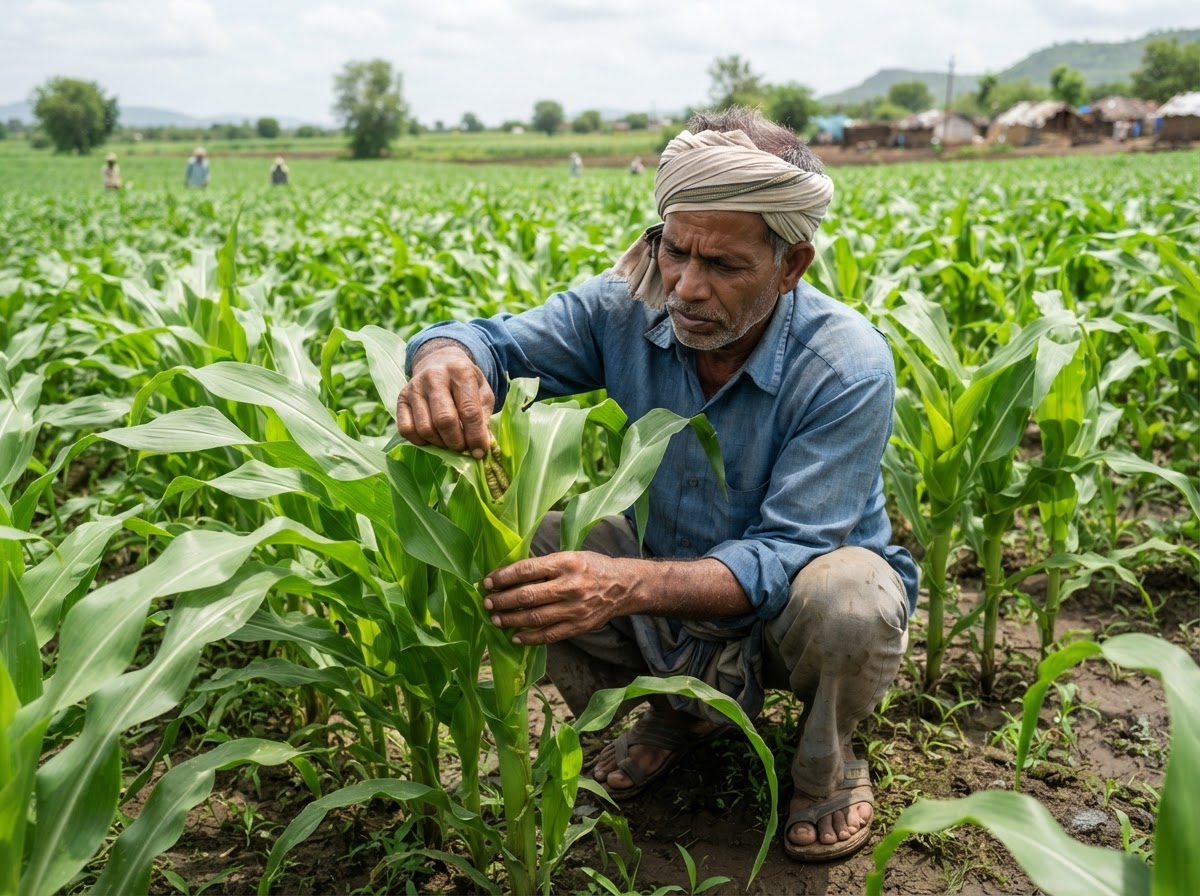
A healthy maize plant has broad, upright, deep-green leaves with no yellowing at the midrib, a thick stem free of holes, and a clean whorl — open the whorl of five plants at random each week and look for sawdust-like frass, which is the signature of fall armyworm. A mature crop changes visibly: lower leaves dry from the tip, the husk turns pale and papery, the silk darkens and dries, and the kernels become hard and dented. Cut a cob and check the kernel base for the black layer — the physiological maturity signal. A crop that yellows from the lower leaves upward with a V-shaped pattern, or shows a chlorotic band in the middle of young leaves, is short of nitrogen or zinc respectively, not diseased.
9. Pests, Diseases and Prevention / कीट, रोग और बचाव
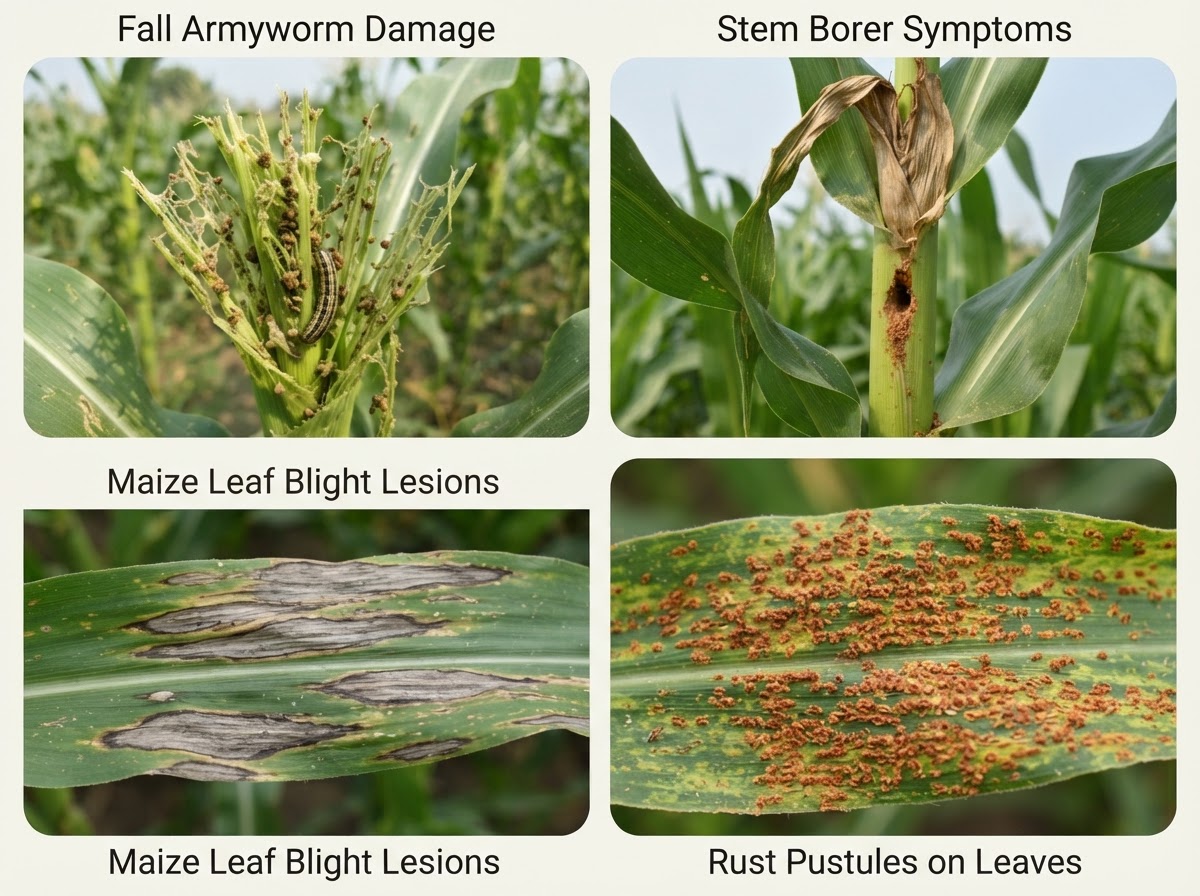
Fall armyworm (Spodoptera frugiperda) is the defining pest, damaging every stage from the seedling whorl to the tassel and ear. Prevention is a season-long package from the ICAR-IIMR/NCIPM/NBAIR bulletin: deep ploughing to expose pupae; neem cake at 200 kg per acre; the seed treatment described above; ridge-and-furrow planting; intercropping with legumes; flowering plants such as marigold and sesame on the bunds to host natural enemies; three to four rows of napier as a trap crop; pheromone traps and weekly scouting. Stem borers (spotted and pink) show as dead hearts and pin-holes on the stem, and are managed with the same scouting discipline. Among diseases, maydis leaf blight and turcicum leaf blight cause long grey-green lesions on the leaves, and charcoal rot appears under terminal moisture stress; tight-husk genotypes and clean cultivation reduce ear rots and aflatoxin risk. The general framework is in our IPM guide and crop diseases guide.
10. Treatment of Disease and Pest Attack / रोग और कीट का उपचार
Spray safety: Wear gloves, a mask and full-sleeve clothing when applying any biopesticide or insecticide. Spray early morning or evening, never in the midday heat or ahead of rain, and always observe the pre-harvest interval printed on the product label before harvesting fodder or grain.
Act on thresholds, not on fear. For fall armyworm, the IIMR sequence is: a first blanket spray of 5 per cent neem seed kernel extract when 10 per cent of plants are infested, around 10 days after germination; then, at 10–20 per cent infestation around 15 days after germination, whorl application of a biopesticide — Bacillus thuringiensis at 2 g per litre, or Metarhizium anisopliae or Beauveria bassiana at 5 g per litre; and only at 20 per cent infestation, around 20–25 days, a whorl application of a recommended synthetic insecticide such as chlorantraniliprole 18.5 SC at 0.4 ml per litre or spinetoram 11.7 SC at 0.5 ml per litre, at the label’s per-acre rate. Repeat only if fresh infestation appears in 20–30 per cent of plants after 12–15 days, and after 45 days use a green-label product with the shortest waiting period. For leaf blights, remove severely affected leaves and spray a recommended fungicide only if the disease is spreading up the plant. Technique and safety are in agrochemical application methods.
11. Harvesting / कटाई
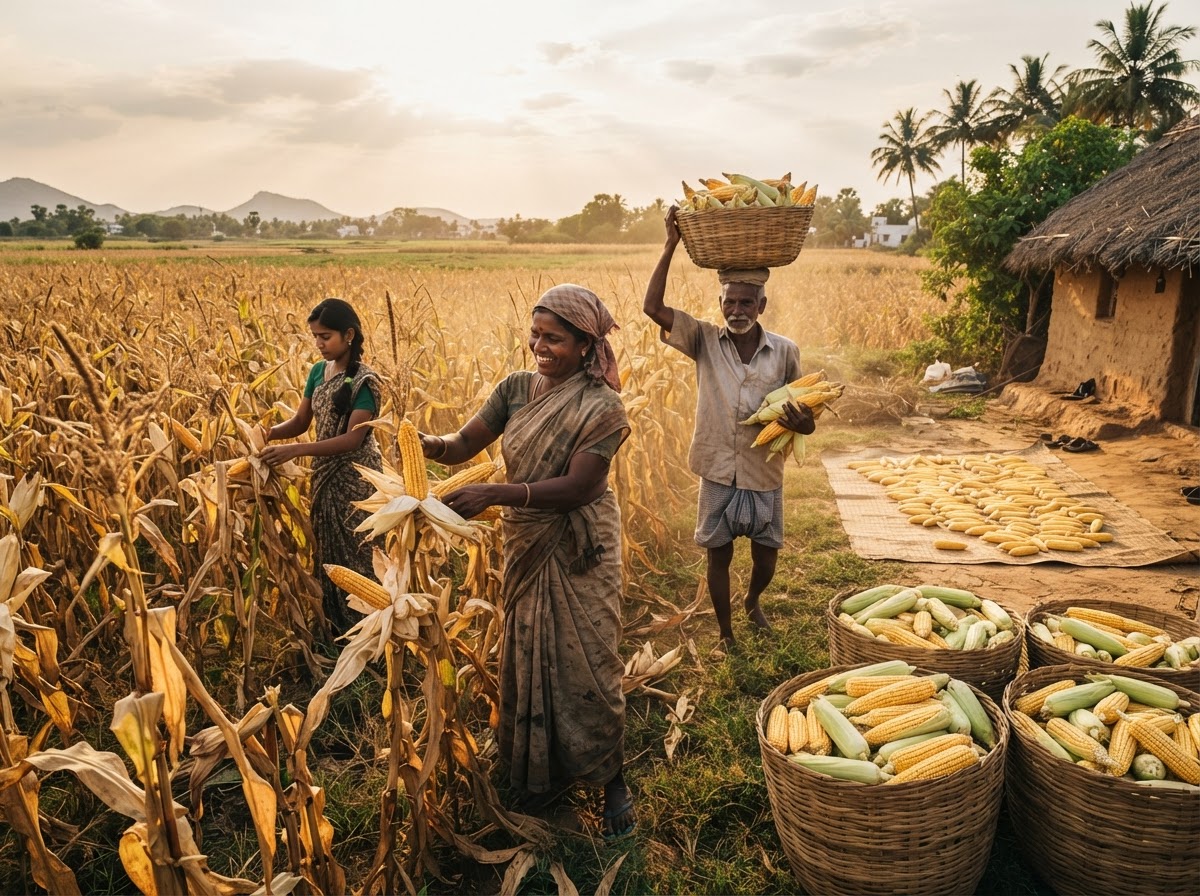
Harvest grain maize when the husk is dry and papery, the silk is brown and dry, and the kernel shows the black layer at its base — roughly when the grain moisture has fallen to the mid-20s per cent. Harvest cobs by hand and keep them in shade, or combine where the crop is standing dry. For sweet corn, pick at the milk stage when the silk has just browned and the kernels squirt milky juice; for baby corn, harvest within a day or two of silk emergence, early in the morning, when the cob is 2–4 cm of silk out. Delay in fodder or sweet corn costs quality within 24 hours.
12. After Harvest / कटाई के बाद
Dry shelled grain to 12–13 per cent moisture before storage — this single step decides whether the lot survives the season and whether aflatoxin develops. Dry on a clean tarpaulin or a drying floor, never on bare soil or a road, and never in a heap that traps moisture. Clean and grade, then store in dry, ventilated bags on pallets away from the wall, with a neem-leaf or approved grain-protectant treatment against weevils, and inspect monthly. Sell on the MSP where maize is notified, or through e-NAM; the stover is valuable fodder and should be stacked dry and covered. Insure the crop under PMFBY if maize is notified in your state.
Key Takeaways / मुख्य बातें
- Maize dies in standing water — plant kharif maize on raised beds and choose a drained field.
- Sow 20 kg/ha of grain maize at 60 × 20 cm, 3.5–5 cm deep, with a fungicide plus fall armyworm seed treatment.
- Drill all P and K with one-third of the nitrogen at sowing, then top-dress the rest at knee-high and pre-tasseling.
- Scout the whorls weekly, use pheromone traps and neem-based sprays first, and keep synthetic insecticide for threshold-level infestation.
- Dry grain to 12–13 per cent moisture before storage, and harvest sweet corn and baby corn within a day of the right stage.
Sources / स्रोत
- ICAR-Indian Institute of Maize Research — maize production technologies, kharif and rabi packages (iimr.icar.gov.in)
- ICAR-IIMR, NCIPM and NBAIR — Management of Fall Armyworm and Aflatoxin in Maize, Bulletin 01/2024
- ICAR-CCARI, Goa — Maize: plant population, seed rate, fertiliser application (ccari.res.in)
- Department of Agriculture, Government of Meghalaya — Package of Practices: Maize
- PJTSAU Regional Agricultural Research Station — Maize package of practices


Leave a Reply