
भारत में ऑयल पाम की खेती: NMEO-OP सब्सिडी, व्यवहार्यता मूल्य और आवेदन प्रक्रिया – Oil palm is the only crop in India where the Union government promises a floor price for the farmer’s produce and pays the shortfall directly into the bank account. That promise sits inside the National Mission on Edible Oils – Oil Palm (NMEO-OP), a centrally sponsored scheme approved in August 2021 with an outlay of ₹11,040 crore. This guide sets out exactly what the mission pays for, how the price assurance is calculated, who is eligible, and the documents and steps a farmer has to complete to get on the list — using only figures published by the Ministry of Agriculture and Farmers Welfare and the Department of Agriculture and Farmers Welfare.
Why oil palm, and why the mission matters / ऑयल पाम क्यों, और यह मिशन क्यों मायने रखता है
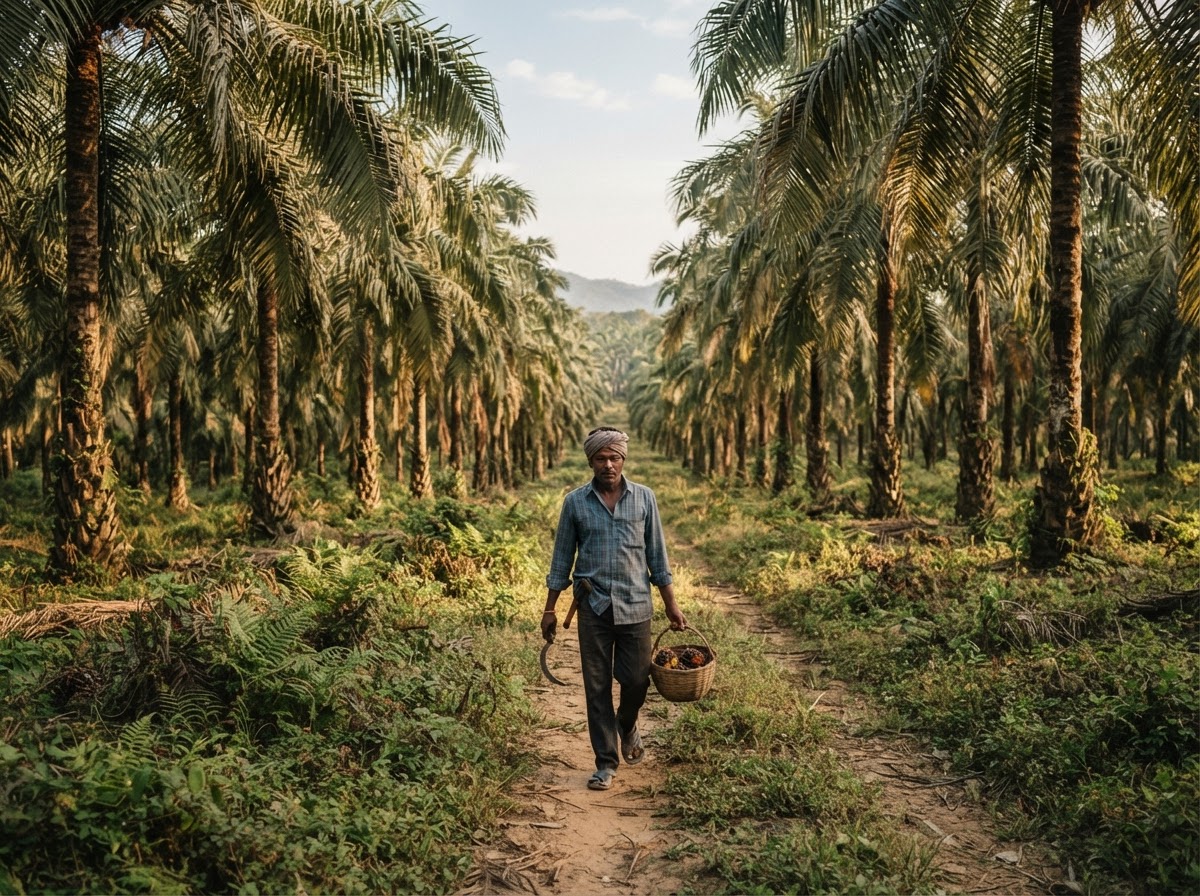
India meets a large share of its edible-oil demand through imports, and palm oil is the single biggest item in that import bill. Oil palm yields more oil per hectare than any other oilseed crop the country grows, which is why the Cabinet approved NMEO-OP on 18 August 2021 as a new centrally sponsored scheme with a special focus on the North-East and the Andaman and Nicobar Islands. The approved outlay is ₹11,040 crore, of which ₹8,844 crore is the Government of India share and ₹2,196 crore the state share, and the target was to bring an additional 6.5 lakh hectares under oil palm between 2021-22 and 2025-26 (Prime Minister’s Office, Cabinet decision, 18 August 2021).
The mission is being implemented in 15 states — Andhra Pradesh, Arunachal Pradesh, Assam, Chhattisgarh, Goa, Gujarat, Karnataka, Kerala, Manipur, Mizoram, Nagaland, Odisha, Tamil Nadu, Telangana and Tripura (PIB, Rajya Sabha reply, 7 August 2026). What sets it apart from an ordinary input subsidy is that it does two things at once: it carries the farmer through the long, unproductive four-year wait before the first harvest, and it insures against a fall in the international crude palm oil price through a mechanism called the Viability Gap Payment.
Do not confuse it with the National Mission on Edible Oils – Oilseeds (NMEO-OS), launched separately on 3 October 2024 for mustard, groundnut, soybean and other annual oilseeds. Oil palm, by contrast, is a tree crop with its own mission, its own assistance rates and its own price formula.
What the mission pays for, component by component / मिशन में किन-किन मदों पर सहायता मिलती है
The rates below are the approved norms for the mission period 2021-22 to 2025-26, as placed before Parliament by the Department of Agriculture and Farmers Welfare (PIB annexure, August 2025). Assistance is normally routed through the state department or the oil palm processor rather than paid as cash in hand.
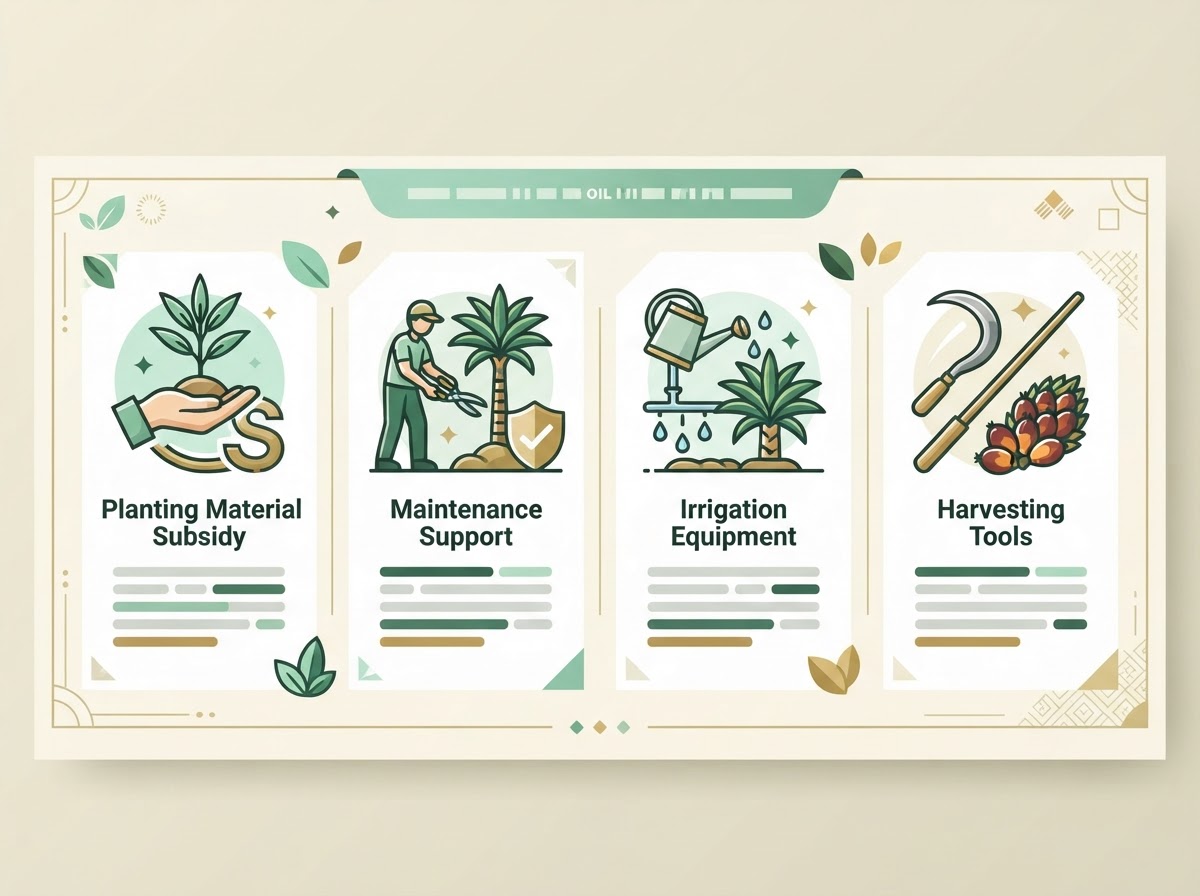
- Planting material: ₹20,000 per hectare for domestic seedlings and ₹29,000 per hectare for imported seedlings, calculated at 150 plants per hectare and available for the farmer’s entire land holding and planting area.
- Maintenance and intercropping during gestation: ₹42,000 per hectare over the four-year gestation period in general states, and ₹50,000 per hectare in the North-East and Andaman and Nicobar Islands — split equally between maintenance and intercropping inputs, paid year by year.
- Replanting old gardens: a one-time grant of 50% of the cost, at ₹250 per plant, for gardens that are 25–30 years old.
- Irrigation and farm assets: drip irrigation as per Pradhan Mantri Krishi Sinchayee Yojana norms, borewell, pump set, water-harvesting structure and vermicompost unit as per MIDH guidelines, and solar pumps as per PM-KUSUM norms.
- Harvesting tools: ₹2,500 for a cutter, ₹15,000 for a motorised chisel, ₹20,000 for wire mesh, ₹5,000 for a portable ladder, ₹50,000 for a chaff cutter and ₹2 lakh for a tractor with trolley.
- Custom Hiring Centre cum FFB Harvester Group: a one-time grant of ₹25 lakh per unit for equipment, tools, training and maintenance, set up by processors, states, self-help groups or FPOs.
- Seed gardens and nurseries: ₹80 lakh for a seed garden and ₹40 lakh for a nursery in the rest of India; ₹100 lakh and ₹50 lakh respectively in the North-East.
- Training: ₹30,000 per two-day batch of 30 farmers, and ₹40,000 per batch of 20 officers.
Funding is shared 60:40 between the Centre and general-category states, and 90:10 with North-Eastern states. Seed gardens, nurseries, research and the Viability Gap Payment are funded 100% by the Government of India. The state Department of Agriculture or Horticulture is the nodal agency, and work is planned through Annual Action Plans approved by the state-level sanctioning committee.
If you are weighing up other support available alongside this scheme — working capital, farm machinery, or a small processing unit — the Kisan Credit Card covers short-term crop and plantation needs, while the Agriculture Infrastructure Fund supports post-harvest and processing assets at 3% interest subvention.
The viability price: how the price assurance actually works / व्यवहार्यता मूल्य: मूल्य आश्वासन वास्तव में कैसे काम करता है
Oil palm farmers sell fresh fruit bunches (FFB) to the processing mill allotted to their zone. The mill’s price has historically moved with the international crude palm oil (CPO) price, so a farmer’s income swung with a market he could not see. NMEO-OP answers that with two numbers.
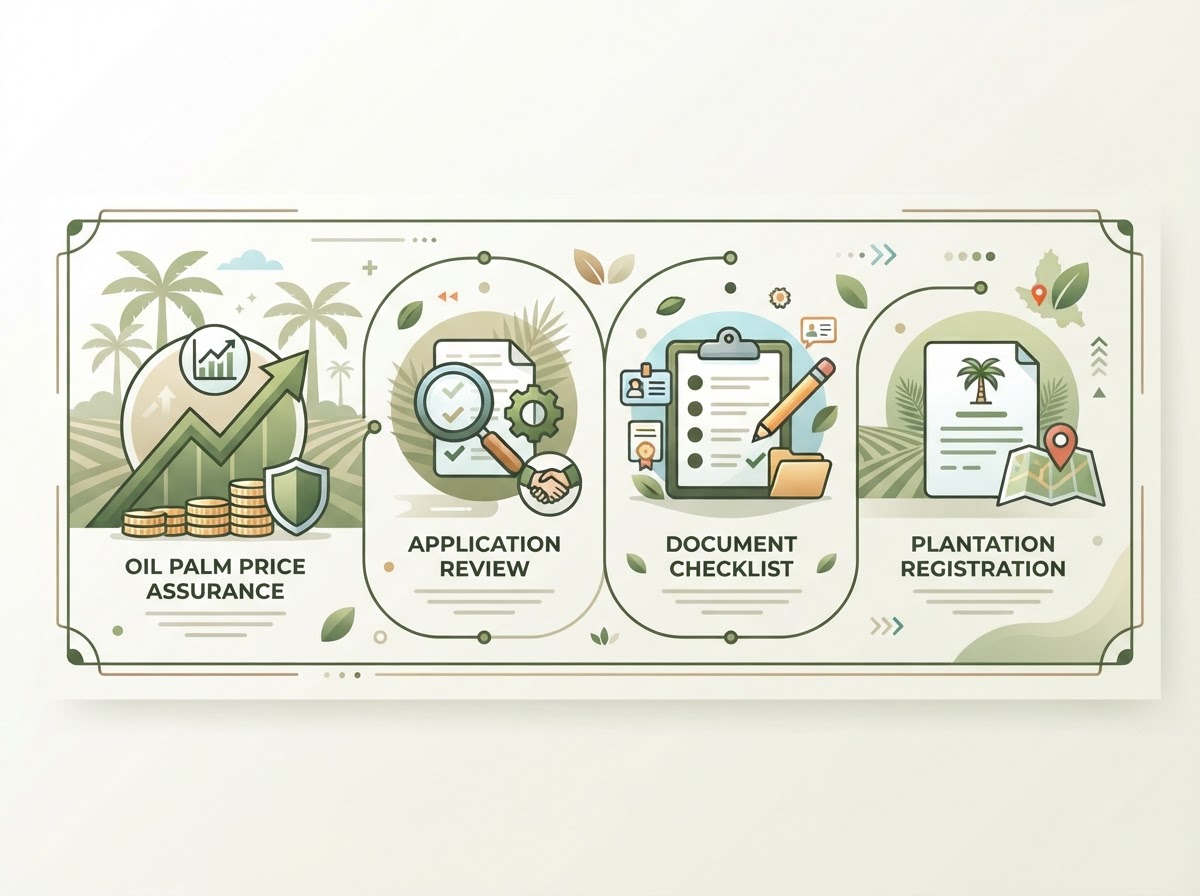
The first is the Viability Price (VP), declared once a year by the Centre for the Oil Palm Year, which runs from 1 November to 31 October. It is worked out as 14.3% of the annual average CPO price of the last five years, adjusted for the wholesale price index. The second is the Formula Price (FP), fixed every month as 14.3% of the CPO price. When the monthly formula price falls below the annual viability price, the difference is paid to the farmer as the Viability Gap Payment (VGP) through Direct Benefit Transfer. The industry is mandated to pay 14.3% of the CPO price, rising gradually to 15.3%, and the arrangement carries a sunset clause of 1 November 2037. For the North-East and the Andaman and Nicobar Islands, the Centre bears an additional 2% of the CPO price so that growers there are paid at par with the rest of the country.
For the Oil Palm Year 2025-26, the viability price was declared at ₹15,488 per tonne of FFB, effective 1 November 2025 to 31 October 2026 (Office Memorandum F. No. 3-14/2021-OP (SB), Department of Agriculture and Farmers Welfare, 1 January 2026). A fresh viability price is declared for each oil palm year, and at the time of writing we could not verify a published 2026-27 rate — check the current figure with your state horticulture office or the mission portal before you plan a harvest. Note also that the VGP is paid only in states that have signed an MoU adopting the Centre’s payment formula; states that fix FFB prices under their own oil palm legislation — Andhra Pradesh, for instance, sets FFB prices for its factory zones under its Oil Palm Act — operate their own price orders.
The money is real but modest so far. As on early August 2026, ₹18.90 crore had been disbursed as Viability Gap Payment to 9,244 oil palm farmers across Goa, Tamil Nadu, Gujarat, Karnataka, Odisha, Arunachal Pradesh, Assam and Mizoram (PIB, Lok Sabha reply, 4 August 2026).
Who can apply / कौन आवेदन कर सकता है
Eligibility is decided district by district, because oil palm needs a processing mill within economical distance of the plantation. In practice a farmer qualifies when all of the following are true:
- The land lies in a district notified for oil palm expansion under NMEO-OP in one of the 15 implementing states.
- The plot has assured irrigation — a borewell, open well, canal or lift irrigation that can carry the palms through the dry months. Rainfed land is generally not sanctioned.
- The land record stands in the applicant’s name, or there is a registered long-term lease covering the plantation’s life.
- The farmer is willing to sign an FFB supply agreement with the processor allotted to that zone, usually a tripartite agreement involving the farmer, the state and the processor.
- There is an Aadhaar-linked bank account, because both the subsidy components and the Viability Gap Payment move by DBT.
Read the second condition as a hard one. The mission’s guidelines are built around a four-year gestation and a plantation life of 25 to 30 years; there is no exit if the water fails.
How to apply, step by step / आवेदन कैसे करें — चरण दर चरण
There is no single national application form. Each state runs its own registration window and portal, and the state Department of Agriculture or Horticulture is the nodal agency. The sequence, however, is the same everywhere.
- Confirm your district is notified and find your mill. Ask the District Horticulture or Agriculture Office whether your block is in the current year’s oil palm area and which processing company holds the zone. Without a mill, there is no assured buyer and no sanction.
- Register as a beneficiary. Registration happens on the state portal, at a Common Service Centre or at the department office. Assam, for example, allows self-registration at nmeo-op.assam.gov.in, after which the empanelled implementing partner reviews the application and forwards it to the District Agricultural Officer. Telangana runs an online registration form for its oil palm mission with a ₹25 fee and OTP verification to the Aadhaar-linked mobile. Karnataka asks for a FRUITS ID before the horticulture office accepts the file.
- Keep the papers ready. Land record or Record of Rights for the survey number being planted, Aadhaar, a bank passbook page for the Aadhaar-seeded account, a passport photograph and the processor agreement. Assam’s portal, for instance, accepts a photograph as PNG and the Aadhaar, bank and land documents as PDFs, each under 200 KB.
- Sign the FFB supply or tripartite agreement. This fixes who supplies seedlings, who gives technical support and who buys your fruit bunches, and it is what makes the price assurance enforceable.
- Face the joint inspection. Horticulture officials and the processor’s field staff check soil, water source and layout, and record the plantation area that will be paid for.
- Take seedlings in the planting window and plant to the recommended layout. Planting material is supplied through the department or the processor; the assistance rate assumes 150 plants per hectare.
- Claim each component after its inspection. Planting material is settled first, then maintenance and intercropping year by year through the gestation period, then tools and irrigation assets as they are installed.
- From the first harvest, sell to your mill and watch the monthly price. Where the formula price drops below the viability price in an MoU state, the gap arrives by DBT without a separate application.
Where the mission stands in 2026 / 2026 में मिशन कहाँ पहुँचा है
The record is mixed and worth stating plainly. Against a target of 6.5 lakh hectares for 2021-22 to 2025-26, 2.73 lakh hectares were actually brought under oil palm, taking the cumulative area to 6.40 lakh hectares as on 31 March 2026. Over the same period 114.66 lakh tonnes of fresh fruit bunches were harvested and 20.10 lakh tonnes of crude palm oil produced, with 27 processing mills operating across the country (PIB, Lok Sabha reply, 4 August 2026).
The mission’s approved five-year period ended with 2025-26. Annual Action Plans for 2026-27 have since been approved for the implementing states at ₹1,143.9 crore, so planting and assistance continue (PIB, Rajya Sabha reply, 7 August 2026); a fresh five-year approval has not been announced. In a Lok Sabha reply on 11 August 2026 the ministry also stated that there is no proposal to increase the assistance rates under the area expansion programme. For 2026-27 the area target is about 1.19 lakh hectares, of which roughly 55,614 hectares had been covered by late October 2026, with Bihar joining the mission (The Hindu BusinessLine, 29 October 2026).
What to weigh before you plant / पौध लगाने से पहले क्या सोचें
Oil palm is not a crop you can reverse in a season. Four years pass before the first meaningful harvest, and the palms then occupy the land for 25 to 30 years. During gestation, the maintenance and intercropping assistance of ₹42,000 per hectare is spread across four years — support, not income. It helps to plan an intercrop such as banana, cocoa or a pulse to keep cash coming in, as explained in our guide to intercropping.
Water is the other deciding factor. Drip irrigation under the mission follows Per Drop More Crop norms, and NABARD’s Micro Irrigation Fund can help state agencies finance the system. Fresh fruit bunches deteriorate quickly after cutting, so the distance to your mill and its buying discipline matter as much as the subsidy itself. Where a group of farmers is negotiating with a mill, a Farmer Producer Organisation gives better leverage on weighing, transport and payment.
Finally, treat the price assurance as a floor and not a profit guarantee. It only applies in states that have signed the MoU, it is recalculated every November, and the government has said it does not intend to raise the assistance rates in this phase. Model your numbers on the current viability price, your own yield, and the mill’s actual monthly rate — not on the headline subsidy.
Key takeaways / मुख्य बातें
- NMEO-OP is a centrally sponsored scheme approved in August 2021 with ₹11,040 crore, running in 15 states; state Departments of Agriculture or Horticulture are the nodal agencies.
- Assistance includes ₹20,000 per hectare for domestic and ₹29,000 per hectare for imported planting material, ₹42,000 per hectare for maintenance and intercropping over the four-year gestation (₹50,000 in the North-East and Andaman and Nicobar Islands), and ₹250 per plant for replanting old gardens.
- The Viability Price for Oil Palm Year 2025-26 was ₹15,488 per tonne of fresh fruit bunches; the shortfall against the monthly formula price is paid as the Viability Gap Payment by DBT, but only in states that have signed the MoU.
- You need notified land, assured irrigation, a processor agreement and an Aadhaar-seeded bank account; registration is through the state portal, a CSC or the district horticulture office.
- 2.73 lakh hectares were added against a 6.5 lakh hectare target by 2025-26; 2026-27 plans are approved at ₹1,143.9 crore, and the ministry has said no increase in assistance rates is proposed.
Sources / स्रोत
- Prime Minister’s Office, Cabinet approves implementation of National Mission on Edible Oils – Oil Palm, 18 August 2021 — pmindia.gov.in
- PIB, Implementation of NMEO-OP, Rajya Sabha reply, 7 August 2026 — pib.gov.in
- PIB, Oilseed and Palm Oil Production, Lok Sabha reply, 4 August 2026 — pib.gov.in
- PIB, Rate of Assistance of Various Components under NMEO (OP), August 2025 — pib.gov.in (PDF)
- Department of Agriculture and Farmers Welfare, Office Memorandum declaring the Viability Price for OPY 2025-26, 1 January 2026
- Department of Agriculture and Farmers Welfare, NMEO-OP Operational Guidelines (2021-22 to 2025-26), April 2022 — nmeo.dac.gov.in
- Lok Sabha Starred Question No. 330, National Mission on Edible Oils – Oil Palm, 11 August 2026 — sansad.in
- NMEO-OP Assam, Department of Agriculture, Government of Assam — nmeo-op.assam.gov.in
- The Hindu BusinessLine, 47% of the targeted area covered under India’s oil palm expansion this fiscal, 29 October 2026


Leave a Reply