
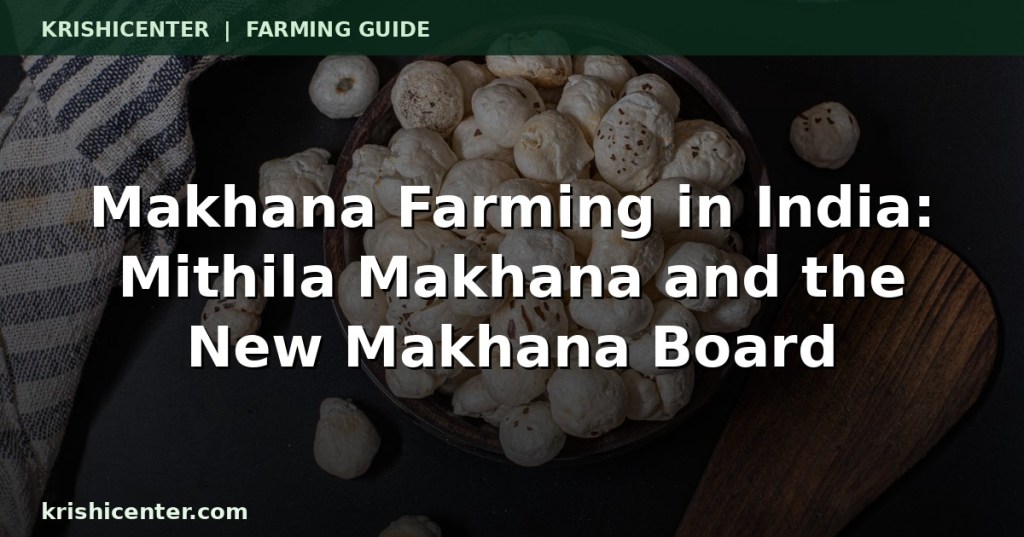
Makhana (fox nut) is one of India’s most valuable aquatic crops — and Bihar grows almost all of it. This guide explains what Mithila Makhana is, how the crop is cultivated, what the newly established National Makhana Board does, which subsidies a grower can claim, and what a farmer can realistically earn.
What Is Makhana and Why It Matters / मखाना क्या है और यह क्यों महत्वपूर्ण है
Makhana, botanically Euryale ferox, is a freshwater aquatic plant also known as fox nut or gorgon nut. It grows in stagnant perennial water bodies — ponds, land depressions, oxbow lakes and swamps — and is harvested for its seeds, which are roasted and popped into the edible product sold as ‘makhana lawa’. India is the world’s largest producer, and Bihar alone accounts for more than 90 per cent of national output according to the National Makhana Board’s operational guideline; other official and academic estimates put the state’s share at 85–90 per cent. It is a genuine cash crop: marketed as a gluten-free, high-protein, low-fat, low-glycaemic superfood, it commands prices that ordinary cereals cannot match.
Commercial production is concentrated in north Bihar — Darbhanga, Madhubani, Saharsa, Supaul, Madhepura, Purnia, Katihar, Kishanganj, Sitamarhi and Araria. Cultivation and processing are carried out largely by resource-poor households, especially the Mallah (fisherfolk) community, for whom makhana is a primary livelihood.
Mithila Makhana and Its GI Tag / मिथिला मखाना और उसका जीआई टैग
‘Mithila Makhana’ was granted a Geographical Indication (GI) tag with effect from 16 August 2022. The registration (GI Application No. 696, Class 29) stands in the name of the Mithilanchal Makhana Utpadak Sangh, Purnea, and is valid up to 13 August 2030. It was the fifth product from Bihar to receive a GI tag, after Bhagalpur’s Jardalu mango, Katarni rice, Maghai paan and Muzaffarpur’s Shahi litchi.
The GI tag is not a formality. It gives the produce legal protection — no one outside the registered user list may sell a similar product under the name ‘Mithila Makhana’ — and it supports branding, premium pricing and export marketing. Makhana is also a cultural staple of the Mithila region, traditionally used in Kojagara Puja.
How Makhana Is Cultivated / मखाना की खेती कैसे की जाती है
Makhana is grown under two systems. The traditional pond system uses natural water bodies with a water depth of 4–6 feet, a seed requirement of 80–90 kg per hectare, a crop duration of 8–10 months and a seed yield of about 1.8–2.0 tonnes per hectare. The newer field system grows makhana in lowland, off-season waterlogged rice fields with roughly 1 foot of standing water; it needs only about 20 kg of seed per hectare, matures in 4–5 months and can yield 2.6–3.0 tonnes per hectare. Because the field system is shorter, it allows makhana to be rotated with other crops, which is why it is spreading.
The crop calendar runs through the year: sowing in November, germination in December–January, transplanting in March, flowering in April–May, fruiting from May–June, and the mature fruits bursting underwater in July, after which the seeds settle on the pond bed. Harvesting of the sunken seed, from August onwards, is a strenuous manual task carried out mainly by skilled women of the Mallah community.
Processing is equally specialised. The collected seeds are washed, sun-dried for 2–3 hours to about 25 per cent moisture, graded through wooden sieves, pre-heated in an earthen pitcher or iron pan, tempered for 48–72 hours, then roasted at around 300°C and cracked with a wooden hammer to release the popped nut. The recovery rate is only 40–42 per cent — roughly 100 kg of raw seed yields 38–40 kg of popped makhana. Seed yields typically range from 12 to 20 quintals per hectare.
Improved varieties are now available. Swarna Vaidehi gives 28–30 quintals of seed per hectare with 35–40 per cent pop recovery, and Sabour Makhana-1 (IC 620551, notified in 2019) gives 32–35 quintals per hectare with a 55–60 per cent recovery — both substantially better than local landraces. Mechanisation is still limited, though farmers in north Bihar have begun using drone spraying for foliar nutrition and plant protection.
The National Makhana Board / राष्ट्रीय मखाना बोर्ड
A Makhana Board for Bihar was announced in the Union Budget 2025-26 on 1 February 2025 by Finance Minister Nirmala Sitharaman, with an initial allocation of ₹100 crore. The National Makhana Board was then formally established by the Ministry of Agriculture and Farmers Welfare through Gazette Notification No. 28-02/2025 Hort-Tech dated 14 September 2025, and Prime Minister Narendra Modi launched it at Purnea on 15 September 2025. The Centre has approved a development package of nearly ₹475 crore for the sector, covering modern machinery, new variety development and processing facilities.
The Board operates under the Ministry of Agriculture and Farmers Welfare. Its stated objectives are to promote production and new technology, strengthen post-harvest management, promote value addition and processing, develop markets, exports and branding, fund research and development, build the capacity of farmers and Farmer Producer Organisations (FPOs), and drive convergence with other government schemes so that makhana growers actually receive their benefits.
A key promise of the Board is that people engaged in the makhana sector will be organised into FPOs and given handholding and training support. For a sector dominated by small, scattered and largely landless growers, collective organisation is the lever most likely to shift bargaining power away from intermediaries.
The Central Sector Scheme and Subsidies / केंद्रीय क्षेत्र योजना और सब्सिडी
The Board’s work is backed by a Central Sector Scheme for Development of Makhana, funded 100 per cent by the Government of India. Assistance ranges from 35 to 60 per cent of cost norms for individuals and FPOs, and up to 100 per cent for public-sector institutions on a project basis. Major components include:
- Pond cultivation including nurseries — unit cost ₹1.79 lakh per hectare, 40 per cent assistance for farmers, maximum 2 hectares
- Field cultivation including nurseries — unit cost ₹1.32 lakh per hectare, 40 per cent assistance, maximum 2 hectares
- Construction of a new pond — unit cost ₹7 lakh per hectare, 40 per cent assistance, credit-linked, maximum 1 hectare
- Mechanical harvesting equipment — unit cost ₹7 lakh, 50 per cent for farmers and 60 per cent for FPOs
- Micro-level processing unit — ₹10 lakh (35 per cent for private sector, 50 per cent for FPOs); small-level ₹39 lakh; medium-level ₹300 lakh
- Seed production, frontline demonstrations, and training of farmers at ₹1,000 per farmer (up to 2,000 farmers per block per year)
Eligible beneficiaries include makhana farmers, fishermen, self-help groups, women’s SHGs, FPOs, farmer producer companies, cooperatives, registered companies and public institutions. The scheme is designed to converge with PMMSY, NRLM, PMKSY, PM-KUSUM, the Agriculture Infrastructure Fund, MIDH, PMFME, Kisan Credit Card, MGNREGA, APEDA, ATMA and KVKs. The Board will also coordinate with states to extend Pradhan Mantri Fasal Bima Yojana (PMFBY) — specifically the Restructured Weather Based Crop Insurance Scheme (RWBCIS) — to makhana farmers, and to facilitate KCC and term-loan credit with NABARD’s support.
At the state level, Bihar runs the Makhana Development Scheme, which provides a 75 per cent subsidy on Swarna Vaidehi seed, calculated at ₹97,000 per hectare. Makhana is also an approved product under the Centre’s One District One Product (ODOP) scheme, under which food processors can receive support for branding, marketing and infrastructure. Farmers can buy subsidised seed from Krishi Vigyan Kendras at about ₹180 per kg.
Income Potential for Farmers / किसानों के लिए आय की संभावना
Makhana is profitable, but the published numbers vary widely because returns depend on the cultivation system, yield, water availability, lease cost and — above all — whether the farmer sells raw seed or processed pop. The figures below are from separate studies and should be read as a range, not a single figure:
- A NABARD/ICAR-supported study of 120 smallholders in Darbhanga, Madhubani and Saharsa found an average cost of ₹45,000 per hectare and a gross return of ₹85,000 per hectare — a net profit of about ₹40,000 per hectare, with a benefit–cost ratio of 1.89.
- A 2020 study in Darbhanga and Madhubani put the cost of cultivation at ₹57,370 per hectare against a gross return of ₹1,71,630 per hectare, with net returns over Cost A of ₹1,17,345 per hectare and a benefit–cost ratio of 2.16.
- A study of Darbhanga district estimated total cost at ₹63,211 per hectare for the pond system (gross return ₹2.94 lakh) and ₹76,357 per hectare for the field system (gross return ₹3.63 lakh).
- A 2022 study in Darbhanga and Madhubani found an average cost of ₹89,372 per hectare and a net return of ₹41,432 per hectare, noting that harvesting alone accounted for 41 per cent of cost.
- The Agro-Economic Research Centre, Bhagalpur, reported per-acre net returns of ₹18,093 (traditional pond system) and ₹21,241 (field system), with cost–benefit ratios of 1:1.43 and 1:1.46 respectively.
The spread is explained by price and by the point in the value chain at which the farmer sells. Raw, ungraded makhana seed fetches only about ₹50–₹200 per kg; once the shell is removed the price climbs to ₹400–₹800 per kg; and first-grade popped makhana can sell for ₹1,100–₹1,250 per kg, with the best quality touching ₹1,400 per kg. A farmer who sold at around ₹200 per kg in 2017 could command roughly ₹500 per kg in 2025 for the processed product. This gap between raw-seed and processed prices is the single biggest income opportunity — and the reason the Board is pushing micro- and small-level processing units and value addition.
There is also a strong employment dimension. Makhana cultivation and popping are labour-intensive: cleaning and transplanting alone require about 20–25 workers per acre over a week. Integrated systems such as makhana-cum-fish farming, supported under the Pradhan Mantri Matsya Sampada Yojana (PMMSY), add a second income stream from the same water body, while mechanisation support under the Sub-Mission on Agricultural Mechanization (SMAM) can reduce the drudgery of harvesting.
Challenges Before Makhana Growers / मखाना उत्पादकों की चुनौतियां
- Harvesting and popping remain largely manual and physically hazardous, with an estimated 30–40 per cent post-production loss at various stages.
- Most growers do not own the land or pond they cultivate — around 91 per cent of the operated area is leased-in — so lease costs (often ₹20,000–₹30,000 per hectare a year) and harvesting together make up 80–87 per cent of total cost.
- Marketing is dominated by intermediaries, and the crop has no minimum support price; prices are ad hoc and volatile, having ranged from ₹4,000 to ₹22,000 per quintal of seed across recent seasons.
- Value addition and export infrastructure are thin in Bihar — much makhana is exported from other states — and supply is limited by the crop’s dependence on water bodies in flood-prone districts.
Key Takeaways / मुख्य बातें
- Bihar grows the overwhelming majority of India’s makhana; ‘Mithila Makhana’ has held a GI tag since 16 August 2022.
- The National Makhana Board was announced in the Union Budget 2025-26, established on 14 September 2025 and launched by the Prime Minister at Purnea, with a package of nearly ₹475 crore for the sector.
- The Central Sector Scheme offers 35–60 per cent assistance on pond and field cultivation, processing units and harvesting equipment, converging with KCC, PMFBY-RWBCIS, PMMSY and other schemes.
- Reported net returns for makhana range from roughly ₹18,000 per acre to over ₹1 lakh per hectare depending on system, yield and price — so processing and value addition, not just cultivation, decide profitability.
Sources / स्रोत
- National Makhana Board, Central Sector Scheme for Development of Makhana — Operational Guidelines (horticulture.bihar.gov.in)
- Press Information Bureau, Government of India — release on the Makhana Board (pib.gov.in)
- Directorate of Horticulture, Government of Bihar — document on makhana
- Bihar Agricultural University, Sabour — Makhana research highlights
- IP India, Geographical Indications Registry — Mithila Makhana, GI Application No. 696
- APEDA Market Intelligence Cell — monthly dashboard on Makhana
- The Hindu BusinessLine, The Indian Express, Down To Earth and NDTV — reporting on the Makhana Board and farmer incomes
- Agro-Economic Research Centre, Bhagalpur — study on the economics of makhana
- Published cost-and-returns studies on makhana in Darbhanga and Madhubani (IJCMAS, Indian Journal of Extension Education, Plant Archives)


Leave a Reply