
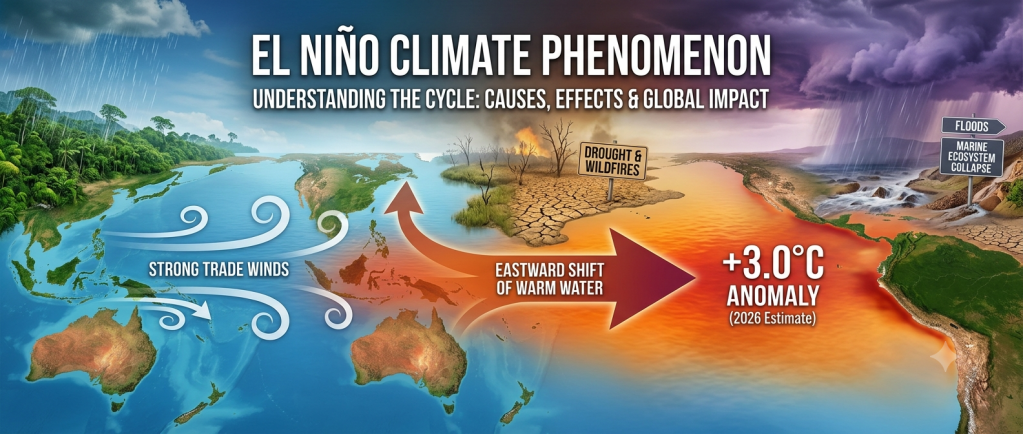
El Niño—spanish for “The Little Boy” or “The Christ Child”—is one of the most powerful natural drivers of climate variability on Earth. Originating as a periodic warming of sea surface temperatures across the central and eastern tropical Pacific Ocean, this phenomenon disrupts global atmospheric circulation, triggering ripple effects that range from severe droughts and heatwaves in Asia to torrential flooding in South America.
1. What Causes El Niño?
El Niño is the warm phase of the broader El Niño–Southern Oscillation (ENSO) cycle, a coupled ocean-atmosphere climate interaction.
NORMAL / LA NIÑA CONDITIONS (Trade winds push warm water west)┌─────────────────────────────────────────────────────────┐│ West Pacific (Asia/Aus) East Pacific (S. America)││ Warm Water + High Rainfall ◄── Deep Cold Upwelling │└─────────────────────────────────────────────────────────┘EL NIÑO CONDITIONS (Trade winds weaken/reverse)┌─────────────────────────────────────────────────────────┐│ West Pacific (Asia/Aus) East Pacific (S. America)││ Drought + Suppressed Rain ──► Warm Water Sloshes East│└─────────────────────────────────────────────────────────┘
The Mechanism
- Normal Conditions (Walker Circulation): Strong easterly trade winds blow from east to west across the tropical Pacific. They push surface waters warmed by the sun toward Indonesia and Australasia, causing cold, nutrient-rich deep water to upwell along the coast of South America (Peru and Ecuador).
- El Niño Breakdown: Trade winds weaken or reverse into westerlies. Without the wind push, the deep pool of warm water accumulated in the western Pacific sloshes eastward toward South America.
- Atmospheric Coupling: As warm surface waters move east, atmospheric convection (cloud formation and rainfall) shifts with them. This movement alters jet streams and global weather patterns thousands of miles away.
2. Global Effects of El Niño
When El Niño sets in, the world’s weather maps undergo significant shifts:
| Region | Primary El Niño Impacts |
| South America (Peru, Ecuador, Chile) | Extreme rainfall, flash flooding, and landslides. Coastal upwelling collapses, disrupting marine food chains and crashing local fisheries. |
| Southeast Asia & Australasia (Indonesia, Australia, Philippines) | Severe drought, prolonged heatwaves, reduced agricultural yields, and bushfires. |
| North America | Milder, warmer winters across Canada and the northern US; wetter, cooler winters across the US Sunbelt and California. |
| Horn of Africa | Heavy, erratic rainfall leading to localized flooding, often offsetting previous drought cycles. |
| Southern Africa | Hotter, drier conditions leading to crop failures and water shortages. |
3. History of El Niño: Historical Impact on India & World
Historical Context in India
India’s agricultural sector depends heavily on the Southwest Monsoon (June–September), which accounts for over 70% of the country’s annual rainfall. Historically, about 60% of El Niño events have coincided with a monsoon deficit or drought in India.
- The 1876–1878 Great Famine: A super El Niño triggered a severe monsoon failure, causing catastrophic famines across British India that led to millions of deaths.
- 1972 & 1982–1983 Events: Major El Niño years that resulted in widespread droughts, sharp declines in food grain production, and severe agricultural distress across India.
- 1997–1998 “El Niño of the Century”: One of the strongest events on record. Global economic losses exceeded $35–45 billion. However, India survived with only a mild rainfall deficit due to a strongly positive Indian Ocean Dipole (IOD)—often called the “Indian Ocean El Niño”—which counteracted the Pacific warming.
- 2014–2016 “Godzilla” El Niño: Caused back-to-back drought years in India (2014 and 2015), leading to severe rural water stress and lower crop yields. Globally, 2016 became the hottest year on record at the time.
4. Current Estimates and Outlook for 2026–2027
As of late 2026, climate monitoring agencies—including the World Meteorological Organization (WMO), NOAA’s Climate Prediction Center, and Columbia University’s International Research Institute for Climate and Society (IRI)—indicate the development of an unusually strong El Niño.
┌─────────────────────────────────────────────────────────────┐│ 2026–2027 "SUPER EL NIÑO" INDICATORS │├─────────────────────────────────────────────────────────────┤│ • Niño 3.4 SST Anomaly : Reached +3.0°C (Sept 2026) ││ • NOAA/IRI Probability : >90% chance of "Very Strong" ││ • Global Temp Baseline : Developing over baseline ocean ││ warmth (+1.37°C above pre-ind.) │└─────────────────────────────────────────────────────────────┘
Projections & Key Findings
- Intensity Metrics: The Niño 3.4 index (a key metric tracking Pacific Ocean temperatures) reached +3.0°C above baseline averages. Dynamic climate models project a high probability (>90%) that the 2026–2027 event will be classified as a “Very Strong” or “Super El Niño” through early 2027.
- Compound Warming: Unlike historic events, the 2026 El Niño is unfolding over a backdrop of record-high ocean temperatures and global baselines. Forecasters caution that 2027 could exceed 2024 as the warmest single year in recorded history.
Expected Impacts on India (2026–2027)
- Monsoon & Agriculture: The 2026 monsoon showed uneven spatial distribution and a 12% national rainfall deficit as it began withdrawing. Dry spells during the late Kharif and upcoming Rabi planting cycles pose risks to rice, pulse, and oilseed output.
- Heat Stress & Public Health: Epidemiological studies and climate projections warn of an estimated 15,000+ additional heat-related mortality risks in India between late 2026 and early 2027 due to prolonged heatwaves.
- The Counter-Factor (Positive IOD): Oceanographers note that a strongly positive Indian Ocean Dipole (IOD) has developed in late 2026. This positive IOD may provide localized moisture surges to partially offset El Niño’s suppressing effect on regional rains.
Global Economic & Commodity Estimates
- Food Inflation: Production shocks in major agricultural exporters—rice in India/Thailand, wheat in Australia, and palm oil in Indonesia—are expected to drive commodity price inflation into mid-2027.
- Energy Demand: Extreme heat across South and Southeast Asia is projected to drive record electricity demand for cooling, placing additional strain on regional power grids.
5. Strategic Knowledge Points
1. Modoki El Niño vs. Standard El Niño
Not all El Niño events behave identically:
- Canonical El Niño: Maximum sea surface warming occurs off the coast of South America (Eastern Pacific).
- El Niño Modoki: Maximum warming develops in the Central Pacific, flanked by cooler waters to the east and west. Modoki events trigger distinctly different global teleconnections and often lead to two-pronged drought conditions in parts of India and Australia.
2. The Global Ocean-Atmosphere Dynamic (ENSO + IOD)
El Niño does not operate in isolation:
- Positive IOD: Warm water in the Western Indian Ocean (near Africa) and cold in the East (near Australia). Actively supports Indian monsoon rainfall.
- Negative IOD: Cold water near Africa and warm near Australia. Amplifies El Niño’s drying effect over South Asia.
3. Climate Change Amplification
While El Niño is a natural climate cycle, anthropogenic climate change increases the frequency of “Extreme El Niño” events. Higher global baseline air and sea temperatures mean that even a moderate El Niño can produce record-breaking heatwaves, intense storms, and rapid evaporation rates.
Government Plans and Strategic Measures to Counter El Niño Impact
Managing the economic, agricultural, and socio-economic risks posed by El Niño requires coordinated policies across water management, agricultural adaptation, social safety nets, and price stabilization.
1. Agricultural Preparedness & Climate-Smart Farming
To cushion farmers against monsoon deficits and prolonged dry spells, governments and research bodies deploy strategic agricultural interventions:
- Contingency Crop Planning: Agricultural departments (such as ICAR in India) issue district-specific contingency plans recommending short-duration, drought-tolerant, and less water-intensive crops (e.g., millets, pulses, and oilseeds) instead of water-heavy crops like paddy or sugarcane.
- Seed Bank Readiness: Maintaining strategic reserves of certified, climate-resilient seeds to facilitate re-sowing or late-season sowing in regions affected by delayed rainfall.
- Micro-Irrigation Expansion: Accelerating schemes like Per Drop More Crop (PDMC) to expand drip and sprinkler systems, maximizing crop output per unit of water used.
- Direct Seeded Rice (DSR): Promoting DSR techniques over traditional puddle transplanting to save up to 20%–30% of irrigation water during early growth stages.
2. Water Resource Management & Reservoir Governance
Water conservation and equitable allocation are essential to withstand extended heatwaves and drought conditions:
- Reservoir Storage Monitoring: Water resource ministries implement strict release protocols for major reservoirs, prioritizing drinking water and livestock needs over secondary industrial uses during El Niño years.
- Rainwater Harvesting & Rejuvenation: Scaling up rural infrastructure projects under programs like PM Krishi Sinchayee Yojana (PMKSY) and community water harvesting (e.g., Amrit Sarovar initiatives) to recharge groundwater aquifers.
- Canal Maintenance & Desilting: Cleaning and desilting canal beds to ensure irrigation water reaches tail-end farm plots without significant loss.
3. Financial Protection & Social Safety Nets
To prevent rural debt traps and income collapse during climate-induced crop failures, targeted financial safeguards are triggered:
| Mechanism | Government Strategic Action |
| Crop Insurance (e.g., PMFBY) | Fast-tracking localized calamity and mid-season adversity claims using satellite imagery and remote sensing for faster payouts. |
| Employment Guarantees (e.g., MGNREGA) | Expanding the guaranteed work allotment (e.g., from 100 days to 150 days) in officially declared drought-hit blocks to provide supplementary wage income. |
| Input Subsidies | Offering diesel, seed, or electricity subsidies to help farmers operate pump sets for emergency irrigation. |
| Credit Rescheduling | Directing nationalized and rural cooperative banks to restructure short-term crop loans and offer moratoria on interest payments for affected farmers. |
4. Market Regulation & Price Stabilization
El Niño often leads to lower crop yields, causing food inflation. Governments utilize trade and supply-chain controls to keep essential commodities affordable:
- Buffer Stock Releases: Open market sales of government-held stocks (such as wheat, rice, and pulses) via agencies like FCI and NAFED to suppress speculative price hikes.
- Trade Policy Adjustments: Calibrating import tariffs (e.g., reducing duties on edible oils or pulses) and imposing temporary export restrictions (e.g., export duties or minimum export prices) on key staple grains to ensure adequate domestic availability.
- Anti-Hoarding Directives: Enforcing stock limits on traders, wholesalers, and processors under essential commodities regulations to stop artificial supply shortages.
5. Early Warning Systems & Institutional Coordination
- Agromet Advisory Services: Integrating weather forecasts from meteorological departments (e.g., IMD) with platforms like Bharat-VISTAAR to send real-time voice and SMS alerts directly to farmers.
- Inter-Ministerial Task Forces: Establishing high-level coordination committees across Agriculture, Food, Water Resources, Power, and Rural Development ministries to review reservoir levels, power grid demand, and crop health on a weekly basis.


Leave a comment