
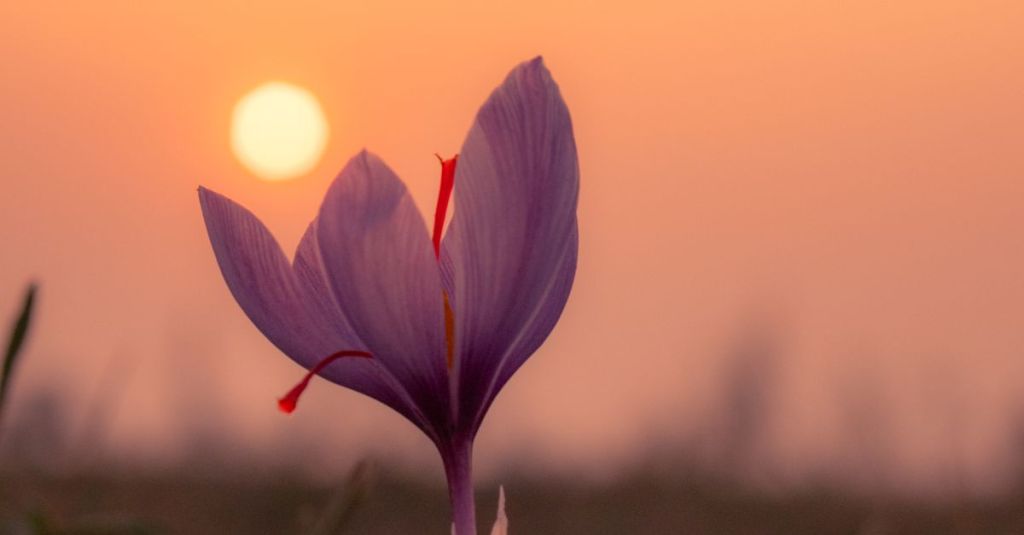
India grows saffron in exactly one place — the karewa plateau of Kashmir — and it sells for more than silver. Here is how the crop works, what the National Saffron Mission changed, and the real economics of an acre.
Saffron is the most expensive spice in the world, and India’s entire crop comes from a few hundred square kilometres of Kashmir. The deep-red stigmas of the autumn crocus are picked by hand, dried and graded, and the best of them — the Kashmir variety — fetch a price that has overtaken silver. That price is not a marketing story; it is a direct consequence of how brutally labour-intensive the crop is. It takes roughly 40 hours of hand labour to produce a single kilogram of saffron, which itself comes from about 1.5 lakh flowers and some 4.5 lakh individual strands. Nothing about that arithmetic can be automated away, and it is why saffron occupies a category of its own among Indian crops.
Where saffron grows, and why only there / केसर कहाँ उगता है और क्यों
Saffron — Crocus sativus — is a perennial that grows at 1,500–2,000 m on the well-drained karewa soils of the Kashmir valley. The main belt is the heritage site around Pampore in Pulwama district, which alone accounts for the great majority of the valley’s saffron area, with the crop also grown in Budgam, Srinagar and Kishtwar in Jammu. Kashmir is the only part of India where saffron is produced, and it supplies roughly 90% or more of national output. The crop’s quality rests on its chemistry: Kashmir saffron is prized for a high crocin content (the compound behind its colour) along with safranal (aroma) and picrocrocin (flavour), which is why it commands a premium over most Iranian and Spanish material. For broader guidance on how soil properties affect crop suitability, see this guide to soil types, nutrients and crop suitability.
The price, and the market behind it / कीमत और बाज़ार
The farm-gate and trade price for good Kashmir saffron has ranged between roughly ₹2.5 lakh and ₹3.5 lakh a kilogram in recent seasons, with the best grade quoted around ₹3.25 lakh a kg — more, by weight, than silver. Internationally the spice trades around $1,500 a kg, and premium lots go higher. India’s domestic demand is estimated at about 100 metric tonnes, against a national production that has recently run between 15 and 16 tonnes, so the gap is filled by imports, overwhelmingly from Iran, whose saffron is cheaper.
Kashmir saffron carries a Geographical Indication tag, and the trade sorts it into grades — mongra (the pure, deep-red stigma, the most valuable and the main export grade), lacha, zarda/androciam and gucchha. Grading, moisture control and packaging matter as much as yield: a poorly dried or adulterated lot loses both price and reputation, and adulteration has historically damaged the market for genuine Kashmir saffron. Growers can also explore the KrishiCenter K-Bazaar for agricultural products and market resources.
The National Saffron Mission / राष्ट्रीय केसर मिशन
The National Saffron Mission was launched in 2010 with an outlay of about ₹400 crore, at a time when both area and yield were falling. Its components were practical rather than exotic: rejuvenating existing saffron fields with graded corms, improving soil health through integrated nutrient, pest and disease management, building irrigation through deep borewells and sprinkler systems, and mechanising post-harvest handling and drying.
The results are measurable. Per-hectare yield in the valley rose from about 1.88 kg in 2010 to over 5 kg by 2022 — more than doubling — and roughly 2,598 hectares of the valley’s saffron land has been rejuvenated. Production climbed back to around 16 tonnes in a good year, against a low of under 3 tonnes in the worst. A modern India International Kashmir Saffron Trading Centre was set up at Pampore to give growers organised marketing, quality-based pricing, stigma-separation and coded cold storage. But the Mission has also drawn sharp criticism from growers: many of the borewells installed under it have fallen into disrepair, and in bad years irrigation and support have not been enough to protect the crop.
How the crop is actually grown / फसल कैसे उगाई जाती है
Saffron is grown from corms — bulb-like structures — planted in September. Improved practice, as recommended by the saffron research station at SKUAST-Kashmir, is to plant graded corms of 8 g and above at a geometry of about 20 × 10 cm, after applying farmyard manure at around 10 tonnes per hectare with a basal NPK dose of roughly 90:60:50 kg/ha and vermicompost. Fields are worked and pulverised several times over the summer so the corms sit in a fine, well-drained seedbed; the crop dislikes waterlogging and heavy clay. For background on choosing and applying nutrients, see this overview of fertilizers and crop requirements.
Flowering begins in the second half of October and runs to early November, in flushes, with the heaviest bloom in the second flush. The flowers are picked early in the morning — ideally within two days of opening — and the red stigmas are separated from the petals within about ten hours, by hand, before being dried. Drying is the step where quality is won or lost: sun-drying or solar and hot-air dryers that bring moisture down without scorching the strands preserve the colour and aroma that buyers pay for. Poor drying, or delay in separating the stigmas, is one of the commonest reasons a grower gets a lower price than the crop deserved.
What it costs and what it returns / लागत और आय
Saffron is a high-cost, high-return crop whose economics turn almost entirely on the corm. In published cost-of-cultivation studies from the Kashmir valley, seed corms account for around 95% of the total cost of the first-year establishment, and the first year is by far the heaviest. One study of a five-year planting cycle put gross expenditure at about ₹4.31 lakh per hectare, with gross returns of roughly ₹23.66 lakh and a net profit of about ₹3.87 lakh per hectare per year when saffron sells at around ₹230 a gram. Another, over a nine-year cycle, estimated the total cost of cultivation at about ₹2.63 lakh per hectare with net returns of about ₹4.13 lakh and a benefit–cost ratio of about 2.57. Agricultural scientists have argued that a well-managed hectare can earn a grower ₹24–27 lakh, provided productivity rises toward 8–9 kg per hectare — roughly double today’s average.
The catch is the corm investment and the wait: a new planting takes a couple of years to settle into full flowering, and the crop is sensitive enough that a single dry autumn can halve the harvest. In 2024, a prolonged dry spell cut yields in Pampore by 50–70%, and production across J&K has fallen from a peak of about 14 tonnes a decade ago to barely 2.6 tonnes in the worst recent year. A grower planning saffron has to plan for that variability, not just the good year. This is part of the wider relationship between climate and agriculture.
The real challenges / असली चुनौतियाँ
Three pressures stand out. First, climate: erratic rainfall and snowfall, and rising temperatures, are leaving the karewa soils too dry for a crop that depends on autumn moisture. Second, land: Pampore is peri-urban, and saffron fields have been steadily lost to orchards, housing and industry — including cement factories whose dust and emissions have cut output in some villages. Third, market integrity: adulteration and cheaper Iranian imports put constant pressure on the premium that genuine Kashmir saffron should earn. Growers and researchers are now experimenting with controlled and indoor cultivation, and with extending saffron into non-traditional areas of the valley, precisely to reduce that dependence on a shrinking belt.
Key takeaways
- Saffron is grown in India only in Kashmir, mainly on the Pampore karewa plateau; the crop is hand-picked and takes about 40 hours of labour per kilogram.
- Prices have run ₹2.5–3.5 lakh a kilogram, above silver, on the strength of high crocin content and a GI tag.
- The National Saffron Mission (2010, ~₹400 crore) doubled valley yield from about 1.88 to over 5 kg per hectare and rejuvenated ~2,598 ha, though irrigation upkeep has been weak.
- Plant graded corms (8 g+) in September at ~20 × 10 cm with FYM and balanced NPK; pick within two days of flowering and separate and dry stigmas fast.
- Studies put net returns around ₹3.9 lakh per hectare per year over a planting cycle, but corms dominate the first-year cost and a dry autumn can halve the harvest.
Sources
CSIR-Indian Institute of Integrative Medicine (IIIM) saffron production notes; SKUAST-Kashmir Saffron Research Station and FAO GIAHS saffron heritage site report (Pampore); National Saffron Mission documents and Press Information Bureau / Government of Jammu & Kashmir updates; published economics-of-saffron-cultivation studies (Journal of Hill Agriculture and Connect Journals, Kashmir valley); Reuters and BBC reporting on saffron prices, climate pressure and indoor cultivation (2023–2025); The Hindu and New Indian Express reporting on Kashmir saffron prices and the National Saffron Mission.


Leave a Reply