
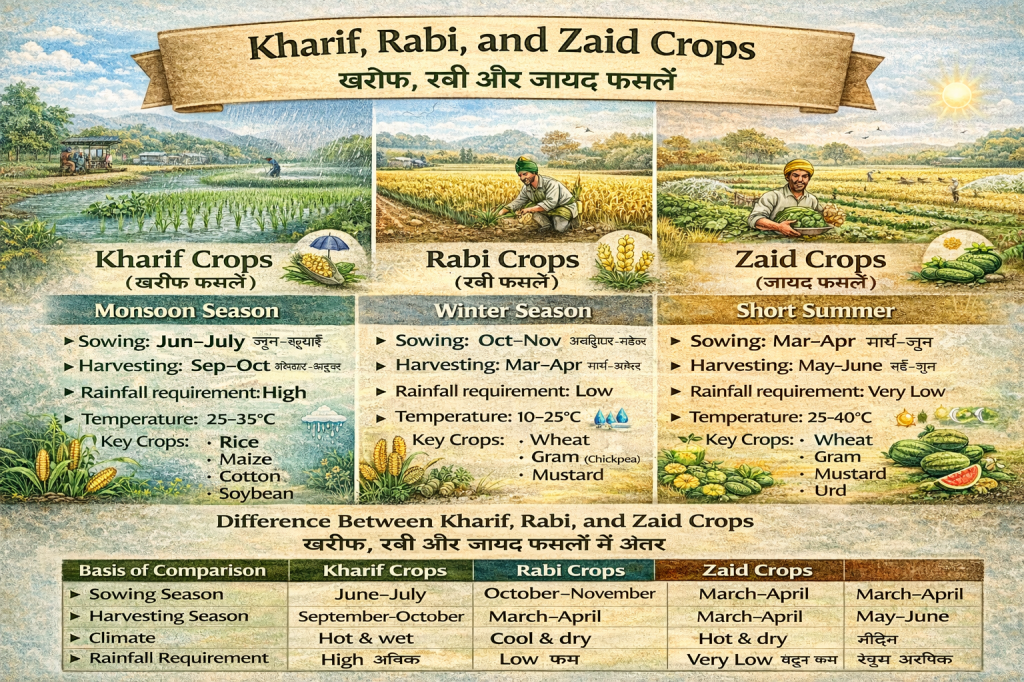
What are Kharif, Rabi, and Zaid Crops?
(खरीफ, रबी और ज़ायद फसलें)
Indian agriculture is largely season-dependent. Based on climatic conditions, crops in India are broadly classified into Kharif, Rabi, and Zaid crops. Each crop season differs in terms of sowing time, harvesting period, temperature requirement, and water availability.
Kharif Crops
(खरीफ फसलें)
Kharif crops are grown during the monsoon season. Sowing begins with the onset of monsoon rains, usually in June–July, and harvesting takes place in September–October. These crops require high rainfall and warm climatic conditions.
Key Characteristics of Kharif Crops
- Sowing time: June–July
- Harvesting time: September–October
- Rainfall requirement: High
- Temperature: 25–35°C
- Dependence on monsoon: Very high
Major Kharif Crops
Rabi Crops
(रबी फसलें)
Rabi crops are grown during the winter season. They are sown in October–November after the monsoon retreats and harvested in March–April. These crops require cool temperatures and less rainfall, making irrigation an important factor.
Key Characteristics of Rabi Crops
- Sowing time: October–November
- Harvesting time: March–April
- Rainfall requirement: Low
- Temperature: 10–25°C
- Dependence on irrigation: High
Major Rabi Crops
Zaid Crops
(ज़ायद फसलें)
Zaid crops are grown in the short summer season between Kharif and Rabi crops. Sowing usually takes place in March–April, and harvesting is done by May–June. These are short-duration crops and rely heavily on irrigation rather than rainfall.
Key Characteristics of Zaid Crops
- Sowing time: March–April
- Harvesting time: May–June
- Crop duration: 2–3 months
- Temperature: 25–40°C
- Dependence on rainfall: Very low
Major Zaid Crops
- Watermelon
- Muskmelon
- Cucumber
- Moong
- Urd
- Vegetables
Difference Between Kharif, Rabi, and Zaid Crops
(खरीफ, रबी और ज़ायद फसलों में अंतर)
| Basis of Comparison | Kharif Crops | Rabi Crops | Zaid Crops |
|---|---|---|---|
| Sowing Season | June–July | October–November | March–April |
| Harvesting Season | September–October | March–April | May–June |
| Climate | Hot & wet (monsoon) | Cool & dry | Hot & dry |
| Rainfall Requirement | High | Low | Very low |
| Irrigation Dependency | Low | High | Very high |
| Crop Duration | Medium | Long | Short |
| Examples | Rice, Maize, Cotton | Wheat, Gram, Mustard | Watermelon, Moong |
| Risk Factors | Monsoon failure | Frost / cold waves | Heat stress, water scarcity |
Importance of Crop Seasons in Indian Agriculture
(भारतीय कृषि में फसल ऋतुओं का महत्व)
- Kharif crops contribute significantly to food grain and oilseed production.
- Rabi crops ensure national food security, especially wheat and pulses.
- Zaid crops provide additional income and support vegetable production during summer.
Together, these crop seasons help maintain year-round agricultural productivity and farmer income stability.
Conclusion
The classification of crops into Kharif, Rabi, and Zaid forms the backbone of Indian agriculture. Understanding their seasonal requirements enables farmers to optimize crop planning, reduce risks, and increase productivity. Proper irrigation management, climate awareness, and timely sowing are key to successful cultivation in all three seasons.
 KrishiCenter
Leave a comment