

नमो शेतकरी महासन्मान निधी: पीएम-किसान पर महाराष्ट्र का ₹6,000 अनुदान और हप्तों की स्थिति – Maharashtra pays its landholding farmers an extra ₹6,000 a year on top of the Centre’s PM-KISAN transfer, in the same three-instalment rhythm, without a separate application form. This article explains what the Namo Shetkari Mahasanman Nidhi Yojana (NSMNY) actually is, who is on its beneficiary list and who is not, how the money is released, where the scheme stood in November 2026 after eight instalments, and what a farmer can do when a payment does not show up. Every figure below is attributed to a government resolution, a ministry guideline or a named news report; where a number could not be verified, it is left out.
What the Namo Shetkari Mahasanman Nidhi is / नमो शेतकरी महासन्मान निधी क्या है
The scheme was announced in the Maharashtra budget for 2023-24 as a state contribution layered on the Centre’s Pradhan Mantri Kisan Samman Nidhi (PM-KISAN), and was given formal approval by a Government Resolution of the Department of Agriculture, Animal Husbandry, Dairy Development and Fisheries dated 15 June 2023 (GR number Kisani-2023/CR 42/11-A). The resolution describes it as a scheme that adds the state government’s own ₹6,000 to the ₹6,000 that the Centre transfers to each farmer family every year.
Three features of that first resolution matter more than anything written in later publicity material. First, the money is ₹2,000 per instalment, three times a year, on the PM-KISAN calendar — April to July, August to November, and December to March. Second, the state does not run a separate enrolment: every family that is registered on the PM-KISAN portal and certified eligible by the Centre is automatically eligible for the state instalment, and any change the Centre makes to eligibility applies to the state scheme without a fresh Maharashtra order. Third, the benefit is paid by Direct Benefit Transfer into the bank account, through a state portal and system built by the Agriculture Department and the Information Technology Department, with the Commissioner (Agriculture), Pune, as the implementing authority.
The same resolution also sets out the recovery route: if a payment reaches someone who is not eligible, the amount is recovered through the revenue machinery and deposited with the government. In other words, the ₹6,000 is a grant, not a loan — there is no repayment — but it is not unconditional either.
Who qualifies — and who does not / कौन पात्र है और कौन नहीं
Because the beneficiary list is the PM-KISAN list, the practical test is the central scheme’s test. Under the PM-KISAN operational guidelines of the Ministry of Agriculture and Farmers’ Welfare, a farmer family means a family of husband, wife and minor children that owns cultivable land in its own name as per the state land records, with 1 February 2019 as the cut-off date for ownership, except where land passes to heirs through succession. The benefit goes to families irrespective of the size of the holding; the scheme was opened to all landholding families from June 2019, after starting out as a small and marginal farmer scheme.
The Ministry’s published FAQs are equally clear about who is left out. A person cultivating land that is not in his or her own name — a tenant farmer or sharecropper, for instance — is not eligible, because landholding is the sole criterion. Institutional landholders are excluded, and so are families in which any member is a former or present holder of a constitutional post, a former or present minister or legislator, a serving or retired government officer or employee (multi-tasking staff and Group D employees excepted), a pensioner drawing ₹10,000 a month or more, an income-tax payer in the last assessment year, a practising doctor, engineer, lawyer, chartered accountant or architect registered with a professional body, or, for new beneficiaries, a non-resident Indian.
For a Maharashtra farmer the checklist therefore runs: land recorded in the family’s name as on 1 February 2019 (or inherited later), a PM-KISAN registration that has cleared the state’s verification, completed e-KYC, and an Aadhaar-seeded bank account. The state dashboard for the scheme, which reports the number of farmers and the amount disbursed, is published on the Maharashtra agriculture department’s website.
The instalment calendar and how the money arrives / हप्तों का कैलेंडर और पैसा कैसे पहुँचता है
The 15 June 2023 resolution fixes the schedule as follows.
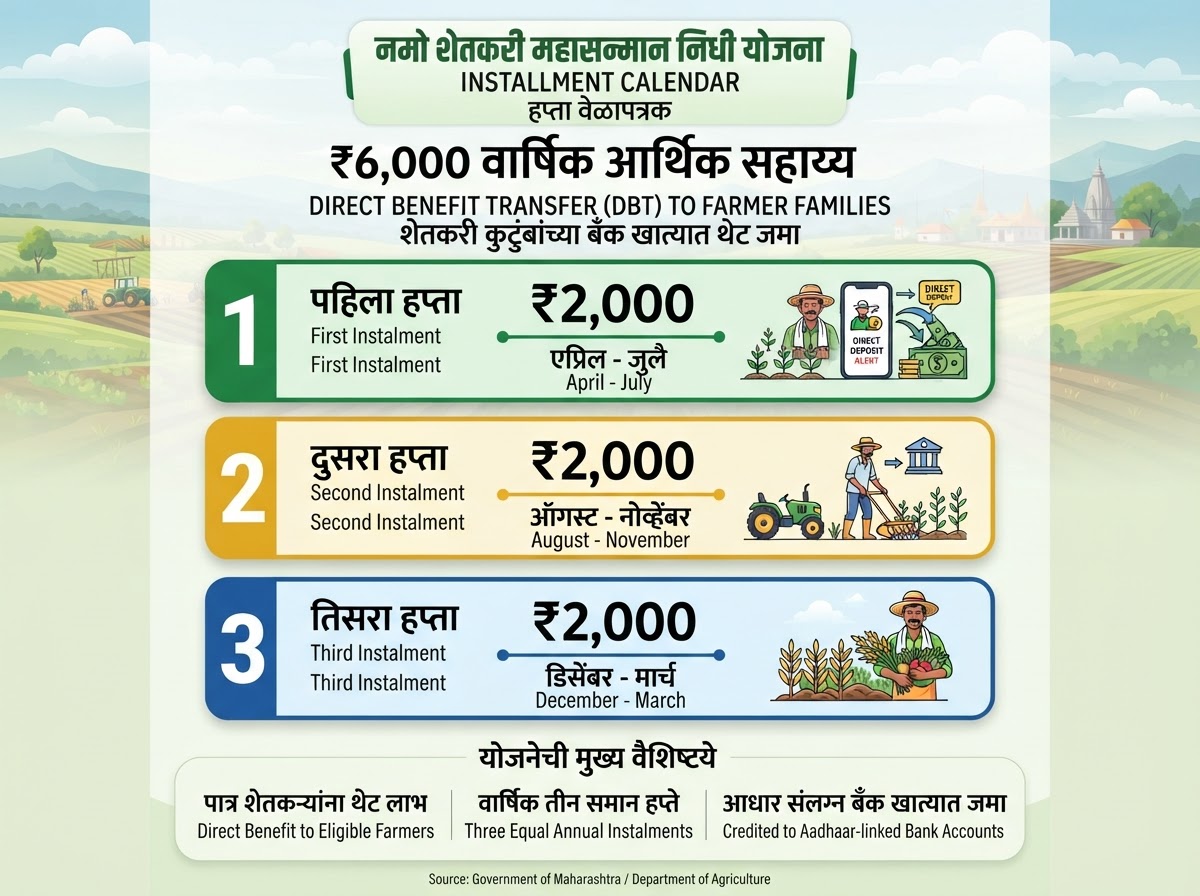
- First instalment: April to July — ₹2,000
- Second instalment: August to November — ₹2,000
- Third instalment: December to March — ₹2,000
For the first six instalments the state money generally moved alongside the central instalment. That has changed. The resolution sanctioning the eighth instalment, issued on 16 March 2026, shows the state release being keyed to the Central government’s 21st PM-KISAN instalment of 19 November 2025: the state drew its beneficiary data from the FTO (fund transfer order) of that central instalment and then released its own funds months later. A farmer should therefore read the state payment as a separate event that follows the central one, not as something that lands on the same day.
The resolution also records two categories that explain many individual complaints: beneficiaries whose PFMS registration is pending, and beneficiaries whose Aadhaar has been de-seeded from the bank account. Both are technical failures at the payment layer, and both stop the money even when the farmer is otherwise eligible.
Where the scheme stands in November 2026 / नवंबर 2026 में योजना की स्थिति
Eight instalments have been released since the scheme began. For the seventh, the state transferred ₹1,892.61 crore to 91.65 lakh farmers for the April to July 2025 period, as reported in September 2025. For the eighth, the Government Resolution of 16 March 2026 sanctioned ₹1,774.00 crore for the August to November 2025 period, and the Chief Minister told the Legislative Assembly on 25 March 2026 that the instalment had been credited to about 90 lakh farmers.
The ninth and tenth instalments were still pending at the end of October 2026. Reporting in the Marathi press put the funding requirement for the two together at about ₹3,700 crore, with proposals sent to the government in March and July, and no official date announced for the credit. As of mid-November 2026 no government resolution sanctioning the ninth instalment had been published on the state’s GR portal, and no date had been officially declared. Any specific date circulating on social media should be treated as unverified until a resolution or an official announcement appears.
The ₹9,000 question / ₹9,000 का सवाल
In February 2025 the state government announced that its share under the scheme would rise from ₹6,000 to ₹9,000 a year, which would take the combined PM-KISAN plus state benefit to ₹15,000. That announcement was reported at the time, but it has not shown up in the scheme’s payment orders: the resolutions sanctioning the seventh and eighth instalments still describe the scheme as a ₹6,000 matching grant paid in three instalments of ₹2,000, and the eighth instalment was sanctioned at the old rate in March 2026.
The honest position, then, is this. A higher state share has been announced at the political level, but no government resolution implementing a ₹9,000 rate was traceable in the documents available when this article was written. Farmers should budget on ₹6,000 from the state until an order says otherwise. This is a reading of the published record, not a statement that the increase has been cancelled.
If a payment does not arrive / भुगतान न आए तो क्या करें
Start with the central record, because the state list is generated from it. The PM-KISAN portal’s Know Your Status page and the Kisan eMitra chatbot show whether a family is on the beneficiary list, which instalments have been approved, and whether a payment is held for physical verification — the ministry’s site notes that cases such as land acquired after 1 February 2019, or two members of the same family drawing the benefit, are withheld until verification. If the central record is wrong, no amount of follow-up at the state level will release the state instalment.
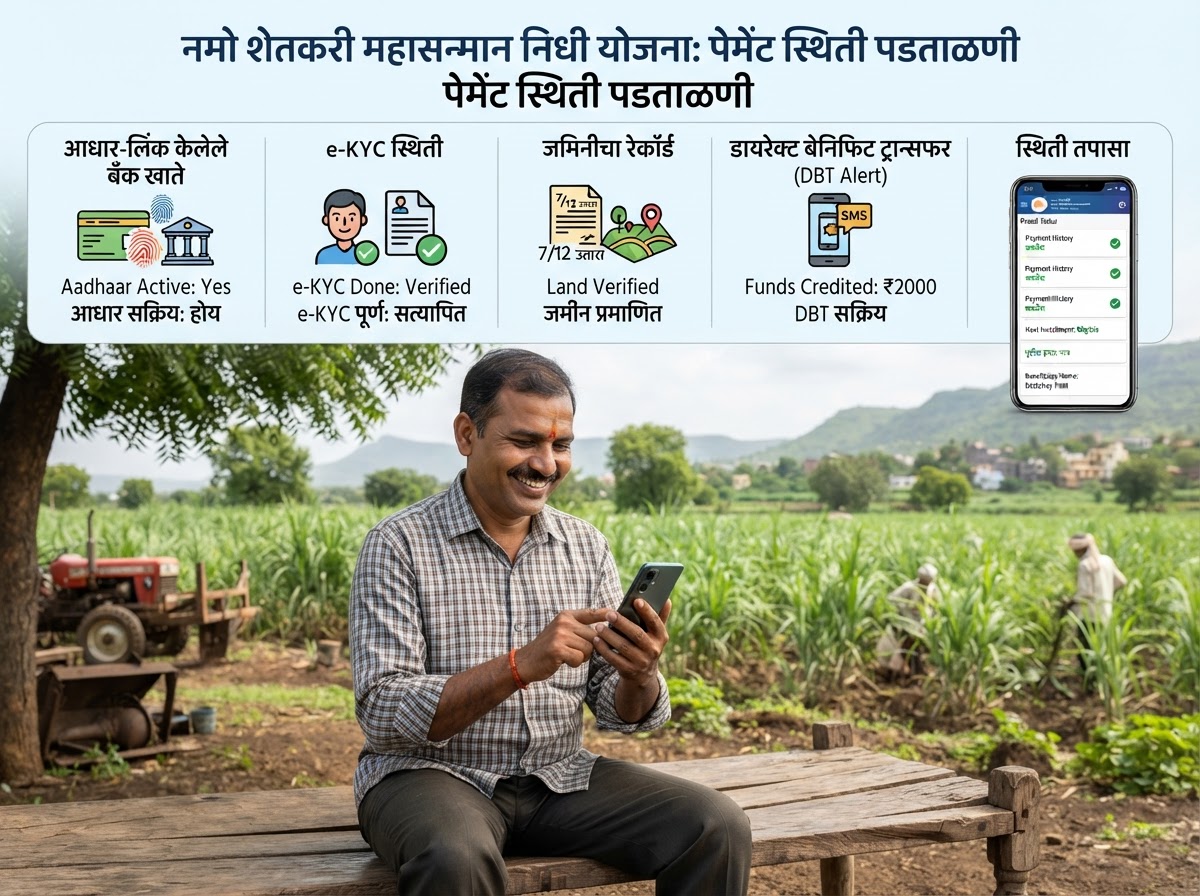
If the central record is clean, check three things in order: that the bank account is Aadhaar-seeded and active, that e-KYC is complete, and that the land record still shows the family as owner. Correction of land records runs through the talathi and the revenue office; bank seeding and e-KYC run through the bank branch and the Common Service Centre. Escalation after that goes to the taluka agriculture office and the district office of the Commissioner (Agriculture), whose project monitoring unit administers the scheme; the state’s agriculture helpline numbers and apps are listed in our guide to government helplines and apps for Indian agriculture.
It is also worth remembering what this money is and is not. It is untied income support: it can go towards seed, fertiliser, diesel or a household expense, and it does not have to be repaid. It is not a substitute for crop insurance, and a farmer who has not enrolled for Pradhan Mantri Fasal Bima Yojana cover for the season is exposed to losses that ₹2,000 cannot absorb. Nor does it replace short-term credit: a Kisan Credit Card limit is what funds a full crop cycle, and the two work best together. Maharashtra’s land and beneficiary records, meanwhile, are progressively moving onto digital infrastructure of the kind described in our explainer on Agri Stack, which is why seeding errors now surface as payment failures rather than as paperwork.
Key takeaways / मुख्य बातें
- Namo Shetkari Mahasanman Nidhi is Maharashtra’s ₹6,000-a-year top-up to PM-KISAN, paid as three instalments of ₹2,000 by DBT; with the central transfer, an eligible family receives ₹12,000 a year.
- There is no separate application. Eligibility is identical to PM-KISAN, which means land in the family’s own name as on 1 February 2019 or acquired by succession, a clean verification, completed e-KYC and an Aadhaar-seeded bank account. Tenant farmers are not covered.
- Eight instalments have been paid. The eighth, sanctioned on 16 March 2026 at ₹1,774.00 crore for August to November 2025, reached roughly 90 lakh farmers.
- The ninth and tenth instalments were pending at the end of October 2026, with no official date announced; the funding requirement was reported at about ₹3,700 crore.
- A rise of the state share to ₹9,000 (₹15,000 combined) was announced in February 2025 but was not reflected in the payment resolutions available up to March 2026. Budget on ₹6,000 until an order says otherwise.
Sources / स्रोत
- Government of Maharashtra, Agriculture, Animal Husbandry, Dairy Development and Fisheries Department, Government Resolution Kisani-2023/CR 42/11-A dated 15 June 2023 (scheme approval, instalment schedule, eligibility and recovery) — gr.maharashtra.gov.in
- Government of Maharashtra, Government Resolution dated 16 March 2026 sanctioning ₹1,774.00 crore for the eighth instalment — gr.maharashtra.gov.in
- Maharashtra Agriculture Department, Namo Shetkari Mahasanman Nidhi disbursement dashboard — krishi.maharashtra.gov.in
- Ministry of Agriculture and Farmers’ Welfare, PM-KISAN operational guidelines and FAQs — pmkisan.gov.in; PIB FAQ, November 2021
- PIB, press release on PM-KISAN, 22 July 2025 — pib.gov.in
- The Hindu, “91.65 lakh Maharashtra farmers receive ₹1,892.61 crore under Namo Shetkari Yojana”, 9 September 2025
- Indian Express, “Maharashtra govt raises amount to farmers under state-run scheme to Rs 9,000”, 25 February 2025
- ABP Majha, report on the Chief Minister’s statement in the Assembly on the eighth instalment, 25 March 2026
- Saam TV (Sakal), reports of 18 and 24 October 2026 on the pending ninth and tenth instalments and the ₹3,700 crore requirement


Leave a Reply