
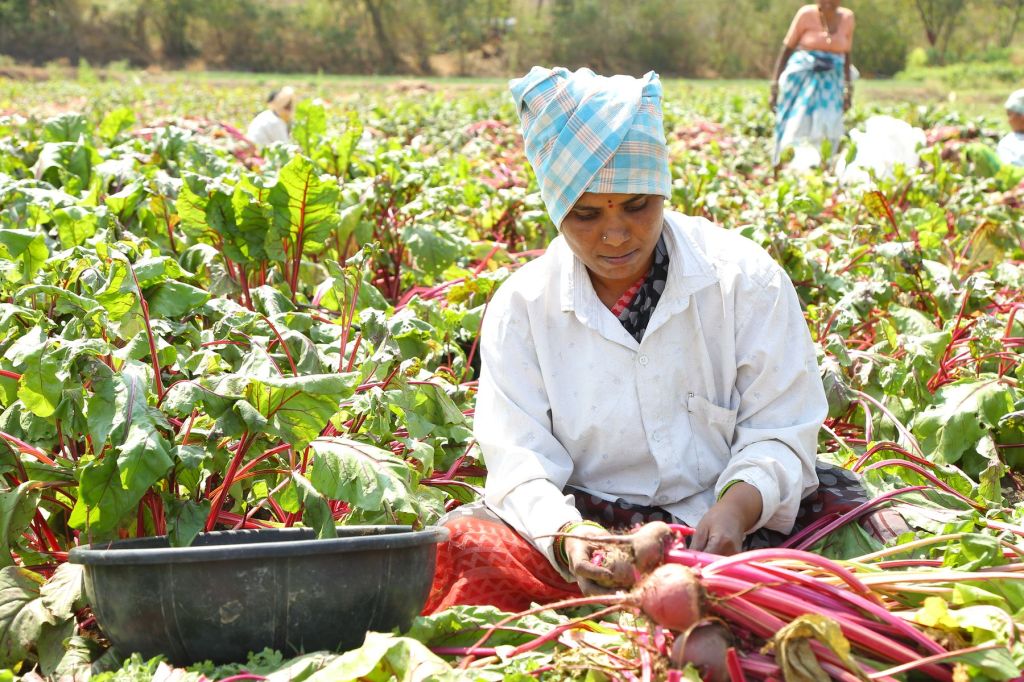
एमआईडीएच: भारतीय किसान बागवानी लागत का 40–50% कैसे पाते हैं — और आवेदन कैसे करें| Every horticulture subsidy a farmer in India can claim — a polyhouse, a new mango orchard, a packhouse, a nursery — flows through one mission: MIDH, the Mission for Integrated Development of Horticulture. Its operational guidelines were rewritten in 2025, which means most rate cards still circulating in state booklets and on WhatsApp are out of date. This guide sets out the current cost norms and subsidy percentages for the main components, who is eligible, and the exact route from the district horticulture office to the money in your bank account.
Subsidy at a glance (summary of figures already covered below)
| Component | Assistance | Cap |
|---|---|---|
| New orchard — general areas | 40% of Rs 1.25 lakh/ha norm | 2 ha per beneficiary |
| New orchard — NE, Himalayan, scheduled areas etc. | 50% of norm | 2 ha per beneficiary |
| Protected cultivation (polyhouse, shade net, etc.) | 50% of cost | 2,500 sq m per beneficiary |
| Farm-gate packhouse | 50% of cost, not credit-linked | Up to Rs 25 lakh per unit |
| Integrated packhouse | 35% (50% in NE/Himalayan/island areas), credit-linked | Up to Rs 160 lakh per beneficiary |
| Large private nursery | 40% | Up to Rs 30 lakh/ha |
| Small private nursery | 50% | Up to Rs 20 lakh/ha |
| Cold storage (NHB sub-scheme) | 35% (45% in NE/Himalayan/island areas), credit-linked | Capped at Rs 2 crore per project |
These figures are drawn directly from the detailed sections below; always confirm current rates with your District Horticulture Officer before applying.
What MIDH is — and where it stands in 2026 / MIDH क्या है — और 2026 में यह कहाँ खड़ा है
The Mission for Integrated Development of Horticulture (MIDH) is the Government of India’s single largest support programme for horticulture — fruits, vegetables, root and tuber crops, mushrooms, spices, flowers, aromatic plants, coconut, cashew, cocoa and bamboo. It is a Centrally Sponsored Scheme, implemented through the State Horticulture Missions, and it sits under the Krishonnati Yojana umbrella along with missions such as the National Food Security and Nutrition Mission and the National Mission on Edible Oils. Funding is shared 85:15 between the Centre and most states, and the Centre bears 100% in the North-Eastern and Himalayan states.
The scheme was re-structured in 2025 with revised Operational Guidelines. According to a PIB reply of 10 February 2026, the revision extended MIDH to all districts of the country, enhanced the cost norms of interventions, brought in high-value, exotic and medicinal crops, and added support for newer technologies. In other words, the rates you will read below are the post-2025 rates — older state booklets quoting Rs 422 per square metre for a naturally ventilated polyhouse are out of date.
The scale of the sector explains the money. Final estimates released by the Department of Agriculture and Farmers Welfare put horticulture production at 3,707.38 lakh tonnes in 2024-25 on 301.36 lakh hectares, up 4.51% in production over the previous year. The Ministry has also stated that horticulture contributes nearly 33% of agricultural gross value added. For 2026-27, the Krishonnati Yojana — of which MIDH is a component — has been allocated Rs 11,200 crore, a 64.7% increase over the 2025-26 revised estimate, according to PRS Legislative Research’s analysis of the Union Budget demand for grants.
If you are new to the sector, our overview of horticulture as a discipline and a business is a useful starting point before you read the component rates.
What the mission pays for / मिशन किन चीज़ों पर सहायता देता है
MIDH is not one subsidy; it is a menu of about eighty components, each with its own cost norm and its own pattern of assistance. For a farmer, they fall into five practical buckets.
- Planting material: setting up or upgrading large, small and hi-tech plug-type nurseries, and tissue culture units.
- Area expansion: new orchards of fruit crops, new vegetable, spice, flower and aromatic plant cultivation, and rejuvenation of old, senile orchards.
- Protected cultivation and inputs: polyhouses, shade net houses, walk-in tunnels, plastic mulching, anti-hail and anti-bird nets, hydroponics and aeroponics, sensor-based fertigation automation.
- Water and mechanisation: water harvesting structures and storage tanks, farm machinery, and support for beekeeping for pollination.
- Post-harvest and marketing: farm-gate packhouses, integrated packhouses, pre-cooling units, cold rooms, ripening chambers and primary processing units.
Two rules apply across the board. First, the cost norm is an upper limit used to calculate your subsidy — if you spend less, the subsidy is calculated on what you actually spend. Second, assistance is given per beneficiary, with the family treated as a unit, and the same component cannot be claimed twice by the same family.
New orchards: 40% of a Rs 1.25 lakh per hectare norm / नए बाग: 1.25 लाख रुपये प्रति हेक्टेयर मानक का 40%
For a new fruit orchard at regular spacing — mango, guava, litchi, pomegranate, citrus and similar crops — the 2025 guidelines set a cost norm of Rs 1.25 lakh per hectare, with assistance at 40% in general areas and 50% in the North-Eastern and Himalayan states, scheduled areas, vibrant villages, Andaman and Nicobar Islands and Lakshadweep. The ceiling is 2 hectares per beneficiary, pro rata for smaller areas.
That works out to a subsidy of about Rs 50,000 per hectare in a general area on the full norm, against an admissible cost of Rs 1.25 lakh per hectare. Higher norms apply to crops such as high-density apple and to several high-value fruits, so the rupee figure varies by crop.
The payment structure matters as much as the rate. Assistance for new gardens is released in two instalments of 60:40 60% on planting, and the remaining 40% only if at least 80% of the plants survive into the second year. Drip irrigation is not funded inside this component; it is converged separately under the Per Drop More Crop component of PMKSY, and state guidelines treat micro-irrigation integration as mandatory for area expansion.
For a crop-level view of the economics before you commit, our guide to mango cultivation in India covers planting density, variety choice and the cost of bringing a block into bearing.
Protected cultivation: what a polyhouse really costs / संरक्षित खेती: पॉलीहाउस की असली लागत
This is where the 2025 revision changed the numbers most. Under the revised cost norms for the NHM and HMNEH sub-schemes, assistance is 50% of cost for a maximum of 2,500 square metres per beneficiary, and the rates are 15% higher in the North-East, Himalayan states, scheduled areas, vibrant villages, Andaman and Nicobar and Lakshadweep.
- Fan and pad polyhouse: Rs 1,800 per sq m up to 500 sq m; Rs 1,600 per sq m from 500 to 1,008 sq m; Rs 1,500 per sq m from 1,008 to 2,500 sq m.
- Naturally ventilated tubular structure: Rs 1,200 per sq m up to 500 sq m; Rs 1,050 per sq m from 500 to 1,008 sq m; Rs 1,000 per sq m above that.
- Bamboo or cable-purlin structure: Rs 450 per sq m, limited to 20 units of not more than 200 sq m each per beneficiary.
- Shade net house on a tubular structure: Rs 710 per sq m. Walk-in tunnels: Rs 720 per sq m, up to three units of 800 sq m each. Plastic or non-woven cloth tunnels: Rs 80 per sq m.
- Plastic mulching: Rs 40,000 per hectare, up to 2 hectares. Anti-hail and anti-bird nets: Rs 50 per sq m, up to 10,000 sq m.
- Add-ons: hydroponics and aeroponics at Rs 350 per sq m up to 1,000 sq m; circulation fans at Rs 5,000 each up to six; sensor-based fertigation automation at Rs 4 lakh per unit.
A worked example: a 1,000 sq m naturally ventilated tubular polyhouse falls in the second band, so the admissible cost is Rs 1,050 per sq m, or Rs 10.5 lakh. At 50%, the subsidy is Rs 5.25 lakh, and the farmer’s share is the same. Materials must conform to BIS standards to be eligible. Our step-by-step guide to setting up greenhouses in India covers orientation, cladding life and the crops that repay a structure fastest.
Nurseries: a project, not a subsidy form / नर्सरी: यह एक परियोजना है, केवल एक आवेदन नहीं
Nursery components are project-based and, for private applicants, mostly credit-linked and back-ended — the subsidy follows a bank loan and is released after inspection.
- Large nursery, 1 to 2 hectares: cost norm up to Rs 30 lakh per hectare; 100% assistance for the public sector, 40% for private applicants. Minimum output of 1,00,000 certified plants per hectare per year.
- Small nursery, 0.4 to 1 hectare: cost norm Rs 20 lakh per hectare; 100% for the public sector, 50% for private applicants, with a minimum of 50,000 plants per hectare per year.
- Upgrading an existing nursery to accreditation standards: up to Rs 4 lakh per hectare, 50% for the private sector, for a nursery of up to 2 hectares.
- Hi-tech plug-type nursery: Rs 1,200 per sq m on 0.2 to 1 hectare, credit-linked back-ended assistance at 50% for the private sector.
Accreditation is not optional: every nursery set up under MIDH has to be accredited within 18 months of the last instalment, and MIDH planting material is meant to be procured only from accredited nurseries. If several growers want to build one together, a Farmer Producer Organisation is usually the cleaner structure for owning and running it.
Post-harvest: packhouse, pre-cooling, cold storage / फसलोत्तर प्रबंधन: पैक हाउस, प्री-कूलिंग, कोल्ड स्टोरेज
Horticulture loses value after harvest, so this is the component with the largest ticket sizes. The Ministry has stated that 55,748 post-harvest management facilities and 11,140 marketing infrastructures were established under MIDH in the five years to 2025.
- Farm-gate packhouse (9 m × 6 m, one unit per beneficiary): 50% of cost, on a cost norm of up to Rs 25 lakh per unit. This is the one post-harvest item that is not credit-linked.
- Integrated packhouse (18 m × 22 m): cost norm up to Rs 160 lakh per beneficiary; credit-linked back-ended assistance at 35% in general areas and 50% in the North-East, Himalayan states, scheduled areas and island territories.
- Pre-cooling unit: cost norm up to Rs 5 lakh per tonne of capacity, 35% or 50% as above. A mobile pre-cooling unit is normed at Rs 30 lakh.
- Cold storage under the National Horticulture Board sub-scheme: following the Board’s August 2026 amendment, credit-linked back-ended subsidy at 35% of eligible project cost in general areas and 45% in the North-East, Himalayan states, scheduled areas, vibrant villages and island territories, with the subsidy capped at Rs 2 crore per project. Land cost is excluded from the eligible project cost.
Credit linkage is optional for projects up to Rs 30 lakh, which is what makes a farm-gate packhouse reachable for an individual grower. For the wider menu of storage and transport subsidies, see our piece on cold chain schemes; for interest subvention on the term loan itself, the Agriculture Infrastructure Fund can be layered on top.
Who can apply / कौन आवेदन कर सकता है
MIDH is demand-driven and state-planned. Nothing is available unless the component you want is in your state’s approved Annual Action Plan for the year, with a target allocated to your district. That single fact decides most applications, and it is the first thing to ask your District Horticulture Officer.
On eligibility, state implementation guidelines issued under MIDH are consistent on the basics: the applicant must be a farmer or entrepreneur with land in the state, either owned or held on a registered lease — commonly ten years for orchard and seasonal activities and fifteen years for project-based activities. Plantation and cultivation support is given only for horticultural crops, and only to a beneficiary with an assured source of irrigation. Beneficiary lists are approved by the District Mission Committee, selection is on a first-come-first-served basis within the target, and assistance flows by DBT into an Aadhaar-seeded bank account.
Eligibility checklist (general guidance)
- The component you want is listed in your state’s approved Annual Action Plan with a target in your district.
- You are a farmer or entrepreneur with land in the state, either owned or on a registered lease (commonly 10 years for orchard/seasonal activities, 15 years for project-based activities).
- You have an assured source of irrigation for plantation and cultivation support.
- Your family has not already received assistance for this same component.
- You hold an Aadhaar-seeded bank account for DBT payment.
Two further points are worth knowing. State guidelines typically require that a family that has already taken a particular component is not given it again, and they earmark 33% of the budget for women beneficiaries, with separate shares for Scheduled Caste and Scheduled Tribe farmers. If you need working capital alongside the project, a Kisan Credit Card covers the crop loan side while the term loan is handled by your bank.
Document checklist (general guidance)
- Land record or registered lease deed
- Aadhaar card
- Bank account details with IFSC code
- Passport-size photograph
- Photograph of the field
- Project report with cost estimate (Form-2), for project-based components such as nurseries, packhouses and cold storage
How to apply, step by step / आवेदन कैसे करें: चरण दर चरण
- Ask about the target first. Visit the District Horticulture Officer or the block Horticulture Officer and ask whether the component you want is in this year’s Annual Action Plan, and how much target is left in your block.
- File the application. Non-project components use the simpler form (Form-1 in most states); project-based components such as nurseries, packhouses and cold storage need a project report (Form-2) with a cost estimate. Many states also accept registration on the MIDH Suraksha portal at midh.gov.in or on the state HortNet portal, where you file the scheme directly.
- Attach the documents. Land record or registered lease, Aadhaar, bank account details with IFSC, a passport photograph and a photograph of the field. Bank account details are verified by the Horticulture Officer.
- Wait for District Mission Committee approval and pre-inspection. The Horticulture Officer inspects 100% of fields before sanction; the district officer re-inspects a sample. Do not start land preparation or construction before sanction — work done in advance is usually not eligible.
- Execute to specification. Buy planting material from accredited or government nurseries, use BIS-standard structures, and keep bills and invoices from registered firms. For credit-linked components, get the term loan sanctioned and appraised first.
- Post-inspection and payment. After completion, the officer inspects the work, the district committee approves the release, and the subsidy is credited to your account by DBT through the SNA-SPARSH route. For new orchards, the second instalment comes in the following year against an 80% survival check.
There is no single all-India portal to track an individual MIDH application status sits with your state’s horticulture portal or with the district office holding the file. Applying is free, and no one should be paid to file it for you. For a broader map of what the Ministry offers, see our round-up of government programmes that enhance farmers’ income.
Common mistakes to avoid (general guidance)
- Starting land preparation or construction before sanction — work done in advance is usually not eligible.
- Buying planting material from a non-accredited nursery, which can disqualify the claim.
- Assuming a component is available without first checking whether it is in your district’s Annual Action Plan target.
- Forgetting that drip irrigation is funded separately under Per Drop More Crop, not inside the orchard component.
- Using non-BIS-standard structures or materials for protected cultivation, which can make costs inadmissible.
- Paying anyone to file the application — applying is free.
What is changing, and what to watch / क्या बदल रहा है, और किस पर नज़र रखें
Two things are moving at once. The Krishonnati Yojana allocation has risen sharply for 2026-27, which points to more money flowing through its components, including MIDH. At the same time, the Ministry has circulated an Expenditure Finance Committee note proposing to merge PM-RKVY, Krishonnati Yojana, the National Mission on Natural Farming and the National Bee and Honey Mission into a single umbrella scheme for the 16th Finance Commission period, with fund allocation partly linked to state reform milestones. As reported in January and February 2026, the proposal was still in inter-ministerial consultation; the restructuring details will be settled only when the EFC note is finalised and the Cabinet approves it.
The practical reading for a farmer is simple: apply under the current 2025 guidelines, because those are the norms in force, and expect the component names and state-level processes to stay stable even if the umbrella above them changes.
Practical calculation examples (using figures already covered above)
| Example | Admissible cost | Subsidy rate | Subsidy amount |
|---|---|---|---|
| New fruit orchard, 1 hectare, general area | Rs 1.25 lakh/ha | 40% | ~Rs 50,000 |
| 1,000 sq m naturally ventilated tubular polyhouse | Rs 1,050/sq m = Rs 10.5 lakh | 50% | Rs 5.25 lakh |
Key takeaways / मुख्य बातें
- MIDH pays 40% (50% in the North-East, Himalayan states, scheduled areas and island territories) of the cost norm for new orchards, capped at 2 hectares, with the second instalment tied to 80% plant survival.
- Protected cultivation gets 50% of cost up to 2,500 sq m per beneficiary, at post-2025 rates of Rs 1,200 per sq m for a naturally ventilated tubular house up to 500 sq m.
- Post-harvest support is the big-ticket part: 50% on a farm-gate packhouse normed up to Rs 25 lakh, and 35% credit-linked on an integrated packhouse normed up to Rs 160 lakh.
- Nothing is sanctioned unless the component is in your state’s Annual Action Plan for the year — check the district target before you spend anything.
- Applications go through the District Horticulture Officer, the MIDH Suraksha or state HortNet portal, District Mission Committee approval, pre- and post-inspection, and finally DBT.
Sources / स्रोत
- Press Information Bureau, “Re-structuring of National Horticulture Mission”, 10 February 2026 pib.gov.in
- Press Information Bureau, “Support to Farmers under MIDH”, 28 July 2026 pib.gov.in
- Press Information Bureau, final estimates of horticulture area and production for 2024-25, 17 March 2026 pib.gov.in
- Department of Agriculture and Farmers Welfare, MIDH Operational Guidelines 2025, cost norms and pattern of assistance (NHM and HMNEH sub-schemes) hortnet.hortharyana.gov.in
- MIDH Suraksha portal, Department of Agriculture and Farmers Welfare midh.gov.in
- State Horticulture Mission, Telangana, MIDH implementation guidelines 2025-26 shm.tg.nic.in
- National Horticulture Board, scheme circular amending commercial horticulture and cold storage guidelines, 21 August 2026 nhb.gov.in
- National Centre for Cold Chain Development, Engineering Guidelines and Minimum System Standards, edition 2025 nhb.gov.in
- PRS Legislative Research, Demand for Grants 2026-27 analysis, Agriculture and Farmers Welfare prsindia.org
- The Indian Express, “Govt to merge agricultural schemes, link funds to state reforms”, 12 January 2026 indianexpress.com
Your next step
Before you spend a rupee, visit your District Horticulture Officer and confirm that your component is in this year’s Annual Action Plan with target still available in your block. From there, follow the step-by-step process above — file the right form, attach your documents, and keep every bill from a registered firm so your subsidy is released without delay.


Leave a Reply