
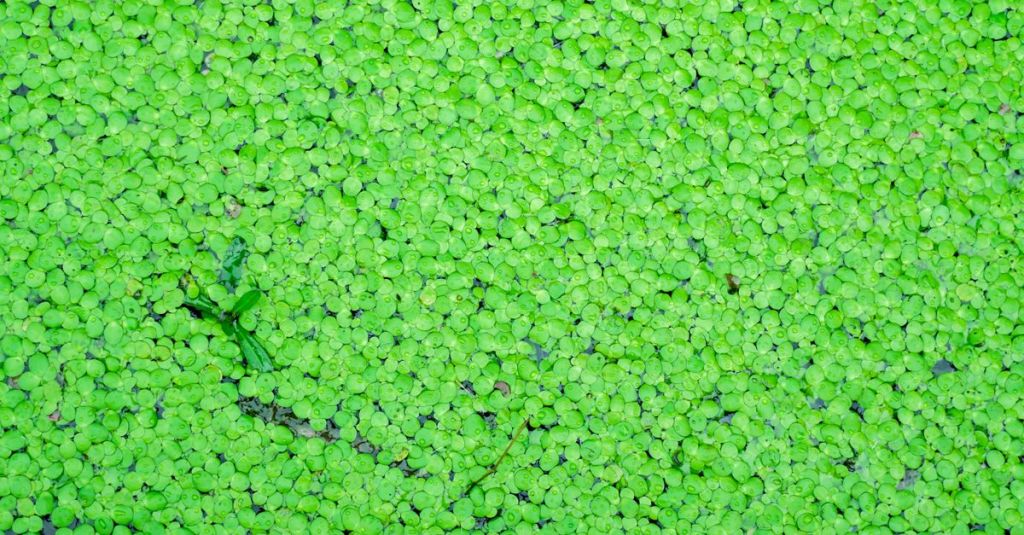
A two-metre pit in your backyard can grow, every day, a green feed that is a quarter protein and has lifted milk yields by 15–20% in field trials. Azolla is the cheapest fodder most farmers have never tried.
Azolla is a small free-floating aquatic fern that forms a green mat on the surface of still water. On its own it would be unremarkable, but it carries a partner: inside cavities in its leaves lives a nitrogen-fixing cyanobacterium, Anabaena azollae, which pulls nitrogen out of the air and hands it to the plant. That partnership is why azolla is called a “powerhouse of nitrogen” and why it has been used for centuries as a green manure in paddy, and why it is now being rediscovered as the cheapest green fodder a smallholder can grow. It doubles its biomass every three to seven days under good conditions, and it will grow in rainwater alone — no soil, dung or phosphorus is strictly necessary for it to multiply.
Why livestock farmers should care / पशुपालकों के लिए यह क्यों जरूरी है
India’s fodder gap is chronic. Estimates put the shortage of dry fodder at 12–14%, of green fodder at 25–30%, and of concentrate feed at 30–35%. That gap is what pushes dairy farmers to buy expensive commercial feed and squeezes the margin on every litre of milk. Azolla answers that gap directly, and cheaply.
On a dry-weight basis azolla contains 25–35% protein, 10–15% minerals and 7–10% amino acids, along with vitamin A, vitamin B12, beta-carotene and minerals including calcium, phosphorus, potassium, iron, copper and magnesium. Because it is low in lignin, animals digest it easily. Its productivity is remarkable: azolla can produce around 1,000 tonnes of fresh biomass per hectare a year against roughly 250 tonnes for hybrid napier, and its protein content (around 24%) dwarfs napier’s (about 4%).
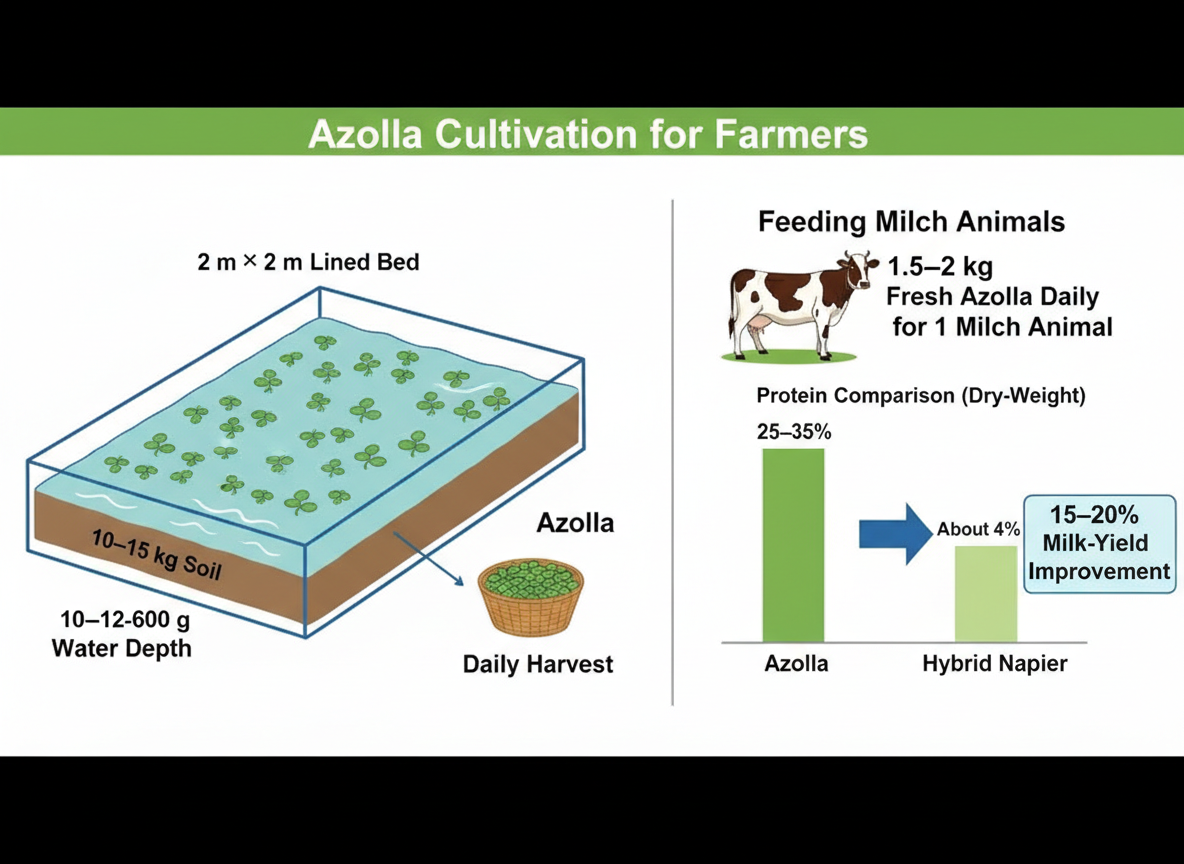
The feeding results are well documented. Feeding about 1.5–2 kg of fresh azolla a day to a milch animal typically lifts milk yield by 15–20%. In a Krishi Vigyan Kendra demonstration in Ajmer, cows on azolla showed a 20.96% increase in milk yield and buffaloes 16.9%, with milk fat rising from 4.3% to 4.7% in cows and 6.2% to 6.9% in buffaloes. Another ICAR study found that a single kilogram of fresh azolla a day raised average milk yield by half a litre per cow while improving fat content. Farmers also report better animal health — brighter coats, clearer eyes and greater activity — which is why azolla has spread quickly once demonstrated. It can be fed to cattle, buffaloes, goats, sheep, pigs, poultry and rabbits, and even to fish.
Setting up an azolla bed / एज़ोला बेड कैसे बनाएं
A bed is cheap and needs no expertise. The standard unit is a pit about 2 m × 2 m (or a rectangular bed 2.5 m × 1.5 m), dug to roughly 20 cm and lined with a UV-stabilised plastic or silpauline sheet so that 10–12 cm of water can stand. If you prefer a permanent structure, a cement tank of 2 m × 1 m × 0.5 m works well and several can be laid side by side with a water tap connection.
Spread 10–15 kg of sieved fertile soil over the sheet, then add a slurry made from about 2 kg of cow dung and 30 g of single super phosphate mixed in 10 litres of water, and top up with water to a depth of about 10 cm. Inoculate with 0.5–1 kg of fresh, pure azolla mother culture, sprinkled evenly after lightly stirring the water. Within 7–15 days the fern covers the bed as a thick mat and is ready for harvest — 500–600 g a day from a 2 × 2 m bed, or about 1.5 kg a day from the larger rectangular bed. Harvest with a plastic sieve or tray, and wash the azolla in clean water before feeding to remove the smell of cow dung. The wash water is itself a useful liquid manure for nearby plants.
Water quality and site selection / पानी की गुणवत्ता और स्थान का चुनाव
Azolla is sensitive to what goes into its water, so choosing the right spot and the right water source matters as much as the bed itself. Use clean, non-saline water — azolla struggles and may die back in brackish or heavily mineralised water, so avoid water sources known to be salty or hard. Place the bed where it gets partial shade rather than full, harsh sun all day; a spot under a tree canopy, alongside a wall, or under a simple shade net keeps water temperature more stable and reduces evaporation.
Good drainage around the bed is important too, so that rain does not pool and overflow into the pit, carrying soil or debris with it. Site the bed away from paths used by chemical sprays, pesticide mixing areas, or runoff from treated fields and roads, since even small amounts of agro-chemicals can wipe out a culture. Keeping the bed near the homestead, as is commonly recommended, also makes it easier to watch for these risks daily.
Keeping it productive / इसे उत्पादक बनाए रखना
Azolla rewards a light routine. Add about 20 g of single super phosphate and 1 kg of cow dung every five days to sustain rapid multiplication. Replace about 5 kg of the bed soil with fresh soil every 30 days to prevent nitrogen build-up and micronutrient deficiency, and change 25–30% of the water every ten days for the same reason. Clean the bed, replace soil and water, and re-inoculate from a pure culture about once every six months. Azolla grows best at 20–30°C, in about 50% sunlight, at a pH between 5.5 and 7; growth slows below 15°C and stops above 35°C. In cold regions a plastic sheet over the bed keeps production going through winter, and a shade net cuts excessive summer light. Harvest daily — overcrowding is what kills a bed, not neglect of feeding.
Common problems and solutions / आम समस्याएं और समाधान
Most azolla problems trace back to water, nutrients or crowding, and most have simple fixes.
- Foul smell: usually means the water has gone stale or there is too much decomposing dung or dead azolla. Change a larger portion of the water, remove any blackened or rotting mat, and reduce the dung dose for a few cycles.
- Yellowing or browning: often points to nutrient deficiency, too much direct sun, or water that has turned too acidic or alkaline. Check that shading is adequate, top up with a little fresh soil and super phosphate, and confirm the water pH is within the 5.5–7 range.
- Slow growth: can follow from cold weather, overcrowding, poor light, or a weak starter culture. Thin out the mat by harvesting more, move the bed to better light if it is too shaded, and renew the culture if growth stays sluggish after other fixes.
- Pests: insects, snails or frogs can damage or contaminate a bed. Net the bed to keep larger pests out, remove any visible pests by hand, and avoid insecticides, which will also kill the azolla.
- Overcrowding: a mat left unharvested thickens, blocks light and starts to rot from underneath. Harvest daily or every alternate day once the bed is established, so the fern never fully covers the surface for long.
- Contamination: algae, duckweed or other aquatic weeds can invade and outcompete the azolla. Remove contaminants by hand as soon as they appear, and if a bed is badly contaminated it is usually faster to clean it out fully and re-inoculate with a fresh, pure culture.
Safe harvesting and feeding / सुरक्षित कटाई और खिलाना
Always harvest azolla with a clean sieve or tray and wash it thoroughly in clean water before feeding, to rinse off cow dung residue, pond debris and any smell. Fresh azolla can be fed as is, or mixed into regular feed or fodder to make it more palatable.
Introduce azolla to any animal gradually rather than all at once, starting with a small quantity over the first few days and watching how the animal responds before increasing the amount. As a general guide, 1.5–2 kg of fresh azolla a day for a milch animal is a commonly used quantity, but exact amounts should be adjusted to the animal’s size, species and existing diet, and farmers new to azolla are best advised to start smaller and build up.
It is important to treat azolla as a supplement to the regular diet, not a replacement for it. It should be fed alongside normal fodder and concentrate rather than instead of them, giving animals the protein and mineral boost azolla offers while still meeting their full nutritional needs from a balanced diet.
Azolla in the paddy field / धान के खेत में एज़ोला
Azolla’s older use is as a biofertiliser. Inoculated into a flooded rice field shortly after transplanting, it spreads across the water surface, fixes nitrogen and, when it decomposes, releases that nitrogen to the crop. Research at the ICAR-National Rice Research Institute found that dual-cropping azolla with rice produced 10–15 tonnes per hectare of green matter containing 28–33 kg of nitrogen, and that rice yields with azolla were comparable to, or better than, those with 60 kg of urea nitrogen per hectare. Field trials in India and abroad have shown that replacing a quarter to half of the urea dose with azolla maintains or increases grain yield while cutting fertiliser cost substantially — one Senegal trial cut input costs by a third with a modest yield gain. Alongside the nitrogen benefit, azolla suppresses tender weeds by covering the water surface and reduces evaporation, which saves irrigation water. The same fern, grown in a cordoned-off corner of a fish pond, becomes a low-cost feed for grass carp and other fish.
Seasonal care / मौसम के अनुसार देखभाल
Azolla’s needs shift noticeably with the seasons, and a little extra attention at each change keeps production steady through the year.
In summer heat, provide more shade, top up water more often to offset faster evaporation, and harvest a little more frequently so the mat does not thicken and overheat. In winter cold, covering the bed with a plastic sheet, especially overnight, helps hold warmth, and growth will naturally slow down when temperatures drop below about 15°C — this is normal and not a sign of a failing culture. During heavy rain, make sure the bed cannot overflow or be flooded with muddy runoff, which dilutes nutrients and can wash the azolla away; a slightly raised edge or a simple cover during storms helps protect the bed.
Keeping production going year-round is mostly a matter of adjusting shade, water depth and harvesting frequency to the season rather than changing the basic routine, and farmers who maintain two or three beds can stagger maintenance on each so that at least one bed is always ready to harvest.
Cost, returns and the catch / लागत, आय और सीमाएं
The economics are almost absurdly favourable. A bed costs little more than a plastic sheet, a few kilos of soil and cow dung, and some super phosphate; several states have offered subsidies for construction — in Rajasthan, ATMA approved a 50% subsidy of ₹2,000 for a pucca azolla trench, and KVK Ajmer established 523 units in five years on the strength of the results alone. Against that, 1.5–2 kg of fresh azolla a day replaces a meaningful share of purchased concentrate for a milch animal, and the milk response shows up within weeks. The main constraints are not cost but care: azolla needs a pure, uncontaminated culture, regular harvesting and periodic water and soil changes; it is sensitive to extreme temperature; and it needs daily attention, which is why it is best sited near the homestead. The largest barrier, though, is simple awareness — azolla remains confined to a relatively small number of progressive farmers because the technique has not been widely demonstrated.
Simple farm record / सरल फार्म रिकॉर्ड
Keeping a basic written record, even a simple notebook, makes it far easier to see whether azolla is paying off and to catch problems early. Useful things to note each day or week include:
- The quantity of azolla fed to each animal or group of animals.
- Milk yield, so any change can be compared against what was being fed.
- General animal response — appetite, coat condition, activity level and any health changes.
- When water and soil in the bed were changed, so the maintenance routine stays on schedule.
- Input costs, such as cow dung, super phosphate and any materials bought for the bed, to track the real cost of production over time.
Reviewing this record every few weeks helps a farmer decide whether to expand to more beds, adjust the feeding quantity, or troubleshoot a bed that is not performing as expected.
Key takeaways
- Azolla is a free-floating aquatic fern with a nitrogen-fixing partner; it doubles every 3–7 days and needs only water, a little soil and cow dung to multiply.
- Dry-weight protein is 25–35%; feeding 1.5–2 kg fresh azolla a day typically lifts milk yield by 15–20% and improves fat content.
- Set up a 2 × 2 m lined pit with 10–15 kg soil, cow dung and super phosphate; inoculate with 0.5–1 kg mother culture and harvest 500–600 g daily from day 7–15.
- Maintain it with super phosphate and cow dung every five days, soil replacement every 30 days, and a full reset every six months.
- In rice, azolla dual-cropping fixes 28–33 kg N/ha, matches or beats 60 kg urea-N/ha in trials, suppresses weeds and cuts evaporation; subsidies for beds have been available in several states.
- Choose a clean water source, partial shade and good drainage away from chemical runoff; watch for smell, discolouration, slow growth, pests, overcrowding and contamination, and treat azolla as a supplement, not a complete feed.
Sources
ICAR-Research Complex for Eastern Region (Patna) azolla advisory; ICAR-National Rice Research Institute, Cuttack — azolla research bulletin (No. 47) and dual-cropping studies; ICAR Indian Farming articles on azolla cultivation, rainwater use and milk yield; Krishi Vigyan Kendra Ajmer study “Use of Azolla (Azolla pinnata) as Cattle Feed” (Journal of Krishi Vigyan); TNAU Agritech / NABARD model project on azolla fodder plots; IIT Mandi azolla cultivation note; Journal of Agricultural Science, Cambridge — Azolla pinnata with chemical nitrogen in rice; Tandfonline Senegal azolla-rice intercropping trial (2025).


Leave a Reply