
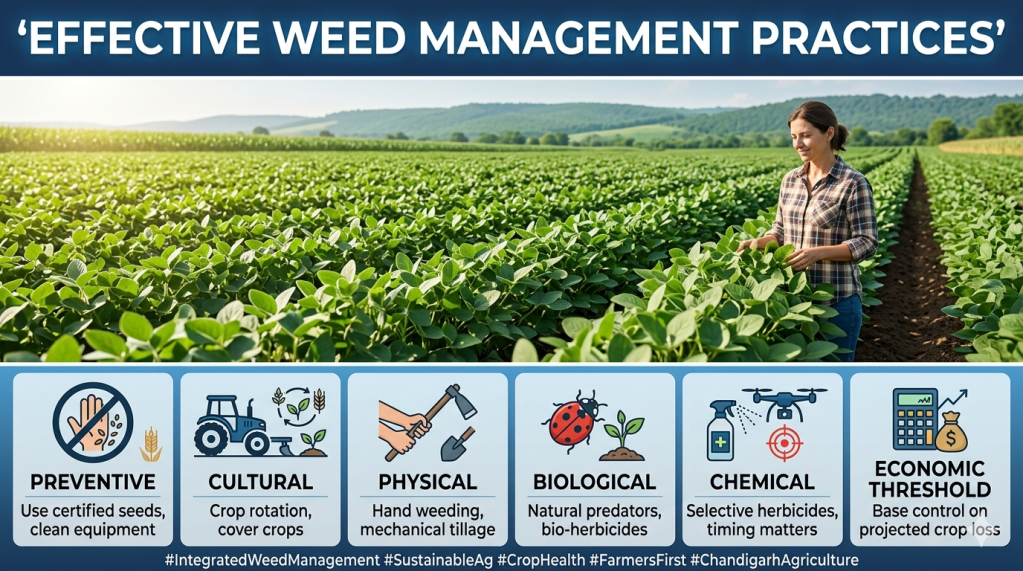
Effective weed management is a cornerstone of successful agriculture, directly impacting crop yields, quality, and resource efficiency. Weeds compete with primary crops for water, sunlight, and soil nutrients, often acting as hosts for pests and diseases.
A modern, sustainable approach relies on Integrated Weed Management (IWM)—a strategy that combines biological, cultural, physical, and chemical methods to keep weed populations below an economic threshold.
1. Preventive Management Practices
Prevention is the first line of defense. The goal is to stop weed seeds or vegetative parts from entering the field in the first place.
- Clean Seeds: Always use certified, weed-free seeds.
- Sanitization: Thoroughly clean farm machinery and tools when moving between fields to prevent the transfer of seeds.
- Irrigation Control: Filter irrigation water and keep canal banks clear of weeds to prevent seeds from traveling through water flow.
- Screening Manure: Ensure that animal manure is well-composted; the high temperatures during composting kill most weed seeds.
2. Cultural Management Practices
These practices focus on making the environment more favorable for the crop and less favorable for the weeds by enhancing crop competition.
- Crop Rotation: Alternating crops with different life cycles or growth habits disrupts the specialized environment that certain weeds need to thrive.
- Cover Cropping: Planting “smother crops” like clover or rye during the off-season prevents weeds from establishing on bare soil.
- Intercropping: Growing two or more crops together increases the leaf canopy, shading out emerging weeds.
- Stale Seedbed Technique: The field is prepared and irrigated to encourage weed germination. Once weeds emerge, they are destroyed via light cultivation or flame before the actual crop is sown.
3. Physical and Mechanical Practices
These are traditional methods involving manual labor or machinery to physically remove or kill weeds.
- Tillage: Turning the soil buries weed seeds and disrupts the roots of established weeds. However, excessive tillage can lead to soil erosion.
- Hand Weeding and Hoeing: While labor-intensive, this remains the most precise method for removing weeds around the base of sensitive crops.
- Mulching: Covering the soil surface with organic matter (straw, wood chips) or synthetic materials (plastic sheets) blocks the sunlight necessary for weed germination.
- Mowing: Frequent mowing in orchards or pastures prevents weeds from reaching the flowering stage, thus stopping seed production.
4. Biological Management Practices
Biological control involves using natural enemies—insects, fungi, or bacteria—to suppress specific weed species.
- Allelo-chemicals: Some crops, like rye or sorghum, naturally release chemicals into the soil that inhibit the growth of neighboring weed species.
- Bio-herbicides: Utilizing specific pathogens (like the fungus Colletotrichum) to target and kill specific weeds without harming the crop.
- Grazing: Integrating livestock like sheep or goats can effectively manage weed populations in pasture-based systems.
5. Chemical Management Practices
When other methods are insufficient, herbicides are used. However, they must be applied judiciously to prevent environmental damage and the development of herbicide-resistant “superweeds.”
Classification of Herbicides
- Pre-emergence: Applied to the soil before weed seeds germinate.
- Post-emergence: Applied directly to the foliage of established weeds.
- Selective: Targets specific weed types (e.g., broadleaf) while leaving the crop unharmed.
- Non-selective: Kills all green plant tissue it contacts (e.g., glyphosate).
The Economic Threshold Concept
The “Economic Threshold” is the point where the cost of managing weeds is equal to the potential crop loss caused by those weeds. Farmers use this metric to decide when a chemical or mechanical intervention is financially justified.
Cost of Control=(Yield Loss per Weed×Market Price of Crop)×Weed Density
By monitoring weed density and applying this formula, growers can avoid unnecessary herbicide applications, saving costs and protecting the ecosystem.
Summary of Management Strategies
| Method | Key Advantage | Main Limitation |
|---|---|---|
| Preventive | Cost-effective; stops problems early. | Requires high discipline and monitoring. |
| Cultural | Improves soil health and crop vigor. | Can be complex to plan (rotations). |
| Physical | Reliable and organic-friendly. | High labor costs or risk of soil erosion. |
| Chemical | Fast-acting and highly effective. | Risk of resistance and environmental impact. |
Frequently Asked Questions: Integrated Weed Management
Effective weed control requires a balance of timing, technique, and consistency. Below are answers to the most common questions regarding modern weed management practices.
Common Weed Plants
Common Weed plants – Krishicenter
| Scientific Name | Common Name | Hindi Name | Description & Impact |
| Parthenium hysterophorus | Carrot Grass / Congress Grass | गाजर घास (Gajar Ghas) | Invasive Perennial: Highly aggressive; causes skin and respiratory allergies. Suppresses nearby crops through toxic root chemicals. |
| Chenopodium album | Lambsquarters | बथुआ (Bathua) | Annual Herb: Extremely common in winter (Rabi) crops like wheat. While edible and nutritious, it competes heavily for soil nitrogen. |
| Cyperus rotundus | Purple Nutsedge / Nutgrass | मोथा (Motha) | Perennial Sedge: Hardest to kill due to deep underground tubers (nuts). Thrives in moist soil and affects rice and sugarcane. |
| Solanum nigrum | Black Nightshade | मकॉय (Makoy) | Annual/Short-lived Perennial: Found in vegetable gardens. Produces small green berries that turn black. Green parts can be toxic to livestock. |
| Argemone mexicana | Mexican Prickly Poppy | सत्यानाशी (Satyanashi) | Annual Herb: A spiny plant with yellow flowers and yellow sap. Often found in fallow land; its seeds are a dangerous contaminant in mustard seeds. |
| Digitaria sanguinalis | Crabgrass | खीरा घास (Khira Ghas) | Annual Grass: Grows in thick, low-spreading mats. Spreads rapidly through rooting at the joints (nodes) and is a major pest in lawns. |
| Cynodon dactylon | Bermuda Grass | दूब घास (Doob Ghas) | Perennial Grass: While used for lawns, it is a persistent weed in agricultural fields because it regrows from even tiny pieces of roots. |
| Ageratum conyzoides | Billygoat Weed | बकरी घास (Bakri Ghas) | Annual Herb: Recognizable by its soft purple/white fluffy flowers. Quickly invades plantations and damp, shady areas. |
| Lantana camara | Lantana / Wild Sage | रायमुनिया (Raimuniya) | Perennial Shrub: A major forest and pasture weed. Forms thick, thorny barriers that prevent the growth of grass for cattle. |
General Management Questions
What is the “Critical Period” for weed control? The critical period is the specific window in a crop’s life cycle when weed competition causes the most significant yield loss. For most seasonal crops, this is usually the first 4 to 8 weeks after sowing. Managing weeds during this window is vital for a healthy harvest.
How does crop rotation help in managing weeds? Different crops require different planting times, nutrients, and cultivation practices. By rotating crops (e.g., following a cereal with a legume), you disrupt the life cycle of weeds that are specifically adapted to one type of crop, preventing them from becoming dominant.
Can mulching completely eliminate weeds? While mulching is highly effective, it rarely eliminates 100% of weeds. Some aggressive perennial weeds can push through thin layers of organic mulch. For best results, use a layer at least 2 to 3 inches thick or combine organic mulch with a base layer of biodegradable paper.
Chemical & Technical Questions
What is the difference between Pre-emergence and Post-emergence herbicides?
- Pre-emergence: Applied to the soil before weed seeds sprout. it creates a chemical barrier that kills weeds as they try to germinate.
- Post-emergence: Applied directly to the leaves of weeds that are already growing.
How can I prevent herbicide resistance in my fields? To avoid “superweeds,” never rely on a single chemical. Rotate between different modes of action (herbicides that kill weeds in different biological ways) and always integrate mechanical or cultural methods like hoeing or cover cropping.
Is biological weed control safe for my primary crop? Yes. True biological control agents (like specific insects or fungi) are “host-specific,” meaning they are tested to ensure they only attack the target weed and do not harm the crop, local flora, or the environment.
Visual Timeline of an Integrated Weed Management System
This timeline follows the life cycle of a single crop, showing how different strategies stack on top of one another.
| Strategic Level (Timing) | Practical Function (Mechanism) | Core Technique (Action) | Key Benefit & Role |
|---|---|---|---|
| I. Field Preparation (Pre-Sowing) | Preventive / Cultural | Stale Seedbed Preparation | Encourages early germination of weeds, which are then destroyed via a non-selective herbicide or light cultivation, starting the crop in a clean field. |
| II. Sowing & Establishment (Weeks 0 – 3) | Cultural / Physical | Cover Cropping (Relay) | Sowing a cover crop (e.g., clover) immediately after the main cereal crop. The cover crop establishes quickly, smothering emerging weeds through canopy competition. |
| Physical | Mulching (Organic) | Applying rice straw mulch between the rows. Blocks sunlight from reaching the soil surface, inhibiting weed germination while conserving moisture. | |
| III. Vegetative Growth (Weeks 4 – 8) | Chemical | Early Post-Emergence Herbicide | Application of a selective herbicide (e.g., targeting broadleaf weeds only) exactly at the Economic Threshold, targeting specific weeds that escaped mechanical control. |
| Physical / Mechanical | Inter-row Hoeing / Cultivation | Utilizing mechanized hoes or sensors between crop rows. Physically dislodges large weeds, particularly perennial escapes, when chemical options are limited. | |
| IV. Reproductive Phase (Week 9 – Harvest) | Cultural | Precision Fertigation / Nutrient Placement | Applying fertilizer and water directly to the crop’s root zone rather than broadcasting. Feeds the crop while starving the surrounding weeds. |
| V. Post-Harvest & Fallow (Post-Harvest) | Cultural | Crop Rotation (Legume) | Rotating the field with a high-nitrogen legume (e.g., chickpeas or lentils) in the following season to break the dominance of grass weeds and improve soil fertility. |
Cost & Efficiency
Is manual weeding still cost-effective? On a large commercial scale, manual weeding is often too expensive due to labor costs. However, for high-value organic crops or small-scale vegetable farming, it remains the most effective way to ensure zero crop damage and maintain organic certification.
How do I calculate if a weed treatment is worth the cost? Use the Economic Threshold principle. If the predicted value of the crop loss (caused by the current weed density) is higher than the cost of the herbicide and labor, the treatment is financially justified.
Treatment Justified if: (Yield Loss×Market Price)>Cost of Intervention


Leave a Reply