
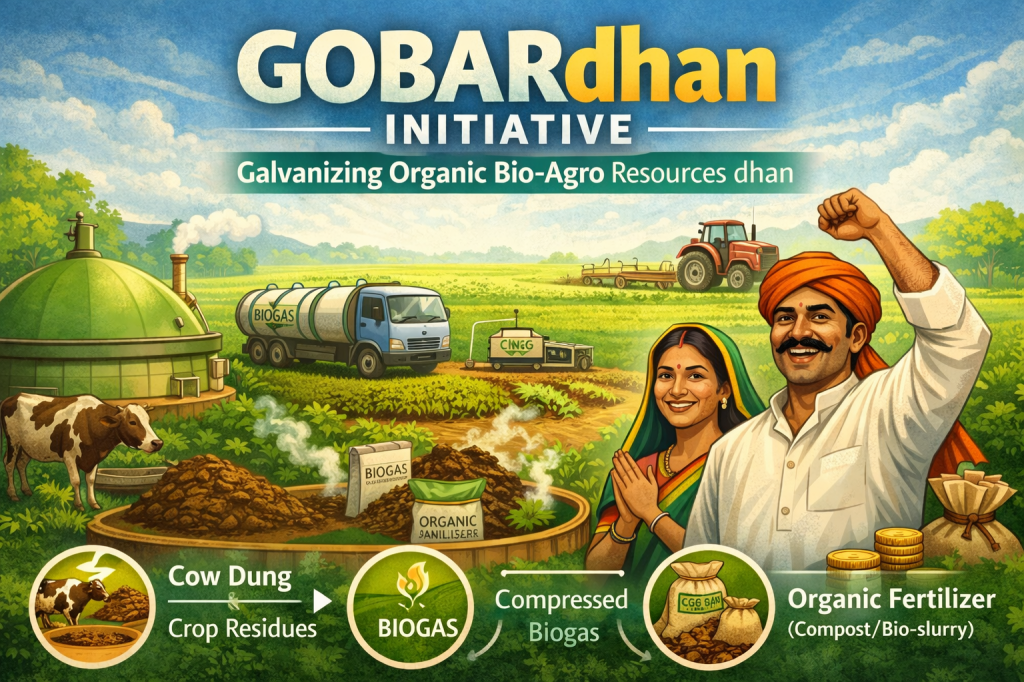
What is GOBARdhan Intiative, detailed information and process, GOBARdhan under SBM -G Phase II (2020-2027)
The GOBARdhan Initiative stands for Galvanizing Organic Bio-Agro Resources Dhan. It is a flagship initiative of the Government of India launched in 2018 to promote the scientific management of cattle dung and organic agricultural waste in rural areas.
The scheme is implemented under the Swachh Bharat Mission (Gramin) Phase II (SBM-G Phase II) from 2020–2027 by the Ministry of Jal Shakti through the Department of Drinking Water and Sanitation.
The initiative aims to convert animal dung, crop residues, and other biodegradable waste into biogas, compressed biogas (CBG), and organic fertilizers, thereby creating wealth from waste in rural India.
Objectives of the GOBARdhan Initiative
The key objectives include:
1. Waste to Wealth
- Convert cattle dung and organic waste into biogas and organic manure.
- Promote circular economy in agriculture.
2. Improve Rural Sanitation
- Prevent open dumping of cattle waste.
- Reduce environmental pollution.
3. Promote Renewable Energy
- Produce biogas and compressed biogas (CBG) for cooking, electricity, and transport fuel.
4. Increase Farmers’ Income
- Farmers can sell dung and agricultural residues to biogas plants.
- Generate income from organic fertilizers and bio-slurry.
5. Reduce Chemical Fertilizer Use
- Promote organic manure production from digested slurry.
GOBARdhan under SBM-G Phase II (2020–2027)
The second phase of Swachh Bharat Mission (Gramin) focuses on sustaining ODF villages and improving waste management.
Major Components
- Community Biogas Plants
- Compressed Biogas (CBG) Plants
- Organic Fertilizer Production Units
- Village Level Waste Management Systems
Target
- Establish thousands of biogas and CBG plants across rural India.
- Promote biodegradable waste management in villages.
Key Features of GOBARdhan Scheme
1. Biogas Production
Animal dung and organic waste are converted into biogas through anaerobic digestion.
Uses of biogas:
- Cooking fuel
- Electricity generation
- Compressed biogas for vehicles
2. Organic Fertilizer Production
After gas extraction, the leftover slurry is processed into organic manure.
Benefits:
- Improves soil fertility
- Reduces dependency on chemical fertilizers
3. Community Participation
Villagers supply:
- Cow dung
- Agricultural residues
- Organic waste
In return they receive:
- Payments for dung supply
- Access to organic manure
4. Public–Private Partnership
The scheme encourages:
- Private investors
- Farmer Producer Organizations (FPOs)
- Cooperatives
- Entrepreneurs
to build and operate plants
Implementation Process of GOBARdhan
Step-by-Step Process
Step 1: Waste Collection
- Collect cow dung, crop residues, and organic waste from villages.
Step 2: Transportation
- Waste is transported to the biogas plant.
Step 3: Anaerobic Digestion
- Waste is decomposed in airtight digesters.
- Microorganisms break down the organic matter.
Step 4: Biogas Production
- Methane-rich biogas is generated.
Step 5: Gas Utilization
Biogas is used for:
- Cooking gas
- Electricity generation
- Compressed biogas fuel
Step 6: Slurry Processing
The leftover slurry is processed into:
- Organic manure
- Biofertilizers
Step 7: Distribution
- Organic manure is supplied to farmers.
- Gas or electricity is distributed locally.
Flowchart of the GOBARdhan Process
Organic Waste (Cow dung + crop residues)
│
▼
Waste Collection
│
▼
Transport to Biogas Plant
│
▼
Anaerobic Digestion
│
┌───────────────┐
▼ ▼
Biogas Slurry
│ │
▼ ▼
Cooking / Power Organic Fertilizer
Generation (Compost/Bio-slurry)
Financial Support under the Scheme
Funding is provided through:
- Central Government
- State Governments
- Private investment
- CSR funds
- Financial institutions
Entrepreneurs may also get support through schemes like:
- SATAT Initiative (Sustainable Alternative Towards Affordable Transportation) for compressed biogas production.
Benefits of the GOBARdhan Initiative
For Farmers
- Additional income from dung sales
- Availability of organic manure
- Reduced fertilizer costs
For Villages
- Cleaner environment
- Improved sanitation
- Renewable energy access
For Environment
- Reduced greenhouse gas emissions
- Sustainable waste management
- Improved soil health
Importance for Sustainable Agriculture
The GOBARdhan initiative supports:
- Organic farming
- Climate-smart agriculture
- Waste recycling
- Rural employment generation
It is a key step towards achieving:
- clean villages
- energy security
- sustainable agriculture
in India.
Conclusion
The GOBARdhan scheme turns cow dung and farm waste into valuable resources like biogas and organic fertilizer, helping farmers earn income while improving sanitation and sustainability in rural India.


Leave a Reply