
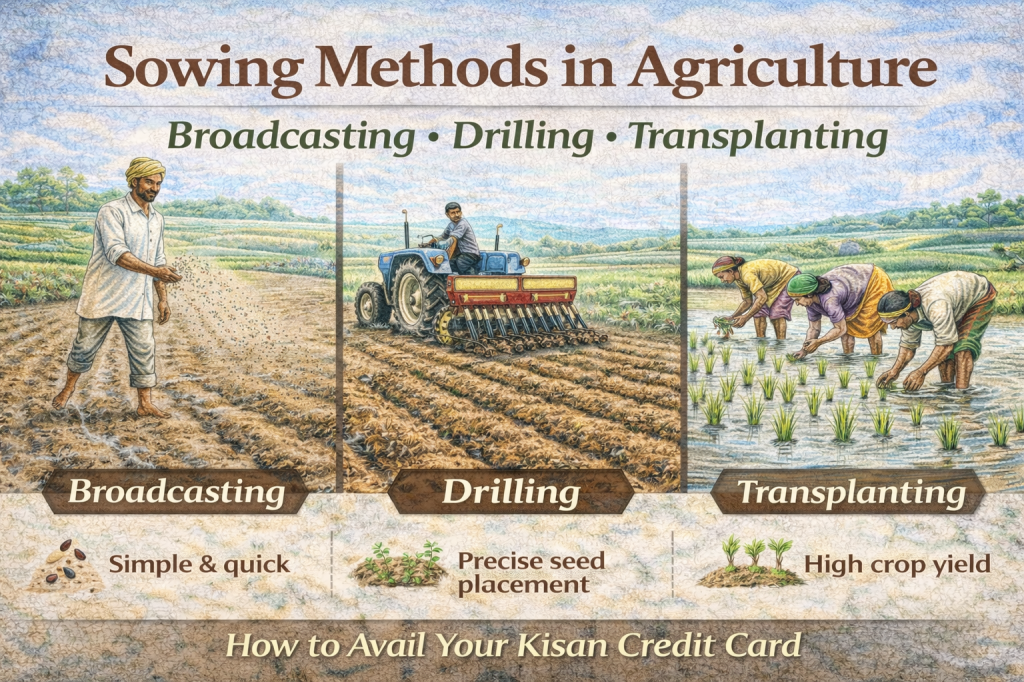
Sowing is one of the most important operations in agriculture. It involves placing seeds in the soil at the proper depth. Seeds must be spaced correctly. This ensures they can germinate and grow into healthy plants. Proper sowing methods ensure uniform crop growth, better use of nutrients, efficient irrigation, and higher crop yield.
Farmers use different sowing methods depending on the type of crop, soil condition, climate, and available technology. Among the various methods, broadcasting, drilling, and transplanting are the most commonly used techniques in agricultural practices.
Each method has its own advantages, limitations, and suitable crops.
Broadcasting Method
Broadcasting is the simplest and oldest method of sowing seeds, where seeds are scattered uniformly over the field either by hand or by mechanical spreaders.
In this method, seeds are thrown over the prepared soil surface and then lightly covered with soil using planking or harrowing.
Types of Broadcasting
- Manual Broadcasting
- Seeds are scattered by hand.
- Common in traditional farming.
- Mechanical Broadcasting
- Machines or seed spreaders distribute seeds more uniformly.
Sowing Methods – seed Broadcasting – Krishicenter
Crops Suitable for Broadcasting
This method is commonly used for crops such as:
- Wheat
- Paddy (in some regions)
- Mustard
- Millets
- Fodder crops
- Grass crops
Advantages
- Simple and quick method
- Requires less labor and equipment
- Suitable for large fields
Disadvantages
- Uneven seed distribution
- Higher seed wastage
- Poor spacing between plants
- Lower crop yield compared to improved methods
Drilling Method
Dirilling method involves sowing seeds in rows at a specific depth and spacing using a seed drill or similar equipment. This method is more scientific and efficient compared to broadcasting.
A seed drill machine places seeds into the soil and covers them automatically.
Sowing Methods – Drilling – Krishicenter
Crops Suitable for Drilling
- Wheat
- Maize
- Cotton
- Soybean
- Groundnut
- Pulses
Advantages
- Uniform seed distribution
- Proper spacing between plants
- Better germination rate
- Efficient use of seeds
- Easier intercultural operations such as weeding
Disadvantages
- Requires machinery or equipment
- Higher initial cost
- Needs skilled operation
Sowing Methods – Drilling Machinery – Krishicenter
Despite these limitations, drilling is widely adopted in modern mechanized agriculture because it increases crop productivity.
Transplanting Method
Transplanting is a method in which seedlings are first grown in a nursery and later transferred to the main field after they reach a certain stage of growth.
This method is commonly used for crops that require careful plant spacing and early protection.
Sowing Methods – Rice Transplanter Improves Farming Efficiency – Krishicenter
Crops Suitable for Transplanting
- Rice (paddy)
- Tomato
- Onion
- Cabbage
- Cauliflower
- Brinjal (eggplant)
Steps in Transplanting
- Preparation of nursery beds
- Sowing seeds in nursery
- Growing seedlings for 20–30 days
- Uprooting seedlings carefully
- Planting seedlings in the main field at proper spacing
Advantages
- Better plant selection and survival rate
- Proper spacing between plants
- Reduced seed requirement
- Higher crop yield
Disadvantages
- Requires more labor
- Time-consuming process
- Higher production cost
Despite these disadvantages, transplanting is widely used in rice cultivation because it ensures strong plant establishment.
Comparison of Sowing Methods
| Feature | Broadcasting | Drilling | Transplanting |
|---|---|---|---|
| Seed Placement | Scattered randomly | Placed in rows | Seedlings planted manually |
| Seed Requirement | High | Moderate | Low |
| Labor Requirement | Low | Moderate | High |
| Equipment | Minimal | Seed drill machine | Nursery preparation |
| Crop Yield | Lower | Higher | Very high |
| Suitable Crops | Wheat, mustard | Maize, soybean | Rice, vegetables |
Importance of Proper Sowing Methods
Selecting the correct sowing method is important for several reasons:
- Ensures uniform crop growth
- Improves seed germination
- Enhances efficient use of water and fertilizers
- Reduces weed competition
- Increases agricultural productivity
Modern agriculture increasingly uses improved sowing techniques such as mechanized seed drills and precision planting to maximize crop production.
Conclusion
Sowing is a fundamental agricultural operation that significantly affects crop growth and productivity. Among the various sowing techniques, broadcasting, drilling, and transplanting are widely practiced depending on crop requirements and farming conditions. Broadcasting is simple but less efficient, drilling provides uniform seed placement and higher yield, while transplanting ensures strong plant establishment and better crop management. By adopting appropriate sowing methods, farmers can improve crop performance, optimize resource use, and achieve sustainable agricultural development.
 KrishiCenter
Leave a comment