
Diversification of crops with special emphasis on Oilseeds & Pulses
The National Rabi Campaign (NRC) 2025 places strong emphasis on crop diversification to improve farm income. It ensures nutritional security. It conserves natural resources and reduces over-dependence on wheat and rice. The campaign aligns with India’s long-term goal of sustainable, climate-resilient agriculture.
What is Crop Diversification?
A shift from regional dominance of one crop to regional production of a number of crops to meet ever ever-increasing demand of pulses, oilseeds, maize, fiber, fruits, etc.
Why Crop Diversification in Rabi Season?
India’s rabi season has traditionally been dominated by wheat. However, monocropping has led to:
- Groundwater depletion
- Soil nutrient imbalance
- Rising input costs
- Market price risks
Crop diversification offers a practical solution to these challenges.
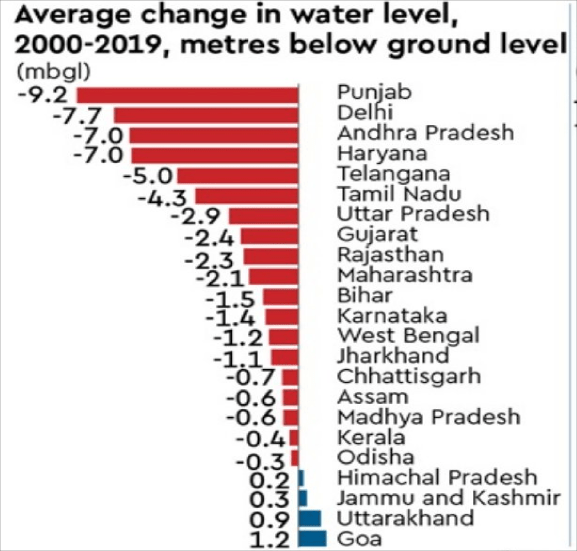
The states with red bars facing a significant groundwater depletion; Punjab tops the list. Only a few states have rising groundwater level.
Key Objectives of NRC 2025 (Diversification Focus)
- Reduce excessive area under wheat in stressed regions
- Promote pulses, oilseeds, coarse cereals, and horticultural crops
- Enhance farmers’ income through high-value and low-input crops
- Improve soil health and water-use efficiency
- Strengthen nutritional security
Procurement of Rice and Wheat by the FCI
Recent procurement of Paddy and Wheat by the FCI
Paddy: During the 2023–24 KMS, FCI procured 525.48 LMT of rice, which accounts for 38.13% of the total rice production in the country. Nearly 56.10% of the total Rice procurement is done from Punjab, Haryana, Chhattisgarh and Odisha.
Wheat: During the 2024–25 RMS, FCI procured 266.05 LMT, which accounts for 23.50% of the total wheat production in the country. Nearly 73.71% of the total Wheat procurement is done from Punjab and Haryana.
Crop Diversification Strategies
discouraging crop shift
- Incentives needed to encourage crop shift
- Paddy has a clear profitability advantages over the alternatives discouraging crop shift
- Funded through savings from economic costs of paddy
- Rice stored in the godowns of FCI costs approx. Rs 33/kg including procurement costs, milling, transport, storage, etc. Accordingly, assuming yield of rice 41.25 q/ha, Govt. spends about Rs. 1,36,000/ha. This does not include subsidies given for power, fertilizers and seed.
- So, if one ha area of rice is left fallow or a crop, that is not procured, is grown, Govt. has a resource saving of Rs. 1,36,000/ha
- There are distortions in coposition of agricultural output
- Till 1stApril, 2022, rice and wheat stocks in central pool were 55.03 and 18.99 MMT respectively against the buffer stock norms of 13.58 and 7.46 MMT respectively.
- Valuable economic resources locked up (about Rs.2.85 lakh crore) at a huge opportunity cost.
- State wise planning for crop diversification is needed
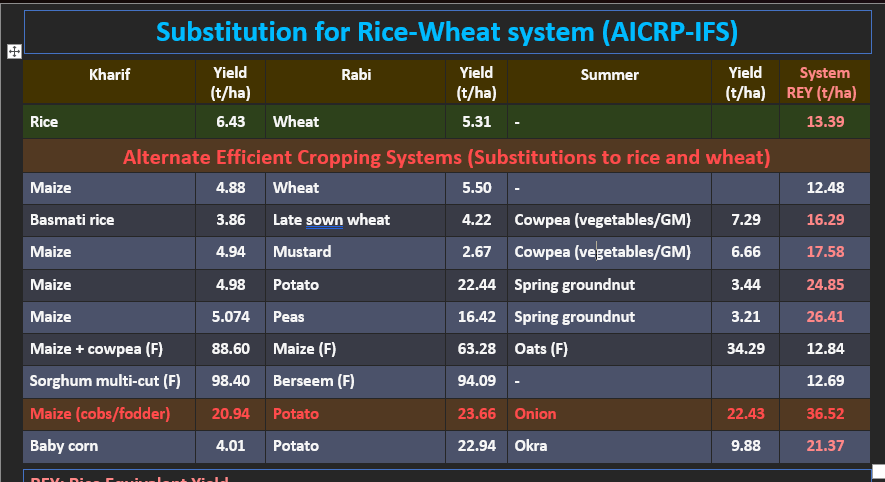
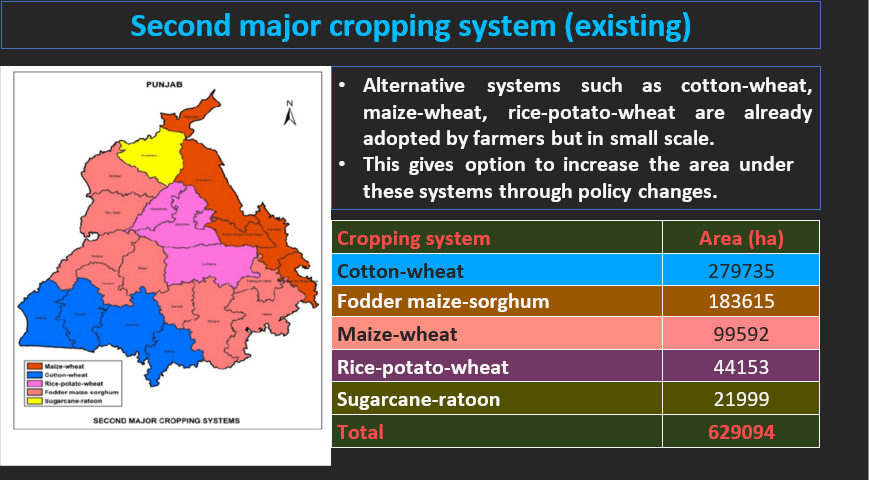
Priority Crops Promoted under Rabi Diversification
1. Pulses
- Chickpea (Gram)
- Lentil (Masur)
- Field pea
Benefits:
✔ Nitrogen fixation improves soil fertility
✔ Lower water requirement
✔ MSP and procurement support
2. Oilseeds
- Mustard
- Linseed
- Sunflower
Benefits:
✔ Reduces edible oil import dependence
✔ Short duration & climate-resilient
✔ Better market demand
3. Nutri-cereals & Coarse Grains
- Barley
- Oats
Benefits:
✔ Suitable for low-water areas
✔ Growing demand in health food markets
4. Horticulture & High-Value Crops
- Onion, garlic
- Vegetables
- Seed spices (coriander, cumin)
Benefits:
✔ Higher income per hectare
✔ Employment generation
Crop diversification in GR States
- MSP/Price incentivization for diversified crops and assured procurement
- Enabling the availability of quality and climate – resilient certified seeds of diversified crops
- Promote the integrated farming system as crop diversification is inbuilt in IFS
- Availability of machinery to make easy harvesting of alternative crops like green gram, groundnut, maize, cotton, etc
- Landscape – level efforts to control stray animal/monkey/bird losses for the introduction of a new crop
- Productivity enhancement through advanced management practices such as precision farming leading to higher incomes
- Special focus under crop insurance: Premium support to farmers
How to plan and monitor the crop diversification?
Agri-Stack:
- Three core registries
- Farmers linked dynamically with their Land Records
- Georeferenced Farmland Plot Registries
- Crop Sown Registries (Collected through DCS)
- Agri stack can help in identifying farmers and their croplands for targeted planning, monitoring, and transferring benefits (both in cash and kind)
Krishi-DSS
- Objective
- Crop diversification—growing a variety of crops in a single area is essential.
- Implementation on a large scale requires detailed, up-to-date spatial data that’s difficult to collect manually.
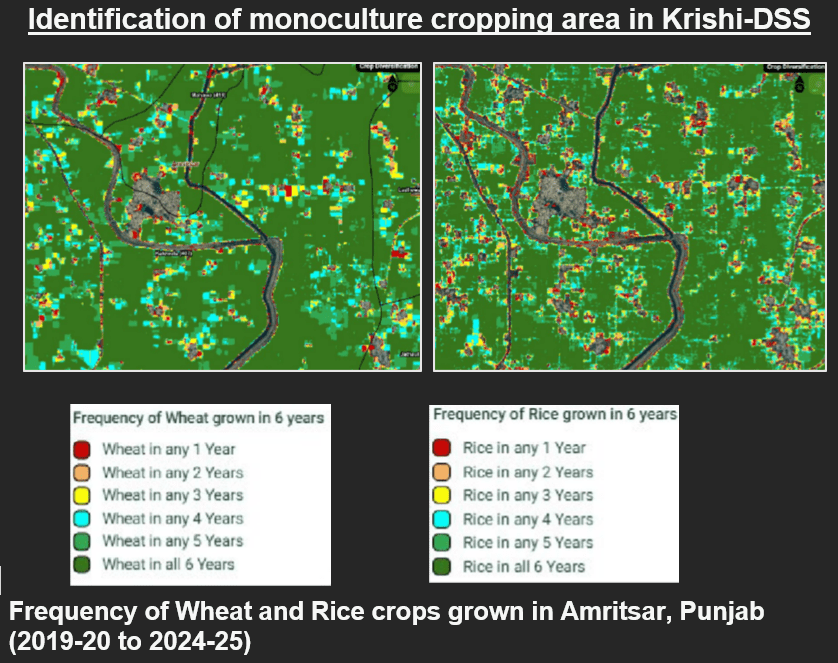
Identification of monoculture cropping area in Krishi-DSS
- K-DSS provides evidence for planningIdentify traditional farming (monoculture) areas leading to soil degradation, increased pest and disease vulnerability, and reduced climate resilience.
- Farmers growing water-intensive crops in water- stressed areas and growing inappropriate crops as per the Argo-climatic zone.
Government Support under NRC 2025
- Seed distribution of diversified crops
- Demonstration plots and cluster approach
- Soil Health Card–based crop planning
- Micro-irrigation & mechanization support
- Market linkage and MSP assurance
Replacement of any existing crop may face farmers’ resistance, so how to motivate the farmers?
- Incentives to farmers: Easiest approach, but will it be sustainable?
- Value Chain approach: Inputs (quality seeds, pesticides, and machinery), assistance for processing. and assured procurement from the diversified areas
- Availability of quality seeds and pesticides is paramount: SATHI Portal with AI, and IPMS to locate quality seeds and pesticides, respectively
- Growing niche crops and Integrating with natural farming missions so that farmers can benefit from the niche and organic market and don’t turn back.
- Demonstrate and handhold farmers to build confidence: Involve FPOs, PACS etc
Target Regions
- Indo-Gangetic plains with declining water tables
- Rice-wheat dominated belts
- Rainfed and semi-arid regions
Expected Outcomes
- Sustainable use of water and soil resources
- Reduced input costs for farmers
- Improved farm profitability
- Balanced food and nutrition basket
- Climate-resilient cropping systems
Conclusion
The National Rabi Campaign 2025 marks a decisive shift from quantity-focused farming to value-driven and sustainable agriculture. Crop diversification is not optional anymore—it is essential for farmer resilience, environmental protection, and India’s food security.


Leave a Reply