
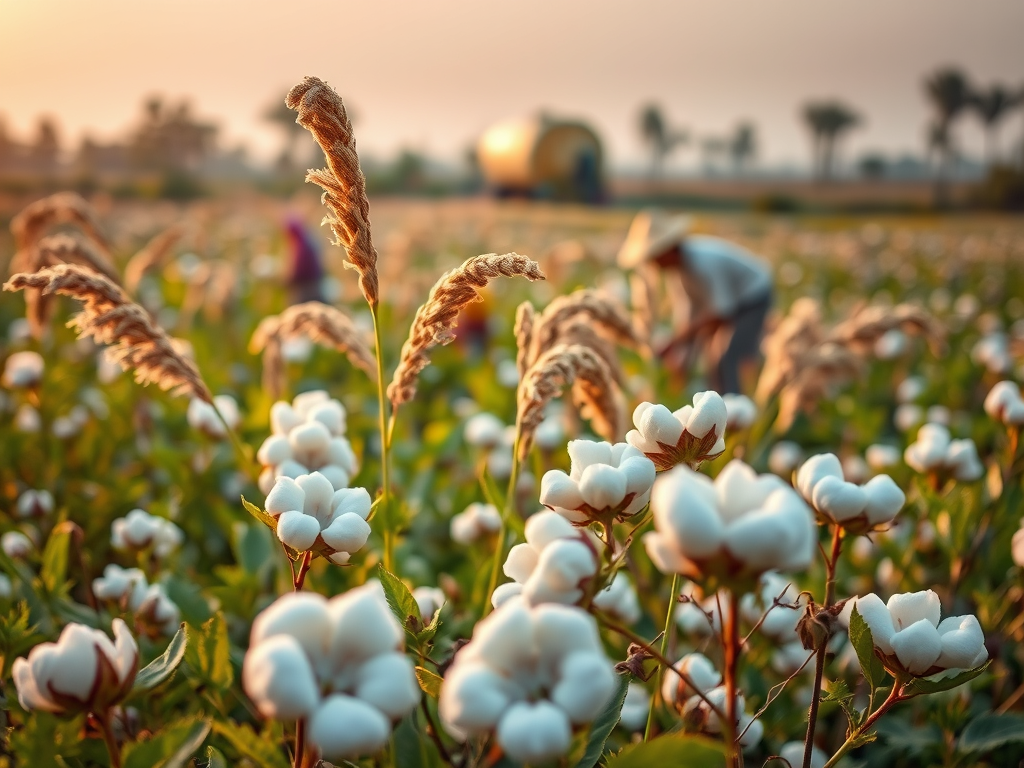
What are Fibre Crops?
Fibre crops are agricultural crops grown primarily for their fibres. These fibres are used in making textiles, ropes, sacks, carpets, paper, and other industrial products. In India, fibre crops play a vital role in rural employment, agro-based industries, exports, and farmer income. It helps the rural economy to grow in diversified markets.
India is one of the world’s largest producers of natural fibres. This is especially true for cotton and jute. This makes fibre crops economically and strategically important for Indian economy as a whole.
Major Fibre Crops Grown in India
1. Cotton
- Most important natural fibre crop
- Used in textile and garment industries
- Major producing states: Gujarat, Maharashtra, Telangana, Punjab, Haryana
2. Jute
- Known as the “Golden Fibre”
- Used for gunny bags, ropes, mats, eco-friendly packaging
- Major producing states: West Bengal, Bihar, Assam, Odisha
3. Mesta
- Alternative to jute
- Used for ropes and coarse fabrics
- Grown in eastern and southern India
4. Sunn Hemp
- Used for cordage and ropes
- Also improves soil fertility as a green manure crop
Economic Importance of Fibre Crops
Employment Generation
- Supports millions of farmers, laborers, and workers
- Textile and jute industries provide large-scale rural and urban employment
Contribution to GDP and Exports
- Cotton textiles are among India’s top export commodities
- Jute products contribute to eco-friendly export markets
Industrial Development
- Raw material for spinning mills, textile units, jute mills, and handicrafts
- Encourages agro-based industrialization
Environmental Benefits
- Natural fibres are biodegradable
- Jute products reduce plastic use and pollution
Challenges in Fibre Crop Production
- Pest attacks (especially in cotton)
- Price fluctuations
- High cost of inputs
- Competition from synthetic fibres
Government Support & Schemes
The Government of India periodically introduces various schemes. They implement mechanisms to help the fibre crop industry. These efforts aim to propel its growth engine.
- Minimum Support Price (MSP) for cotton and jute
- National Cotton Mission
- Jute Packaging Materials (JPM) Act
- Technology Mission on Cotton
Conclusion
Fibre crops are the backbone of India’s textile economy and sustainable material production. With proper policy support, modern technology, and value addition, fibre crops can significantly enhance farmer income and promote eco-friendly industries.
 KrishiCenter
Leave a comment