
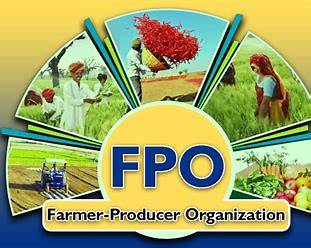
What is an FPO?
A Farmer Producer Organization (FPO) is a collective of farmers. They usually consist of 300 to 1,000 members. These farmers come together to carry out production, processing, marketing, and agribusiness activities collectively.
Key features of an FPO:
- Registered under the Companies Act as a Producer Company, or under the Cooperative Societies Act.
- Run by farmers, for farmers.
- Operates like a company with professional management.
- Ensures collective bargaining and economies of scale.
Formation & Promotion of New 10,000 FPOs in India: A Complete Guide
The Government of India launched the Central Sector Scheme (CSS) for “Formation and Promotion of 10,000 Farmer Producer Organizations (FPOs)” in the year 2020 to strengthen the backbone of Indian agriculture. This programme aims to transform small and marginal farmers into powerful agribusiness collectives, enabling them to gain better market access, reduce input costs, adopt improved technologies, and secure higher incomes.
With nearly 86% of Indian farmers belonging to the small and marginal category, FPOs are seen as a game-changing model that unites farmers, empowers them economically, and ensures long-term sustainability of their livelihoods.
The scheme has a total budgetary outlay of Rs.6865 crores. Formation & promotion of FPOs are to be done through Implementing Agencies (IAs), which further engage Cluster Based Business Organizations (CBBOs) to form & provide professional handholding support to FPOs for a period of 5 years.
Launched in 2020, this government scheme supports the formation and promotion of 10,000 new FPOs within five years.
Nodal Agencies
- Small Farmers’ Agri-Business Consortium (SFAC)
- NABARD
- NCDC (National Cooperative Development Corporation)
These organizations act as Implementing Agencies (IAs), while Cluster-Based Business Organizations (CBBOs) are responsible for ground-level execution.
Objectives of the Scheme
Strengthen collective farming
Reduce cost of cultivation
Improve access to quality inputs
Enhance market linkages
Introduce value addition & processing
Promote entrepreneurship among farmers
Ensure fair prices and reduce exploitation
Ultimately, the scheme aims to double farmers’ income and make agriculture more market-oriented.
Role of Cluster-Based Business Organizations (CBBOs)
CBBOs are the backbone of the scheme, responsible for handholding and capacity-building of FPOs for 5 years.
Key Functions of CBBOs
- Mobilizing farmers into groups
- Developing business plans
- Ensuring legal registration and compliance
- Training farmers in governance, finance, and marketing
- Linking FPOs with banks, markets, and institutions
- Monitoring and evaluating performance
CBBOs include NGOs, FPO federations, private companies, cooperatives, SHG federations, and agri-startups.
How to Form or register an FPO?
The creation of an FPO to be done through Implementing Agencies (IAs), which further engage Cluster Based Business Organizations (CBBOs) to form & provide professional handholding support to FPOs for a period of 5 years. Below is the simple step by step guide:

Step 1: Farmer Mobilization & Awareness
- Conduct village-level meetings
- Identify leaders and clusters
- Select crop-based or commodity-specific groups
Step 2: Formation of Farmer Interest Groups (FIGs)
- FIGs of 15–20 farmers each
- Multiple FIGs combine to form the FPO
Step 3: Legal Registration
- Register as a Producer Company under Companies Act, or
- Register as a cooperative society
Documents required:
- PAN, Aadhaar
- Memorandum & Articles of Association
- Address and identity proof of directors
- Digital signatures
Step 4: Development of a Business Plan
A business plan focuses on:
- Crop selection
- Market opportunities
- Input supply strategy
- Financial projections
- Value-added activities
Step 5: Capital Mobilization
- Minimum paid-up capital (₹1–10 lakh depending on scale)
- Share contribution by members
- Grants from government
Step 6: Bank Account Opening & Operations
- Opening of current account
- Member onboarding
- Start of collective procurement, sales, input distribution etc.
Financial Support Under the Scheme
FPOs get a financial assistance upto Rs 18.00 lakh per FPO for a period of 03 years. In addition to this, provision has been made for matching equity grant upto Rs. 2,000 per farmer member of FPO with a limit of Rs. 15.00 lakh per FPO and a credit guarantee facility upto Rs. 2 crore of project loan per FPO from eligible lending institution to ensure institutional credit accessibility to FPOs. Suitable provisions have been made for training and skill development of FPOs.
1. Handholding Support – ₹18 Lakh per FPO
Distributed over 5 years for:
- Registration
- Manager salary
- Accountant
- Training and capacity building
- Office expenses
2. Equity Grant – Up to ₹15 Lakh
To strengthen the share capital of FPOs so they can leverage bank finance.
3. Credit Guarantee Support – Up to ₹2 Crore Loan Coverage
Provided through the Credit Guarantee Fund for collateral-free loans.
Business Activities FPOs Can Undertake
Further, FPOs are onboarded on National Agriculture Market (e-NAM) platform which facilitate online trading of their agricultural commodities through transparent price discovery method to enable FPOs to realize better remunerative prices for their produce.
FPO – Farmer Producer Organization works – krishicenter
✔ Input supply (seeds, fertilizers, pesticides)
✔ Aggregation & collective marketing
✔ Primary processing and packing
✔ Storage and warehousing
✔ Value addition (milling, grading, cleaning)
✔ Branding & retail
✔ Farmers’ training and extension services
✔ Custom hiring centers (CHCs) with agri-machinery
Benefits to Farmers
Economic Benefits
- Better bargaining power
- Lower cost of cultivation
- Higher price realization
- Access to premium markets
Social Benefits
- Strengthened farmer unity
- Leadership development
- Increased awareness
Technical Benefits
- Access to new technologies
- Scientific farming practices
- Better access to extension services
Challenges in FPO Formation
- Limited financial literacy
- Poor management skills
- Difficulty in maintaining farmer engagement
- Market competition
- Lack of trained professionals in rural areas
Strategies to Strengthen FPOs
✔ Continuous training and capacity building
✔ Strong leadership and governance
✔ Market-driven business planning
✔ Use of digital tools and MIS
✔ Partnerships with companies, startups & government schemes
✔ Promote women-led and youth-led FPOs
Conclusion
The Formation & Promotion of 10,000 new FPOs is one of the largest farmer-empowerment programmes in the world. By giving farmers collective strength, professional management, and financial support, this initiative aims to transform Indian agriculture into a profitable, sustainable, and market-oriented sector. As on 31.12.2023, total 7,774 FPOs were registered under the scheme in the country.
FPOs not only make farmers stronger economically but also prepare them for future challenges like climate change, global competition, and fluctuating markets. With the right support, training, and vision, FPOs can become the growth engine of rural India.

 KrishiCenter
Leave a reply to Watershed Development Component – PMKSY – KrishiCenter Cancel reply