
Introduction
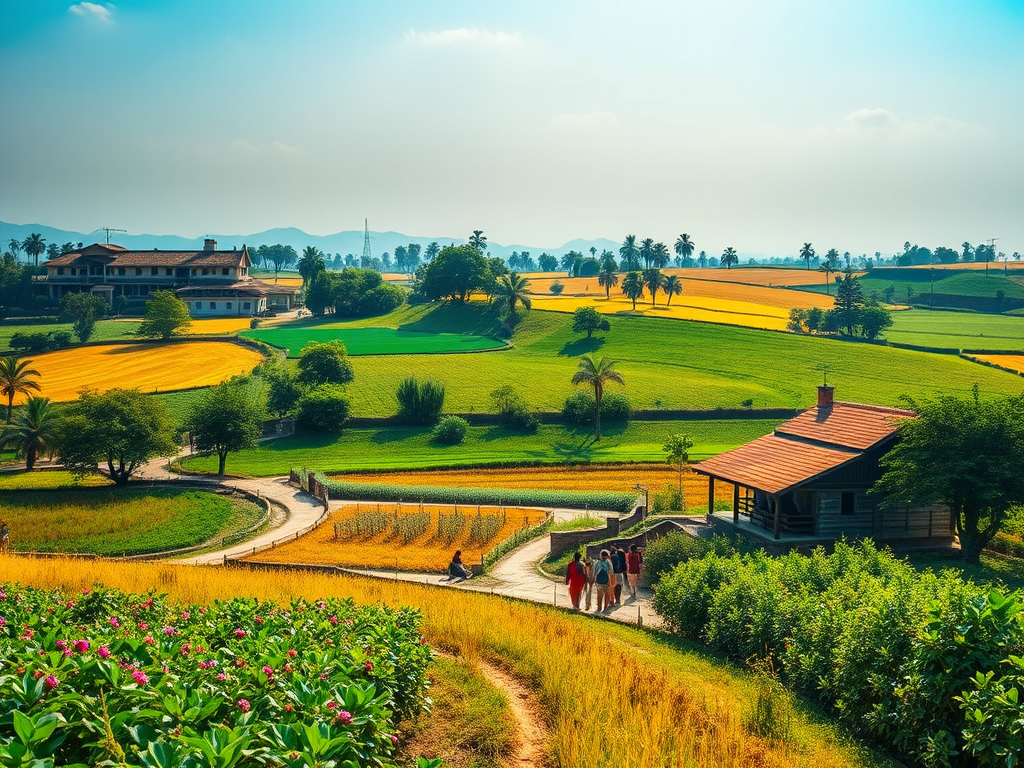
Agro-tourism (or agritourism) involves visiting working farms or rural agricultural settings. It offers tourism, recreation, and education. Visitors sometimes directly participate in agricultural activities.
In India, with its vast rural population, there is rich agro-diversity and increasing domestic tourism. Agro-tourism offers a promising intersection of agriculture, tourism, and rural development.

Why India is well-positioned for agro-tourism
Several factors point to India’s suitability:
- A large portion of the population lives in rural areas (over 70% in many estimates) and there are millions of villages.
- India’s agriculture sector is broad and diverse (crops, orchards, plantations, spices, etc.) which provides a rich base for tourism experiences.
- Growing interest among domestic tourists for “authentic”, “rural”, “immersive” experiences beyond conventional sightseeing. (agriindiatoday.in)
- Existing state‐level initiatives: for example, in Maharashtra the Agri‑Tourism Development Corporation (ATDC) was set up to promote agritourism. (Drishti IAS)
- The potential to diversify farmer income is significant. Agriculture alone faces risks such as climate change and market volatility. Agro-tourism offers a complementary income stream.
Current status & trends in India
Here are some key observations:
Demand & supply
- A recent scoping review (“Rise of Agritourism in India: A Scoping Review”) notes that agritourism is still in early stages. In India, it is just beginning. However, it is growing.
- Empirical work finds that farmers’ awareness, availability of infrastructure, marketing, and technological support are still moderate/weak in many regions.
State‐level examples
- In Maharashtra: ATDC has registered many agri-tourism centres (e.g., farm stays, vineyard tours, mango orchards) across districts.
- In Karnataka (Coorg) and Kerala – plantation stays (coffee, spices) are being used as agri-tourism products.
Growth potential
- One review estimates the global agritourism market will reach US $ 62.98 billion by 2027 (from ~US $ 42.46 billion in 2019) – pointing to growth space.
- The tourism sector and rural tourism specifically are seen as important for inclusive development, so governments are increasingly supportive.
Advancements and innovation
Beyond just “farm stay + tour”, here are advancements:
- Technology & digital platforms are enabling booking, marketing, virtual tours, and farm-experience management.
- Data-driven approaches: Recent research (“Identifying Key Features for Establishing Sustainable Agro-Tourism Centre”) utilizes machine learning. It identifies features such as location, infrastructure, culture, and connectivity for successful agritourism.
- Integration with local culture, eco-practices, and sustainability: Agritourism is being positioned not just as recreation. It is also seen as rural development, conservation, and knowledge exchange.
- In Maharashtra, for example, training of farmers under “Agri-Tourism Vistar Yojana” included environment conservation, hygiene, handicrafts, farm-produce sales, etc.
Key benefits
The benefits of agro-tourism include:
- For farmers/rural communities: Additional income source, use of existing land/farm resources, diversification of livelihood, empowerment of local community.
- For tourism sector: Adds new tourism products (rural stays, farm visits, experiential tourism) beyond standard heritage/nature tourism.
- For rural development: Encourages rural infrastructure (roads, hospitality, sanitation), keeps youth engaged locally, preserves rural culture/traditions.
- For sustainability & education: Visitors get to learn about agriculture, rural life, ecosystem, which promotes awareness; farms can adopt sustainable practices and use tourism as a channel.
Challenges & constraints
However, several hurdles remain:
- Infrastructure & connectivity: Many rural areas lack good roads, reliable power, sanitation, accommodations at the level tourists expect.
- Awareness & marketing: Not all farmers or rural communities are aware of agritourism potential or how to brand/market their farm-stay experiences.
- Funding & investment: Setting up agritourism operations (accommodation, hospitality services, visitor management) requires capital, which many farmers may lack.
- Regulatory/permission issues: Land use norms, safety regulations, local regulations may be a barrier.
- Sustainability risk: If tourism overwhelms rural resources or disrupts local community, then social/environmental tensions may rise.
- Seasonality & demand variability: Tourism may fluctuate seasonally; aligning farm production cycles with tourist patterns may be tricky.
These challenges have been flagged in multiple reviews.
Strategic direction for advancement
To accelerate agritourism in India, following strategic actions are recommended:
- Capacity building & training – Train farmers and rural entrepreneurs in hospitality‐management, visitor engagement, marketing, hygiene, safety.
- Infrastructure & connectivity improvement – Improve rural roads, basic utilities, internet connectivity, signage, access to nearby tourist markets.
- Digital platforms & marketing – Use online booking platforms, social media, farm-experience packages to reach urban/domestic tourists.
- Government support & incentives – Subsidies/loans for agritourism ventures, regulatory simplification, mapping of agritourism zones, certification.
- Diversified offerings – Farm stays + activities (harvesting, seed sowing, cooking with farm produce, handicrafts) + cultural immersion. The more diverse, the more engaging for tourists.
- Sustainability & community integration – Ensure local community benefits, preserve local culture, avoid overt commercialization, involve women and youth.
- Linkages with agriculture and tourism value chains – Sell farm produce direct to visitors, tie‐in with local tourism circuits, collaborate with tour operators.
- Data & monitoring – Collect data on visitor numbers, feedback, economic impact to continually refine offerings – as seen in data-driven studies.
Outlook & conclusion
In conclusion: India holds strong potential to become a hub of agro-tourism, especially as tourists increasingly look for unique, rural, experiential stays, and as rural economies seek diversification. While still emerging, the sector is advancing via state initiatives, research, digital tools and improved awareness.
With the right institutional support, infrastructure investment, and farmer-community engagement, agritourism can become a meaningful driver of rural employment, tourism income and cultural-agricultural exchange. The recent studies show both the opportunities and the structural gaps that need addressing.

 KrishiCenter
Leave a reply to National Beekeeping and Honey Mission: A Sweet Revolution (NIBH) – KrishiCenter Cancel reply