
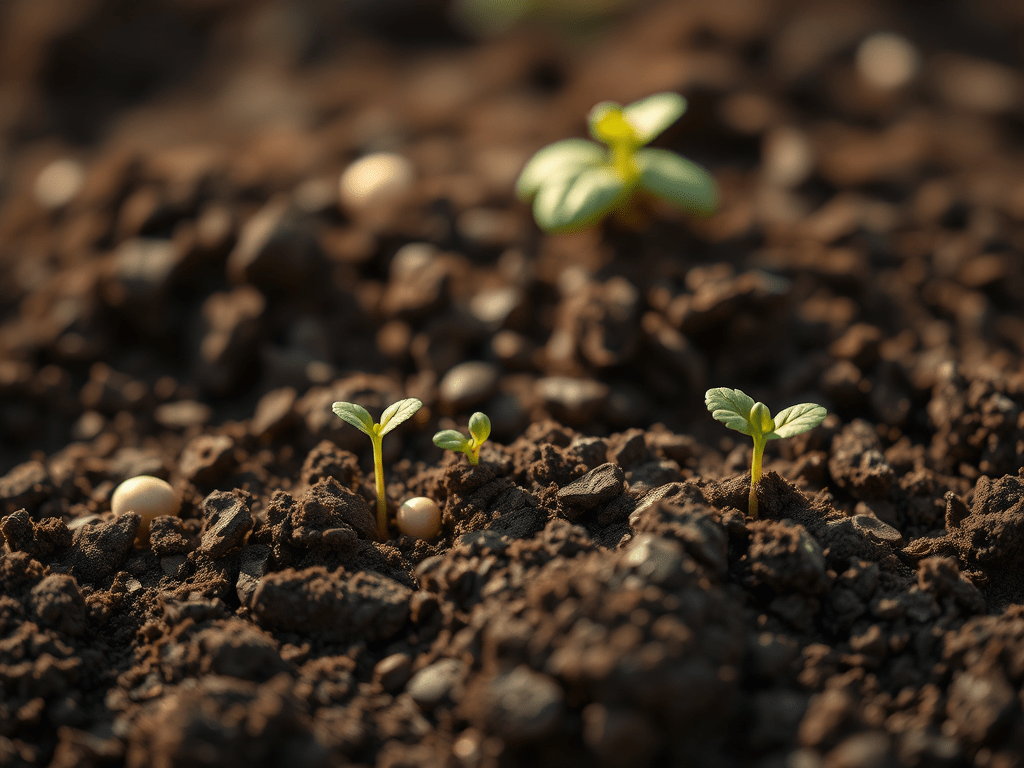
🌍 Understanding Soil – Farming Guide
Soil is the foundation of all agriculture. It determines water availability, nutrient supply, microbial activity, and ultimately the yield and quality of crops. Understanding soil helps farmers choose the right crop, optimize fertilizers, and improve long-term soil health.
🧱 1. What Is Soil?
Soil is a natural mixture of minerals, organic matter, water, air, and microorganisms. It forms through the weathering of rocks over thousands of years and varies widely across regions.
Major Components of Soil
| Component | % Composition | Role |
|---|---|---|
| Mineral particles (sand, silt, clay) | 45% | Structure, water holding, nutrients |
| Organic matter | 5% | Fertility, moisture retention, microbial activity |
| Water | 25% | Dissolves nutrients and supports plant metabolism |
| Air | 25% | Root respiration |
🧱 2. Soil Texture & Structure
Soil Texture
Based on particle size:
- Sand: Large particles → drains quickly, low nutrients
- Silt: Medium particles → good fertility
- Clay: Small particles → high water & nutrient holding, poor aeration
Loam Soil
A balanced mixture of sand, silt, and clay.
Ideal for most crops.
🏞️ 3. Types of Soil (Globally & Agriculturally Important)
A. Sandy Soil
- Large particles, low water retention
- Warms quickly
- Low nutrients
Best for:
Groundnut, watermelon, coconut, carrots, potatoes, millets.
B. Clayey Soil
- Very small particles
- Sticky, poor aeration
- High nutrient retention
Best for:
Rice, wheat, sugarcane, jute, cotton.
C. Silt Soil
- Fertile and smooth
- Good water capacity
Best for:
Vegetables, fruits, tobacco, pulses.
D. Loamy Soil
- Balanced texture (ideal structure)
- Excellent water retention and drainage
Best for:
Cereals, pulses, oilseeds, vegetables, floriculture, horticulture.
E. Peaty Soil
- High organic matter
- Acidic
- High moisture
Best for:
Vegetables, rice, and crops needing wet conditions.
F. Chalky/Calcareous Soil
- High calcium
- Alkaline
- Low nutrient availability
Best for:
Barley, beets, cabbage, spinach (after amendments).
G. Saline & Alkaline Soil
- Excess salts or high pH
- Poor growth unless reclaimed
Best for:
Salt-tolerant crops like barley, sugar beet, cotton (with treatment).
H. Black Soil (Regur)
- Clayey, rich in iron & magnesium
- High swelling-shrinking nature
Best for:
Cotton, soybean, sorghum, maize, groundnut.
I. Red Soil
- Sandy to clayey
- Rich in iron but poor in nutrients
Best for (with fertilizers):
Millets, pulses, groundnut, potato, tobacco.
J. Laterite Soil
- Reddish, acidic, low fertility
- Requires organic matter additions
Best for:
Cashew, tea, coffee, rubber.
K. Alluvial Soil
- Rich, fertile, well-drained
- Found near rivers
Best for:
Rice, wheat, sugarcane, vegetables, fruits.
🧪 4. Soil Nutrients & Their Role in Crop Growth
Primary Nutrients
| Nutrient | Role | Deficiency Symptoms |
|---|---|---|
| Nitrogen (N) | Leaf & stem growth | Yellowing of leaves |
| Phosphorus (P) | Root development, flowering | Poor root growth |
| Potassium (K) | Disease resistance, grain filling | Tip burn, weak plants |
Secondary Nutrients
| Nutrient | Role | Deficiency |
|---|---|---|
| Calcium | Cell walls, root health | Leaves curl |
| Magnesium | Chlorophyll production | Yellowing between veins |
| Sulfur | Protein synthesis | Light-green young leaves |
Micronutrients
| Nutrient | Role | Deficiency |
|---|---|---|
| Zinc | Growth hormone regulation | Stunted growth |
| Iron | Enzyme function | Yellowing in young leaves |
| Boron | Flower & fruit formation | Cracked stems & fruits |
| Copper | Photosynthesis | Wilting |
| Manganese | Metabolism | Interveinal yellowing |
| Molybdenum | Nitrogen fixation | Yellow, twisted leaves |
🌱 5. Soil pH and Its Importance
pH determines nutrient availability.
| Soil pH | Category | Suitability |
|---|---|---|
| < 5.5 | Acidic | Tea, potato, pineapple |
| 5.5–7.5 | Neutral | Most crops |
| > 7.5 | Alkaline | Cotton, barley (limited) |
🍃 6. Soil Organic Matter (SOM)
Improves:
- Water retention
- Nutrient availability
- Soil structure
- Microbial life
Sources: - Farmyard manure
- Compost
- Cover crops
- Green manuring
🚜 7. Crop Suitability Matrix (Soil vs Crops)
| Soil Type | Ideal Crops |
|---|---|
| Sandy | Groundnut, potato, carrot, watermelon |
| Clayey | Rice, sugarcane, wheat |
| Loamy | Vegetables, cereals, pulses |
| Alluvial | Rice, wheat, fruits |
| Red Soil | Millets, pulses, tobacco |
| Black Soil | Cotton, soybean, sorghum |
| Laterite | Tea, coffee, cashew |
| Peaty | Rice, leafy vegetables |
| Chalky | Barley, beet |
🌍 8. Region-Specific Soils (India, US, Europe, Africa)
🇮🇳 India
| Region | Soil Type | Notes |
|---|---|---|
| Indo-Gangetic Plains | Alluvial | Highly fertile |
| Deccan Plateau | Black Soil | Cotton belt |
| Eastern India | Laterite/Red | Needs fertilization |
| Western India | Desert/Sandy | Drip irrigation important |
| Coastal Regions | Saline/Alluvial | Salt-tolerant crops |
🇺🇸 United States
| Region | Soil Type | Notes |
|---|---|---|
| Midwest (Corn Belt) | Mollisols | World’s most fertile soils |
| Southeast | Ultisols | Acidic; needs lime |
| Great Plains | Aridisols | Dry; suited for wheat |
| Northeast | Alfisols | Forest-derived, fertile with amendments |
| California | Diverse (Entisols, Inceptisols) | High-value crops |
🇪🇺 Europe
| Region | Soil Type | Notes |
|---|---|---|
| Central Europe | Chernozem | Rich in humus; cereals |
| Mediterranean | Calcareous/Clay | Olives, grapes |
| Northern Europe | Podzols | Acidic; suited for forestry, potatoes |
| Eastern Europe | Black Earth | Major wheat-growing region |
🌍 Africa
| Region | Soil Type | Notes |
|---|---|---|
| Nile Valley | Alluvial | Very productive |
| East Africa Highlands | Volcanic (Andisols) | Coffee, tea |
| West Africa | Lateritic | Cashew, cocoa |
| Sahara Belt | Arid, sandy | Drip irrigation needed |
🌿 9. How to Improve Soil Health
Physical improvements
- Tillage reduction
- Adding organic matter
- Mulching
Chemical improvements
- Liming (to reduce acidity)
- Gypsum (to reclaim sodic soils)
Biological improvements
- Cover crops
- Microbial inoculants
- Avoid chemical overuse
Fertigation
Fertigation’ is the technique of supplying dissolved fertiliser to crops through an irrigation system. When combined with an efficient irrigation system both nutrients and water can be manipulated and managed to obtain the maximum possible yield of marketable production from a given quantity of these inputs
Below is the Fertigation Chart (easy to follow, farmer-friendly and technically accurate) followed by a well-written conclusion to complete your soil guide.
💧 Fertigation Chart for General Field Crops
(This chart assumes use of drip irrigation. Adjust quantities based on soil tests and crop specifics.)
1. Fertigation Frequency
- Vegetables: 2–3 fertigations/week
- Field crops (cotton, maize, soy, cereals): 1–2 fertigations/week
- Fruit crops: Weekly, increasing during flowering & fruiting
📘 Standard Fertigation Chart (Example for 1000 m² or 0.1 ha)
(Multiply ×10 for 1 hectare)
A. Basal (Before planting / transplanting)
| Stage | Fertigation Material | Quantity | Purpose |
|---|---|---|---|
| Basal preparation | FYM/Compost | 500–800 kg | Improves organic matter |
| SSP (16% P₂O₅) | 20–25 kg | Root establishment | |
| Gypsum/Lime (if needed) | As per soil test | pH correction |
B. Early Growth Stage (1–3 weeks after sowing)
| Week | Fertilizer | Dose/1000 m² | Notes |
|---|---|---|---|
| Week 1 | Urea | 1.5–2 kg | Boosts initial vegetative growth |
| Week 2 | MAP (12:61:0) | 1–1.5 kg | Enhances rooting |
| Week 3 | Potassium Nitrate (13:0:45) | 1–1.5 kg | Improves vigor; stress tolerance |
C. Vegetative Stage (3–6 weeks)
| Fertilizer | Dose/1000 m² | Purpose |
|---|---|---|
| Urea | 2–3 kg/week | Leaf & stemelongation |
| 19:19:19 (NPK) | 1–2 kg/week | Balanced nutrition |
| Calcium Nitrate | 1 kg/week | Strengthens cell walls |
D. Pre-Flowering Stage
| Fertilizer | Dose/1000 m² | Why? |
|---|---|---|
| 12:32:16 | 2 kg/week | Pushes flowering |
| Magnesium Sulfate | 0.5–1 kg/week | Prevents yellowing |
| Micronutrient mix | 200–250 g/week | Enhances bud formation |
E. Flowering Stage
| Fertilizer | Dose/1000 m² | Purpose |
|---|---|---|
| 13:0:45 (KNO₃) | 1.5–2 kg/week | Necessary for flowering & seed set |
| 00:52:34 (MKP) | 1–1.5 kg/week | Encourages flower retention |
| Boron (Soluble) | 20–40 g/week | Essential for pollen growth |
F. Fruiting / Grain Filling Stage
| Fertilizer | Dose/1000 m² | Purpose |
|---|---|---|
| Sulfate of Potash (0:0:50) | 1.5–2.5 kg/week | Increases size, quality & oil content |
| Calcium Nitrate | 1–1.5 kg/week | Prevents cracking & strengthens fruits |
G. Maturity Stage (Last 2–3 weeks)
| Fertilizer | Dose | Purpose |
|---|---|---|
| Water only / minimum fertigation | — | Helps proper grain hardening & reduces lodging |
⭐ Micronutrient Fertigation Guide
(Generalized across major crops)
| Micronutrient | Fertigation Dose/1000 m² | Benefits |
|---|---|---|
| Zinc (Zn) | 50–100 g/month | Prevents stunting |
| Iron (Fe) | 100–150 g/month | Green, strong foliage |
| Boron (B) | 20–40 g/month | Flower & fruit success |
| Manganese (Mn) | 50–80 g/month | Photosynthesis efficiency |
| Molybdenum (Mo) | 5–10 g/month | Nitrogen fixation |
🧪 Rules for Safe Fertigation
- Always use fully soluble fertilizers.
- Maintain pH between 5.5–6.5 in fertigation tank.
- Avoid mixing calcium fertilizers with sulfates or phosphates in the same tank.
- Filter water to prevent clogging.
- Start with water, then feed fertilizer, end with clear water.
🧾 Conclusion
Understanding soil—its texture, nutrients, pH, organic matter, and regional characteristics—is the cornerstone of successful farming. Soil determines not just what can be grown, but also how crops should be fertilized, irrigated, and managed. By choosing the right crops for the right soil, applying nutrients through efficient methods like fertigation, and maintaining soil health through organic matter and proper pH management, farmers can significantly increase yields, improve crop quality, and ensure long-term sustainability.
Healthy soil isn’t just a resource—it is an investment. When farmers nurture soil, the soil returns the favor with better harvests, resilient crops, and a more profitable farm over time.
 KrishiCenter