
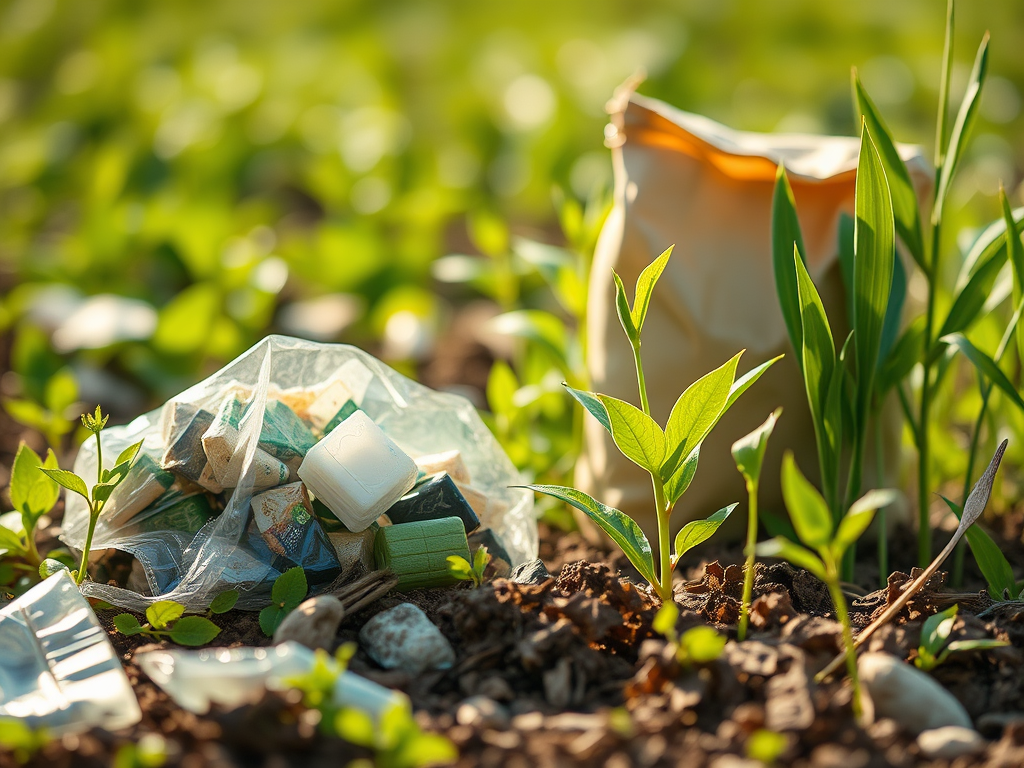
Increasing Role of Agriculture in Reducing the Carbon Footprint
Overview
The global dependence on petroleum-based plastics poses severe environmental and climatic challenges. This is primarily due to their persistence, fossil fuel origin, and contribution to greenhouse gas emissions. The emergence of bio-based and biodegradable alternatives offers a promising transition toward sustainable material production. Simultaneously, the agricultural sector—traditionally viewed as a major emitter of greenhouse gases—holds the potential to become a critical player in carbon sequestration and the development of bio-based materials. This paper examines emerging alternatives to conventional plastics, explores agricultural innovations that support carbon mitigation, and discusses the synergistic relationship between bio-based material development and regenerative farming practices.
1. Introduction
Since the mid-20th century, plastics have revolutionized manufacturing, packaging, and transportation sectors due to their durability, versatility, and low cost. However, these same characteristics have created significant ecological problems. Over 400 million tonnes of plastic waste are produced annually, with approximately 79% accumulating in landfills or the natural environment (UNEP, 2022). The decomposition of plastics can take up to 500 years, resulting in pervasive microplastic pollution that threatens marine and terrestrial ecosystems (Geyer et al., 2017).
Moreover, plastic production is heavily dependent on fossil fuels, accounting for nearly 6% of global oil consumption and an estimated 1.8 billion tonnes of CO₂-equivalent emissions per year (Zheng & Suh, 2019). Consequently, there is a pressing need to develop renewable, biodegradable, and low-carbon alternatives. Agricultural systems, through sustainable management and innovation, offer a dual opportunity: they can both provide renewable feedstocks for bioplastic production and serve as carbon sinks through regenerative practices.
2. Limitations of Conventional Plastics
Conventional plastics such as polyethylene (PE), polypropylene (PP), and polyethylene terephthalate (PET) are derived from petrochemicals. Their environmental impact arises primarily from:
- High carbon intensity of production: Polymerization of hydrocarbons requires significant energy, leading to high CO₂ emissions.
- Persistence in the environment: Traditional plastics are resistant to microbial degradation.
- Toxicity of degradation products: Additives such as phthalates and bisphenol A (BPA) can leach into ecosystems, affecting biodiversity and human health (Rochman et al., 2019).
Efforts to recycle plastics have yielded limited results; globally, less than 10% of all plastic ever produced has been recycled (Geyer et al., 2017). This underscores the need for systemic innovation rather than incremental improvement.
3. Emerging Alternatives to Conventional Plastics
3.1 Bioplastics
Bioplastics refer to polymers derived partly or wholly from renewable biological sources such as starch, cellulose, or vegetable oils. They are broadly categorized into bio-based non-biodegradable plastics (e.g., bio-PET, bio-PE) and bio-based biodegradable plastics (e.g., polylactic acid [PLA], polyhydroxyalkanoates [PHAs]).
- PLA (Polylactic Acid): Synthesized from fermented plant starch, PLA exhibits good mechanical strength and biodegradability under industrial composting conditions. It has found applications in packaging, textiles, and biomedical devices (Niaounakis, 2015).
- PHAs (Polyhydroxyalkanoates): Produced by bacterial fermentation of sugars or lipids, PHAs are fully biodegradable in marine and soil environments, representing one of the most sustainable polymer families (Sudesh et al., 2011).
- Bio-PET and Bio-PE: These polymers mirror the chemical structure of their fossil-based counterparts, allowing integration into existing recycling systems while reducing reliance on petroleum.
However, the scalability of bioplastics remains constrained by high production costs, limited industrial composting facilities, and concerns regarding competition with food crops for feedstock.
3.2 Natural Fiber Composites
Natural fibers such as hemp, flax, jute, and sisal are being used as reinforcing agents in polymer composites. These fibers are lightweight, renewable, and biodegradable. Studies have shown that natural fiber composites can reduce life-cycle CO₂ emissions by up to 50% compared to glass fiber composites (Joshi et al., 2004). Such materials are increasingly adopted in automotive and construction sectors.
3.3 Mycelium-Based Materials
Mycelium, the vegetative root network of fungi, can be cultivated on agricultural residues to form lightweight, durable, and fully compostable materials. Research indicates that mycelium-based packaging possesses mechanical strength comparable to polystyrene, while being entirely biodegradable within weeks (Jones et al., 2017).
3.4 Algae and Seaweed-Derived Plastics
Marine biomass such as seaweed and microalgae represents a sustainable raw material for biopolymer synthesis. These organisms absorb CO₂ during growth, require no arable land or freshwater, and can yield polysaccharide-based films suitable for packaging (Fernand et al., 2019). Moreover, seaweed farming contributes to carbon sequestration and marine ecosystem restoration.
4. Agriculture’s Role in Reducing Carbon Footprint
4.1 Carbon Farming and Soil Sequestration
Agriculture has the capacity to act as a carbon sink through management practices that enhance soil organic carbon (SOC). Carbon farming techniques—such as conservation tillage, cover cropping, crop rotation, and organic compost application—facilitate the long-term storage of atmospheric CO₂ in soils (Lal, 2020). Increasing global SOC by even 0.4% per year could offset a significant portion of anthropogenic CO₂ emissions (“4 per 1000 Initiative”, FAO, 2019).
4.2 Biochar Application
Biochar, a form of charcoal produced from agricultural residues via pyrolysis, offers a dual benefit of carbon sequestration and soil fertility improvement. It is estimated that large-scale biochar application could sequester up to 2.2 gigatonnes of CO₂-equivalent annually (Lehmann et al., 2015).
4.3 Utilization of Agricultural Waste for Bioplastics
Crop residues—such as rice husks, sugarcane bagasse, wheat straw, and corn stover—can be converted into bio-based polymers and packaging materials. For instance, bagasse-based packaging has become a viable alternative to expanded polystyrene, reducing both landfill waste and carbon emissions associated with synthetic materials (Singh et al., 2021).
4.4 Regenerative Agriculture
Regenerative agricultural practices focus on enhancing biodiversity, restoring degraded soils, and increasing ecosystem resilience. By promoting natural carbon cycles and reducing synthetic input dependence, regenerative systems contribute to a net-negative carbon balance (Gosnell et al., 2019).
5. Synergistic Potential: Agriculture and Circular Bioeconomy
The integration of agricultural carbon sequestration with bio-based material production represents a cornerstone of the circular bioeconomy. Agricultural by-products can serve as feedstocks for bioplastics, while regenerative farming offsets the carbon emitted during material processing. This closed-loop system reduces reliance on fossil resources and enhances rural economic development. The transition, however, requires supportive policy frameworks, technological innovation, and market incentives to ensure scalability and affordability.
6. Conclusion
The transition away from fossil-based plastics is both an environmental imperative and an economic opportunity. Bio-based alternatives—ranging from PLA and PHAs to natural fiber composites—demonstrate significant potential to replace conventional plastics. Concurrently, agriculture, when managed regeneratively, can shift from being a net emitter to a carbon sink. By aligning material innovation with sustainable farming practices, societies can move toward a low-carbon, circular economy where waste is minimized and carbon is actively drawn down from the atmosphere.
Achieving this vision demands cross-sector collaboration among scientists, policymakers, and agricultural stakeholders. The convergence of agricultural innovation and material science stands as a crucial frontier in addressing both the plastic crisis and the broader challenge of climate change.
References
- FAO (2019). The 4 per 1000 Initiative: Soils for Food Security and Climate.
- Fernand, F., et al. (2019). “Seaweed-Based Polymers for Sustainable Packaging.” Marine Biotechnology, 21(2), 87–102.
- Geyer, R., Jambeck, J. R., & Law, K. L. (2017). “Production, use, and fate of all plastics ever made.” Science Advances, 3(7), e1700782.
- Gosnell, H., Gill, N., & Voyer, M. (2019). “Transformational adaptation and regenerative agriculture: converging pathways to sustainability.” Global Environmental Change, 58, 101-231.
- Jones, M., et al. (2017). “Mycelium composites: A review of engineering characteristics and growth kinetics.” Journal of Bionanoscience, 11(1), 65–79.
- Joshi, S. V., et al. (2004). “Are natural fiber composites environmentally superior to glass fiber reinforced composites?” Composites Part A, 35(3), 371–376.
- Lal, R. (2020). “Carbon sequestration by agricultural soils.” Agronomy Journal, 112(5), 3265–3274.
- Lehmann, J., et al. (2015). Biochar for Environmental Management: Science, Technology and Implementation. Routledge.
- Niaounakis, M. (2015). Biopolymers: Applications and Trends. Elsevier.
- Rochman, C. M., et al. (2019). “Plastic pollution and human health.” Science, 364(6437), 977–980.
- Singh, R., et al. (2021). “Sustainable packaging from agricultural waste: A case study on bagasse-based materials.” Journal of Cleaner Production, 278, 123876.
- Sudesh, K., et al. (2011). “Synthesis and degradation of polyhydroxyalkanoates (PHAs): Progress and challenges.” Journal of Biotechnology, 155(1), 1–12.
- UNEP (2022). From Pollution to Solution: A Global Assessment of Marine Litter and Plastic Pollution.
- Zheng, J., & Suh, S. (2019). “Strategies to reduce the global carbon footprint of plastics.” Nature Climate Change, 9(5), 374–378.


Leave a Reply