
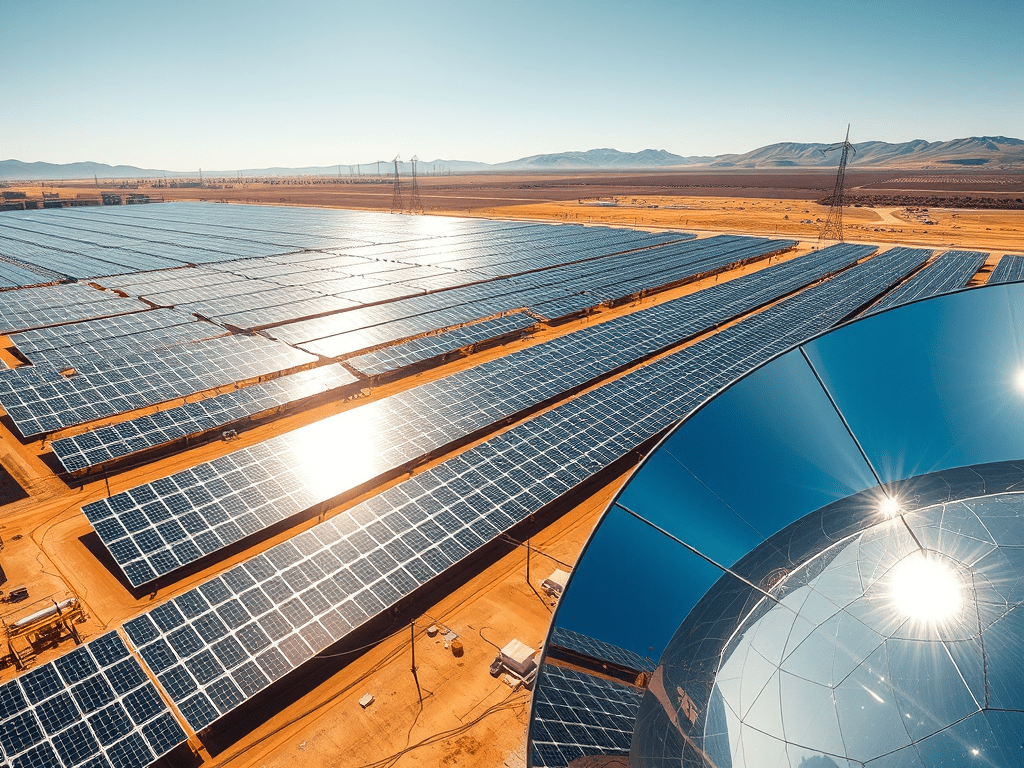
Solar Plants and Their Working: An In-depth Overview
Introduction to Solar Energy
Solar energy is one of the most abundant and renewable sources of energy available on Earth. Solar plants, also known as solar power plants or photovoltaic (PV) plants, convert sunlight into electricity through photovoltaic cells or thermal collectors. This process is clean, sustainable, and helps reduce dependency on fossil fuels, contributing to a reduction in carbon emissions and the mitigation of climate change.
Types of Solar Plants
Solar plants can be broadly categorized into two types based on the technology they use to harness solar energy:
- Photovoltaic (PV) Solar Power Plants:
- These are the most common type of solar plants.
- They utilize solar panels (composed of photovoltaic cells) to convert sunlight directly into electricity.
- PV solar plants are typically used for both residential and large-scale power generation applications.
- Concentrated Solar Power (CSP) Plants:
- CSP plants use mirrors or lenses to focus sunlight onto a small area, which generates heat. This heat is then used to produce electricity via a steam turbine or other heat engines.
- CSP plants are usually used for large-scale power generation due to their high efficiency and ability to store thermal energy.
How Solar Plants Work
The working mechanism of solar plants varies slightly depending on the type (PV or CSP), but the fundamental principle of converting sunlight into electricity remains the same.
Photovoltaic (PV) Solar Power Plants:
- Solar Panels:
- Solar panels are made of semiconductor materials (such as silicon). When sunlight hits the solar cells in the panels, it excites electrons in the material, generating an electric current (direct current or DC).
- Inverters:
- The electricity generated by solar panels is in DC form, but most electrical appliances and the grid use alternating current (AC).
- Inverters are used to convert DC into AC electricity, which can then be used to power homes, industries, or fed into the electrical grid.
- Grid Connection (For Utility-Scale Solar Plants):
- Large-scale solar plants are often connected to the national or regional power grid.
- The solar electricity generated can be used locally or transmitted across long distances.
- Monitoring Systems:
- Solar power plants are equipped with monitoring systems to track performance, ensure efficient operation, and troubleshoot any potential issues. These systems help operators monitor the amount of electricity generated and detect maintenance needs.
Concentrated Solar Power (CSP) Plants:
- Solar Collectors:
- CSP plants use mirrors or lenses to focus sunlight onto a receiver. The sunlight heats up a fluid, often oil or molten salt, which absorbs the thermal energy.
- Thermal Energy Storage:
- The heated fluid is stored in tanks and can be used to generate electricity even when the sun is not shining. This allows CSP plants to generate power continuously, even during the night or cloudy days.
- Power Conversion:
- The thermal energy stored in the fluid is transferred to a steam generator, which produces steam that drives a turbine connected to a generator, producing electricity.
- Grid Connection:
- Like PV plants, CSP plants are usually connected to the power grid to distribute the electricity generated to consumers.
| Cost Component | Photovoltaic (PV) Solar Power Plants (Utility-Scale) | Rooftop Solar Systems |
|---|---|---|
| Initial Investment | – ₹40,000 – ₹45,000 per kW for large-scale plants (based on location and scale). | – ₹40,000 – ₹60,000 per kW (varies based on panel quality, inverter, and installation complexity). |
| Operation & Maintenance (O&M) | – ₹5,000 – ₹10,000 per MW/year (Annual maintenance, cleaning, and monitoring). | – ₹1,500 – ₹3,000 per kW/year (Annual service and monitoring). |
| Solar Panel Life Expectancy | – 25+ years (with warranties of 10-15 years for efficiency). | – 25 years or more (Warranties on panels/inverters up to 25 years). |
| Energy Output | – Typically 1,500 – 2,000 MWh per MW/year (depends on solar radiation, location). | – 3-5 kWh/day per kW (varies based on location and panel efficiency). |
| Payback Period | – 5-7 years (depends on scale and region). | – 4-6 years (shorter due to smaller system size). |
| Government Incentives/Subsidies | – Up to 30% subsidy for rooftop systems under schemes like Solar Rooftop Subsidy Scheme. | – 30% subsidy for residential installations (Central Government Subsidy). |
| Financing Options | – Power Purchase Agreements (PPA), government loans, or private investors for large plants. | – Loans and EMI options available through banks for residential installations. |
| Land Acquisition Costs | – Requires large land areas (typically 2-3 acres per MW). | – No land required (uses existing roofs). |
| Grid Connection Costs | – ₹1-2 crore per MW for transmission infrastructure. | – Low cost for grid connection, mostly related to inverter and net-metering fees. |
Advantages of Solar Power Plants
- Renewable and Sustainable: Solar energy is inexhaustible as long as the sun exists.
- Environmentally Friendly: Solar power generation does not emit harmful greenhouse gases, contributing to reduced air pollution and combating climate change.
- Low Operating Costs: After installation, solar power plants require relatively low maintenance and operational costs.
- Energy Independence: Solar energy reduces dependency on imported fossil fuels and provides a stable source of energy.
- Scalable: Solar plants can be scaled to different sizes, from small rooftop installations to large utility-scale plants.
Challenges in Solar Power Generation
- Intermittency: Solar energy is only available when the sun is shining, making it a variable source of energy.
- High Initial Cost: The cost of solar panels and related infrastructure can be significant, although prices have been steadily decreasing.
- Energy Storage: Effective and cost-efficient storage solutions (such as batteries) are still in development to help balance supply and demand during cloudy periods or nighttime.
| Benefit | Photovoltaic (PV) Solar Power Plants (Utility-Scale) | Rooftop Solar Systems |
|---|---|---|
| Environmentally Friendly | – Zero emissions during power generation. | – Zero emissions, reduces electricity grid reliance. |
| Energy Security | – Reduces reliance on fossil fuels and imports. | – Provides self-sufficiency in energy, reducing electricity bills. |
| Operational Cost Savings | – After initial investment, operational costs are low. | – Significant savings on electricity bills after installation. |
| Scalability | – Can be scaled up for large-scale power generation. | – Easily scalable (expandable in phases). |
| Job Creation | – Creates employment in construction, installation, and maintenance. | – Generates jobs in installation and maintenance. |
| Grid Flexibility | – Can be grid-connected, providing power to local grids. | – Net-metering allows surplus energy to be exported back to the grid. |
| Long-Term Benefits | – Long lifespan of 25+ years ensures long-term returns. | – Long lifespan, reducing long-term energy costs. |
| Government Support | – Various subsidies and incentives such as the National Solar Mission. | – Government subsidies for installation under the Solar Rooftop Scheme. |
| Energy Storage | – Energy storage options available to ensure consistent power supply. | – Battery storage can be added for backup power, especially for critical loads. |
Solar Energy Schemes in India
India has made remarkable progress in the solar energy sector, driven by the need for energy security and reducing carbon emissions. The government has launched several schemes to promote solar power, both for individual consumers and for large-scale power generation.
1. National Solar Mission (NSM):
Launched in 2010, the National Solar Mission (NSM) is part of India’s National Action Plan on Climate Change (NAPCC). The mission aims to promote the development and use of solar energy across the country.
- Target Capacity: The NSM initially set a target of 20 GW of solar power capacity by 2022, which has since been revised to 100 GW by 2022 under the Pradhan Mantri Kusum Yojana (PM-KUSUM).
- The mission promotes both grid-connected and off-grid solar projects.
2. Pradhan Mantri Kisan Urja Suraksha Evam Utthaan Mahabhiyan (PM-KUSUM):
Launched in 2019, this scheme aims to provide solar energy solutions for farmers and rural areas.
- Objectives:
- Installation of solar pumps to replace diesel pumps.
- Setting up solar power plants in rural areas to provide electricity to the grid.
- Development of off-grid solar systems to ensure energy access to remote areas.
- Target: Installation of 30.8 GW of solar capacity under this scheme, which includes solarizing agricultural pumps, rural electrification, and community power plants.
| Component | Description | Target/Objective | Subsidy/Financing | Key Benefits |
|---|---|---|---|---|
| Component A: Solarization of Agricultural Pumps | Installation of solar-powered pumps for irrigation in agriculture. | – 10 lakh solar pumps to be installed for farmers. | – 30% subsidy from the central government. | – Reduction in fuel/energy costs for farmers. |
| – Reduction in dependency on grid and diesel pumps. | – 30% subsidy from state governments. | – Sustainable and eco-friendly power for irrigation. | ||
| Component B: Solar Power Generation by Farmers | Setting up solar power plants on farmland to generate electricity. | – 17.5 GW of solar power capacity to be generated by farmers. | – Financial assistance for setting up solar plants. | – Additional income from selling surplus solar power to the grid. |
| – Farmers can earn by selling power to the grid under PPA. | – Loan facilities available through financial institutions. | – Energy security for rural and agricultural areas. | ||
| Component C: Solarization of Rural Feeder and Distribution Infrastructure | Solarization of rural feeders and distribution systems. | – Complete solarization of rural feeders to ensure power access. | – Support from DISCOMs and government schemes. | – Improved electricity access to rural areas. |
| – Power for agricultural and other rural needs. | – Cost-effective grid connection and energy distribution. | – Reduction in transmission losses and power cuts. |
3. Solar Rooftop Scheme:
The Solar Rooftop Scheme is aimed at promoting the installation of rooftop solar systems in residential, commercial, and industrial sectors.
- Financial Incentives: The government offers subsidies for residential rooftop solar installations. The subsidy can cover a significant portion of the installation cost, with the central government covering 30% of the cost for residential consumers.
- Target: Installation of 40 GW of rooftop solar power by 2022.
4. Solar Park Scheme:
The Solar Park Scheme focuses on developing large-scale solar parks across India to attract investments and ease the process of setting up solar plants.
- Target: To set up 50 solar parks with a total capacity of 40 GW across the country.
- Benefits: By concentrating multiple solar plants in a single area, solar parks provide economies of scale, reduce land acquisition challenges, and lower project costs.
5. Atal Mission for Rejuvenation and Urban Transformation (AMRUT):
AMRUT includes a focus on solar energy for urban areas. The program facilitates solar rooftops and promotes the installation of solar street lights, smart grids, and other sustainable urban energy solutions.
6. State-Level Solar Policies:
Various states in India have launched their own state-level solar policies to promote solar energy.
- Examples:
- Rajasthan offers incentives for rooftop solar installations and solar parks.
- Gujarat has a policy to provide solar power plants for agricultural use and for supplying power to the grid.
- Telangana has developed solar parks with attractive policies to boost solar generation.
7. International Solar Alliance (ISA):
India is a founding member of the International Solar Alliance (ISA), a coalition of over 120 countries focused on increasing the use of solar energy across the globe.
- Goal: To promote solar energy to address climate change and ensure sustainable energy access to all.
Conclusion
Solar plants play a crucial role in India’s transition toward renewable energy and sustainability. With both large-scale projects and individual rooftop solar systems gaining traction, India is on its way to achieving its ambitious solar energy targets. The combination of government schemes, technological advancements, and falling costs of solar technology makes solar energy a critical component of India’s future energy mix.
As the world moves toward cleaner energy, India’s experience in scaling up solar power generation offers valuable insights into how nations can harness solar energy for both economic growth and environmental sustainability.


Leave a Reply