
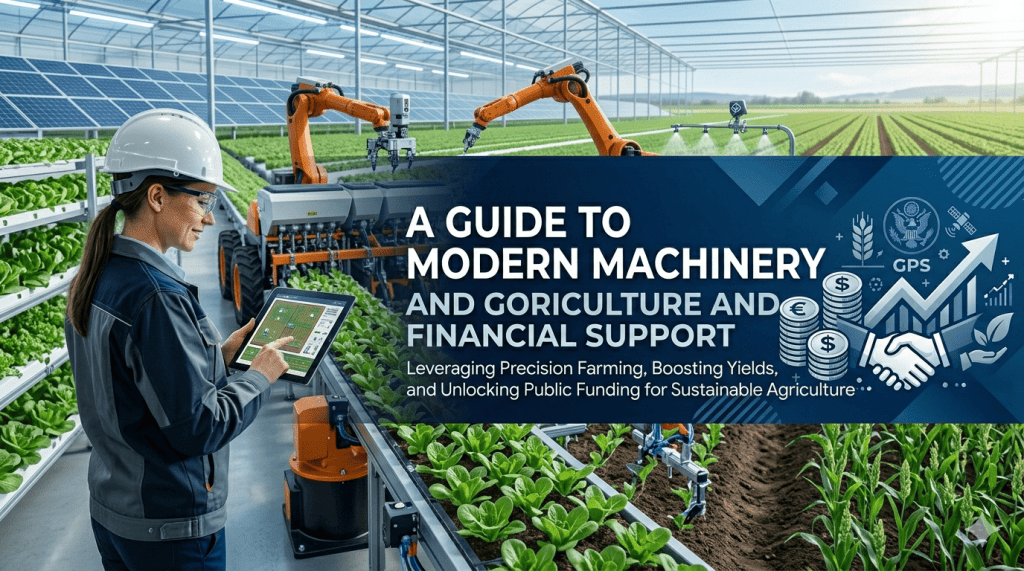
A Guide to Modern Machinery and Government Financial Support, Agriculture in India is undergoing a paradigm shift from traditional labor-intensive methods to technology-driven mechanization. This transition is essential for increasing productivity, reducing post-harvest losses, and doubling farmers income.
To make this easy to navigate, I’ve categorized the machinery by the specific stage of the farming cycle they support.
1. Soil Cultivation & Land Preparation
Before seeds can go into the ground, the soil must be aerated, leveled, and cleared of debris.
- Tractors: The “workhorse” of the farm. They provide the power to pull or push almost every other implement on this list.
- Plows (Ploughs): Used for initial soil turning. Varieties include Moldboard, Disc, and Chisel plows.
- Harrows: These break up large clods of soil and level the surface. Common types are Disc, Chain, and Power harrows.
- Rotavators (Rotary Tillers): Use rotating blades to pulverize and mix the soil, creating a fine seedbed.
- Cultivators: Generally used to stir the soil and remove weeds between rows of existing crops.
2. Planting & Sowing
Modern equipment ensures that seeds are planted at the exact depth and spacing required for maximum yield.
- Seed Drills: Precisely sow seeds in rows at a fixed depth (e.g., Air Seeders or Box Drills).
- Planters: Used for larger seeds like corn, soybeans, and sunflowers, often spacing them out individually.
- Transplanters: Automated machines that plant young seedlings (common for rice or vegetables) into the soil.
- Seed-Counting Machines: Used in high-precision farming to ensure no waste of expensive hybrid seeds.
3. Fertilizing & Pest Control
Protecting and feeding the crops is critical for a healthy harvest.
- Fertilizer Spreaders: Distribute dry fertilizer evenly across a field.
- Sprayers: Used for applying liquid pesticides, herbicides, or liquid fertilizers. Types include Knapsack (manual), Boom, and Orchard sprayers.
- Slurry Tankers: Used for spreading liquid manure (slurry) onto fields as an organic fertilizer.
4. Irrigation
Ensuring crops get enough water, especially in dry regions.
- Center Pivot Systems: Large-scale sprinklers that rotate around a central point, creating circular green fields often seen from airplanes.
- Drip Irrigation Systems: Low-pressure systems that deliver water directly to the plant roots, saving water.
- Water Pumps: Stationary or tractor-mounted units that move water from wells or rivers to the fields.
5. Harvesting
The most labor-intensive part of farming is now highly mechanized.
- Combine Harvester: A massive machine that performs three functions in one pass: cutting (reaping), threshing (separating grain from straw), and cleaning.
- Forage Harvesters: Used for making silage (animal feed) by chopping grass or corn into small pieces.
- Reapers: Machines that cut crops but don’t thresh them (often used for smaller grain operations).
- Specialized Harvesters: Machines tailored for specific crops, such as Cotton Pickers, Potato Diggers, Sugarcane Harvesters, and Grape Harvesters.
6. Post-Harvest & Processing
Once the crop is out of the field, it needs to be cleaned, moved, and stored.
- Balers: Collect hay, straw, or silage and compress it into compact square or round bales.
- Threshers: Separate the grain from the stalks (often used when a combine isn’t available).
- Chaff Cutters: Cut straw or fodder into small pieces for livestock feed.
- Grain Dryers: Use heat and airflow to reduce the moisture content of grain to prevent spoilage in storage.
7. Support & Transportation
- Telehandlers & Skid Steers: Versatile loaders used for lifting heavy pallets, hay bales, or moving dirt.
- ATVs/UTVs: Small, fast vehicles used for farm scouting and transporting tools quickly.
- Agricultural Trailers: Used for hauling everything from livestock to harvested grain.
Pro Tip: If you’re looking to start a small-scale operation, a Tractor with a Rotavator and a Sprayer attachment is usually the “starter kit” that covers about 80% of basic needs.
The document provides a comprehensive breakdown of major financial initiatives designed to stimulate the Indian economy. Key sections include:
- MSME Support: Details on MUDRA loans (Shishu, Kishore, Tarun) and the CGTMSE collateral-free credit guarantee scheme.
- Startup Ecosystem: Information on the Startup India Seed Fund (SISFS) for early-stage validation and the Credit Guarantee Scheme for Startups.
- Employment Generation: Analysis of the PMEGP, highlighting the subsidies available (up to 35%) for manufacturing and service units.
- Inclusive Growth: The Stand-Up India scheme specifically targeting SC/ST and Women entrepreneurs with loans up to ₹1 crore.
- Sector-Specific Incentives: Overview of the Agriculture Infrastructure Fund and the high-impact Production Linked Incentive (PLI) schemes for domestic manufacturing.
Key Highlights of the Article:
- Modern Machinery Overview:
- Soil Preparation: Tractors, Laser Land Levelers, and Power Tillers.
- Sowing & Planting: Happy Seeders (for sustainable residue management) and Rice Transplanters.
- New Tech: The emergence of Agricultural Drones for precision spraying.
- Government Financial Support:
- Application Process: Guidance on using the DBT (Direct Benefit Transfer) portals to ensure transparent and efficient fund allocation.
MECHANIZING INDIAN AGRICULTURE
A Guide to Modern Machinery in Farming and Government Financial Support
Agriculture in India is undergoing a paradigm shift from traditional labor- intensive methods to technology-driven mechanization. This transition is
essential for increasing productivity, reducing post-harvest losses, and doubling
farmers’ income.
I. Essential Agricultural Machinery & Equipment
1. Land Preparation & Soil Health
The foundation of a good harvest lies in the quality of the seedbed.
Tractors & Power Tillers: The primary power source. Power tillers are
particularly effective in small landholdings and hilly terrains.
Laser Land Leveler: Uses laser sensors to ensure the field is perfectly flat,
reducing water consumption by up to 25%.
MB Plow & Disc Harrow: Essential for deep tillage and breaking soil clods to
improve aeration.
2. Sowing & Planting Technology
Happy Seeder: A specialized machine that sows wheat directly into rice
stubble without burning it, promoting eco-friendly farming.
Pneumatic Planters: Ensures vacuum-based precise spacing and depth for
crops like maize and cotton.
Rice Transplanters: Mechanized planting of paddy seedlings, significantly
reducing labor costs and time.
3. Crop Protection & Irrigation
Boom Sprayers: Tractor-mounted sprayers that cover large areas quickly
with uniform chemical distribution.
Drones (Agri-Bots): The latest frontier in Indian farming, used for precision
spraying and crop health monitoring.
Solar Pumps: Eco-friendly irrigation solution, reducing dependence on the
electrical grid or diesel.
4. Harvesting & Threshing
Combine Harvesters: Multi-functional machines that reap, thresh, and
winnow in a single operation.
Multi-crop Threshers: Designed to handle various crops like wheat, mustard,
and pulses with adjustable settings.
II. Major Government Funding & Subsidy Schemes
The Government of India provides substantial financial assistance to make these
expensive machines accessible to small and marginal farmers.
Flagship Scheme
1. Sub-Mission on Agricultural Mechanization (SMAM)
SMAM is the primary scheme for promoting farm mechanization. It provides
subsidies ranging from 40% to 50% for purchasing various implements.
Individual Ownership: Financial assistance to individual farmers.
Custom Hiring Centres (CHCs): Promoting the establishment of hubs
where farmers can rent machinery at nominal rates. Subsidies up to 40%
(max ₹10-15 Lakhs) are provided for setting up these centres.
2. Rashtriya Krishi Vikas Yojana (RKVY)
This scheme gives states the flexibility to choose their own agriculture and
allied sector development activities. Many states use RKVY funds to provide
additional top-up subsidies on high-value machinery like Combine
Harvesters.
3. PM-KUSUM (Pradhan Mantri Kisan Urja Suraksha evam Utthaan
Mahabhiyan)
Focused specifically on solar energy in agriculture.
Component B: Installation of 17.50 lakh stand-alone solar agriculture
pumps.
Funding: Central Govt provides 30% subsidy, State Govt provides 30%,
and the farmer pays only 40% (with loan options).
4. Mission for Integrated Development of Horticulture (MIDH)
Dedicated to the development of the horticulture sector. It offers assistance
for specialized machinery like power tillers, tractors (below 20 HP), and
specialized sprayers for orchards.
III. How to Apply?
Most of these subsidies are now routed through the Direct Benefit Transfer
(DBT) portal of the Department of Agriculture. Farmers must register on the
National Agriculture Portal or their respective State Agriculture Department
websites (e.g., AgriMachinery.nic.in) with their Aadhaar and land records.


Leave a Reply