
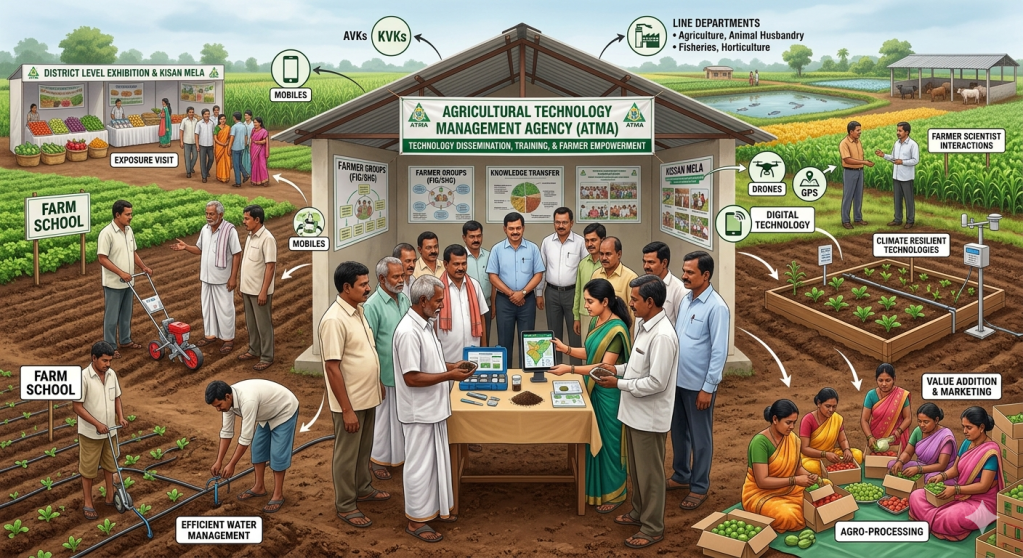
The Agricultural Technology Management Agency (ATMA) scheme is a centrally sponsored initiative under the Sub-Mission on Agricultural Extension (SMAE) of the Krishonnati Yojana. Managed by the Ministry of Agriculture & Farmers Welfare, the scheme serves as a vital pillar for agricultural development by empowering farmers with the technology, skills, and information necessary to enhance sustainability and income.
1. Background and Vision
The ATMA scheme was restructured in 2025 to align with the goals of the “Doubling of Farmers’ Income” (DFI) report.
- Objective: To promote a decentralized, farmer-friendly extension system focusing on Natural Farming, Climate Resilient Agriculture, and Digital Agriculture.
- Vision: Empowering farmers across all agricultural sub-sectors and value chains to realize higher net income through better risk and farm management practices.
2. Key Reforms and Strategic Changes
The 2025 guidelines introduce several shifts from traditional extension models:
- Market Orientation: Shifting focus from mere production to Post-Harvest Management and Agriculture Marketing.
- Skill Development: Introducing a minimum 200-hour skill training for rural youth to encourage entrepreneurship.
- Recognition of Prior Learning (RPL): Organizing 2-day training sessions at the Gram Panchayat level to certify progressive farmers who can then mentor others.
- Digital Outreach: Utilizing Video Conferencing for regular interactions between experts and farmers.
3. Organizational Structure and Human Resources
The scheme operates through a tiered organizational setup to ensure effective delivery:
| Level | Key Body / Entity | Responsibility |
| State | Inter-Departmental Working Group (IDWG) | Day-to-day coordination and management. |
| SAMETI | Training and capacity building for extension functionaries. | |
| District | ATMA Governing Board (GB) | Policy direction and approval of action plans. |
| ATMA Management Committee | Implementation of scheme activities. | |
| Block | Block Technology Team (BTT) | Preparing and executing Block Action Plans. |
| Village | Farmer Friend (FF) | Link between farmers and the extension system (1 per 2 villages). |
4. Cafeteria of Activities
The “ATMA Cafeteria” is a menu of eligible activities that States can choose from based on local needs identified in the Strategic Research and Extension Plan (SREP).
- Farmer Oriented Activities: Includes inter-state and intra-state training, demonstrations (agriculture and allied sectors), and exposure visits.
- Farm Information Dissemination: Support for Kisan Melas, exhibitions, and low-cost publications.
- Innovative Components: Setting up Community Radio Stations (CRS) with funding up to ₹65.00 lakh for capital and recurring costs.
5. Convergence Strategies
To maximize impact, ATMA integrates with various other missions:
- Research-Extension Linkage: Monthly interface meetings and joint visits by ATMA and Krishi Vigyan Kendra (KVK) scientists.
- Cross-Ministry Support: Using Krishi Sakhis (Ministry of Rural Development) and Pashu Sakhis (Fisheries/Animal Husbandry) to create awareness at the grassroots level.
- Panchayati Raj: Mapping activities to involve local Village Panchayats in identifying beneficiaries and prioritizing local tasks.
6. Monitoring, Evaluation, and Budget
The scheme maintains strict accountability through:
- Quarterly Reviews: Periodic workshops and concurrent evaluations to track program delivery.
- Impact Assessment: Conducted by expert agencies specifically for Farm Schools and Farmer Friends.
- Financial Support: Funding is allocated for training (approx. ₹1,500 – ₹2,000 per participant depending on venue), demonstrations (up to ₹6,000 per plot), and farmer awards at State, District, and Block levels.
Note: For further technical details, specific cost ceilings are listed in Annexure-V(a) of the full guidelines.


Leave a Reply