
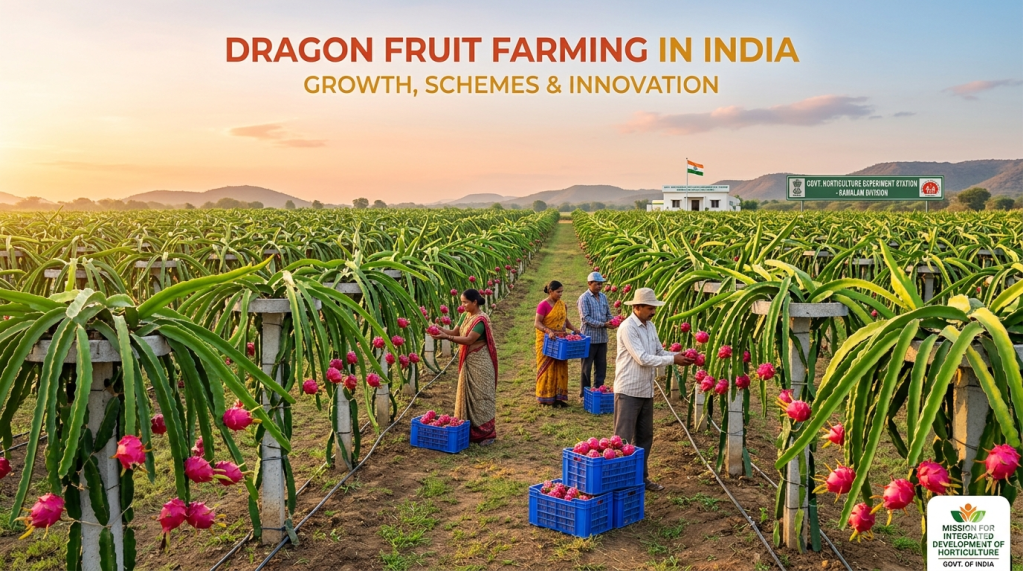
Dragon fruit, the exotic variety in fruits basket in rebranded as “Kamalam” by the Indian government, has transformed from a curiosity to a cornerstone in India’s high-value fruit farming. As of 2026, it is no longer just a trend; it is a strategic tool for crop diversification and doubling farmer income
The Rise of Dragon Fruit in India (2024–2026)
Initially imported from Vietnam and Thailand, dragon fruit is now thriving in India’s arid and semi-arid regions.
- Expansion: The cultivation area is rapidly scaling from 3,000 hectares toward a national goal of 50,000 hectares.
- Key Hubs: While Gujarat and Maharashtra were the pioneers, the crop has successfully moved into Karnataka, Tamil Nadu, Andhra Pradesh, and even non-traditional zones like Punjab, West Bengal, and the North East.
- Economic Impact: With a lifespan of 20 years, the plant begins yielding within its first year and reaches full productivity by year three. Farmers are reporting profits ranging from ₹10 lakh to ₹15 lakh per acre annually once the orchard matures.
Cultivation Practices: The Indian Model
Dragon fruit is a cactus-like perennial climber that requires specific structural support and minimal water.
Climate and Soil
- Temperature: Thrives between 20°C and 40°C. High humidity is tolerated, but waterlogging is fatal.
- Soil: While it grows in almost any soil, sandy loam with a pH of 5.5 to 7.0 is ideal.
- Water: Extremely water-efficient; drip irrigation is the standard.
The Support System (Trellis)
The most common method in India is the Pole and Ring system:
- A RCC (Reinforced Cement Concrete) pole of 5–6 feet is erected.
- A circular ring or frame is placed on top to allow the vines to hang down, which triggers flowering.
- Usually, 4 plants are planted around each pole.
Trellis for Farming plant support – Krishicenter
Nutrient Management
Being a heavy feeder during the fruiting season (June to November), it requires:
- Organic: Farmyard manure (FYM) and vermicompost.
- Chemical: Nitrogen, Phosphorus, and Potassium (NPK) in split doses.
Government Schemes and Subsidies (2025-26 Updates)
Under the Mission for Integrated Development of Horticulture (MIDH), the central government has classified Kamalam as a “niche fruit,” unlocking significant financial backing.
Central Government Initiatives
- MIDH Subsidies: Assistance is typically 40% of the cost (up to ₹2 lakh/ha) in general areas and 50% in North Eastern and Himalayan states.
- Centre of Excellence (CoE): A dedicated CoE for Kamalam has been established at IIHR, Bengaluru (Hirehalli) to provide high-quality planting material and technical training.
State-Specific Schemes (2026 Status)
| State | Key Highlights | Subsidy Details |
|---|---|---|
| Gujarat | Pioneer state; rebranded it to “Kamalam.” | Provides up to ₹1.25 lakh per hectare for planting and trellis systems. |
| Tamil Nadu | Rapid expansion in Karur and Tiruchirapalli. | Subsidy increased to ₹1.62 lakh per hectare (2025-26) for small/marginal farmers. |
| Haryana | Promoting as an alternative to paddy. | Subsidies available under the State Horticulture Mission covering up to 50% of the cost. |
| Maharashtra | Integrating with drip irrigation schemes. | Focus on export-quality production via Magel Tyala Shetal and MIDH. |
| Punjab | Diversification from wheat-paddy cycle. | Providing financial aid for poles and drip systems to encourage water conservation. |
Market and Export Potential
India’s goal is to move from a net importer to a global exporter.
- Import Substitution: India used to import roughly ₹100 crores worth of dragon fruit annually. Domestic production is now significantly cutting these costs.
- APEDA Support: The Agricultural and Processed Food Products Export Development Authority (APEDA) is facilitating shipments to the UAE, UK, and European markets.
- Value Addition: Beyond raw fruit, there is a growing industry for dragon fruit powder, jams, wines, and cosmetic extracts.
Challenges for New Farmers
While lucrative, dragon fruit farming has high initial setup costs (₹4–5 lakh per acre) primarily due to the concrete support structures. Additionally, farmers must watch for Sun Scald (stem damage due to extreme heat) and Fungal Rot during heavy monsoons.+1
Expert Tip: Before starting, ensure you have a “buy-back” agreement or a local market link, as the fruit has a relatively short shelf life (4–7 days) without cold storage


Leave a Reply