
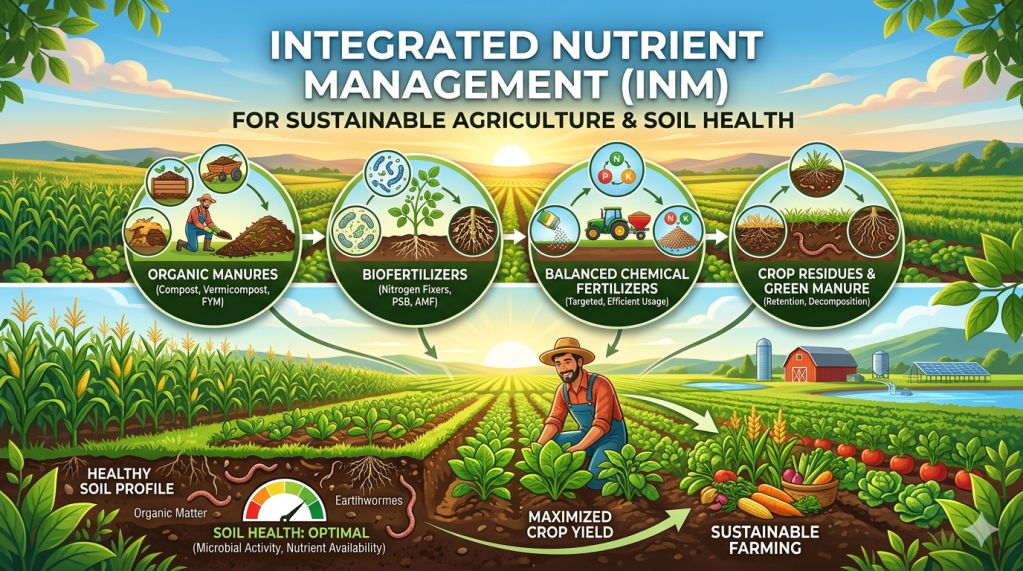
What is Integrated Nutrient Management? (INM) The Future of Sustainable Agriculture
In the face of a growing global population and the degradation of soil health, the traditional “more is better” approach to chemical fertilizers is failing. Enter Integrated Nutrient Management (INM)—a holistic approach to soil fertility that balances crop productivity with environmental stewardship.
What is Integrated Nutrient Management?
At its core, INM is the maintenance or adjustment of soil fertility and plant nutrient supply to an optimum level for sustaining desired crop productivity. This is achieved through the optimization of the benefits from all possible sources of plant nutrients in an integrated manner.
Instead of relying solely on synthetic bags of N-P-K, INM combines:
- Chemical Fertilizers (Inorganic)
- Organic Manures (Compost, FYM, Green Manure)
- Bio-fertilizers (Rhizobium, Azotobacter)
- Crop Residues and Legumes
The Core Components of INM
To implement a successful INM strategy, farmers and agronomists look at four primary “pillars”:
- Inorganic Sources: These provide concentrated, readily available nutrients. While essential for high yields, they are used more efficiently in an INM system to prevent leaching and volatilization.
- Organic Sources: Farmyard Manure (FYM), vermicompost, and poultry manure improve the physical properties of soil, such as water-holding capacity and aeration, which chemical fertilizers cannot do.
- Biological Sources: Bio-fertilizers are living microorganisms that fix atmospheric nitrogen or solubilize phosphorus already present in the soil.
- Green Manuring: Growing specific crops (like Sesbania or Sunn hemp) and plowing them back into the soil adds significant biomass and nitrogen.
Why Shift to INM? (The Benefits)
Moving away from monocultural nutrient reliance offers a “triple win” for the farmer, the consumer, and the planet.
| Benefit Category | Impact of INM |
|---|---|
| Soil Health | Improves soil structure, increases microbial activity, and prevents soil acidification. |
| Yield & Quality | Leads to “sustained” high yields and often improves the nutritional profile (micro-nutrients) of the produce. |
| Economic | Reduces the high cost of purchasing chemical fertilizers by utilizing on-farm waste. |
| Environmental | Minimizes nitrate leaching into groundwater and reduces greenhouse gas emissions (like N2O). |
The Scientific Logic: Nutrient Use Efficiency (NUE)
One of the biggest problems with conventional farming is low Nutrient Use Efficiency. When we apply urea, a large portion is lost to the atmosphere or washed away. INM increases the efficiency of these nutrients.
The mathematical goal is to balance the nutrient balance sheet:
Ntotal=(Nfert+Norg+Nbio+Nrain)−(Nleached+Nvolatilized)
By adding organic matter, we create a “slow-release” mechanism. The organic matter acts as a sponge, holding onto the chemical nutrients and releasing them as the plant grows.
Challenges in Adoption
Despite the clear benefits, INM isn’t a “plug-and-play” solution. It requires:
- Labor Intensity: Managing bulky organic manures requires more physical labor than spreading granules.
- Availability: Farmers may not always have access to enough livestock waste or high-quality bio-fertilizers.
- Knowledge Gap: INM requires soil testing and a deep understanding of crop requirements, moving away from “blanket applications.”
Conclusion
Integrated Nutrient Management is not a return to primitive farming; it is a sophisticated, science-based evolution. By blending the precision of modern chemistry with the resilience of natural biological processes, we can ensure that our soils remain productive for generations to come. It is the only viable path to achieving Food Security without sacrificing Environmental Integrity.


Leave a Reply