
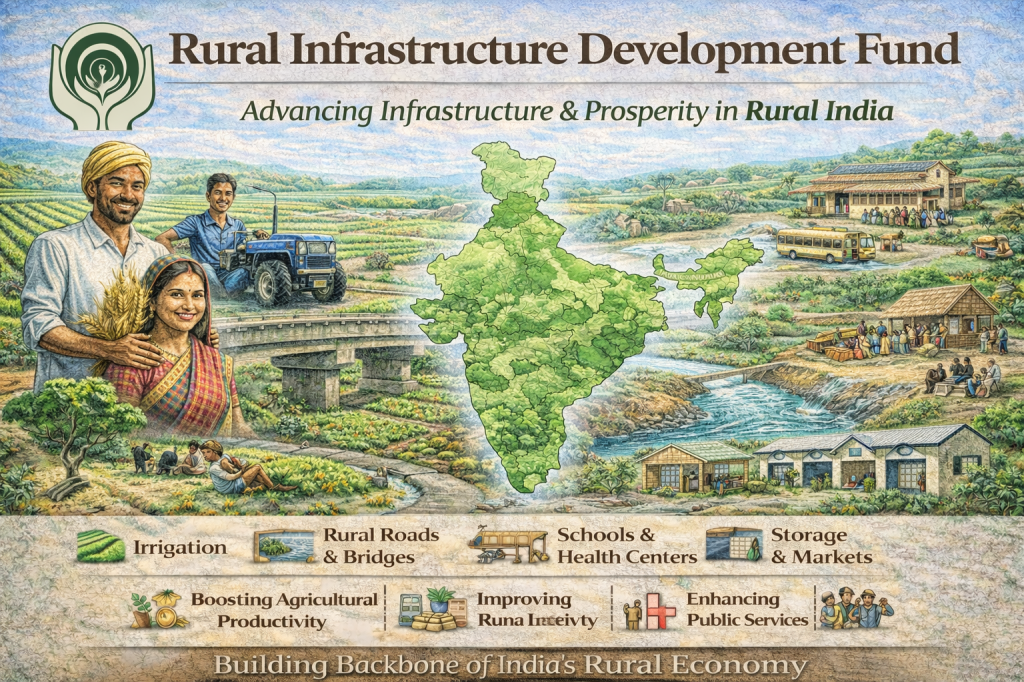
Rural infrastructure plays a crucial role in improving agricultural productivity, rural livelihoods, and overall economic development. In India, many rural areas historically suffered from inadequate infrastructure such as poor roads, limited irrigation facilities, insufficient storage infrastructure, and weak social infrastructure like schools and health centres. To address these gaps, the Government of India created the Rural Infrastructure Development Fund (RIDF) in 1995–96. The fund is managed by the National Bank for Agriculture and Rural Development (NABARD).
The RIDF was designed to finance ongoing and new rural infrastructure projects by providing loans to state governments and state-owned corporations. Over the years, it has become one of the most important mechanisms for financing rural infrastructure in India and has contributed significantly to agricultural growth and rural development.
Background and Establishment of RIDF
The Rural Infrastructure Development Fund was established. This was due to many commercial banks failing to meet their Priority Sector Lending (PSL) targets in agriculture and rural development. Instead of paying penalties, these banks were required to deposit the shortfall amount into the RIDF managed by NABARD.
The fund is then used by NABARD to provide low-interest loans to state governments for the development of rural infrastructure projects. These projects aim to create durable assets in rural areas such as irrigation systems, roads, bridges, warehouses, and social infrastructure.
RIDF was initially launched with a modest corpus in 1995–96, but its size and scope have expanded significantly over time. Today, it supports infrastructure development in agriculture, rural connectivity, irrigation, and the social sector across India.
Objectives of the Rural Infrastructure Development Fund
The RIDF programme has several important objectives:
1. Strengthening Rural Infrastructure
The fund finances the construction and improvement of infrastructure such as rural roads, bridges, irrigation systems, and water supply systems.
2. Promoting Agricultural Development
Infrastructure financed under RIDF helps farmers improve productivity through better irrigation, storage facilities, and market access.
3. Bridging the Rural-Urban Infrastructure Gap
RIDF aims to reduce disparities between rural and urban areas by providing essential facilities in villages.
4. Supporting State Governments
The fund assists state governments in completing ongoing infrastructure projects that face funding shortages.
5. Encouraging Inclusive Growth
Improved rural infrastructure promotes employment generation, better education and healthcare facilities, and overall socio-economic development.
Major Sectors Covered under RIDF
Over the years, RIDF has supported a wide range of rural infrastructure projects across different sectors.
1. Agriculture and Irrigation
- Minor irrigation systems
- Watershed development
- Land development projects
- Flood control and drainage
2. Rural Connectivity
- Rural roads
- Bridges and culverts
- Village connectivity projects
3. Social Infrastructure
- Schools and health centres
- Drinking water supply
- Anganwadi centres and sanitation facilities
4. Rural Market Infrastructure
- Storage facilities and warehouses
- Cold storage and marketing yards
- Rural haats and marketplaces
5. Other Infrastructure
- Fisheries infrastructure
- Soil conservation projects
- Renewable energy and rural electrification
These investments help create long-term productive assets in rural areas.
Implementation Mechanism
The RIDF programme operates through a structured implementation system:
- State Governments identify projects in sectors such as irrigation, roads, and social infrastructure.
- Detailed Project Reports (DPRs) are prepared and submitted to NABARD.
- NABARD evaluates the proposals and sanctions loans from RIDF.
- State governments implement the projects through line departments.
- NABARD monitors the project progress and ensures proper utilization of funds.
This system ensures transparency and effective use of financial resources.
Year-wise Development of RIDF
RIDF is implemented in phases known as “Tranches”. Each financial year corresponds to a new tranche.
| Year | RIDF Tranche | Major Developments |
|---|---|---|
| 1995–96 | RIDF I | Establishment of the Rural Infrastructure Development Fund |
| 1996–97 | RIDF II | Inclusion of rural roads and bridges in the programme |
| 2000–01 | RIDF VI | Expansion of irrigation and agricultural infrastructure projects |
| 2005–06 | RIDF XI | Increased funding for rural connectivity and social infrastructure |
| 2010–11 | RIDF XVI | Expansion to rural drinking water and health infrastructure |
| 2011–12 | RIDF XVII | ₹14,970 crore support extended by NABARD for rural infrastructure projects (The Economic Times) |
| 2015–16 | RIDF XXI | Increased funding for agriculture and irrigation projects |
| 2020–21 | RIDF XXVI | ₹30,200 crore sanctioned for rural infrastructure projects (Business Standard) |
| 2021–22 | RIDF XXVII | Allocation increased to ₹40,000 crore in the Union Budget (The Financial Express) |
| 2023–24 | RIDF XXIX | Allocation of ₹40,474.6 crore and sanctions of ₹50,115.5 crore for projects (NABARD) |
| 2024–25 | RIDF XXX | Continued funding for rural infrastructure across states |
These successive tranches have expanded the scope and scale of rural infrastructure financing in India.
Achievements and Impact of RIDF
Since its inception, the RIDF programme has achieved significant progress in rural infrastructure development.
1. Large-scale Infrastructure Creation
Thousands of infrastructure projects have been completed across the country including roads, bridges, irrigation canals, and storage facilities.
2. Increased Agricultural Productivity
Improved irrigation facilities and better connectivity have helped farmers increase crop production and income.
3. Rural Employment Generation
Infrastructure construction and development activities have generated employment in rural areas.
4. Improved Market Access
Better roads and transportation systems have enabled farmers to access markets more efficiently.
5. Strengthening Rural Economy
Investments through RIDF contribute significantly to rural capital formation and economic growth.
According to estimates, RIDF funding contributes to nearly 10% of gross capital formation in rural areas. This amount highlights its importance in rural development. (The Financial Express)
Challenges in Implementation
Despite its success, the RIDF programme faces several challenges:
- Delays in project implementation by state governments
- Limited technical capacity in some regions
- Maintenance issues for rural infrastructure assets
- Climate risks affecting infrastructure sustainability
Addressing these challenges requires improved monitoring and stronger institutional coordination.
Future Prospects
The importance of RIDF is expected to increase in the future as India focuses on rural transformation and sustainable agriculture. The government is expanding funding to support:
- Climate-resilient infrastructure
- Sustainable irrigation systems
- Rural logistics and storage infrastructure
- Renewable energy in rural areas
These initiatives will strengthen rural economies and improve the quality of life in villages.
Conclusion
The Rural Infrastructure Development Fund (RIDF) is managed by the National Bank for Agriculture and Rural Development. It has played a transformative role in strengthening rural infrastructure in India. By financing irrigation systems, rural roads, bridges, and social infrastructure, the programme has significantly contributed to agricultural growth and rural development.
Over the past three decades, RIDF has expanded through multiple tranches and has become a vital source of funding for state governments. Its continued expansion will help bridge the rural-urban infrastructure gap. It will improve agricultural productivity. Additionally, it will promote inclusive and sustainable development in rural India.
 KrishiCenter
Leave a comment