
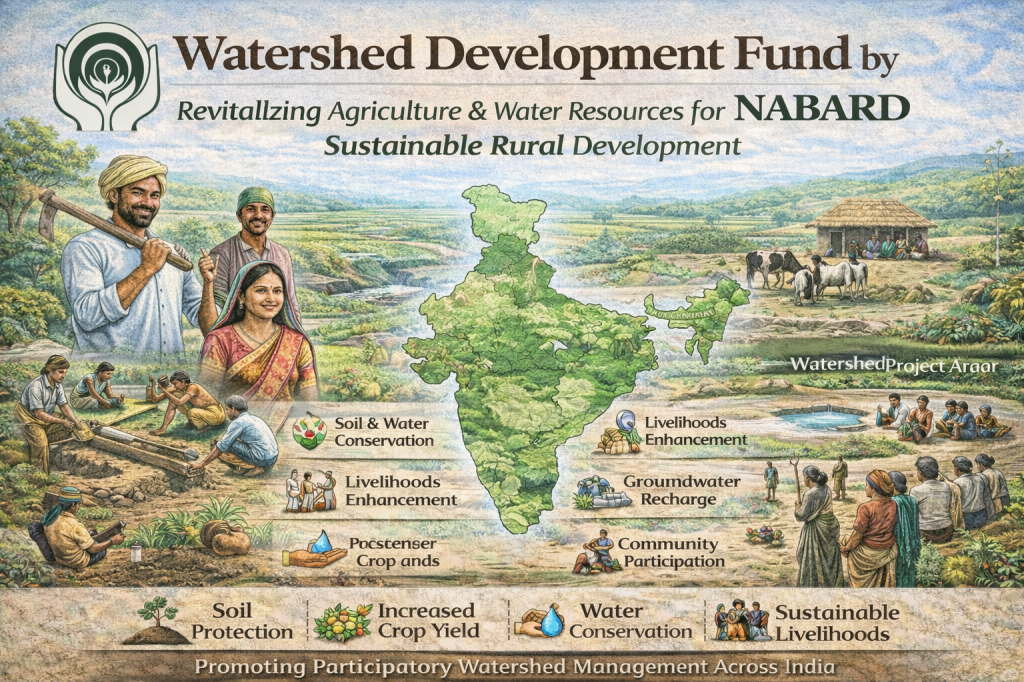
Watershed development has emerged as one of the most important strategies for sustainable agricultural growth in India, particularly in rain-fed and drought-prone regions. Recognizing the need for integrated natural resource management, the National Bank for Agriculture and Rural Development (NABARD) established the Watershed Development Fund (WDF) to promote participatory watershed development across the country.
The programme aims to conserve soil and water resources, improve agricultural productivity, recharge groundwater, and enhance rural livelihoods. Over time, WDF has evolved into one of the largest watershed initiatives in India, covering millions of hectares of degraded land and benefiting thousands of rural communities.
Background and Establishment of WDF
The watershed development initiatives of NABARD began with pilot participatory watershed projects in Maharashtra in 1992, which demonstrated the effectiveness of community-based resource management. (NABARD)
Building on this success, the Watershed Development Fund (WDF) was formally created in 1999–2000 with an initial corpus of ₹200 crore, contributed equally by the Government of India and NABARD. (Core)
Initially, the programme targeted 100 priority districts across 14 states, mainly drought-prone and rain-fed regions. The fund has since expanded significantly through interest earnings and additional allocations.
By 2015, the corpus had increased to ₹1084.94 crore, reflecting the growing importance of watershed development in rural development policy. (NABARD)
Objectives of the Watershed Development Fund
The main objectives of the WDF programme include:
1. Soil and Water Conservation
- Prevent soil erosion and land degradation
- Improve soil fertility and moisture retention
2. Groundwater Recharge
- Enhance groundwater levels through water harvesting structures
- Promote sustainable water management
3. Sustainable Agricultural Productivity
- Improve crop productivity in rain-fed areas
- Introduce improved farming practices
4. Livelihood Enhancement
- Generate employment in rural areas
- Promote allied activities such as horticulture, agro-forestry, and livestock
5. Community Participation
- Strengthen local institutions like Watershed Committees
- Encourage participatory planning and implementation
Implementation Structure of WDF Projects
Watershed projects under NABARD generally follow a two-phase approach:
1. Capacity Building Phase (CBP)
- Training of local communities
- Formation of village watershed committees
- Preparation of detailed project reports
2. Full Implementation Phase (FIP)
- Construction of soil and water conservation structures
- Land treatment and afforestation
- Promotion of agricultural diversification and livelihood activities
Typical watershed interventions include:
- Contour bunding
- Check dams
- Farm ponds
- Percolation tanks
- Agro-forestry and pasture development
- Micro-irrigation systems
These interventions help capture rainwater, reduce runoff, and improve groundwater recharge.
Major Watershed Development Projects
Several watershed projects under WDF have been implemented through NGOs, government agencies, and community organizations.
Example: Ramanathapuram Watershed Project (Tamil Nadu)
Key interventions included:
- Construction of field bunds and farm ponds
- Agro-forestry and horticulture plantation
- Grass seeding and pasture development
- Deepening of percolation ponds
Impact:
- Increased groundwater levels
- Improved soil fertility
- Higher agricultural productivity
- Reduced seasonal migration of farmers (coodu.org)
Expansion and Coverage of WDF
The WDF programme expanded rapidly over the years.
Key achievements
- Watershed development programmes implemented across 27 states
- 442 watershed projects sanctioned by 2018
- 19.60 lakh hectares of land treated
- ₹1611 crore disbursed for watershed programmes (NABARD)
As of March 2023:
- 3,673 watershed and related projects sanctioned
- 2,684 projects completed
- 26.45 lakh hectares treated
- 1.2 million households benefited
- ₹2750 crore grant assistance committed (bhuvan.nabard.org)
By 2025:
- 3,761 watershed projects sanctioned
- 27.2 lakh hectares covered
- ₹2,355 crore disbursed cumulatively (Scribd)
Year-wise Progress of Watershed Development Fund
The following table summarizes the major milestones and progress of the WDF programme.
| Year | Major Development |
|---|---|
| 1992 | Participatory watershed development pilot launched |
| 1999–2000 | Watershed Development Fund created with ₹200 crore corpus |
| 2001–02 | 119 capacity-building projects sanctioned in 9 states |
| 2015 | Corpus increased to ₹1084.94 crore |
| 2018 | 442 watershed projects implemented covering 19.6 lakh ha |
| 2023 | 3,673 watershed projects sanctioned; 26.45 lakh ha treated |
| 2025 | 3,761 projects sanctioned covering 27.2 lakh ha |
Use of Technology in Watershed Monitoring
NABARD has adopted modern technology for monitoring watershed projects.
One important initiative is the Bhuvan-NABARD portal, developed in collaboration with the National Remote Sensing Centre (ISRO). This platform allows:
- Geotagging of watershed structures
- Satellite-based monitoring of project areas
- Tracking of land use and vegetation changes
- Real-time reporting of project progress (bhuvan.nabard.org)
This technological integration improves transparency and evaluation of watershed interventions.
Impact of Watershed Development Programmes
The WDF programme has had significant environmental, economic, and social impacts.
Environmental Impact
- Increased groundwater levels
- Reduced soil erosion
- Improved vegetation cover
Agricultural Impact
- Higher crop yields
- Increased cropping intensity
- Diversification into horticulture and agro-forestry
Social Impact
- Strengthened community institutions
- Reduced migration
- Increased rural employment
Economic Impact
- Higher farm incomes
- Improved resilience to drought and climate change
Challenges in Watershed Development
Despite its success, the WDF programme faces certain challenges:
- Limited community participation in some areas
- Maintenance of watershed structures after project completion
- Climate change and irregular rainfall patterns
- Coordination among implementing agencies
Addressing these challenges requires stronger local institutions and better monitoring mechanisms.
Conclusion
The Watershed Development Fund of NABARD represents a significant step toward sustainable rural development in India. The programme focuses on soil and water conservation, community participation, and livelihood improvement. As a result, it has transformed large areas of degraded land into productive agricultural landscapes.
Over the past two decades, the WDF initiative has expanded across the country. It covers millions of hectares and benefits millions of rural households. The programme integrates technology and climate-resilient practices. It plays a crucial role in strengthening agricultural sustainability in India. It also enhances rural livelihoods.
 KrishiCenter
Leave a comment