
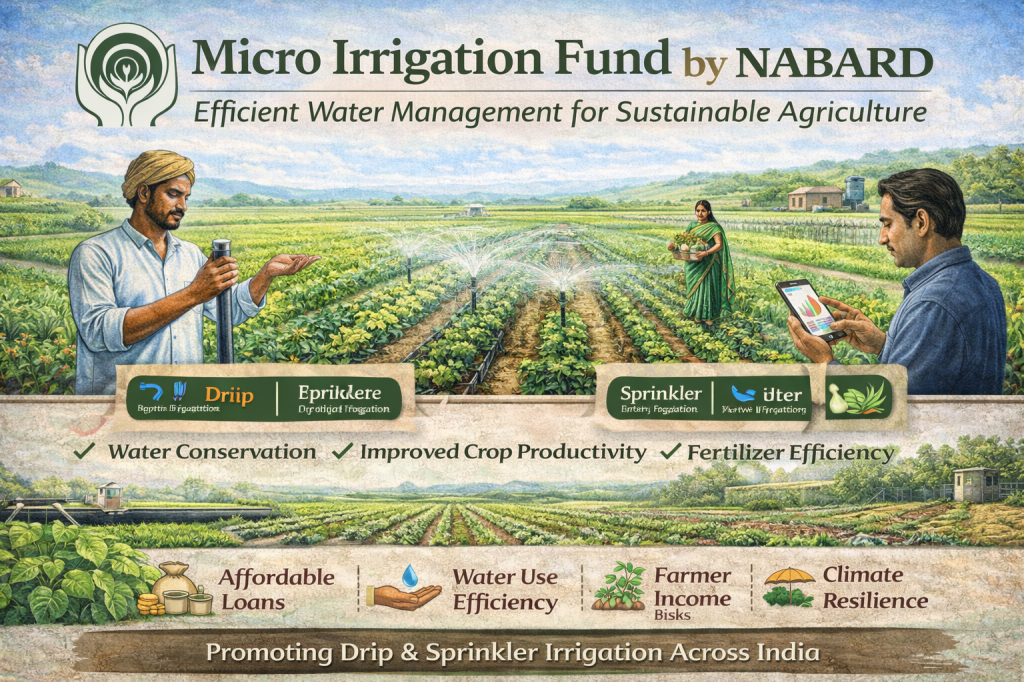
Efficient water management has become one of the most critical challenges in modern agriculture. Rapid population growth, climate variability, declining groundwater levels, and inefficient irrigation practices have intensified pressure on water resources. In response to these challenges, the Government of India introduced several initiatives to promote water-efficient technologies. The Micro Irrigation Fund (MIF) has emerged as a major financial instrument among these initiatives. The fund is implemented through the National Bank for Agriculture and Rural Development (NABARD). NABARD plays a pivotal role in financing and promoting sustainable irrigation practices across the country.
The Micro Irrigation Fund aims to expand the coverage of micro-irrigation systems. It supports various systems such as drip and sprinkler irrigation schemes. The fund provides financial support to state governments. This essay examines the background, objectives, and operational framework of the Micro Irrigation Fund. It discusses the benefits and challenges, highlighting its importance in promoting water-efficient agriculture. The essay also emphasizes its role in sustainable rural development.
Background and Rationale
Agriculture in India accounts for nearly 80 percent of the country’s total freshwater usage. Traditional irrigation methods such as flood irrigation often lead to excessive water consumption, uneven distribution, and soil degradation. In addition, many regions face severe water scarcity due to over-extraction of groundwater and irregular rainfall patterns.
To address these issues, the Government of India launched the Pradhan Mantri Krishi Sinchai Yojana (PMKSY) with the objective of achieving “Har Khet Ko Pani” (water to every field) and improving water use efficiency. Within this broader framework, the Micro Irrigation Fund was created in 2018 with an initial corpus of ₹5,000 crore, later expanded to ₹10,000 crore. The fund is managed by NABARD to facilitate access to low-interest loans for state governments to implement large-scale micro-irrigation projects.
Concept of Micro Irrigation
Micro irrigation refers to irrigation techniques that deliver water directly to the root zone of plants in a controlled manner. These methods significantly reduce water wastage and improve crop productivity.
The two major types of micro-irrigation systems include:
Drip Irrigation:
Water is delivered drop by drop through pipes and emitters directly to plant roots, minimizing evaporation and runoff.
Sprinkler Irrigation:
Water is sprayed over crops in the form of small droplets, simulating natural rainfall.
These systems enhance water efficiency, reduce labor requirements, and allow precise application of fertilizers through fertigation.
Establishment of the Micro Irrigation Fund
The Micro Irrigation Fund was established with NABARD as the implementing agency. The fund primarily provides concessional loans to state governments so they can expand micro-irrigation infrastructure and accelerate adoption among farmers.
Key features of the fund include:
- Dedicated corpus managed by NABARD
- Concessional interest rates
- Long repayment periods for state governments
- Support for both drip and sprinkler irrigation systems
- Encouragement of large-scale micro-irrigation projects
By addressing financial constraints faced by states, the fund facilitates faster implementation of irrigation modernization initiatives.
Operational Framework
Under the Micro Irrigation Fund, state governments submit project proposals to NABARD outlining their plans to expand micro-irrigation coverage. These proposals typically include:
- Target area for irrigation coverage
- Type of irrigation technology
- Implementation strategy
- Estimated project cost
- Expected benefits
Once approved, NABARD provides loans to the state governments at concessional interest rates. The funds are then utilized to implement micro-irrigation systems through subsidies, technical support, and infrastructure development.
The scheme works in convergence with the Per Drop More Crop component of the Pradhan Mantri Krishi Sinchai Yojana.
Objectives of the Micro Irrigation Fund
The Micro Irrigation Fund has several key objectives:
1. Expansion of Micro Irrigation Coverage
One of the primary goals is to increase the area under drip and sprinkler irrigation systems across the country.
2. Water Conservation
Micro irrigation systems reduce water wastage and promote efficient utilization of available water resources.
3. Improved Agricultural Productivity
By ensuring optimal water supply, micro irrigation enhances crop yields and improves crop quality.
4. Climate Resilience
Efficient irrigation systems help farmers cope with erratic rainfall patterns and prolonged drought conditions.
5. Reduction of Energy Consumption
Micro irrigation reduces the energy required for pumping water, thereby lowering electricity consumption in agriculture.
Benefits of the Micro Irrigation Fund
1. Water Use Efficiency
Micro irrigation systems can save 30–50 percent of water compared to traditional irrigation methods. This conservation is crucial in water-stressed regions.
2. Increased Crop Yield
Precise water application improves plant growth and can increase crop yields by 20–40 percent in many cases.
3. Fertilizer Efficiency
Through fertigation, fertilizers are delivered directly to plant roots, reducing wastage and improving nutrient absorption.
4. Reduced Soil Erosion
Since water is applied in controlled quantities, soil erosion and nutrient runoff are minimized.
5. Improved Farmer Income
Higher productivity and lower input costs contribute to increased profitability for farmers.
Role of NABARD in Implementation
The National Bank for Agriculture and Rural Development plays several critical roles in the Micro Irrigation Fund:
- Managing the fund corpus
- Evaluating project proposals submitted by states
- Providing concessional loans
- Monitoring implementation progress
- Promoting best irrigation practices
- Facilitating knowledge sharing among states
NABARD’s expertise in rural finance and agricultural development ensures that the fund is implemented effectively and transparently.
Impact on Indian Agriculture
Since its introduction, the Micro Irrigation Fund has contributed to expanding micro-irrigation coverage in several states, particularly in water-scarce regions. States such as Maharashtra, Gujarat, Andhra Pradesh, and Karnataka have made significant progress in adopting drip and sprinkler irrigation systems.
These initiatives have led to:
- Reduced groundwater extraction
- Improved water productivity
- Enhanced resilience to drought
- Increased farmer incomes
Micro irrigation has also promoted diversification toward high-value crops such as fruits, vegetables, and horticultural crops.
Challenges and Limitations
Despite its potential, the Micro Irrigation Fund faces several challenges.
1. High Initial Investment
The installation of micro-irrigation systems requires substantial upfront investment, which may discourage small farmers even with subsidies.
2. Limited Awareness
Many farmers are still unaware of the benefits and operational aspects of micro irrigation.
3. Maintenance Issues
Proper maintenance of drip and sprinkler systems is essential for long-term performance. Lack of technical knowledge can lead to system failures.
4. Regional Disparities
Some states have adopted micro irrigation more rapidly than others due to differences in administrative capacity and policy support.
Future Prospects
The future success of the Micro Irrigation Fund depends on several strategic measures:
- Expansion of farmer training and awareness programs
- Integration with digital agriculture technologies
- Development of low-cost irrigation systems
- Strengthening public–private partnerships
- Encouraging community-based irrigation models
With growing concerns about water scarcity and climate change, micro irrigation will become increasingly important for sustainable agricultural development.
Conclusion
The Micro Irrigation Fund represents a significant step toward promoting water-efficient agriculture in India. The fund provides financial assistance to state governments. This accelerates the adoption of advanced irrigation technologies. These technologies conserve water, improve productivity, and enhance farmer livelihoods.
The National Bank for Agriculture and Rural Development implements the fund effectively. It supports the broader goals of sustainable agriculture, climate resilience, and rural development. Challenges remain. However, policy support must continue. Technological innovation is essential. Farmer awareness can ensure that the Micro Irrigation Fund becomes a cornerstone of India’s water-smart agricultural future.


Leave a Reply