
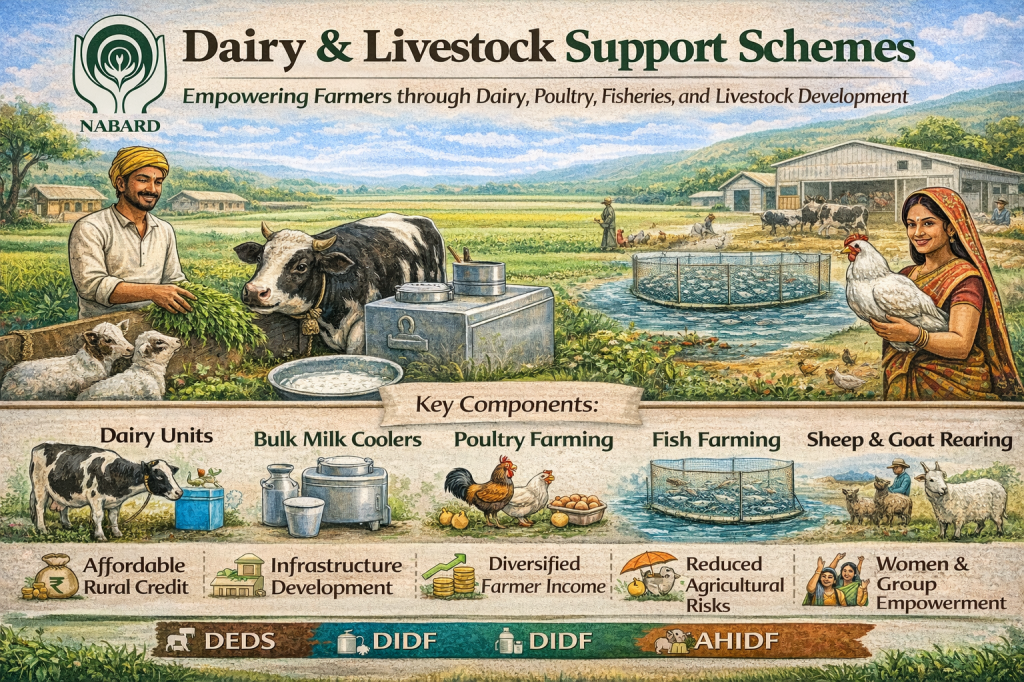
The dairy and livestock sector plays a vital role in India’s rural economy, contributing significantly to agricultural GDP, employment generation, nutritional security, and women’s empowerment. Recognizing its transformative potential, the National Bank for Agriculture and Rural Development (NABARD) has consistently promoted dairy and livestock development through refinance support, promotional initiatives, infrastructure funding, and convergence with government schemes.
NABARD’s interventions are not merely credit-based; they are structured to strengthen rural livelihoods, improve productivity, and build sustainable value chains. This essay critically examines the major dairy and livestock support schemes facilitated by NABARD, their objectives, operational framework, impact, and challenges.
Importance of Dairy & Livestock in Rural India
The livestock sector:
- Contributes significantly to agricultural Gross Value Added (GVA).
- Provides regular income to small and marginal farmers.
- Acts as a risk mitigation mechanism against crop failure.
- Generates employment, especially for women.
- Enhances nutritional security through milk, meat, and eggs.
India is the world’s largest milk producer, and dairy farming is often described as the “ATM of rural households” because of its daily cash flow nature.
NABARD’s Role in Dairy & Livestock Development
NABARD functions as:
- A refinance institution for banks.
- A development agency promoting rural enterprises.
- A capacity-building institution.
- A policy advisor to the Government of India.
It supports dairy and livestock through:
- Refinance assistance to commercial banks, RRBs, and cooperative banks.
- Infrastructure funding.
- Promotional grants.
- Support to Farmer Producer Organizations (FPOs).
- Credit planning and monitoring.
Major Dairy & Livestock Support Schemes
1. Dairy Entrepreneurship Development Scheme (DEDS)
The Dairy Entrepreneurship Development Scheme was implemented with NABARD as the nodal agency.
Objectives:
- Promote self-employment in dairy.
- Upgrade traditional dairy farming.
- Encourage modern dairy practices.
Components Included:
- Purchase of milch animals.
- Establishment of small dairy units.
- Vermicomposting units.
- Cold storage and milk transportation.
Subsidy Pattern:
- Back-ended capital subsidy.
- Higher subsidy for SC/ST and women beneficiaries.
DEDS played a crucial role in improving small-scale dairy enterprises and encouraging scientific dairy farming.
2. Dairy Processing and Infrastructure Development Fund (DIDF)
The Dairy Processing and Infrastructure Development Fund aims to modernize milk processing infrastructure.
Key Features:
- Low-interest loans.
- Long repayment period.
- Support to milk cooperatives and producer companies.
Focus Areas:
- Milk processing plants.
- Value addition facilities.
- Cold chain and bulk milk coolers.
- Energy-efficient equipment.
NABARD manages the fund and provides loans to eligible institutions, thereby strengthening the dairy value chain.
3. Animal Husbandry Infrastructure Development Fund (AHIDF)
The Animal Husbandry Infrastructure Development Fund promotes private sector investment in livestock infrastructure.
Supported Activities:
- Dairy processing and value addition.
- Meat processing.
- Feed manufacturing units.
- Breed improvement infrastructure.
NABARD assists in refinancing and monitoring projects under this scheme, ensuring credit flow and viability assessment.
4. Livestock Development through SHGs and FPOs
NABARD promotes livestock activities under:
- Self-Help Groups (SHGs)
- Joint Liability Groups (JLGs)
- Farmer Producer Organizations (FPOs)
These collective institutions enable:
- Aggregation of milk.
- Bulk purchase of feed.
- Better bargaining power.
- Access to formal credit.
This community-based model reduces transaction costs and enhances income stability.
5. Refinance Support to Banks
NABARD provides refinance to:
- Commercial Banks
- Regional Rural Banks
- Cooperative Banks
For activities such as:
- Dairy units
- Sheep and goat rearing
- Poultry farming
- Pig farming
- Fodder cultivation
Refinance reduces banks’ cost of funds and encourages rural credit expansion.
Financial Architecture of NABARD’s Support
NABARD’s support mechanism includes:
- Short-term refinance for working capital.
- Long-term refinance for capital investment.
- Subsidy-linked credit schemes.
- Credit guarantee support.
The combination of subsidy and refinance reduces credit risk and improves project viability.
Socio-Economic Impact
1. Income Enhancement
Dairy provides steady cash flow compared to seasonal crops. Small farmers with 2–3 animals can generate regular monthly income.
2. Women Empowerment
Livestock rearing is predominantly managed by women. Credit support enhances their financial decision-making power.
3. Employment Generation
Dairy and allied activities create:
- On-farm employment
- Processing jobs
- Transportation and marketing opportunities
4. Nutritional Security
Milk, eggs, and meat improve household nutrition, particularly for children.
5. Risk Diversification
Livestock acts as a hedge against crop failure, especially in drought-prone regions.
Infrastructure Development & Value Chain Strengthening
Modern dairy development requires:
- Cold chain infrastructure
- Quality testing labs
- Veterinary services
- Breed improvement
- Digital traceability
Through funds like DIDF and AHIDF, NABARD strengthens:
- Backward linkages (feed, breeding)
- Forward linkages (processing, marketing)
- Value addition (cheese, yogurt, ghee)
This integrated approach enhances profitability.
Challenges in Implementation
Despite progress, several issues remain:
- Regional imbalances in credit distribution.
- Low productivity of indigenous breeds.
- Inadequate veterinary infrastructure.
- Rising feed costs.
- Climate change impacts.
- Market volatility in milk prices.
Additionally, small farmers often lack technical knowledge regarding scientific dairy management.
Convergence with National Initiatives
NABARD’s dairy and livestock schemes align with:
- Rashtriya Gokul Mission
- National Livestock Mission
- Pradhan Mantri Formalisation of Micro Food Processing Enterprises Scheme
Such convergence ensures integrated rural development.
Sustainability and Future Directions
For long-term sustainability, focus areas include:
- Climate-resilient livestock systems.
- Digital dairy platforms.
- Insurance coverage for livestock.
- Green fodder development.
- Biogas and waste-to-energy units.
- Strengthening cooperative models.
NABARD is increasingly promoting:
- Producer-owned enterprises.
- Women-led dairy federations.
- Digital credit monitoring systems.
Critical Evaluation
NABARD’s dairy and livestock schemes have significantly strengthened rural livelihoods by:
- Expanding institutional credit.
- Enhancing infrastructure.
- Promoting entrepreneurship.
- Supporting cooperative structures.
However, the effectiveness of these schemes depends on:
- Quality implementation.
- Capacity building.
- Market integration.
- Technology adoption.
Without addressing productivity gaps and supply chain inefficiencies, credit alone cannot ensure sustained growth.
Conclusion
Dairy and livestock development remain central to India’s rural transformation strategy. Through refinance, infrastructure funding, subsidy-linked schemes, and institutional promotion, the National Bank for Agriculture and Rural Development has played a pivotal role in strengthening this sector.
Its interventions go beyond financing—they foster entrepreneurship, empower women, reduce poverty, and build resilient rural economies. As India moves toward sustainable and inclusive growth, NABARD’s dairy and livestock support schemes will continue to serve as vital instruments for rural prosperity and economic stability.


Leave a Reply