
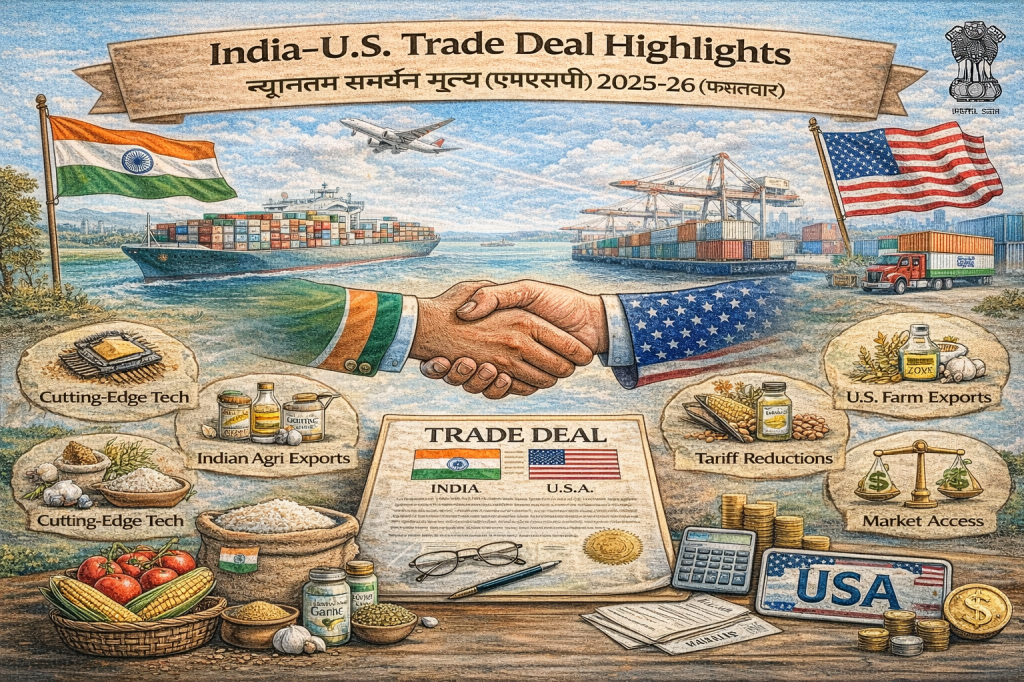
India and the US recently finalized an interim trade deal in early February 2026. The deal focuses on tariff reductions amid President Trump’s reciprocal tariff policies. India agreed to eliminate or reduce tariffs on various US goods. These include agricultural products. Meanwhile, the US lowered its reciprocal tariff on Indian imports from 25% to 18%.
Deal Overview
The agreement provides zero additional duty on $1.36 billion of Indian agricultural exports like spices, tea, and coffee, maintaining India’s $1.3 billion agri-trade surplus with the US. India will reduce tariffs on US items. These items include dried distillers’ grains (DDGS), red sorghum, tree nuts, and fresh/processed fruits. They also include soybean oil, wine, and spirits. Sensitive Indian farm items remain protected via an exclusion list, with no concessions granted.
Agriculture Impacts
US imports like DDGS and red sorghum are increasing. These imports will displace domestic maize, jowar, and soybean in animal feed. This shift may potentially lower prices for Indian farmers. Soybean oil imports may further depress soybean prices, affecting growers in states like Maharashtra and Madhya Pradesh amid ongoing distress. Concerns also arise over GM products in imports and non-tariff barriers being addressed.
Farmer Reactions
Government officials assure full protection for sensitive crops, telling farmers not to worry. Farmer groups express alarm over fodder crop competition and price crashes, urging safeguards. The deal prioritizes export gains for Indian forestry, livelihood crops, and farm products.
How are Indian soybean farmers affected by cheaper US soybean oil imports?
Indian soybean farmers face downward pressure on prices. This is due to cheaper US soybean oil imports. The imports are enabled by tariff reductions under the February 2026 India-US interim trade deal. This exacerbates existing surpluses and low realizations, prompting shifts to other crops.
Price Depression
Lower duties on US crude soybean oil (now around 16.5% or reduced further) make it more competitive than supplies from Argentina or Brazil, potentially flooding the market and reducing demand for domestically processed soybean oil and meal. Soybean prices have already slipped from Rs 5,800-6,000 to Rs 5,500-5,600 per quintal in key regions, below cost recovery levels. Farmers in Madhya Pradesh, Maharashtra, and Rajasthan—cultivating on 13 million hectares—are hit hardest, as every 100 kg of soybean yields 18 kg oil and 82 kg de-oiled cake (DOC).
Broader Effects
Increased DDGS imports compound the issue by displacing soyameal in animal feed, further depressing oilseed demand despite government oilseed promotion efforts. Farmer unions warn of inevitable losses, crop switching (e.g., to rice or peanuts), and anxiety over GM content in imports. Poultry benefits from cheaper feed, but millions of soybean growers risk income erosion without stronger safeguards.
What protections does the exclusion list provide for sensitive Indian crops?
The exclusion list in the February 2026 India-US interim trade deal fully protects India’s most sensitive agricultural crops and products by granting zero tariff concessions on US imports, shielding domestic farmers from competition. This calibrated approach, confirmed by Commerce Minister Piyush Goyal, ensures no market access for these items, preserving food security and livelihoods.
Key Excluded Crops
- Staples like wheat, rice, maize (corn), and soya (soybean).
- Oilseeds and derivatives, including raw soybeans.
- Dairy products such as milk and cheese.
Additional Protections
Vegetables (e.g., onions, potatoes), fruits (bananas, citrus, mangoes), spices, grains, poultry, meat, sugar, ethanol, tobacco, and GM crops receive no concessions, maintaining existing high tariffs or bans. This exemption category prioritizes political sensitivities and rural economies, while less sensitive items like tree nuts and soybean oil face phased reductions.
What Indian agricultural exports gain zero US tariffs
Under the February 2026 India-US interim trade deal, the US grants zero additional duties (zero tariffs) on $1.36 billion worth of Indian agricultural exports, boosting competitiveness in the American market. This reciprocal benefit enhances India’s $1.3 billion agri-trade surplus while protecting sensitive imports via an exclusion list.
Key Benefiting Products
- Spices, tea, coffee, and their extracts.
- Nuts including cashew, Brazil, areca, chestnut; copra, coconut oil, vegetable wax.
- Fruits and vegetables: avocados, bananas, guavas, mangoes, kiwis, papayas, pineapples, mushrooms.
Processed and Other Items
- Cereals and seeds: barley, canary seeds, sesame seeds, poppy seeds.
- Processed foods: bakery products, cocoa and preparations, fruit pulp/juices/jams, citrus juices.
Conclusion
India USA has locked in an interim trade deal. Its full-length details are yet to be finalized in the coming weeks. Although India has shown resilience to protect its agriculture sector but it has to bear the burnt in some areas. The farmers of India and agriculture sector is backbone of Indian economy. Thus hopefully India will stand firm to make it for the benefit of farmers.


Leave a Reply