
What is the Minimum Support Price (MSP) System in India?
Minimum Support Price (MSP) is a government-declared floor price at which the Government of India promises to buy certain agricultural crops from farmers. The objective is to protect farmers from sharp falls in market prices, ensure remunerative returns, and encourage stable food production.
Why MSP is Needed
- Agriculture prices fluctuate due to weather, supply gluts, and market imperfections.
- Farmers often face distress sales right after harvest.
- MSP acts as a price safety net, assuring farmers they won’t have to sell below a minimum price.
How MSP Works
- Announcement: MSPs are announced before the sowing season (Kharif and Rabi).
- Recommendation: The Commission for Agricultural Costs and Prices (CACP) recommends MSPs after analyzing:
- Cost of cultivation (A2, A2+FL, C2)
- Demand–supply situation
- Market price trends
- Impact on consumers and inflation
- Approval: The Cabinet Committee on Economic Affairs (CCEA) approves MSPs.
- Procurement: If market prices fall below MSP, government agencies (like FCI, NAFED) procure crops at MSP.
Crops Covered Under MSP
MSP is announced for 23 crops, including:
- Cereals: Paddy, Wheat, Maize, Jowar, Bajra
- Pulses: Gram, Tur, Moong, Urad, Lentil
- Oilseeds: Mustard, Groundnut, Soybean, Sunflower
- Commercial crops: Cotton, Sugarcane*
*Sugarcane uses FRP (Fair and Remunerative Price), similar to MSP.
MSP and Cost Formula
The government follows the principle of “1.5 times the cost of production (A2+FL)” for most crops, meaning MSP ≥ 1.5 × (paid-out costs + family labour).
Benefits of MSP
- Income security for farmers
- Production stability for key food crops
- Food security for the country
- Encourages adoption of improved inputs and technologies
Limitations and Challenges
- Limited procurement: Effective mainly for wheat and paddy in a few states
- Regional imbalance: Benefits concentrated in states with strong procurement systems
- Crop bias: Encourages cereal-heavy cultivation, affecting crop diversification
- Market distortion: Can discourage private trade in some cases
MSP vs Market Price
- MSP is a guaranteed minimum, not a fixed selling price.
- Farmers are free to sell at higher market prices if available.
- MSP becomes relevant when market prices crash.
Recent Reforms & Debates (in brief)
- Demand for legal guarantee of MSP
- Expanding procurement to pulses and oilseeds
- Promoting price deficiency payment models in some states
MSP is a safety cushion—it assures farmers a minimum price for their crops so they can farm without fear of losses due to price crashes.
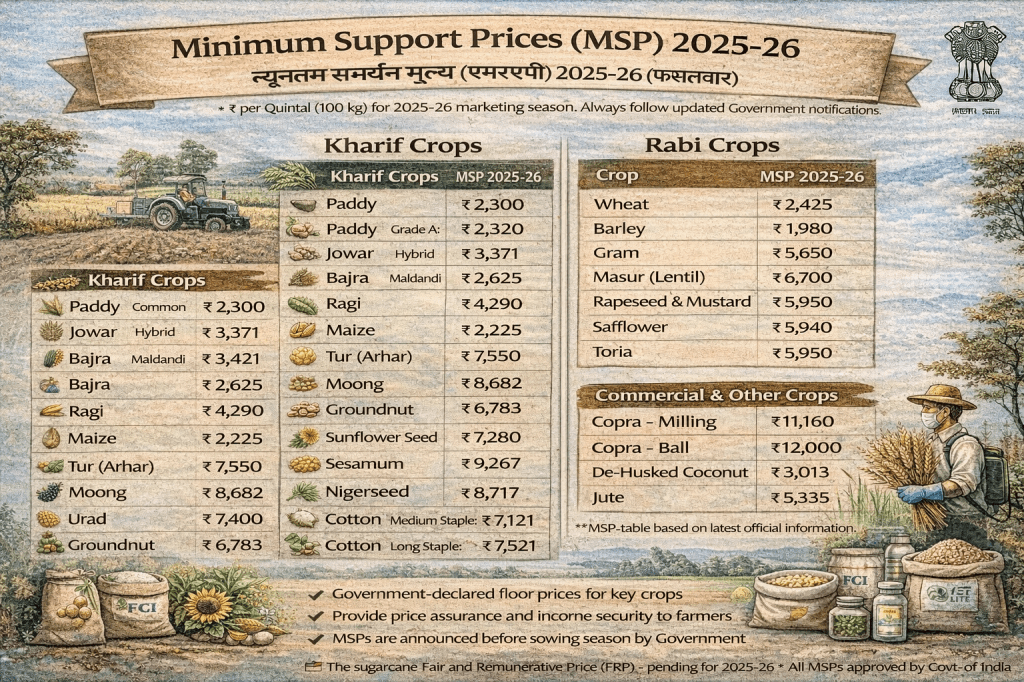
Minimum Support Prices – 2025-26 (Crop-wise)
(₹ per quintal)
Kharif Crops (खरीफ फसलें)
| Crop | Variety | MSP 2025-26 |
|---|---|---|
| Paddy | Common | ₹2,300 |
| Paddy | Grade A | ₹2,320 |
| Jowar | Hybrid | ₹3,371 |
| Jowar | Maldandi | ₹3,421 |
| Bajra | — | ₹2,625 |
| Ragi | — | ₹4,290 |
| Maize | — | ₹2,225 |
| Tur (Arhar) | — | ₹7,550 |
| Moong | — | ₹8,682 |
| Urad | — | ₹7,400 |
| Groundnut | — | ₹6,783 |
| Sunflower Seed | — | ₹7,280 |
| Soyabean (Yellow) | — | ₹4,892 |
| Sesamum | — | ₹9,267 |
| Nigerseed | — | ₹8,717 |
| Cotton | Medium Staple | ₹7,121 |
| Cotton | Long Staple | ₹7,521 |
| *(Kharif list from latest DES & MSP release) (Vajiram & Ravi) |
Rabi Crops (रबी फसलें)
| Crop | MSP 2025-26 |
|---|---|
| Wheat | ₹2,425 |
| Barley | ₹1,980 |
| Gram | ₹5,650 |
| Masur (Lentil) | ₹6,700 |
| Rapeseed & Mustard | ₹5,950 |
| Safflower | ₹5,940 |
| Toria | ₹5,950 |
| *(Approved by Cabinet for the 2025-26 Rabi season) (Vajiram & Ravi) |
Commercial & Other Crops
| Crop | MSP 2025-26 |
|---|---|
| Copra – Milling | ₹11,160 |
| Copra – Ball | ₹12,000 |
| De-Husked Coconut | ₹3,013 |
| Jute | ₹5,335 |
| *(Commercial crop MSP list as per DES MSP release) (Directorate of Economics and Statistics) |
Conclusion Notes
- These MSPs apply for the 2025-26 marketing season announced by the Government of India. (Vajiram & Ravi)
- MSPs are revised annually before the sowing season to ensure farmers get remunerative prices and encourage production. (pmindia.gov.in)
- Actual procurement and benefits vary across crops and states depending on procurement operations and storage capacity.


Leave a Reply