
What Are Agrochemicals? कृषि रसायन क्या हैं?
Agrochemicals play a crucial role in modern agriculture by protecting crops from pests, diseases, and weeds, and by improving crop productivity. However, indiscriminate use can harm human health, soil fertility, water resources, and beneficial organisms. Therefore, understanding their types, correct usage, and safety measures is essential for sustainable farming. Agrochemicals are chemical substances used in agriculture to:
- Control pests, diseases, and weeds
- Enhance crop growth and yield
- Protect harvested produce
They are commonly used in crop production, storage, and post-harvest management.
Types of Agrochemicals कृषि रसायनों के प्रकार
Fertilizers उर्वरक
Used to supply essential nutrients like Nitrogen (N), Phosphorus (P), and Potassium (K).
Examples:
- Urea
- DAP
- MOP
- NPK mixtures
Purpose:
- Promote plant growth
- Increase yield
Pesticides कीटनाशक
Chemicals used to control insects, diseases, weeds, rodents, and nematodes.
a) Insecticides – Control insects
b) Fungicides – Control fungal diseases
c) Herbicides (Weedicides) – Control weeds
d) Rodenticides – Control rats and rodents
Plant Growth Regulators (PGRs) पादप वृद्धि नियामक
Used to regulate flowering, fruiting, and plant growth.
Examples:
- Gibberellic acid
- NAA
- Ethrel
Fumigants धूमन रसायन
Used mainly in stored grains and soil treatment.
Examples:
- Aluminium phosphide
- Methyl bromide (restricted)
Need for Safe and Judicious Use of Agrochemicals
कृषि रसायनों के सुरक्षित एवं विवेकपूर्ण उपयोग की आवश्यकता
Excessive and improper use leads to:
- Pest resistance
- Residues in food
- Soil and water pollution
- Health hazards to farmers and consumers
Hence, balanced and responsible use is necessary.
Principles of Safe and Judicious Use सुरक्षित एवं विवेकपूर्ण उपयोग के सिद्धांत
🌿 1. Use Recommended Dose Only अनुशंसित मात्रा का ही प्रयोग करें
- Never exceed the prescribed dosage
- Follow label instructions
🌿 2. Right Chemical at Right Time सही समय पर सही रसायन का प्रयोग
- Spray at economic threshold level (ETL)
- Avoid calendar-based spraying
🌿 3. Adopt Integrated Pest Management (IPM) एकीकृत कीट प्रबंधन अपनाएं
- Combine cultural, biological, mechanical, and chemical methods
- Chemicals should be the last option
🌿 4. Use Protective Equipment सुरक्षा उपकरणों का प्रयोग करें
- Gloves, mask, goggles, long clothing
- Avoid spraying against wind
🌿 5. Safe Storage and Disposal सुरक्षित भंडारण एवं निपटान
- Store away from food and children
- Do not reuse pesticide containers
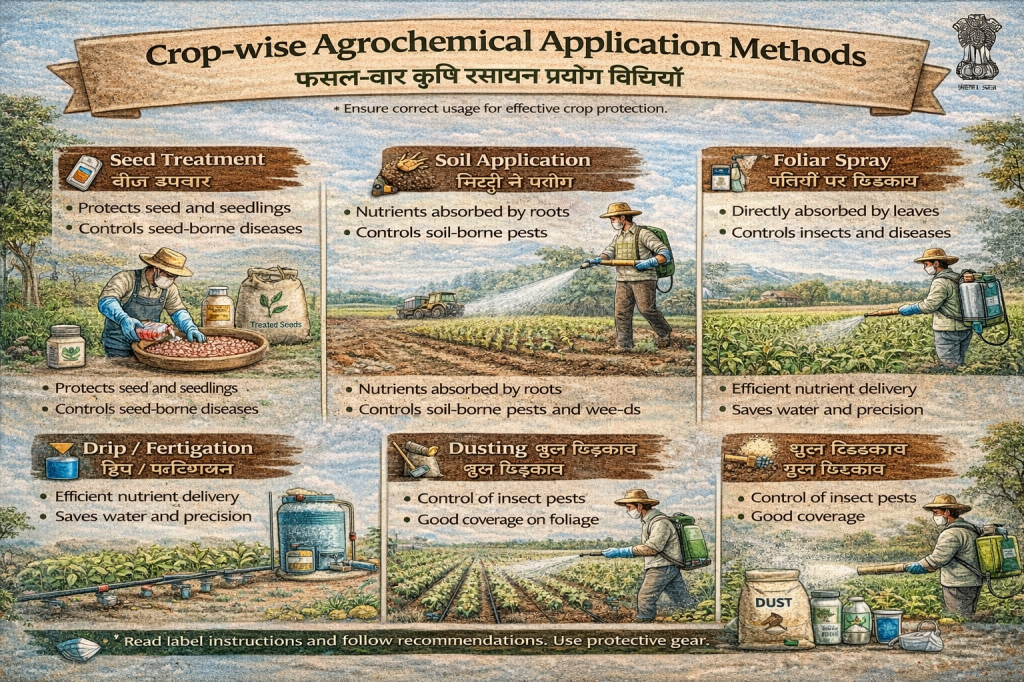
Methods of Agrochemical Application कृषि रसायनों के प्रयोग की विधियाँ
| Method | Description |
|---|---|
| Seed treatment | Chemical coating on seeds |
| Soil application | Mixed with soil before or after sowing |
| Foliar spray | Sprayed on leaves |
| Drip / fertigation | Applied through irrigation |
| Dusting | Dry powder application |
| Fumigation | Gas treatment in storage |
Crop-wise Pesticide Recommendation Table फसलवार कीटनाशक अनुशंसा तालिका
| Crop | Major Pest / Disease | Recommended Pesticide | Dose / Method |
|---|---|---|---|
| Rice | Stem borer | Chlorantraniliprole | 150 ml/ha spray |
| Brown planthopper | Imidacloprid | 100 ml/ha | |
| Wheat | Aphids | Thiamethoxam | 100 g/ha |
| Loose smut | Carboxin (Seed treatment) | 2 g/kg seed | |
| Cotton | Bollworm | Emamectin benzoate | 220 g/ha |
| Whitefly | Flonicamid | 200 g/ha | |
| Maize | Fall armyworm | Spinetoram | 180 ml/ha |
| Pulses | Pod borer | Indoxacarb | 500 ml/ha |
| Vegetables | Fruit borer | Spinosad | 150 ml/ha |
| Sugarcane | Early shoot borer | Chlorpyriphos | Soil application |
| Oilseeds | Aphids | Dimethoate | 1 ml/litre |
⚠️ Always follow state agriculture department recommendations.
Environmental and Health Considerations पर्यावरण एवं स्वास्थ्य संबंधी सावधानियाँ
- Observe waiting period before harvest
- Avoid spraying near water bodies
- Promote bio-pesticides and organic inputs
Conclusion
Agrochemicals are powerful tools in crop protection and productivity, but their misuse can cause serious environmental and health problems. By adopting safe, judicious, and need-based use, along with IPM practices, farmers can ensure sustainable agriculture and food safety.


Leave a Reply