
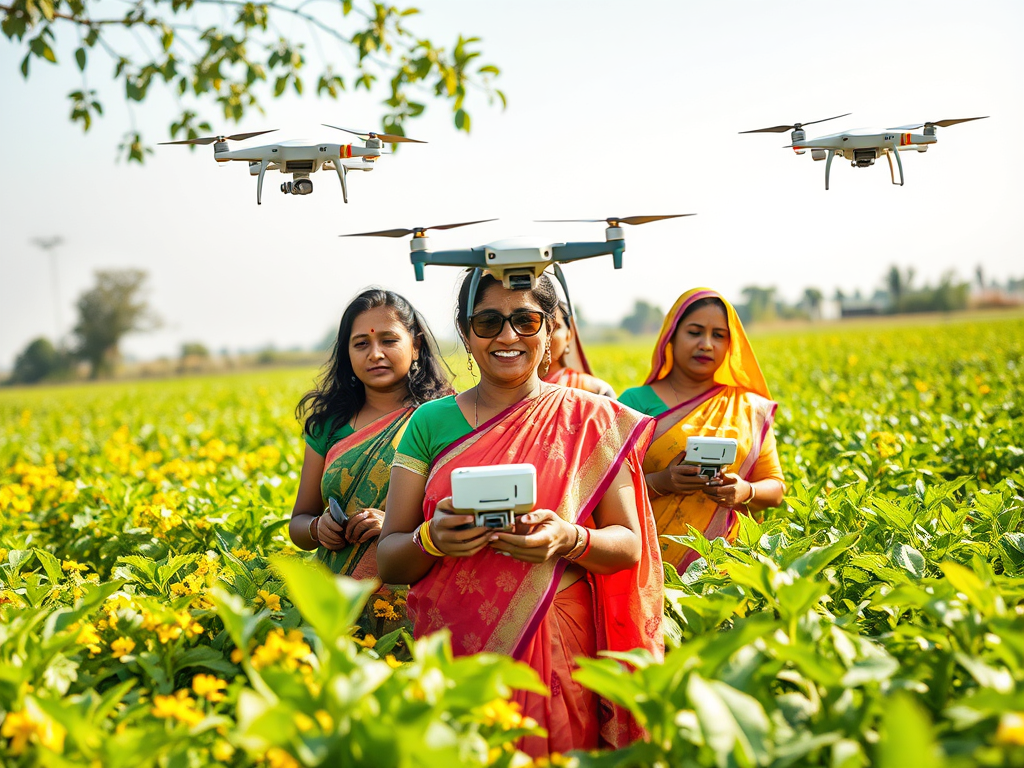
What is NaMo Drone Didi Yojana?
The NaMo Drone Didi Yojana is one of India’s most transformative rural development schemes. It aims at empowering women in agriculture. It also focuses on modernizing farming techniques and making villages self-reliant. The scheme was launched by the Government of India in 2023. It connects technology with women-led entrepreneurship. It does this by training Women Self-Help Groups (SHGs) to operate drones for agricultural activities.
The Government has recently approved a Central Sector Scheme for providing drones to the Women Self Help Group (SHGs) for the period from 2024-25 to 2025-26 with an outlay of Rs. 1261 Crores. The scheme aims to provide drones to 15000 selected Women Self Help Group (SHGs) for providing rental services to farmers for agriculture purpose (application of fertilizers and pesticides). Under this Scheme, Central Financial Assistance @ 80% of the cost of drone and accessories/ancillary charges upto a maximum of Rs. 8.0 Lakhs will be provided to the women SHGs for purchase of drones. The Cluster Level Federations (CLFs) of SHGs may raise the balance amount (total cost of procurement minus subsidy) as loan under National Agriculture Infra Financing Facility (AIF). Interest subvention @ 3% on the AIF loan will be provided to the CLFs. The scheme will also provide sustainable business and livelihood support to SHGs and they would be able to earn additional income of at least of Rs. 1.0 lakh per annum.
Namo Drone Didi Drone Fertlizer – krishicenter
These drones can be used for:
Spraying fertilizers
Spraying pesticides
Nano urea application
Crop monitoring
Land mapping
Women trained under this program become certified drone operators, and their SHG becomes a drone service provider in the village. This creates a new income source for women while supporting farmers with modern technology at affordable rates.
Key Objectives of the Scheme
The primary goals of this scheme include:
Women Empowerment: Build women entrepreneurs in rural areas by giving them high-income skills.
Modernizing Agriculture: Introduce drone-based spraying and mapping for precision farming.
Reducing Farmer Costs: Drone spraying uses less water, less pesticide, and yields better coverage.
Safety for Farmers: Prevent direct contact with harmful chemicals.
Boosting Rural Economy: SHGs earn revenue by offering drone services to nearby farms.
Job Creation: Drone pilots, technicians, battery handlers, data analysts, and repair workers.
Training Provided Under the Scheme
Women receive professional training through accredited institutes to understand the Drone technology and to adapt the usage. After training, women are certified as Drone Pilots and can legally run the machines for agricultural use. Training Includes:
Understanding drone components
Remote operation techniques
Safety protocols
Loading and spraying techniques
Battery management
Minor repair & maintenance
Field management
Data reading (GPS, maps, spraying routes)
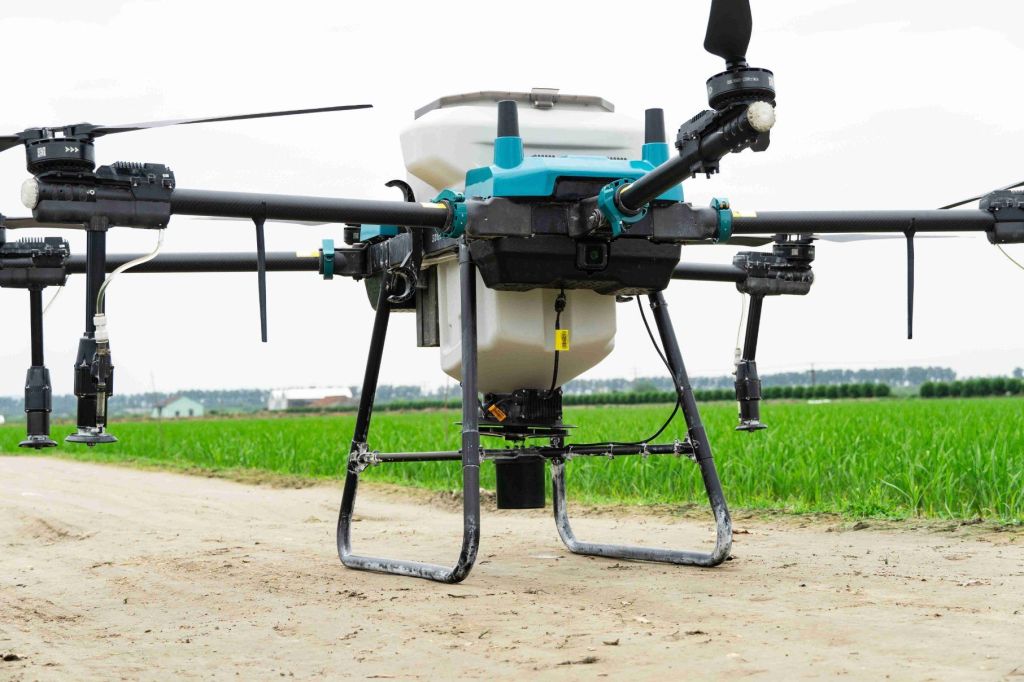
What Type of Drones Are Used?
The scheme uses Agri Drones with modern features:
Typical Drone Specifications:
- Payload: 10–15 liters
- Flight time: 15–25 minutes per battery
- GPS-enabled autopilot
- Pre-programmed spraying routes
- Safety sensors
- Uniform droplet spraying system
- Real-time field monitoring
- Optional multi view camera (for crop health)
These drones increase efficiency and reduce manual labor for farmers.
Financial Assistance & Subsidy Structure
This is one of the strongest parts of the scheme.
Government Support:
- SHGs can access a large subsidy to purchase drones.
- Subsidies typically range between ₹5 lakh to ₹10 lakh depending on the model, training, and support package.
- Easy loans are provided to SHGs through banks.
- NABARD and Rural Livelihood Mission assist in financing.
Cost to Farmers:
Farmers pay a service charge for drone spraying.
Typical rate:
- ₹300–₹600 per acre (depending on crop & area)
This is cheaper than manual spraying and gives better results.
Benefits of NaMo Drone Didi Scheme
For Women:
- High-income opportunity
- Respect and recognition in the village
- Long-term career as drone pilots
- New role in agricultural modernization
For Farmers:
- Saves time and labor
- Precise & uniform spraying
- Reduction in pesticide usage
- Increased productivity
- Safe from chemical exposure
- Covers 10–20 acres/day per drone
For Rural India:
- Creation of drone hubs
- Technical skill development
- Local employment generation
- Boost to Make-in-India agri-tech startups
Namo Drone Didi Drone technology Multispecter – krishicenter
How the NaMo Drone Didi Scheme Works:
Implementation & Operational Model
- SHGs are shortlisted by Rural Livelihood Mission.
- Selected women undergo drone pilot training.
- SHGs receive a drone through subsidy/loan support.
- A cluster of nearby villages is assigned as a service area.
- Farmers book drone spraying services through SHG members.
- Earnings are shared among SHG members and used for maintenance.
Operational Revenue Model
- Per-acre spraying charges
- Annual maintenance contracts with farmers
- Government spraying programs for pests (locust control, disease control)
- Crop health imaging contracts
This model is designed to be economically sustainable.
Who Can Become a Drone Didi?
Eligibility & Selection
- Must be part of a Self-Help Group (SHG)
- Should have basic literacy
- Willingness to learn and travel within the village
- Minimum age: 18 years
- Physically fit and mentally confident for technical training
Priority is given to:
- Rural women
- Women from low-income backgrounds
- Active SHG (Self Help Group) members
Impact on Agriculture
The scheme is bringing huge positive changes:
✔ Increased Yield by Better spraying. It results in healthier crops thus generating more profit per acre.
✔ Reduced Input Costs as Less pesticide through evenly spraying technique and less water usage.
✔ Faster Farm Operations through automated approach. It usually is 10 times faster than manual spraying.
✔ Improved Safety for farmers. No direct exposure to chemicals.
✔ Climate-Friendly Optimized input use reduces the harsh environmental impact.
Namo Drone Didi Drone Spraying – krishicenter
Challenges & Limitations
Although highly beneficial, a few challenges exist:
- High initial cost of drones
- Battery limitations (frequent charging needed)
- Need for regular maintenance
- Lack of awareness among farmers
- Weather dependency (strong winds affect spraying)
- Technical skill gap in some regions
Government and training institutes are continuously working to solve these issues.
Future of NaMo Drone Didi Yojana
The future is incredibly promising:
- Expansion to every block/village cluster
- More advanced drones with longer flight time
- Integration with AI & data analytics
- Crop disease prediction using drone imaging
- Creation of a nationwide network of women agri-tech leaders
- More service-based rural businesses emerging around drones
This scheme will help India become a global leader in technology-led agriculture.
🌿 Conclusion
The NaMo Drone Didi Yojana is more than a government program. It is a revolution that combines women empowerment. It also fosters rural development and agricultural modernization. The scheme is transforming Indian agriculture. It trains rural women as drone pilots. It also makes advanced technology accessible to farmers. Together, these efforts make agriculture more scientific, efficient, and safe. This mission aligns with India’s goals of doubling farmers’ income, promoting precision farming, and creating rural employment through modern tools.
With continuous support, better training, and wider implementation, NaMo Drone Didi will create a future. Every village will have skilled women entrepreneurs. Every farmer will have access to modern spraying tools. Agriculture will become more profitable for all.


Leave a Reply