
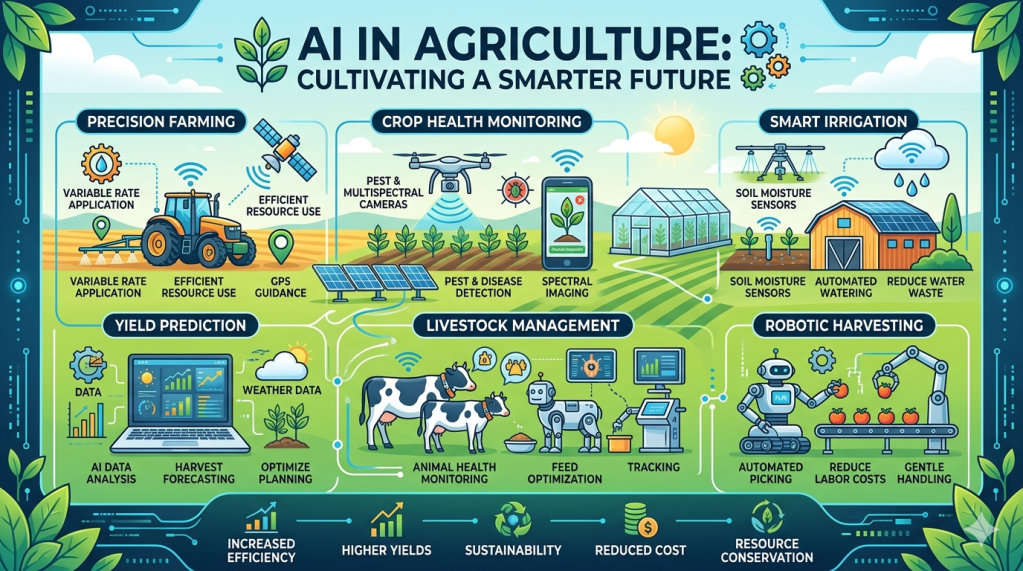
Use of AI and IoT in Agriculture
Modern agriculture is rapidly transforming with the integration of Artificial Intelligence (AI) and the Internet of Things (IoT). These technologies enable farmers to make data-driven decisions, improve productivity, reduce input costs, and promote sustainable farming practices.
AI and IoT together form the foundation of Smart Farming or Precision Agriculture. In this system, crops are monitored and managed using real-time data, sensors, automation, and predictive analytics.
The use of digital technologies helps farmers address challenges such as:
- Climate variability
- Water scarcity
- Soil degradation
- Pest attacks
- Rising input costs
What is AI in Agriculture?
Artificial Intelligence refers to computer systems capable of performing tasks that normally require human intelligence, such as learning, reasoning, prediction, and decision-making.
In agriculture, AI analyzes large datasets collected from fields to provide recommendations regarding:
- Crop selection
- Fertilizer application
- Pest management
- Irrigation scheduling
- Yield prediction
AI uses technologies such as:
- Machine Learning
- Computer Vision
- Robotics
- Predictive Analytics
What is IoT in Agriculture?
Internet of Things refers to a network of physical devices embedded with sensors, software, and connectivity that collect and exchange data over the internet.
In farming, IoT devices monitor:
- Soil moisture
- Temperature
- Humidity
- Crop health
- Livestock movement
- Weather conditions
These sensors send data to cloud platforms where AI analyzes the information and suggests optimal actions.
Importance of AI and IoT in Agriculture
1. Precision Farming
AI and IoT help farmers apply the right input, at the right time, in the right quantity.
Benefits:
- Reduced fertilizer wastage
- Efficient water use
- Increased crop yield
2. Cost Reduction
Automated systems reduce labor costs and prevent excessive use of inputs like pesticides and fertilizers.
3. Increased Productivity
Data-driven decisions help improve crop growth and productivity.
4. Climate-smart Agriculture
AI predicts weather patterns and helps farmers prepare for droughts, floods, or temperature changes.
5. Sustainable Farming
Technology reduces environmental impact by minimizing chemical usage.
Components of AI and IoT-based Smart Agriculture
1. Sensors
Sensors collect field data such as:
- Soil moisture
- Soil pH
- Temperature
- Humidity
- Light intensity
2. GPS Technology
GPS helps track field location and monitor farm activities accurately.
3. Cloud Computing
Collected data is stored on cloud servers for analysis.
4. Mobile Applications
Farmers receive recommendations on smartphones.
5. Drones and Robotics
Used for crop monitoring and pesticide spraying.
Applications of AI and IoT in Agriculture
1. Smart Irrigation Systems
IoT sensors measure soil moisture and automatically control irrigation systems.
Advantages:
- Saves water
- Prevents over-irrigation
- Improves crop health
Example:
Automatic drip irrigation based on soil moisture levels.
2. Crop Health Monitoring
AI-powered cameras and drones detect:
- Plant diseases
- Nutrient deficiencies
- Pest attacks
Farmers receive early warnings to prevent crop loss.
3. Pest and Disease Detection
AI image recognition identifies plant diseases from leaf images.
Benefits:
- Early detection
- Reduced pesticide usage
- Increased yield
4. Soil Health Monitoring
IoT sensors analyze soil conditions to measure soil health such as:
- Moisture
- Nutrient levels
- pH value
Farmers can apply fertilizers based on soil requirement.
5. Weather Prediction
AI analyzes historical weather data to predict:
- Rainfall
- Temperature
- Storm risk
Farmers can plan sowing and harvesting accordingly.
6. Smart Fertilizer Management
AI recommends optimal fertilizer dosage.
Advantages:
- Reduced cost
- Improved soil fertility
- Higher productivity
7. Automated Farm Machinery
Robots and AI machines perform tasks such as:
- Harvesting
- Weeding
- Spraying pesticides
Reduces labor dependency.
8. Livestock Monitoring
IoT devices track animal:
- Health
- Movement
- Feeding behavior
Farmers receive alerts for disease symptoms.
Working Process of AI and IoT in Agriculture
Step 1: Data Collection
Sensors collect real-time field data.
Step 2: Data Transmission
Data is transmitted via internet to cloud servers.
Step 3: Data Analysis
AI analyzes data using algorithms.
Step 4: Decision Making
AI provides recommendations to farmers.
Step 5: Action Implementation
Farmers take action such as irrigation or fertilizer application.
Flowchart of AI and IoT in Agriculture
Sensors collect farm data │ ▼IoT devices transmit data │ ▼Cloud storage system │ ▼AI analyzes data │ ▼Recommendations to farmers │ ▼Improved crop productivity
Advantages of AI and IoT in Agriculture
Economic Benefits
- Higher income for farmers
- Reduced input costs
- Increased efficiency
Environmental Benefits
- Reduced chemical usage
- Water conservation
- Soil health improvement
Social Benefits
- Reduced farmer workload
- Increased rural employment opportunities
- Improved food security
Challenges in Adoption
- High initial cost of devices
- Lack of digital literacy among farmers
- Internet connectivity issues in rural areas
- Data privacy concerns
- Need for technical training
Future Scope of Smart Agriculture
AI and IoT will play a major role in:
- Precision agriculture expansion
- Climate-resilient farming
- Autonomous tractors and robots
- Real-time crop monitoring
- Digital agriculture platforms
Governments and private companies are promoting digital agriculture initiatives to improve productivity and sustainability.
Conclusion
The use of AI and IoT in agriculture is revolutionizing traditional farming into smart, efficient, and sustainable agriculture. These technologies help farmers optimize resources, reduce risks, and increase productivity.
Adoption of AI-based agriculture systems will contribute significantly to food security, environmental protection, and rural economic development.
 KrishiCenter
Leave a comment