
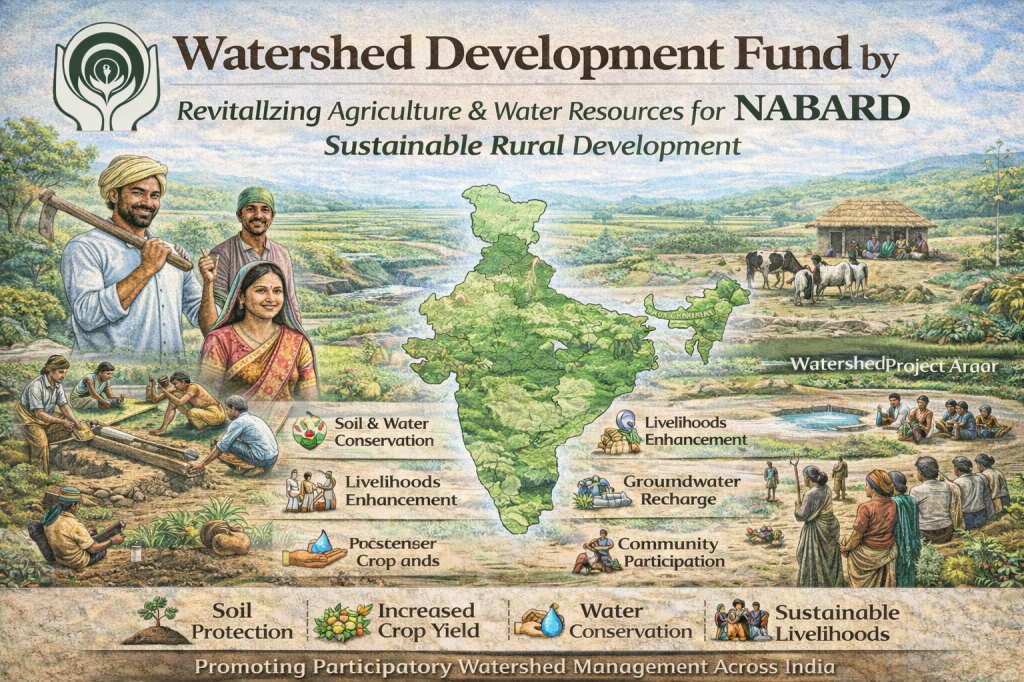
A watershed is an area of land where all rainfall drains into a common outlet such as a stream, river, or lake.
In watershed development:
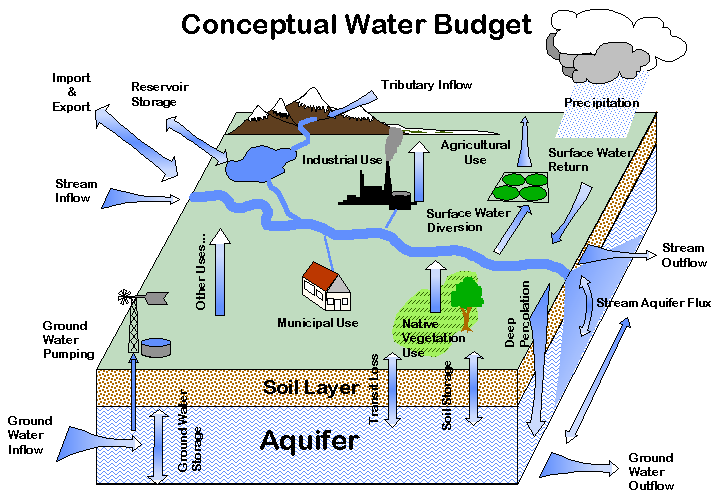
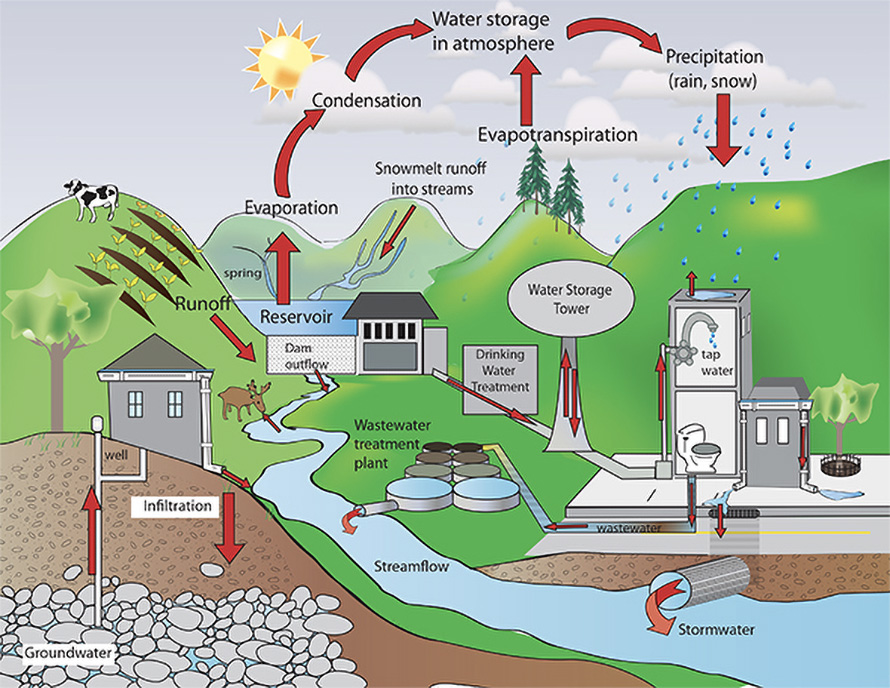
- Rainfall falls on the land surface.
- Some water becomes surface runoff.
- Some water infiltrates into the soil.
- Groundwater is recharged through structures like check dams and percolation tanks.
- Soil and water conservation improves crop productivity and vegetation growth.


The concept follows a “Ridge to Valley Approach”, meaning treatment begins at the highest elevation and gradually moves toward the valley.
Ridge to Valley Treatment Flow Diagram

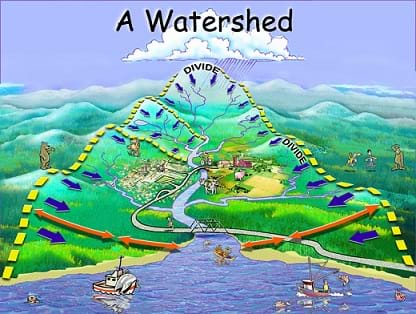
Explanation of Ridge to Valley Approach
| Location | Treatment Measures |
|---|---|
| Ridge Area (Top Hills) | Afforestation, contour trenches, vegetative barriers |
| Upper Slope | Contour bunding, staggered trenches |
| Middle Slope | Farm bunds, gully plugs |
| Lower Slope | Check dams, percolation tanks |
| Valley Area | Farm ponds, irrigation development |
This method reduces soil erosion and allows maximum water infiltration.
Watershed Development Programme Flowchart (Project Implementation)
Identification of Watershed Area │ ▼Baseline Survey & Resource Mapping │ ▼Community Mobilization(Village meetings, awareness) │ ▼Formation of InstitutionsWatershed CommitteeSelf Help GroupsUser Groups │ ▼Capacity Building PhaseTraining & Planning │ ▼Preparation of Detailed Project Report(DPR) │ ▼Implementation PhaseSoil & Water Conservation Works• Contour Bunding• Check Dams• Farm Ponds• Afforestation │ ▼Livelihood Activities• Horticulture• Dairy• Agro-forestry │ ▼Monitoring & Evaluation(GIS / Remote sensing) │ ▼Post Project SustainabilityMaintenance by Community
Institutional Structure Diagram (NABARD Watershed Projects)
                 NABARD
                   │
                   ▼
        State Level Steering Committee
                   │
                   ▼
        Project Implementing Agency
           (NGO / Govt Agency)
                   │
                   ▼
            Watershed Committee
                   │
        ┌──────────┼──────────┐
        ▼          ▼          ▼
    User Groups  SHGs     Farmers
                   │
                   ▼
         Community Participation
Watershed Development Cycle
Planning → Implementation → Monitoring → Evaluation → Sustainability ▲ │ └────────────────Community Participation───────────────┘
Key principles:
- Participatory approach
- Sustainable natural resource management
- Livelihood improvement
Final Key Points for Successful Completion of Watershed Development
Here are the final key points for successful completion of a Watershed Development Process, useful for assignments, reports, or exam answers.
Final Key Points for Successful Completion of Watershed Development
1. Strong Community Participation
- Active involvement of local farmers, villagers, and stakeholders is essential.
- Formation of Watershed Committees, Self-Help Groups (SHGs), and User Groups ensures collective decision-making and ownership.
2. Ridge to Valley Approach
- Treatment must follow the ridge-to-valley principle to control soil erosion effectively.
- Upper areas are treated first, followed by middle slopes and valley areas.
3. Integrated Natural Resource Management
- Successful projects integrate soil conservation, water management, vegetation restoration, and agriculture improvement.
- Activities should include afforestation, contour bunding, check dams, and farm ponds.
4. Capacity Building and Training
- Continuous training of farmers and local institutions improves technical knowledge and maintenance skills.
- Awareness programs help communities adopt sustainable practices.
5. Proper Planning and Scientific Assessment
- Detailed baseline surveys, resource mapping, and planning ensure the correct selection of interventions.
- Use of GIS, remote sensing, and hydrological studies improves project accuracy.
6. Sustainable Livelihood Development
- Watershed projects should include income-generating activities such as horticulture, livestock rearing, agro-forestry, and small enterprises.
- This ensures long-term economic benefits for local communities.
7. Effective Monitoring and Evaluation
- Regular monitoring ensures quality implementation and timely correction of issues.
- Tools such as geo-tagging, satellite monitoring, and progress reports help track project outcomes.
8. Maintenance of Watershed Structures
- Post-project maintenance of structures like check dams, bunds, and ponds is crucial for sustainability.
- Communities should create a Watershed Development Fund or maintenance fund.
9. Institutional Strengthening
- Strengthening local institutions such as Village Watershed Committees ensures long-term governance and management of natural resources.
10. Long-Term Environmental and Economic Impact
A successful watershed project results in:
- Improved groundwater levels
- Reduced soil erosion
- Increased crop productivity
- Improved vegetation cover
- Higher farmer income and rural employment
Conclusion
Successful watershed development relies on community participation, scientific planning, and sustainable resource management. It also depends on the long-term maintenance of conservation structures. These efforts ultimately lead to improved agricultural productivity. They enhance environmental sustainability and improve rural livelihood
 KrishiCenter
Leave a comment