
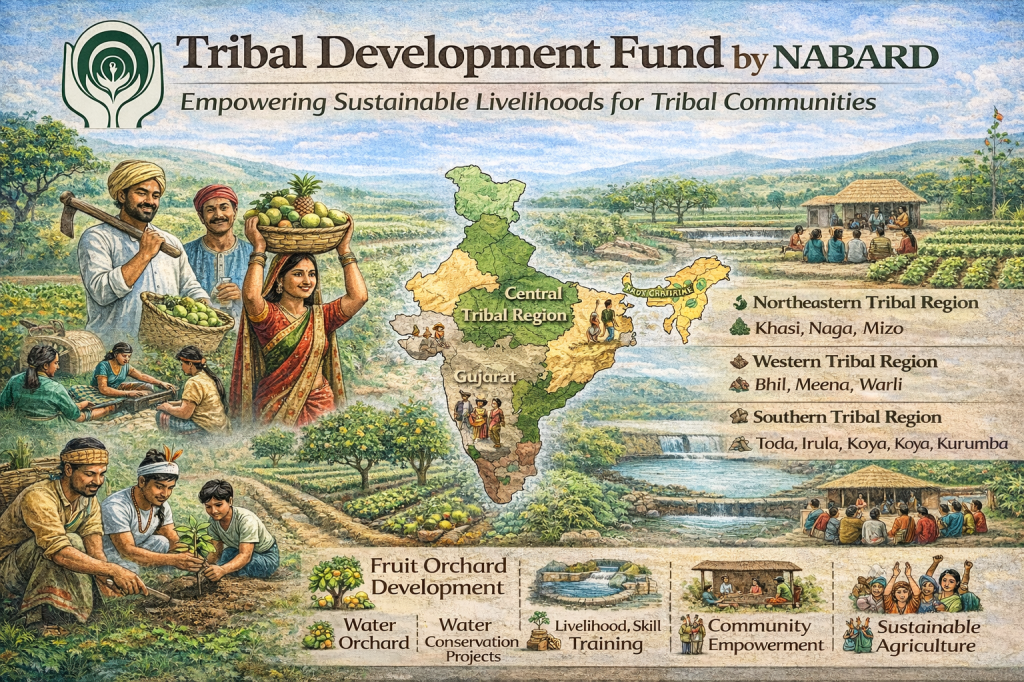
India is home to one of the largest tribal populations in the world. Tribal communities are often referred to as Scheduled Tribes (STs). They represent a significant segment of the rural population. These communities have unique cultural, social, and ecological traditions. However, these communities have historically faced challenges such as poverty, geographical isolation, limited access to infrastructure, and inadequate livelihood opportunities. To address these issues, various developmental initiatives have been undertaken by the Government of India and development institutions. Among these initiatives, the Tribal Development Fund (TDF) is implemented by the National Bank for Agriculture and Rural Development (NABARD). It plays a critical role in improving the socio-economic conditions of tribal households. This is achieved through sustainable livelihood promotion.
The Tribal Development Fund focuses on integrated development strategies that combine agriculture, horticulture, forestry, and community development. This essay examines the concept of the Tribal Development Fund. It outlines its objectives and implementation strategy. Additionally, it discusses the distribution of tribal communities across different regions of India.
Understanding Tribal Communities in India
Tribal communities in India are indigenous groups that have historically lived in forests, hills, and remote regions. These communities possess distinct languages, customs, traditions, and livelihood practices. According to the Census of India, Scheduled Tribes constitute about 8–9 percent of the country’s total population.
Tribal populations are primarily concentrated in central, northeastern, and some southern parts of India. Many tribal communities depend on natural resources such as forests, rivers, and land for their livelihoods. Traditional activities include shifting cultivation, hunting, gathering forest produce, livestock rearing, and small-scale farming.
Despite their cultural richness, tribal communities often face developmental challenges such as limited access to education, healthcare, markets, and financial services.
What is the Tribal Development Fund (TDF)?
The Tribal Development Fund (TDF) is a development initiative launched by the National Bank for Agriculture and Rural Development. It aims to promote sustainable livelihoods among tribal families. This is achieved through participatory and community-based approaches.
The fund primarily supports wadi-based orchard development models, where tribal farmers cultivate fruit trees such as mango, cashew, tamarind, or other region-specific crops on small plots of land. Along with orchard development, the programme integrates activities such as soil conservation, water management, livestock rearing, and capacity building.
The Tribal Development Fund emphasizes long-term livelihood improvement rather than short-term financial assistance. The approach encourages tribal communities to adopt sustainable farming practices while protecting natural resources.
Objectives of the Tribal Development Fund
The main objectives of the Tribal Development Fund include:
- Enhancing Livelihood Opportunities
The programme aims to increase income levels of tribal families by promoting horticulture, agroforestry, and allied agricultural activities. - Promoting Sustainable Agriculture
TDF encourages eco-friendly farming practices that conserve soil, water, and biodiversity. - Reducing Poverty in Tribal Regions
By improving agricultural productivity and market access, the programme helps reduce poverty among tribal communities. - Strengthening Community Institutions
The programme supports self-help groups and community organizations to enhance collective participation in development activities. - Improving Natural Resource Management
TDF promotes watershed management, soil conservation, and sustainable land use practices.
The Wadi Model of Tribal Development
A distinctive feature of the Tribal Development Fund is the Wadi model, which was originally developed by the BAIF Development Research Foundation. In this model, tribal farmers cultivate orchards on small landholdings, typically covering one to two acres.
The Wadi model integrates several components:
- Fruit tree plantation (mango, cashew, etc.)
- Intercropping with vegetables or pulses
- Soil and water conservation measures
- Livestock development
- Capacity building and training
- Market linkages
This integrated approach ensures that farmers receive both short-term income from intercrops and long-term income from fruit orchards.
Implementation Mechanism
The Tribal Development Fund is implemented through partnerships with:
- Non-governmental organizations (NGOs)
- Farmer producer organizations
- State governments
- Community-based institutions
These implementing agencies work closely with tribal communities to identify beneficiaries, develop project plans, provide technical training, and monitor progress.
Financial support under the vairous schemes and programme typically includes assistance for plantation development, irrigation facilities, fencing, soil conservation structures, and capacity-building activities.
Impact of the Tribal Development Fund
Over the years, the Tribal Development Fund has had a significant impact on tribal livelihoods. Some of the major outcomes include:
1. Increased Income
Fruit orchards and diversified farming systems have provided stable income sources for tribal households.
2. Improved Agricultural Practices
Farmers have adopted modern agricultural techniques such as drip irrigation, organic farming, and improved crop management.
3. Environmental Sustainability
The programme promotes tree-based farming systems that enhance soil fertility, prevent erosion, and improve biodiversity.
4. Empowerment of Tribal Communities
Community participation in planning and implementation strengthens local governance and social cohesion.
5. Reduction in Migration
With better livelihood opportunities in their villages, many tribal families reduce seasonal migration to urban areas.
Major Tribal Regions in India
Tribal communities in India are distributed across different geographical regions, each with unique cultural characteristics.
Central Indian Tribal Belt
This region contains the largest concentration of tribal populations and includes states such as:
- Madhya Pradesh
- Chhattisgarh
- Jharkhand
- Odisha
- Maharashtra
Major tribes in this region include:
- Gond
- Bhil
- Santhal
- Oraon
- Munda
These tribes primarily depend on agriculture and forest-based livelihoods.
Northeastern Tribal Region
The northeastern states have diverse tribal populations with rich cultural traditions. States in this region include:
- Assam
- Meghalaya
- Nagaland
- Mizoram
- Arunachal Pradesh
- Tripura
- Manipur
Prominent tribes in the northeast include:
- Khasi
- Garo
- Naga
- Mizo
- Bodo
- Apatani
Many of these communities practice shifting cultivation (jhum cultivation) and maintain strong community governance systems.
Western Tribal Region
This region includes tribal populations in:
- Rajasthan
- Gujarat
- Maharashtra
Important tribes include:
- Bhil
- Meena
- Garasia
- Warli
These communities traditionally rely on agriculture, forest products, and livestock rearing.
Southern Tribal Region
Southern India also has several tribal communities located in forested and hilly areas. States include:
- Andhra Pradesh
- Telangana
- Karnataka
- Kerala
- Tamil Nadu
Major tribes in this region include:
- Toda
- Irula
- Chenchu
- Koya
- Kurumba
Many of these tribes maintain traditional ecological knowledge and sustainable forest management practices.
Challenges in Tribal Development
Despite the progress achieved through initiatives like the Tribal Development Fund, several challenges remain.
- Geographical Isolation
Many tribal villages are located in remote areas with limited infrastructure. - Limited Access to Markets
Farmers often face difficulties in marketing their produce. - Low Literacy Levels
Educational barriers restrict access to modern technologies and financial services. - Land Ownership Issues
Unclear land rights can discourage long-term agricultural investments. - Climate Vulnerability
Tribal regions are often sensitive to climate variability and environmental degradation.
Future Prospects
To enhance the impact of the Tribal Development Fund, several measures can be considered:
- Expanding irrigation facilities in tribal regions
- Strengthening farmer producer organizations
- Promoting value addition and agro-processing
- Enhancing digital access and market connectivity
- Encouraging youth participation in agriculture and entrepreneurship
These strategies can create sustainable livelihood opportunities while preserving the cultural and ecological heritage of tribal communities.
Conclusion
The Tribal Development Fund represents an important initiative for promoting inclusive and sustainable development among tribal populations in India. The programme has improved income levels by focusing on horticulture-based livelihoods, natural resource management, and community participation. It has also strengthened resilience among tribal families.
The fund is implemented by the National Bank for Agriculture and Rural Development. It demonstrates how development interventions can be designed to respect cultural traditions. These interventions also address economic challenges. As India continues its journey toward equitable growth, initiatives such as the Tribal Development Fund will remain essential. They ensure that tribal communities benefit from the nation’s development. These initiatives also help preserve their unique identities and ecological wisdom.
 KrishiCenter
Leave a comment