
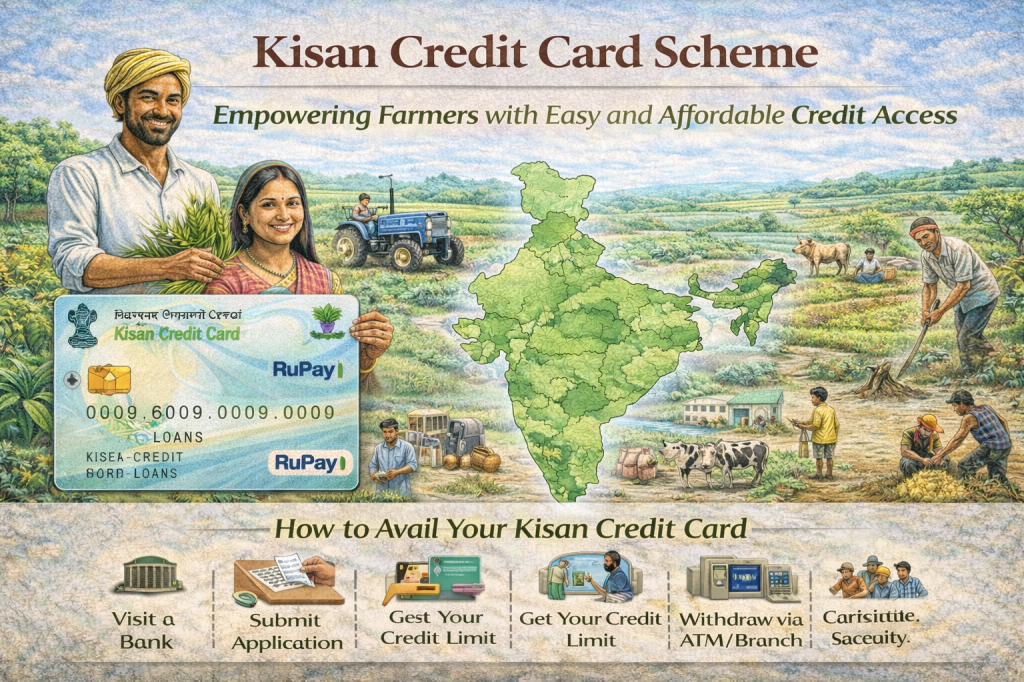
What is Kisan Credit Card? How to Avail the Scheme
The Kisan Credit Card (KCC) scheme is one of the most important agricultural credit initiatives in India. It was introduced in 1998 by the Reserve Bank of India and National Bank for Agriculture and Rural Development to provide farmers with timely and affordable credit for agricultural needs.
Before the introduction of KCC, farmers often depended on informal moneylenders who charged very high interest rates. The KCC scheme was designed to simplify the process of obtaining agricultural loans and ensure that farmers have easy access to working capital for crop production and related activities.
Over the years, the scheme has been expanded and modernized, including linking KCC with the Pradhan Mantri Jan Dhan Yojana and introducing debit card–enabled credit facilities.
Objectives of the Kisan Credit Card Scheme
The main objectives of the KCC scheme are:
- Provide timely credit to farmers for agricultural operations.
- Reduce dependence on moneylenders in rural areas.
- Simplify loan procedures for crop production and allied activities.
- Ensure financial inclusion of farmers in the formal banking system.
- Promote agricultural productivity by providing adequate working capital.
Features of the KCC Scheme
The Kisan Credit Card scheme has several important features that make it beneficial for farmers.
1. Flexible Credit Limit
Farmers receive a revolving credit limit based on:
- Landholding size
- Cropping pattern
- Cost of cultivation
2. Multi-purpose Use
The loan can be used for:
- Crop cultivation
- Purchase of seeds, fertilizers, pesticides
- Farm machinery repair
- Post-harvest expenses
- Household consumption (limited)
3. Interest Subsidy
Farmers benefit from government interest subsidies.
For example, short-term crop loans are often available at 4% effective interest rate if repayment is made on time.
4. Debit Card Facility
Many banks issue RuPay Kisan Cards, which allow farmers to withdraw money from ATMs and make digital payments.
5. Insurance Coverage
KCC holders may also be covered under crop insurance schemes such as Pradhan Mantri Fasal Bima Yojana.
6. Validity Period
KCC accounts generally have a validity of five years, subject to annual review.
Eligible Beneficiaries
The following categories are eligible for the KCC scheme:
- Individual farmers (owner cultivators)
- Tenant farmers and sharecroppers
- Self-Help Groups (SHGs) or Joint Liability Groups (JLGs) of farmers
- Farmers involved in allied activities such as:
- Dairy farming
- Fisheries
- Poultry farming
- Animal husbandry
The scheme has been expanded to include farmers engaged in livestock and fisheries activities.
Loan Limit under KCC
The loan amount depends on the farmer’s requirements and landholding.
Typical credit limits include:
| Category | Credit Limit |
|---|---|
| Small farmers | Up to ₹50,000 |
| Medium farmers | ₹50,000 – ₹3 lakh |
| Larger farmers | Above ₹3 lakh depending on cultivation cost |
Loans up to ₹1.6 lakh generally do not require collateral security.
Documents Required
To apply for a Kisan Credit Card, farmers usually need:
- Identity proof (Aadhaar card, voter ID, etc.)
- Address proof
- Land ownership documents or cultivation certificate
- Passport-size photographs
- Bank account details
Banks may require additional documents depending on the loan amount.
How to Avail the Kisan Credit Card (Application Process)
Farmers can obtain a KCC through the following steps:
Step 1: Visit a Bank
Farmers can apply at:
- State Bank of India
- Punjab National Bank
- Bank of Baroda
- Regional Rural Banks (RRBs)
- Cooperative Banks
Step 2: Fill the Application Form
The farmer fills out the KCC application form with details about landholding, crops grown, and credit requirement.
Step 3: Submit Required Documents
Attach identity proof, land records, and photographs.
Step 4: Verification by the Bank
The bank verifies:
- Land ownership or cultivation status
- Credit history
- Crop pattern and loan requirement
Step 5: Sanction of Loan
Once approved, the bank issues a Kisan Credit Card with a credit limit.
Step 6: Use of Credit
The farmer can withdraw funds using:
- Bank branch
- ATM using RuPay KCC card
- Digital payment systems
Benefits of the KCC Scheme
The KCC scheme offers numerous advantages to farmers:
1. Easy Access to Credit
Farmers can obtain credit quickly without lengthy procedures.
2. Lower Interest Rates
Government subsidies reduce borrowing costs.
3. Flexible Repayment
Repayment is generally linked to harvest cycles, making it convenient for farmers.
4. Reduced Dependence on Moneylenders
The scheme encourages farmers to use formal banking channels.
5. Financial Inclusion
It integrates farmers into the banking system and promotes digital payments.
Achievements of the KCC Scheme
The Kisan Credit Card scheme has made a significant impact on rural credit delivery.
- Millions of farmers across India have received KCC cards.
- The scheme has strengthened the agricultural credit system.
- It has helped improve crop production and rural livelihoods.
The government continues to expand KCC coverage, especially among small and marginal farmers.
Challenges of the KCC Scheme
Despite its success, the scheme faces some challenges:
- Limited awareness among farmers in remote areas
- Difficulties for tenant farmers without land documents
- Delays in loan approval in some banks
- Need for better digital access in rural areas
Efforts are being made to address these issues through financial literacy programs and simplified procedures.
Conclusion
The Kisan Credit Card scheme is a crucial initiative for strengthening agricultural credit in India. By providing easy, affordable, and flexible loans to farmers, the scheme has helped improve agricultural productivity and reduce dependence on informal lenders. The KCC programme will continue to expand. Technological improvements will also occur. It will remain a key instrument for promoting sustainable agricultural development. It will enhance the livelihoods of farmers across the country.
 KrishiCenter
Leave a comment